The adopted 1934 date and the work of finding a place for professional papers.
Reading Library · Anesthesia Epochs · 中文版
Watch the companion film
1934: Mexico’s Anesthetists—From Meetings to a Journal · Watch on YouTube
Historical anchor: 1934. Date details and source qualifications are explained below.
A society can arrange regular meetings before it can afford a journal. Vicente García-Olivera’s account of Mexican anesthesia publishing makes that problem concrete: members presented work each month, but their papers lacked a publication of their own. Juan White Morquecho and Benjamín Bandera sought space in another journal, Medicina.[2,p.79]
That recollection, published in 2004, offers a way into the society’s history through its everyday work.
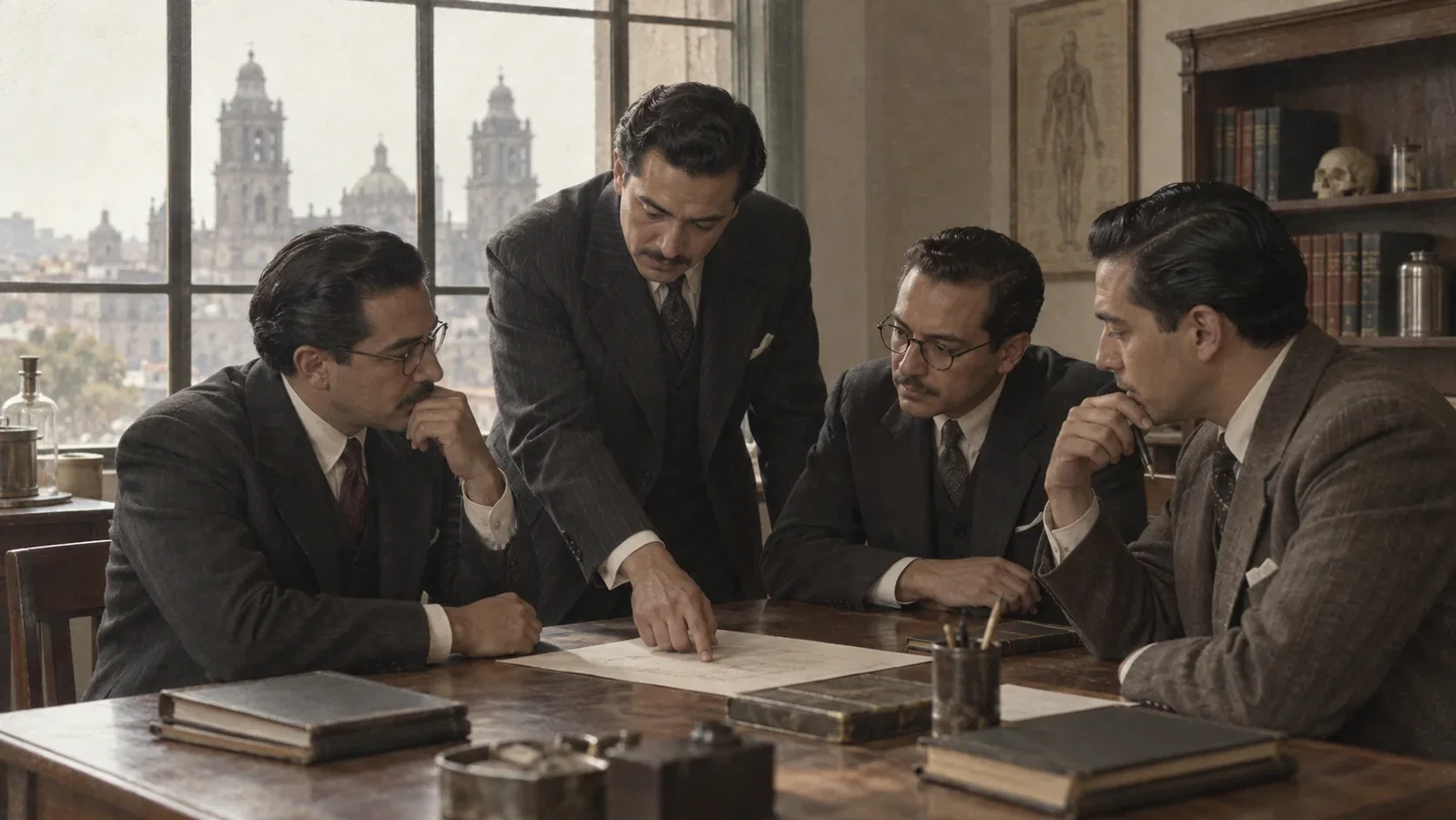
Historical concept illustration. The people, room and papers are imagined, not a portrait of the founders or a record of a particular 1934 meeting.
A date adopted for the public record
November 20, 1934 is the society’s established official foundation date. It needs a qualification. The histories published in 2013 and 2022 reproduce Bandera’s later explanation that the exact beginning of the organization was unknown. The society adopted the date of its public appearance at a surgical convention. The 2013 account also describes earlier organizing meetings, including gatherings in White’s office on Avenida Juárez.[1,p.139;3,p.7]
The date here therefore marks that adopted official date, not a newly verified first organizing meeting. Bandera’s 1960 article and the original 1934 records are not covered here; his explanation is known through the later articles cited.[1,pp.139,154;3,pp.7–8]
The early organization was called Sociedad de Anestesistas de México. According to the 2013 history, its reorganization in 1948 brought the name Sociedad Mexicana de Anestesiología. Putting the later name on a supposed 1934 document would blur two stages.[1,pp.139,141]
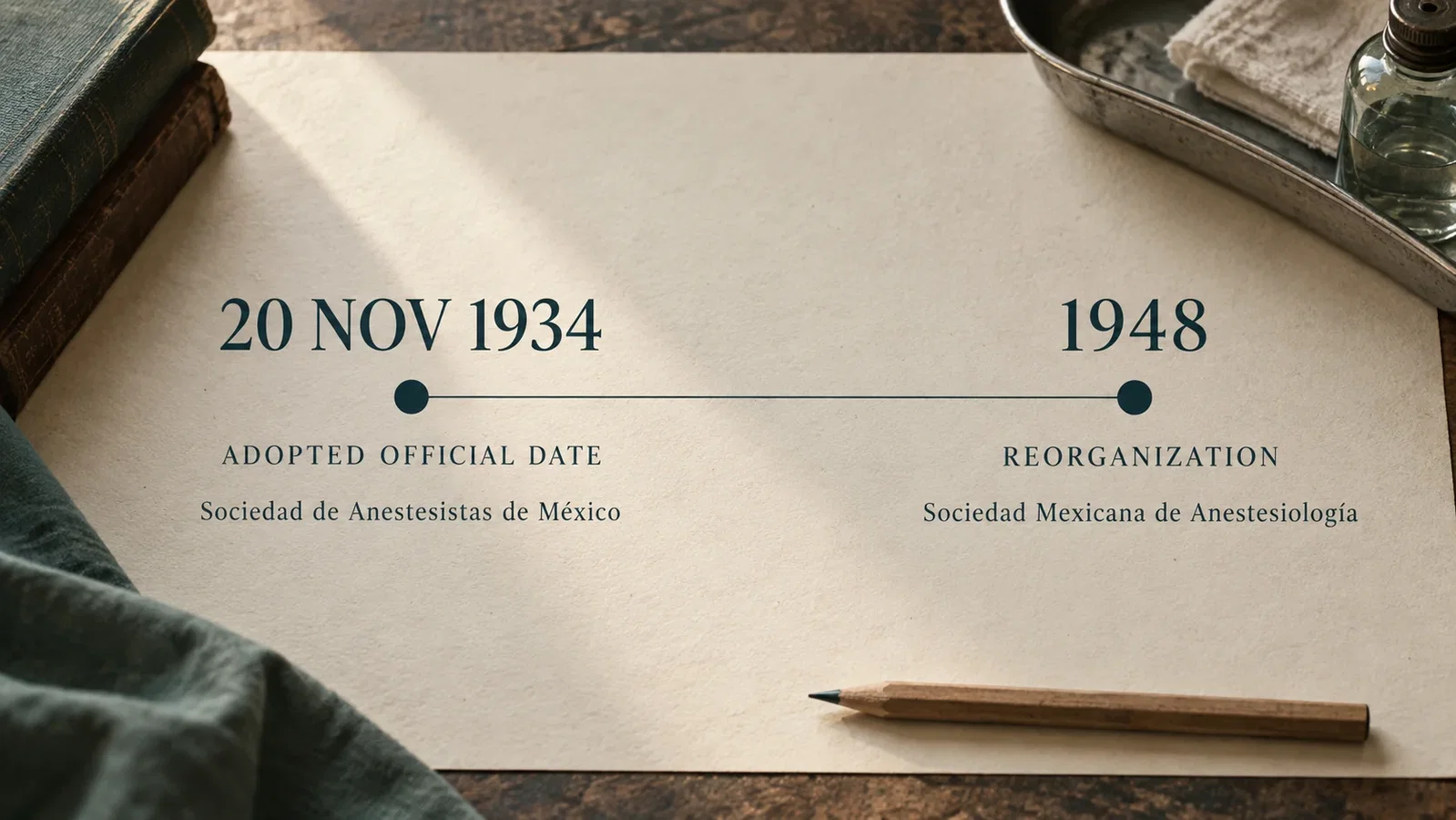
Modern explanatory labels, not reproductions of founding documents.
Finding room in print
The later histories identify a 1936 Anestesia fascicle within the Hospital Juárez journal Cirugía as a predecessor of the Revista Mexicana de Anestesiología. That is a retrospective account: the original fascicle was not directly inspected here.[1,p.139;3,p.7]
García-Olivera describes the practical obstacles to a separate journal in the 1950s. Membership and the number of papers presented had grown, but small dues and late payments made an additional assessment an uncertain foundation for continuing publication. He and Salvador Martínez Osorio approached drug and instrument businesses for advertising support. His recollection assigns Bandera the directorship, García-Olivera the editorial role and Martínez Osorio administration.[2,pp.79–80]
This is a participant’s account written decades afterward. It supplies a view of editorial and financial work, not independently examined contracts or evidence that the society improved clinical outcomes.
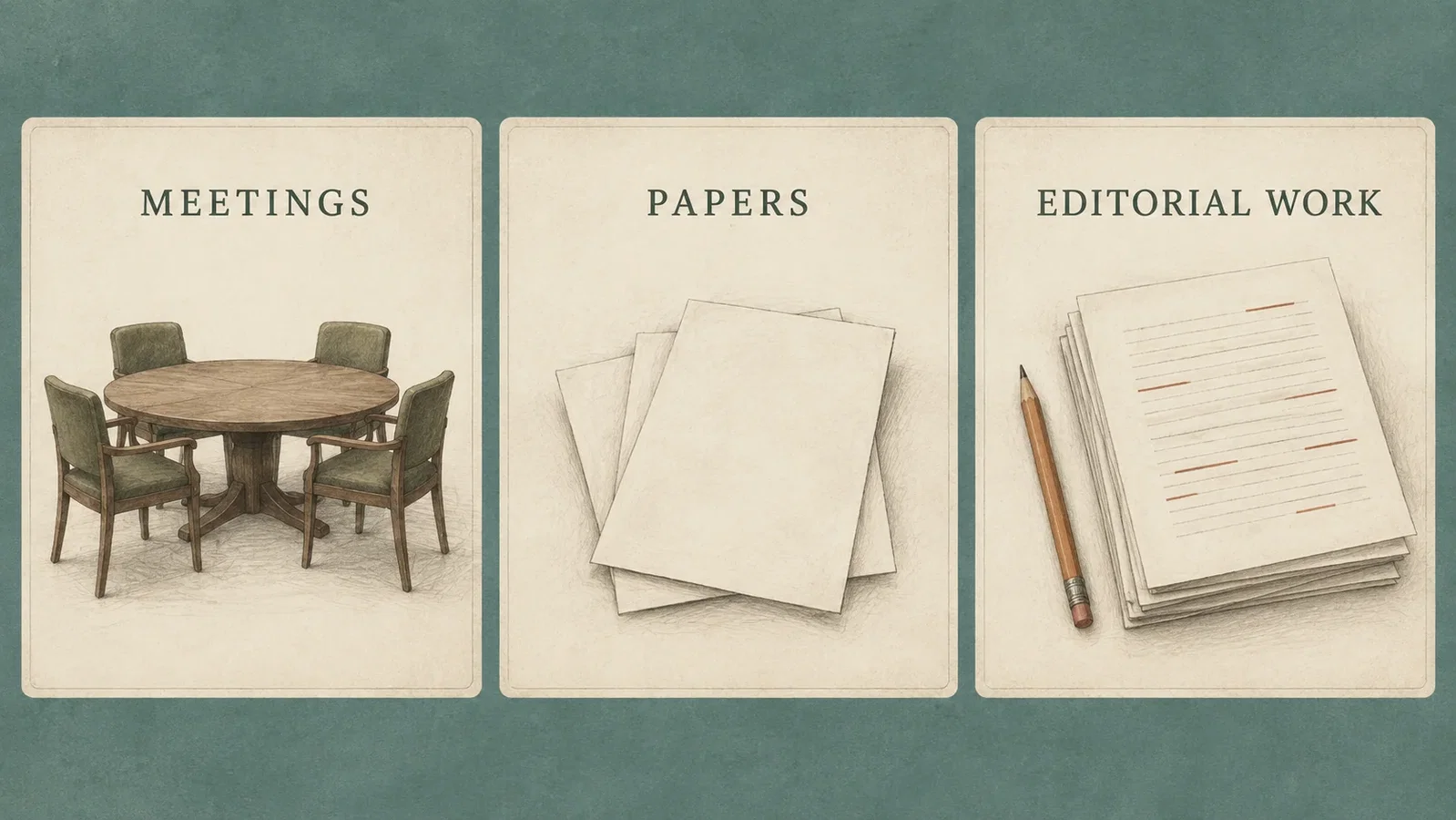
Activities involved in sharing professional work. The diagram does not establish that every meeting paper was published or that a modern peer-review system already existed.
Keeping a disagreement visible
García-Olivera dates the first issue to July 1952. The 2013 history and 2022 editorial also give 1952, whereas Gómez-Rojas’s 2021 review gives 1951. The wording used here is consequently “July 1952, according to García-Olivera’s recollection.” An original first-issue cover has not been inspected to settle the discrepancy.[2,p.80;1,p.142;3,p.7;4,p.298]
A similar restraint applies to institutional priority. The 2013 authors describe the organization as the earliest society of the specialty in Latin America. This article reports their assessment without claiming an exhaustive regional comparison or a global ranking.[1,p.139]
What the meeting leaves behind
The 1893: London's Society of Anaesthetists Brings Experience Before Peers provides a specific comparison. Its contemporary BMJ report preserved questions asked of preliminary observations. The Mexican recollection records a different part of the same practical problem: finding print space for work presented to colleagues.[6;2,p.79]
The comparison concerns how professional discussion becomes a record others can read. It does not establish organizational descent or an influence from London on Mexico.

An imagined publishing workspace, not the 1952 first cover, an authentic editorial-office photograph or an exact reconstruction of a historical press.
Sources and reading limits
- Marrón-Peña M, Moreno-Alatorre C. Antecedentes históricos del Colegio Mexicano de Anestesiología, antes Sociedad Mexicana de Anestesiología: sus orígenes, evolución y trascendencia (1934–1995). Rev Mex Anest. 2013;36(2):136–154. Full text. Pages 136–143 and 154 read. Remaining pages not claimed fully read. Earlier documents cited by the authors were not thereby directly inspected.
- García-Olivera V. Datos sobre la historia evolutiva. Creación de la Revista Mexicana de Anestesiología. Rev Mex Anest. 2004;27(2):79–80. Full text. Both article pages read and viewed. Firsthand retrospective testimony.
- Carrillo-Esper R. La Revista Mexicana de Anestesiología con paso firme y adecuado a la modernidad. Rev Mex Anestesiol. 2022;45(1):7–8. Full text. Both pages read and viewed. Its references include Bandera and source 1; it is not another independent 1934 witness.
- Gómez-Rojas JP. Historia de la anestesiología. Rev Mex Anestesiol. 2021;44(4):288–299. Full text. Pages 288 and 298–299 read and viewed as a control for disagreements in names, people and dates. The preceding broad history was not fully read.
- Colegio Mexicano de Anestesiología. Nosotros. Complete institutional history passage read. Later Colegio formation and merger are separate from the 1934 event. This essay does not adjudicate conflicting later legal dates.
- Society of Anaesthetists. BMJ. 1893;2:1304. Contemporary meeting report. The London article’s text and original page were read, including its society report.
Sources and reading limits are stated above. Illustrations are labelled as original source images or AI-made. Historical accounts are educational; they are not current treatment instructions.
Continue exploring
Related reading connects shared questions and contexts; it does not by itself establish historical influence.