In 2012, her SOAP and Society for Airway Management presidencies overlapped; the convergence reflected years of work at the obstetric-airway interface.
Reading Library · Anesthesia Epochs · 中文版
Watch the companion film
2012: Maya Suresh — Airway Skills for Obstetric Anesthesia · Watch on YouTube
Historical anchor: 2012. Date details and source qualifications are explained below.
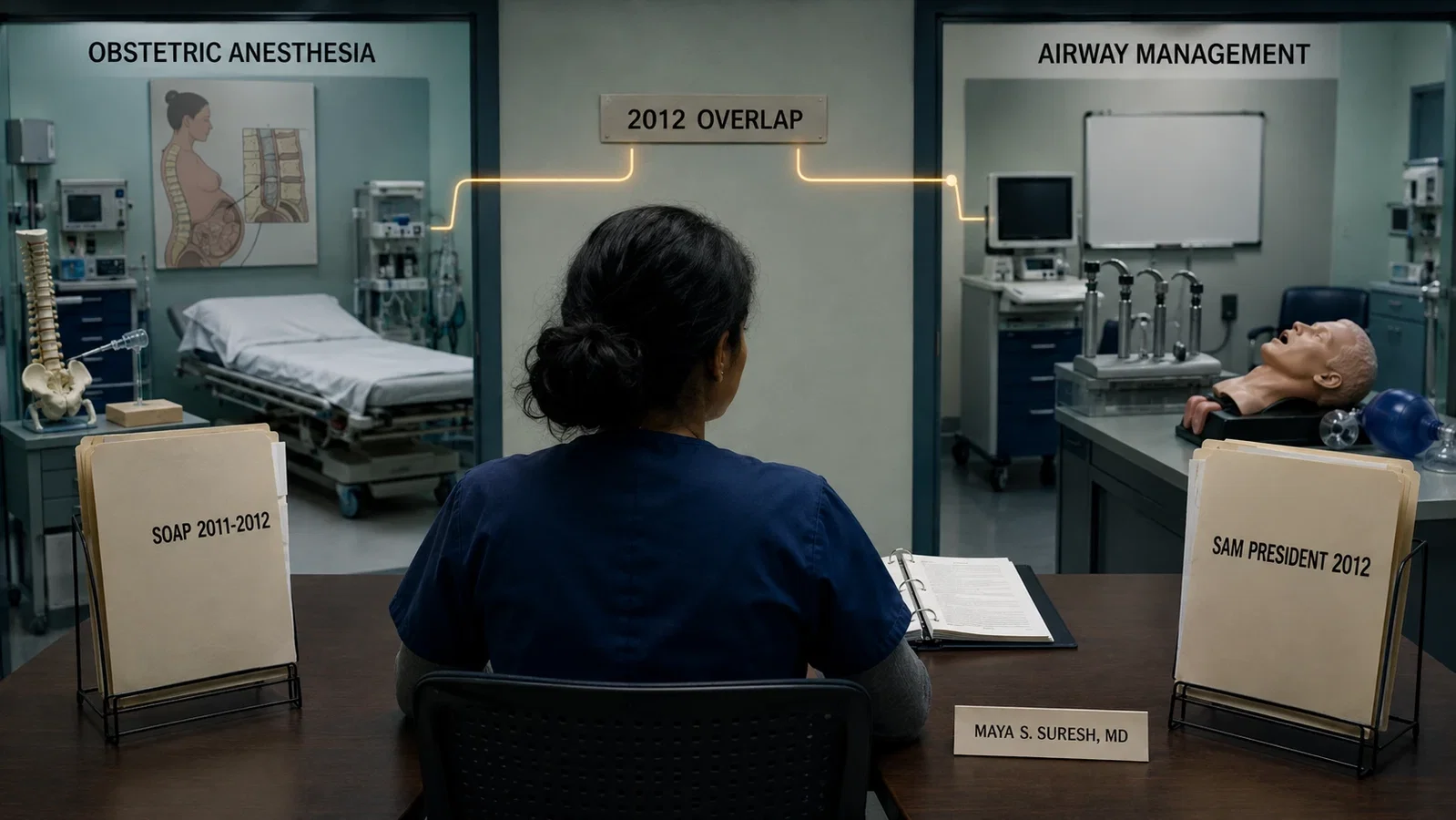
In 2012, Maya S. Suresh appeared in two different records of professional leadership.
The Society for Obstetric Anesthesia and Perinatology lists her among its past presidents for the 2011-2012 term. The Society for Airway Management's 2012 Airway Gazette names her President on its board page, introduces her as the new President, and publishes her presidential message.
Those records do not describe a joint election or a single installation. They belong to separate organizations and keep time in different ways. Together they support a narrower, more defensible statement: Suresh's SOAP and SAM presidential terms overlapped during 2012.
The overlap matters for more than biography. It made visible a problem that sits between obstetric anesthesia and airway management. As general anesthesia became less common in obstetric practice, clinicians encountered fewer routine opportunities to acquire and rehearse advanced airway skills. The need for those skills did not disappear with the case volume.
Two institutional clocks
An official list of past presidents often compresses a year of committee meetings, elections, handovers, and annual conferences into one line. A newsletter may call someone the new President without supplying the exact date on which every responsibility changed. Combining the two can establish an overlap in calendar time, but it cannot safely reconstruct that overlap day by day.
The SOAP roster gives Suresh's term as 2011-2012. The SAM Gazette supplies the contemporaneous 2012 control: her name appears under President, the editor introduces the issue's first feature as the work of the new President, and Suresh begins her message by saying that she was honored to have been elected to serve as President of the Society for Airway Management.
This is why the article uses 2012 with year precision. The date of a SOAP annual meeting is not automatically the first day of a presidential term. The date printed on a Gazette is not automatically the day of election. The fact that an old PDF was later uploaded into a 2017 web directory says nothing about when its historical events occurred.
The 2011 records prevent an easy mistake
Later institutional biographies accurately describe Suresh as a former president of both societies. If those two facts are placed beside the year 2011 without consulting contemporaneous records, they can turn into a plausible but false sentence: she was president of both societies in 2011.
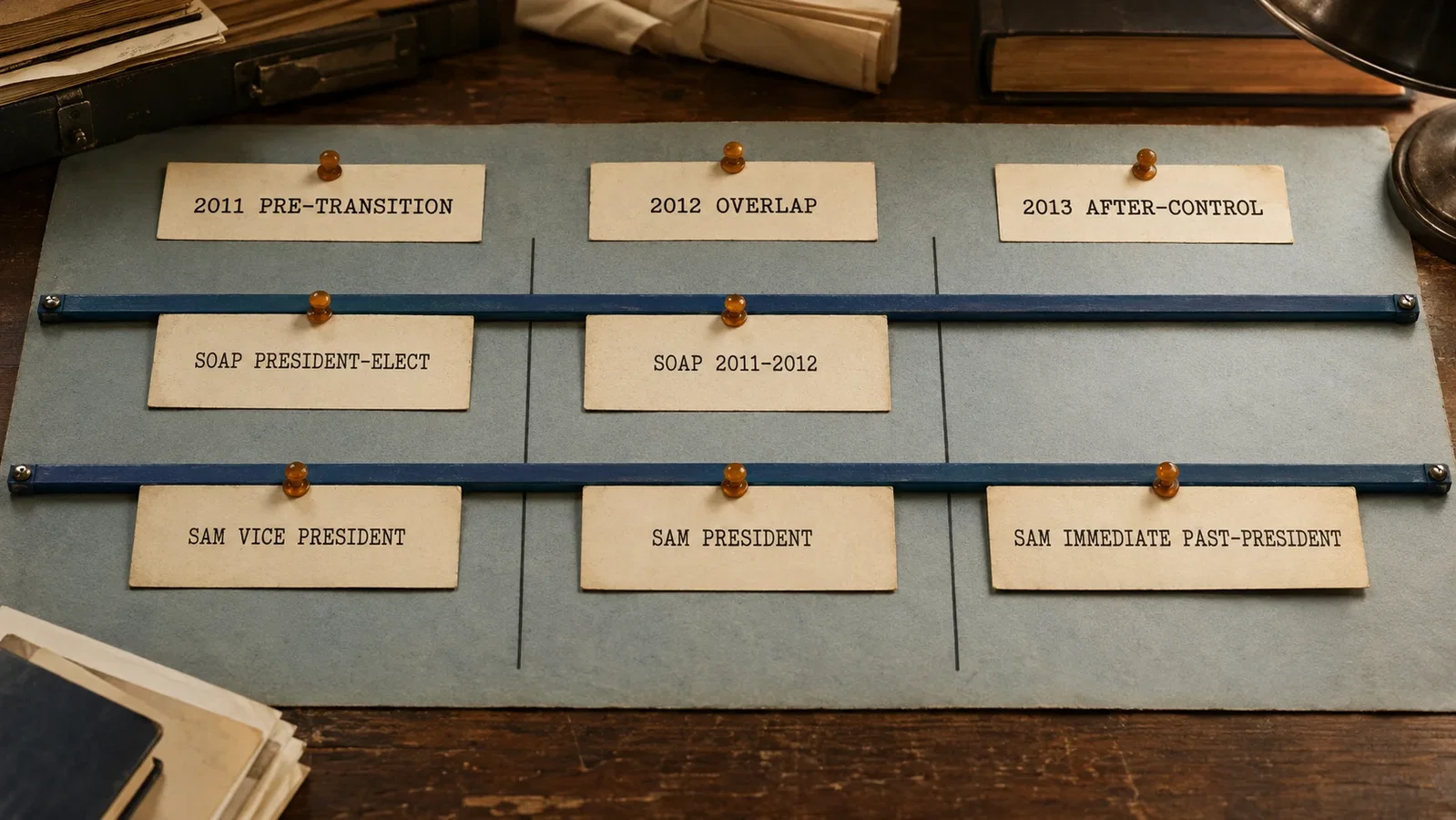
The 2011 board pages show otherwise. In the SOAP annual-meeting syllabus, Robert D'Angelo is President and Suresh is President-Elect. In the SAM Gazette, Elizabeth Behringer is President, Thomas Mort is President-Elect, and Suresh is Vice President.
The following year's SAM record moves her into the presidency. The 2013 Gazette then lists Richard Cooper as President and Suresh as Immediate Past-President. These three points do not reveal every transition date, but they are enough to stop the roles from being moved backward or blended together.
They also keep the societies distinct. SOAP is the Society for Obstetric Anesthesia and Perinatology. SAM is the Society for Airway Management. Neither record makes Suresh President or past President of the American Society of Anesthesiologists. Similar abbreviations and overlapping professional networks are not interchangeable offices.
The clinical bridge came before the titles
Leadership entered this story after the clinical and educational problem was already visible.
In 2005, Uma Munnur, Ben de Boisblanc, and Maya S. Suresh published the peer-reviewed review “Airway problems in pregnancy” in Critical Care Medicine. The article considered pregnancy-related airway problems, preparation for difficult or failed intubation, emergency equipment, and cooperation between anesthesiologists and obstetricians. It places Suresh at the pregnancy-airway interface years before the overlapping presidential terms.
The review is also a historical document. Its device descriptions, algorithms, risk figures, and recommendations reflect the literature available in 2005. A later leadership role does not convert those details into current clinical guidance. For this article, the review establishes the existence and subject of the scholarly work, not a modern standard of care.
The same boundary applies to a 2012 publication in Revista Mexicana de Anestesiología. Its title, “Avoiding airway catastrophes in obstetrical patients,” and its authorship document continued teaching on the same interface. It was published conference material, not a clinical trial, a systematic guideline, or proof that any particular device or algorithm improved outcomes.
The record becomes more informative when these publications are read as continuity rather than a list of achievements. The subject was not added to Suresh's biography after she became a society president. It was already part of her work, and it continued after the overlap.
The vanishing-case paradox
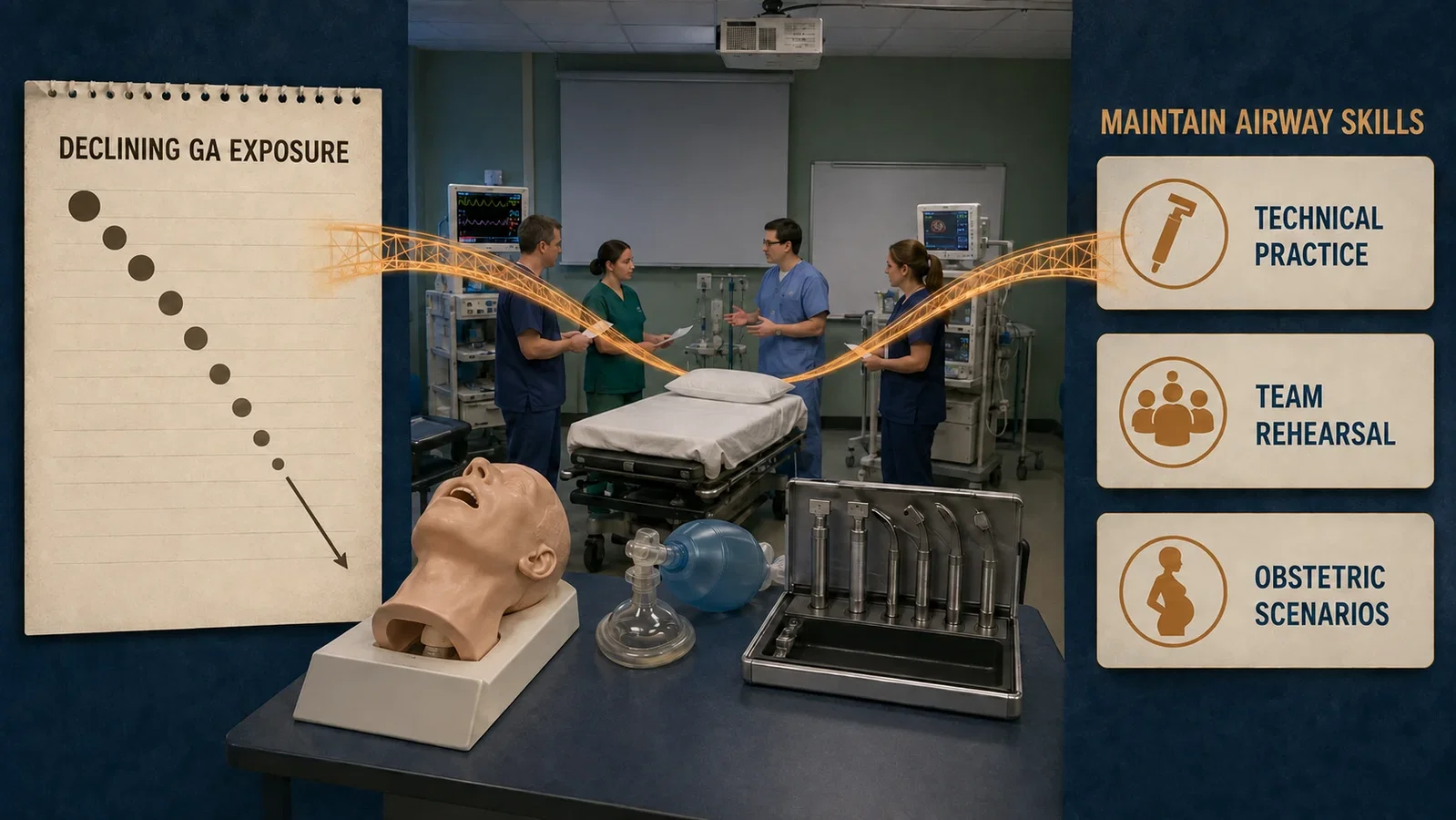
The clearest statement of the educational problem appeared in the program of SOAP's 2011 annual meeting. Suresh's session was titled “Declining Use of GA in Obstetrics: Maintaining Advanced Airway Skills.” The accompanying material argued that reduced use of general anesthesia for cesarean delivery left trainees in the United States and the United Kingdom with little or no experience in a procedure that could still become necessary. Its key points called for residents to acquire advanced airway-management skills and to practise them in obstetric clinical scenarios, integrating technical, nontechnical, and judgment skills.
That argument contains a paradox. A fall in routine exposure may reflect changes in practice that clinicians welcome. Yet a rare, high-consequence task cannot be learned only when it unexpectedly becomes urgent. Fewer cases do not reduce the competence threshold at the moment the task is needed.
The educational response therefore has to be deliberate. Skills can be practised with airway trainers. Teams can rehearse obstetric scenarios. Communication, role allocation, and judgment can be examined during debriefing. None of this proves that a specific curriculum improved clinical outcomes; it explains why ordinary case exposure could no longer be the only educational plan.
This is where the two professional societies meet without becoming the same institution. Obstetric anesthesia supplies the clinical setting and its changing pattern of exposure. Airway management supplies a multidisciplinary community organized around the knowledge, equipment, communication, and rehearsal needed when airway difficulty occurs.
A presidential message is an agenda, not an outcome study
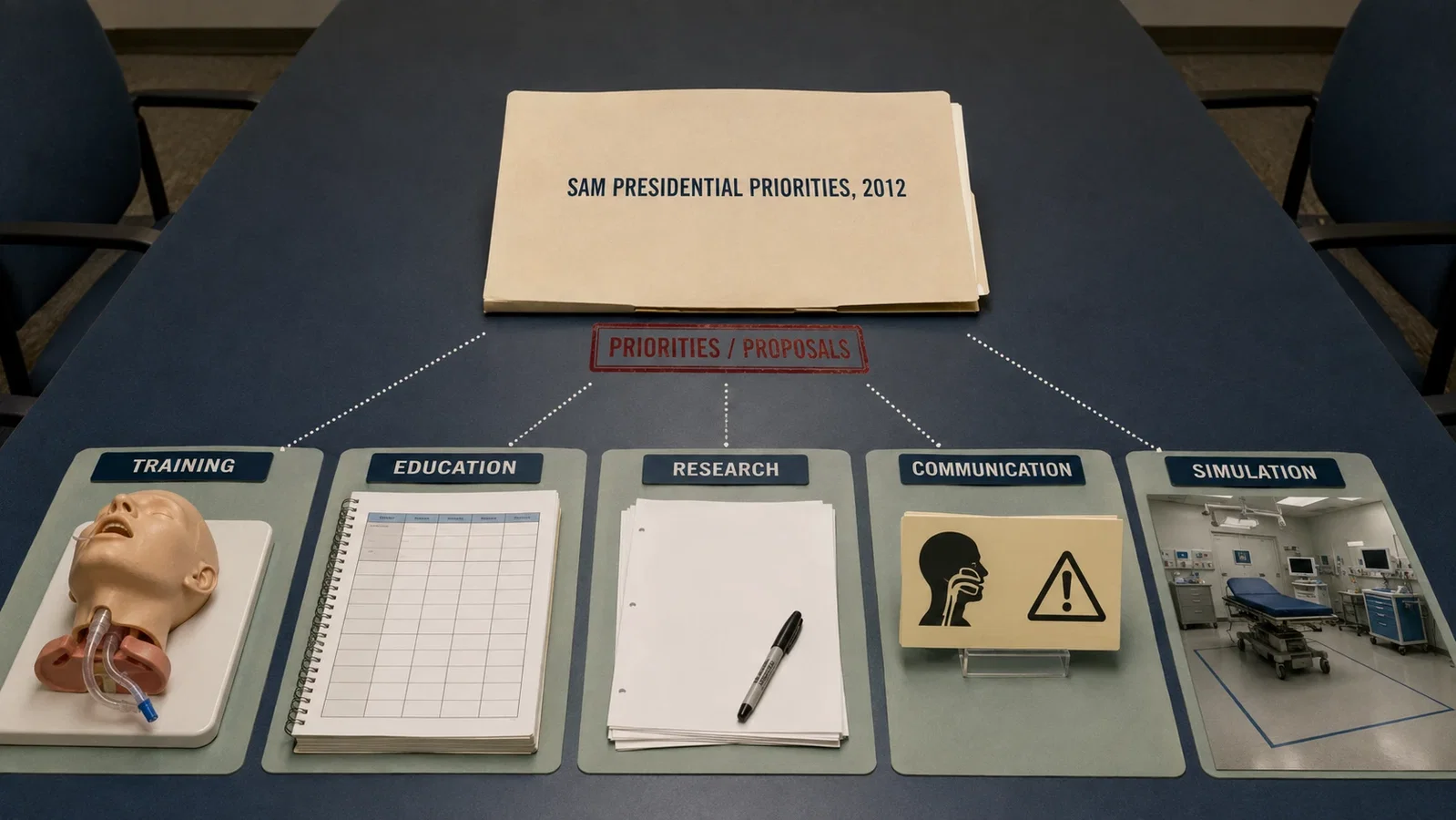
Suresh's 2012 SAM presidential message described the Society as a multidisciplinary subspecialty organization dedicated to training, education, and research in advanced airway management. It also set out possible work for the organization.
The message discussed a more uniform way to tell patients and future clinicians about an expected or unanticipated difficult airway, including airway alerts. It identified extubation and postoperative airway problems as matters requiring attention. It proposed research into serious complications, called for broader communication, and pointed to annual meetings, hands-on workshops, and simulation stations.
The grammar matters. These were ideas, priorities, and proposals. The document can show what a president wanted the Society to address. It cannot show that every proposal was implemented, that practice changed across institutions, or that morbidity and mortality fell because of the presidency.
The distinction protects the historical argument from being inflated. Organizational leadership can create space for education, communication, and research. Whether those activities change care requires separate evidence with designs capable of measuring implementation and outcomes.
The work remained visible after 2012
Several records from the same period show that the obstetric-airway connection did not end with a title.
LWW dates the fifth edition of Shnider and Levinson's Anesthesia for Obstetrics to 24 December 2012 and lists Maya Suresh MD on the product page. Its table of contents names Suresh, Ashutosh Wali, and Edward T. Crosby as the contributors to a chapter on difficult and failed intubation in obstetrical patients.
The 2013 SAM Gazette reports that Immediate Past-President Suresh spoke at an educational meeting in Chiang Mai on avoiding airway catastrophes in obstetrical patients and on extubation and PACU issues in obstetrical patients. The entry records teaching activity. It is not evidence of universal adoption or a measured clinical effect.
Later UTHealth pages add retrospective institutional memory. A 2022 announcement says that, while at Baylor College of Medicine, Suresh helped develop a formal airway-management curriculum and ensure the availability of advanced airway resources. A 2023 institutional account says that she took over the Texas Anesthesia Conference for Obstetrics in 1991, later added a difficult-airway workshop, and ran the two continuing-education courses through 2017.
These later recollections are consistent with the earlier documents, but they serve a different evidentiary role. They can describe how an institution now remembers a long educational program. They cannot define the dates of a 2012 society term more accurately than the contemporaneous records.
Leadership as connective infrastructure
Histories of anesthesia naturally gravitate toward objects and firsts: a new drug, a new airway device, a first operation, a photograph of a machine. The preservation of competence is harder to photograph. It is distributed across course programs, simulation rooms, professional networks, workshops, and the repeated work of teachers and learners.
Nothing in the sources read establishes that Suresh invented an airway device or algorithm. Nothing establishes that she was the first woman, the only person, or the first person of any kind to lead both societies. No source permits a causal line from two presidential titles to better patient outcomes.
The documented contribution is more specific. In 2012, her leadership terms placed the same physician within two professional communities whose concerns met at a practical educational problem. Obstetric general-anesthesia exposure was declining, but readiness for a difficult airway still required judgment, technical ability, communication, and rehearsal. Her teaching before, during, and after the overlap repeatedly addressed that interface.
The historical subject is therefore not two titles displayed as trophies. It is a bridge between communities. The bridge helped make a low-frequency risk into an explicit educational task, one that had to be organized rather than left to chance.
From device design to an educational choice
There is a specific link between this educational work and 1981: Archie Brain Begins Developing the Laryngeal Mask. The 2005 review coauthored by Suresh devotes a section to the laryngeal mask and distinguishes its classic and later forms.[Comparison A, p. S265] Brain's 1983 original begins with the mechanical problem of making a sealed junction at the laryngeal inlet.[Comparison B, p. 801] Read together, the papers distinguish designing a device from discussing its place in a particular clinical setting. This related link assigns neither invention to Suresh nor improved outcomes to a society office.
Comparison A: Munnur U, de Boisblanc B, Suresh MS. Airway problems in pregnancy. Crit Care Med. 2005;33:S259–S268. Page S265 was read for this article. Comparison B: Brain AIJ. The laryngeal mask—a new concept in airway management. Br J Anaesth. 1983;55:801–805. Only page 801 was read for this article; the linked article's 1981 date marks development, not publication of this paper.
Sources and reading limits
Sources: SOAP official Past Presidents and Past Annual Meetings pages; SOAP 43rd Annual Meeting Syllabus, 2011; Society for Airway Management Airway Gazette, 2011, 2012, and 2013; Munnur U, de Boisblanc B, Suresh MS. Crit Care Med. 2005;33(10 Suppl):S259-S268. PMID 16215346; Suresh MS. Rev Mex Anestesiol. 2012;35(Suppl 1):S254-S273; LWW official Shnider and Levinson's Anesthesia for Obstetrics fifth-edition page; UTHealth official retrospective pages. All cited sources were read for this article.
Visual interpretations
These illustrations explore the setting and ideas. Depicted people, actions, instruments and documents are reconstructions, not evidence of their exact historical appearance.
Continue exploring
Related reading connects shared questions and contexts; it does not by itself establish historical influence.
The Source Room · About & Editorial Method
Sources and reading limits are stated above. Illustrations are labelled as original source images or AI-made. Historical accounts are educational; they are not current treatment instructions.