Distinct dates, literature evidence and consultant opinion.
Reading Library · Anesthesia Epochs · 中文版
Watch the companion film
1993: ASA — Practice Guidelines for the Difficult Airway · Watch on YouTube
Historical anchor: 1993. Date details and source qualifications are explained below.
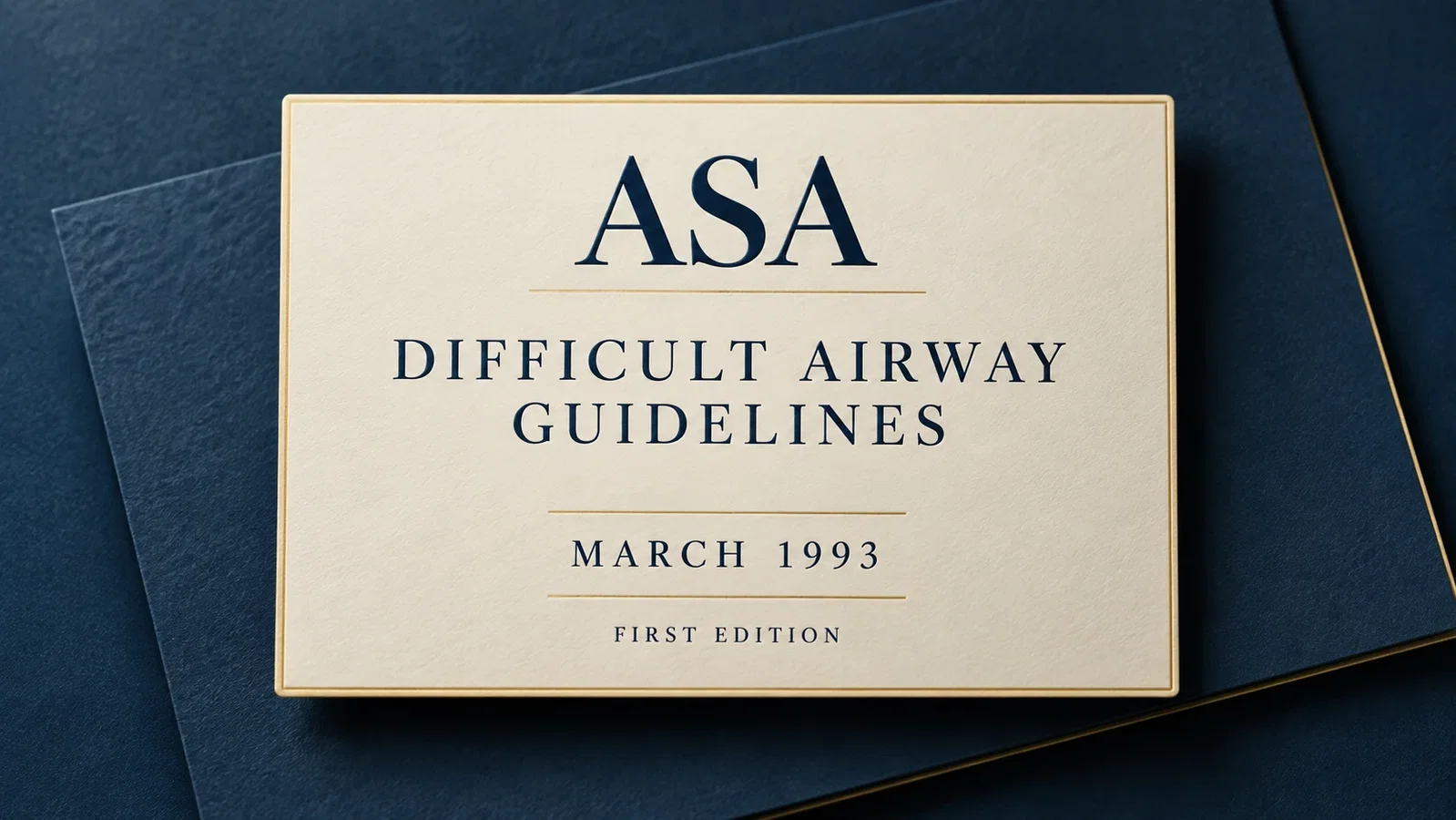
In March 1993, Anesthesiology published practice guidelines from the American Society of Anesthesiologists (ASA) Task Force on Management of the Difficult Airway. The opening page describes systematically developed recommendations to support clinical decisions.[1, p 597; 4] This article examines the first edition’s publication and evidence methods. The available official scan contains only pages 597 and 602; four missing pages prevent reconstruction of the complete algorithm.
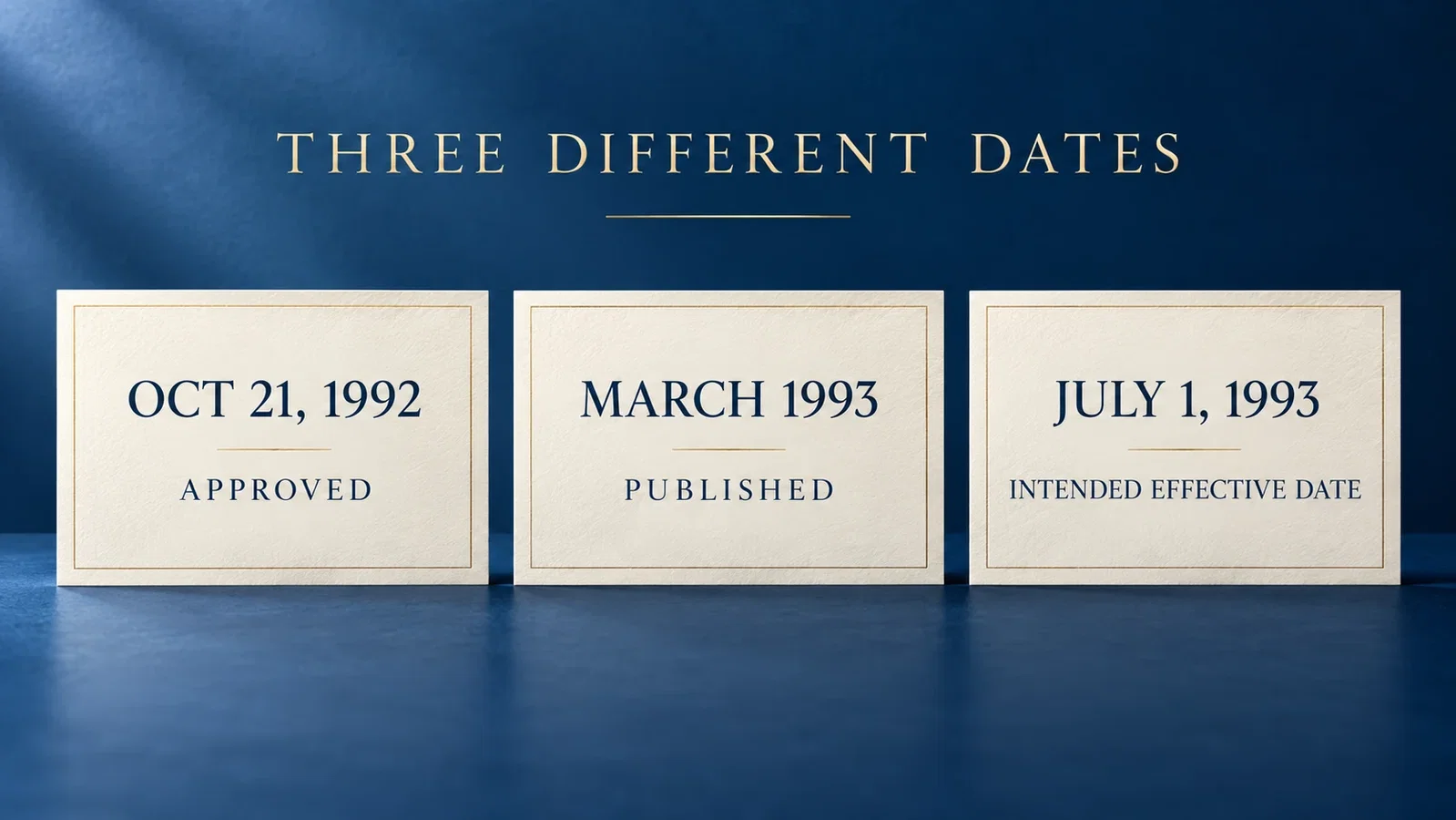
The opening page records distinct dates: approval by the ASA House of Delegates on October 21, 1992, acceptance for publication on December 1, 1992, and an intended effective date of July 1, 1993.[1, p 597] Approval, journal publication and intended implementation were separate events. Robert A. Caplan chaired the task force, whose contributors are listed on that page.
The guideline aimed to facilitate difficult-airway management and reduce adverse outcomes, including death, brain injury, myocardial injury and airway trauma. It also stated that recommendations could be adapted to clinical needs and constraints and could not guarantee a particular outcome.[1, p 597] Risk reduction was a purpose, not proof that publication itself reduced mortality.
The first edition focused on difficult airways encountered during tracheal intubation. Its intended users were anesthesiologists and people delivering anesthetic care under their direct supervision, across anesthetizing locations and patient ages. It expressly did not cover every manifestation or management approach.[1, p 597] Broad intended application did not establish equally strong evidence for every setting.

The airway-history section makes the distinction concrete. Literature and consultant opinion strongly supported taking an airway history, but its predictive value and effect on outcomes had not been clearly defined.[1, p 597] Support for an assessment practice was therefore different from a measured claim about its predictive accuracy.
Page 602 organizes the evidence around ten linkages, described as hypotheses connecting clinical care with outcomes. They concern assessment, preparation, strategies or algorithms, confirmation of intubation, extubation strategy and follow-up. Several thousand citations were initially found; 537 concerned the specified linkages. After excluding material that could not be analyzed, 273 articles published during 1973–1991 were available for consideration.[1, p 602] These were articles, not 273 randomized trials or patients.

The analysis first summarized whether studies supported, refuted or were neutral toward a linkage. Combined statistical testing was possible for some linkages, but the authors reported insufficient data to assess the relative strength of directional support. Opinions from 50 consultant anesthesiologists supplemented the literature analysis.[1, p 602] Consultant agreement was not a measure of clinical success.
Later editions identify their predecessors. The 2003 update explicitly cites and revises the 1993 publication; the opening of the 2013 edition identifies the version adopted in 2002 and published in 2003 as its predecessor.[2, pp 1269–1270; 3, PDF pp 1–2] These statements support the site’s existing link between the first-edition and 2013 articles. Later recommendations cannot fill the missing pages of the original.
The accessible opening page and methodological appendix show how the task force framed recommendations, organized research and acknowledged uncertainty.[1, pp 597, 602] Revision continued in later editions, whose specific recommendations require their own source reading. This is an account of historical documents, not a current airway-management protocol.
Images are modern editorial concepts, not original guideline pages, historical scenes or usable airway algorithms.
Sources and reading limits
- American Society of Anesthesiologists Task Force on Management of the Difficult Airway. Practice guidelines for management of the difficult airway. Anesthesiology. 1993;78(3):597–602. PMID 8457062. The acquired official scan contains only pages 597 and 602, both individually read. Pages 598–601 remain missing; no claim to complete full-text or algorithm review.
- American Society of Anesthesiologists Task Force. Practice guidelines for management of the difficult airway: an updated report. Anesthesiology. 2003;98:1269–1277. PMID 12717151. Pages 1269–1270 read from the public publisher-layout copy; the remaining seven pages were not newly read here.
- Apfelbaum JL, Hagberg CA, Caplan RA, Blitt CD, Connis RT, Nickinovich DG. Practice guidelines for management of the difficult airway: an updated report. Anesthesiology. 2013;118:251–270. PMID 23364566. First two pages of the official ASA copy read. Its placeholder pagination is retained as an archival feature; the full twenty-page article was not reread for this article.
- National Library of Medicine. PubMed 8457062. Archived complete XML read to check the title, March 1993 issue and pages; bibliographic metadata is not a substitute for the missing article pages.
Source limits: the three editions belong to one guideline lineage and are not three independent outcome validations. The 1993 opening page lists nine task-force members, while the 2013 retrospective describes ten for the original and first update; that discrepancy is retained without inventing a tenth name. The 273 articles and 50 consultants are reported in the original methods; the underlying literature set and survey data are not covered here.
Continue exploring
Related reading connects shared questions and contexts; it does not by itself establish historical influence.
- 1997: Hawkins and the Denominators Behind Obstetric Anesthesia Mortality
- 2013: An Old Airway Algorithm Makes Room for Video Laryngoscopy
The Source Room · About & Editorial Method
Sources and reading limits are stated above. Illustrations are labelled as original source images or AI-made. Historical accounts are educational; they are not current treatment instructions.