Two kinds of clinical experience, and a limit to what the records could show.
Reading Library · Anesthesia Epochs · 中文版
Watch the companion film
1922: Haines and Pediatric Anesthesia · Watch on YouTube
Historical anchor: 1922. Date details and source qualifications are explained below.
The larger series did not necessarily offer the better view of what happened afterward.
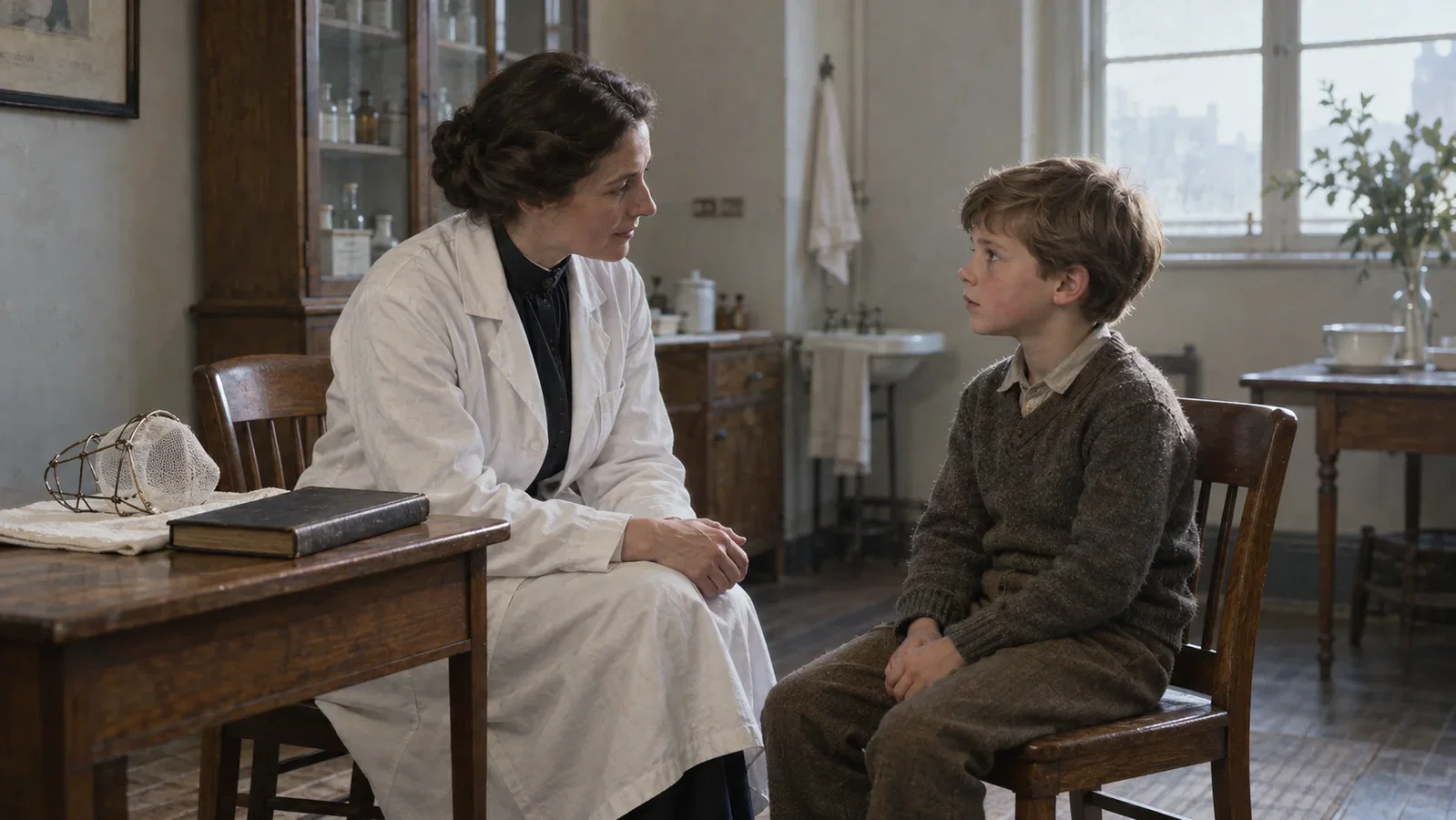
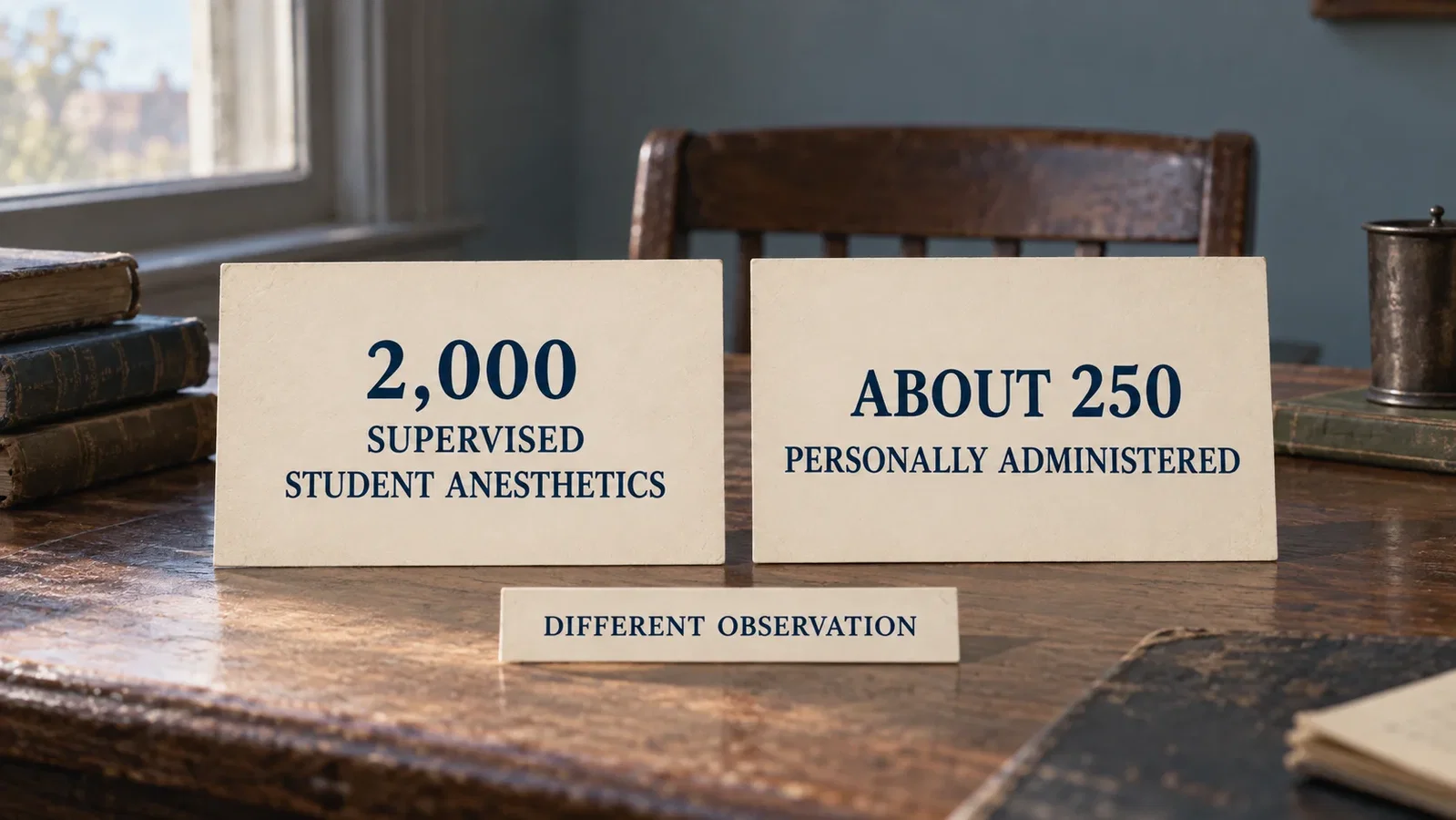
In her 1922 paper on anesthesia in children, Frances E. Haines separated 2,000 anesthetics administered by students under her supervision from about 250 that she had administered herself. She also explained why complications in the larger group might escape her notice: a child treated for tonsils in a large city was unlikely to return to the original clinic if an adverse effect developed later.[1, pp 51,53]
That observation makes the paper more interesting than a ranking of old anesthetic agents. It asks how much of safety an anesthetist could actually see.
Two groups, two kinds of visibility
The 2,000 anesthetics belonged to a teaching practice. Rush Medical College students administered them at the Central Free Dispensary under Haines's instruction and personal supervision. Almost all operations were for tonsils and adenoids. Her approximately 250 personally administered anesthetics were almost all for other operations.[1, p 51]
Combining these into “2,250 anesthetics personally performed by Haines” would change the evidence. It would erase the students' work, her supervisory role and the approximate nature of the smaller number.
The groups were not comparable trial arms. Children in the smaller group were ten years old or younger; many were under six months, and about half were under six years. Haines described generally longer anesthesia, sometimes greater depth, and often more underlying illness than in the tonsil cases. Their operations usually kept them in hospital long enough for subsequent problems to become apparent. The larger outpatient experience offered a less dependable opportunity to observe delayed harm.[1, p 53]
This is a reading of the conditions she described, not a claim that she designed a modern follow-up study. The important distinction is between not finding an event in a record and establishing that it never happened.
The laboratory could reveal what symptoms did not
Haines reported postoperative urinary findings among ether cases whose records showed normal urine before anesthesia: a trace of albumin in about 5%, and casts with albumin in about 3%. She then acknowledged that some surgeons did not routinely order urine examination after anesthesia.[1, p 53]
Those percentages do not come with the case counts needed to reconstruct exact denominators. They must not be applied to all 2,000 anesthetics or all approximately 250 cases, nor converted into a modern incidence of anesthetic kidney injury. The observation and its ascertainment problem belong together.
Her statement that she had found no record of pneumonia likewise does not establish zero risk. She described a transient temperature rise in about 40% of children after anesthesia and operation, not a demonstrated effect of the anesthetic alone.[1, pp 53–54]
The first numbered conclusion returned to the same concern: any agent could produce accidents, even in skilled hands, while less conspicuous adverse effects could remain unknown without careful observation and laboratory investigation.[1, p 54]

Induction was also an encounter with a frightened child
Haines argued against bringing a child into the operating room too early. She emphasized gaining confidence, allowing a calm induction and attending to the irregular breathing that accompanied crying and struggling.[1, pp 51–52]
Her explanations were clinical observations and contemporary reasoning, not results from a randomized anxiety intervention. Some language about controlling a child's thoughts, mental capacity and parental sense also reflects assumptions we should not endorse.
Nevertheless, her discussion was not confined to choosing a drug. For operations in the mouth, she opposed making anesthesia excessively deep merely to keep it lasting through the procedure. The operative field, route of administration, depth and the child's response all entered her account of danger.[1, p 52]
Here, terminology matters. At the beginning of the paper, she excluded intratracheal and several other methods for children as too dangerous or insufficiently established as safe. Later, she advocated intrapharyngeal administration for certain mouth operations. Intrapharyngeal was not intratracheal; translating both as “intubation” would erase her distinction.[1, pp 50,52]
A precise comparison with the preceding Rowbotham/Magill article is possible. Their 1921 plastic-surgery report organized anesthetic access around whether the operation left the mouth or nose available, and separately discussed pharyngeal and tracheal insufflation. Haines made a different selection within a pediatric discussion. Read together, the reports show different boundaries of use in different operative settings. They do not demonstrate contact between the authors, adoption by Haines, a direct debate, or a head-to-head trial.[1, pp 50,52; 3, pp 19–23]
“Safest” depended on who administered it
Within the teaching series, about 600 children received atropine before ether; the remaining 1,400 received ether without that premedication. Haines described more troublesome secretions and less smooth anesthesia in the latter experience. This was an observational basis for her preference, not randomized evidence of a causal treatment advantage.[1, p 53]
Serious difficulties were not absent. One boy in that series, described under the historical label of a persistent thymus, was resuscitated with great difficulty and survived. The label is the author's account, not a verified explanation of the event. Separately, Haines recalled an early-career nitrous-oxide/oxygen anesthetic during which a boy stopped breathing and subsequently resumed spontaneously. She attributed that incident to her own inexperience. These are different episodes; neither should disappear behind her favorable general statements.[1, pp 53–54]
The qualification in her drug preferences becomes clearer on a page that ordinary citations can hide. Page 54 directs the reader to page 70, where conclusions 5–9 continue in the right-hand column. There she described ether as perhaps safest for a moderately expert anesthetist and nitrous oxide with oxygen as safest in expert hands. Her last conclusion stressed a narrower margin between surgical anesthesia and danger in children than in adults.[1, p 70]
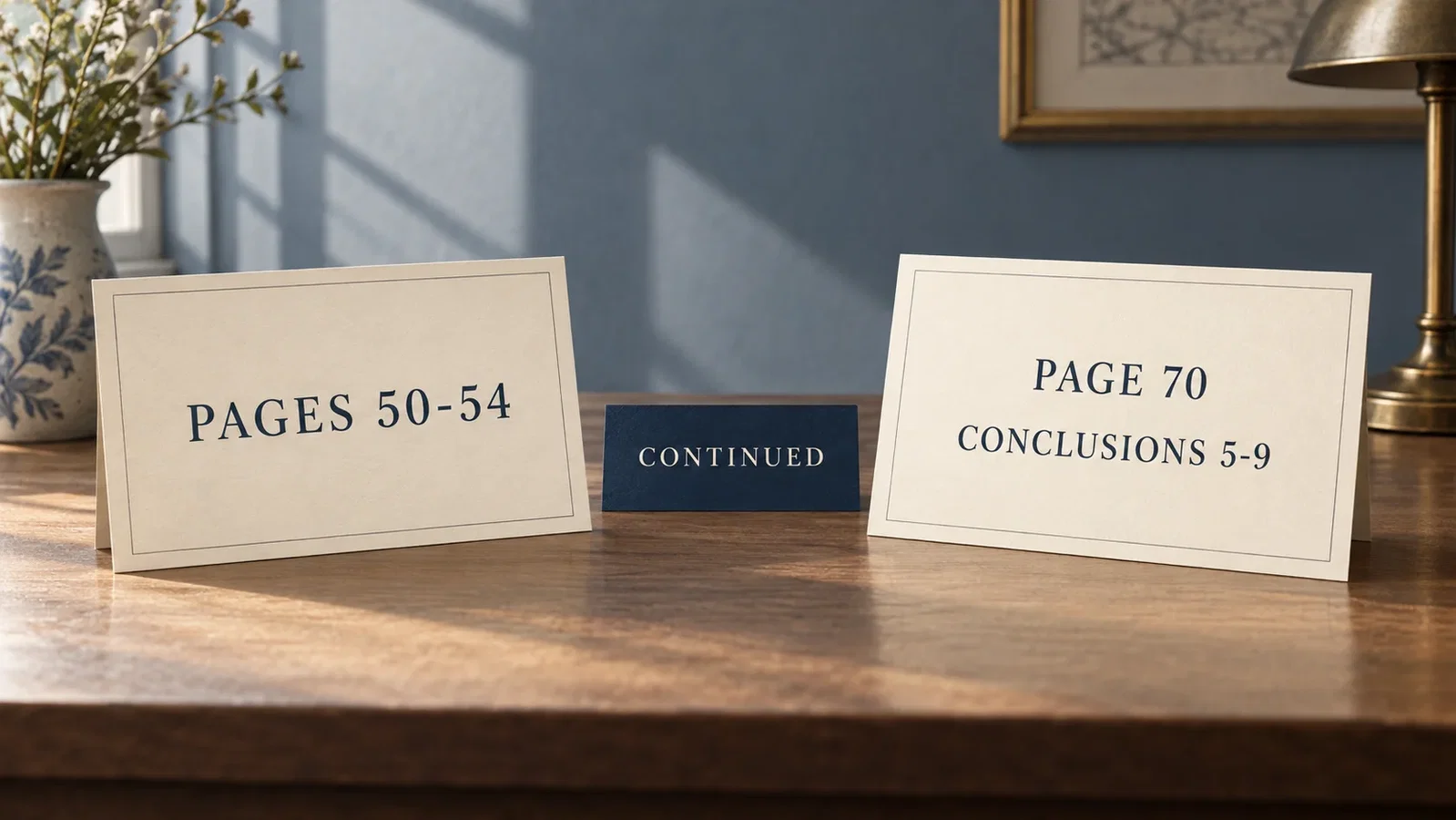
That ending also complicates a quotation earlier in the paper. Haines quoted McKesson as minimizing age-related differences in agent selection and technique, but the same passage warned of rapid deoxygenation. Her own final conclusion emphasized the narrower margin. Extracting only “age has no influence” would discard the qualifications within the text.[1, pp 51,70]
These are historical judgments, not present-day pediatric anesthesia recommendations. The old hypoxic gas mixtures and administration instructions are not reproduced here as a usable technique. Nor does reading the paper require us to validate its physiology, endorse every recommendation or treat a favorable personal experience as proof of safety.
A report with boundaries worth preserving
The original heading dates the article to October 1922. Its footnote says it was read during a joint meeting at the Hotel Jefferson in St Louis, May 22–24, without identifying the particular day. Seldon's fully read journal history dates the inaugural issue to August 1922. Haines's October article should not be moved into that August issue.[1, p 50; 2]
This article centers her documented clinical contribution rather than expanding a priority or military biography from material available only as an abstract or finding aid.
The report's value does not depend on making every conclusion correct. It preserves distinctions that remain important when reading historical clinical evidence: who administered the anesthetic, who was observed afterward, what the records could miss, and whether accidents and subtle abnormalities were allowed into the conclusion.
A child leaving the clinic was not the same as a risk fully observed.
Sources and reading limits
- Haines FE. Anesthesia in Children: Safest Methods and Agents. Anesthesia and Analgesia. 1922;1(2):50–54, with continuation on p 70. Complete article read in six original scans and extracted text; only the right-column continuation on p 70 belongs to Haines. DOI:10.1213/00000539-192210000-00003. Original p 50; continuation p 70. HathiTrust; University of Minnesota copy; Google digitization; marked Public Domain.
- Seldon TH. Anesthesia and Analgesia—50 Years of Publication. Anesth Analg. 1971;50(4):571–577. All seven pages, five figures/captions and nine references read. The combined contents reproduction is not Haines's full text. Mayo Clinic full-text archive.
- Rowbotham ES, Magill I. Anaesthetics in the Plastic Surgery of the Face and Jaws. Proc R Soc Med. 1921;14(Sect Anaesth):17–27. Original pages 19–23 re-read for this comparison; the other pages of the eleven were not re-read. Original article archive.
All four images are modern historical reconstructions or editorial concepts, not actual patient photographs, an authenticated Haines portrait or journal facsimiles, and not clinical instruction.
Continue exploring
Related reading connects shared questions and contexts; it does not by itself establish historical influence.
The Source Room · About & Editorial Method
Sources and reading limits are stated above. Illustrations are labelled as original source images or AI-made. Historical accounts are educational; they are not current treatment instructions.