Tip position, early use and the work of construction in the original records.
Reading Library · Anesthesia Epochs · 中文版
Watch the companion film
1943: The Macintosh Laryngoscope—Why the Tip Matters · Watch on YouTube
Historical anchor: 1943. Date details and source qualifications are explained below.
A short item in the Lancet on 13 February 1943 addressed a practical difficulty: exposing the larynx so that a tracheal tube could pass. Robert R. Macintosh presented a new blade, illustrated its action, and described what he thought made it useful.[1]
The familiar curve can dominate the story. Yet Macintosh wrote that its precise shape mattered less than the position of its tip. Reading the original changes the question from what the blade looked like to how it moved the tissues in front of the observer.[1]

An editorial concept, not an anatomical diagram, an original instrument photograph or an operating demonstration.
Where the tip stopped
Macintosh contrasted the short curved blade with a conventional long straight one. The latter passed beyond the epiglottis and retracted it directly. His new blade stopped at the angle between the base of the tongue and the epiglottis. Elevating the tongue base drew the attached epiglottis upward, bringing the larynx into view.[1,figs.1–5]
The epiglottis was raised indirectly, but the larynx was still seen directly. These are different uses of the word: the instrument changed the mechanical route to exposure without transmitting a camera image to a screen.[1]
The paper also acknowledged alternatives. Macintosh referred to Human's method, Margaret Hawksley's practice in infants that he had observed, and Cassels's slight curve at the end of a long blade. In his account, Cassels's tip still passed beyond the epiglottis. The article therefore does not support a claim that nobody had previously curved a laryngoscope blade. These earlier practices are reported here as Macintosh described them; their underlying publications have not all been separately obtained and read.[1]
An earlier instrument with a different action
Macintosh had already published an instrument note on 27 December 1941. That BMJ device incorporated an epiglottis retractor: a metal projection and notch engaged the epiglottis, which was then everted by slight withdrawal. This was a different arrangement from the short curved blade of 1943.[2]
The 1941 note also addressed illumination. The bulb was moved from the blade to the handle, with a flexible lead and a light-transmitting rod supplying the arrangement. Macintosh discussed breakage, cost and sparks, and thanked the technician R. Salt for helping make the model. Sharing an author does not make the two articles descriptions of the same instrument.[2,figs.1–2]
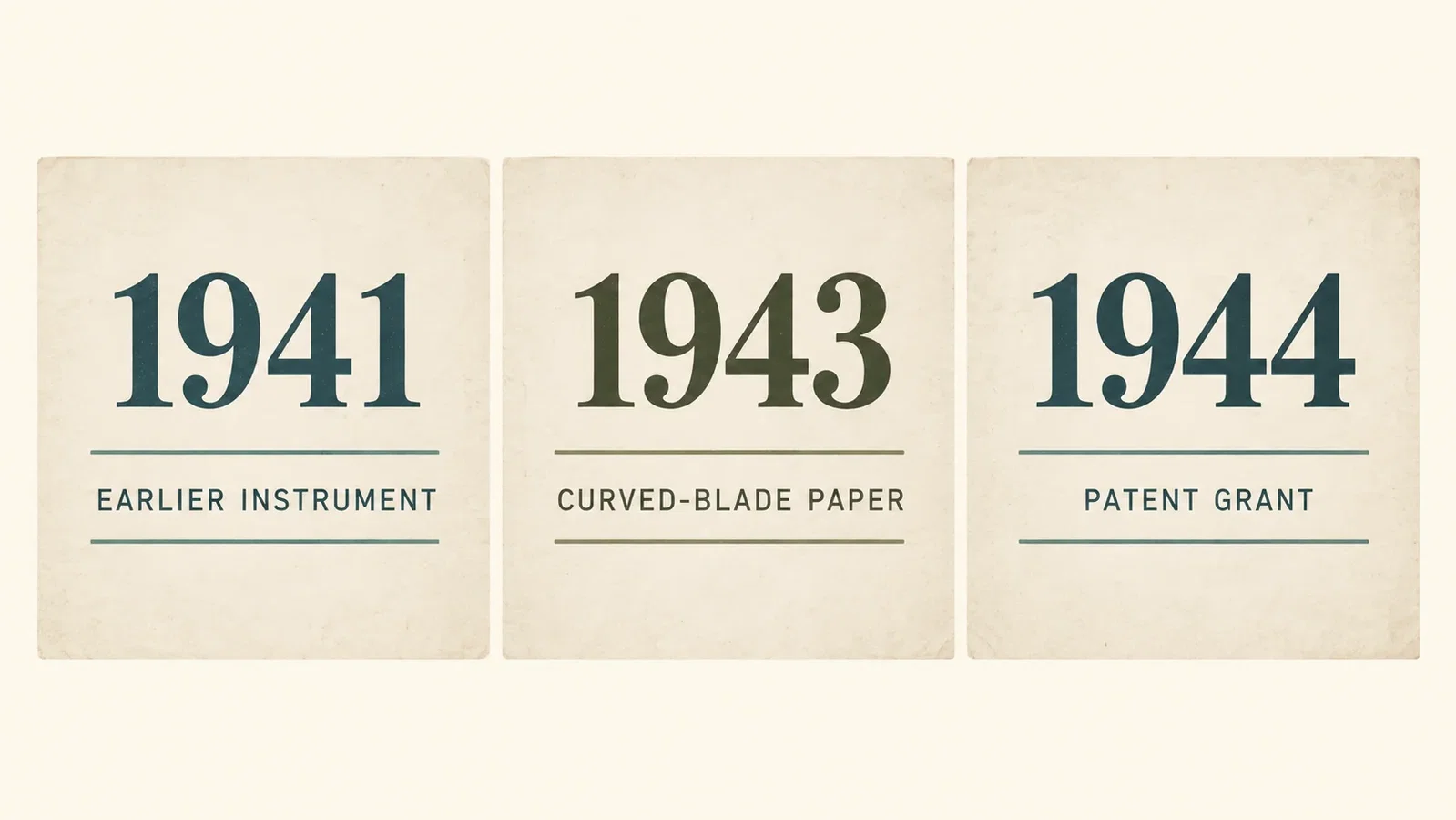
1941 marks the earlier instrument article; 1943 the curved-blade paper; 1944 the patent grant. These are distinct records, not interchangeable invention dates.
The acknowledgments in 1943 were also specific. Macintosh credited N. Saher with suggesting an adjustment to the smaller blade and thanked laboratory colleagues for help with construction. The Wood Library-Museum's prototype catalogue names Macintosh and Richard Salt in its development history. Its object date is “[1943?]”; the question mark matters. A catalogued prototype cannot supply an otherwise undocumented day of invention.[1,5]
Rowbotham wrote back
On 20 February 1943, one week after the paper, the Lancet published Stanley Rowbotham's response. He reported two months of use and praised the way the instrument elevated the tissues at the tongue base, carrying the epiglottis with them. Clinical use plainly preceded publication, although the letter does not establish an exact first-procedure date.[3]
Rowbotham had described nasal intratracheal anesthesia in 1920, including the laryngoscope, illumination, guiding rod and catheter. Magill's instrument note that year described forceps whose geometry kept the operator's hand clear of the view while guiding a catheter. Together, these papers make the connection concrete: access depended on both seeing the opening and leaving room for an instrument to reach it.[6]
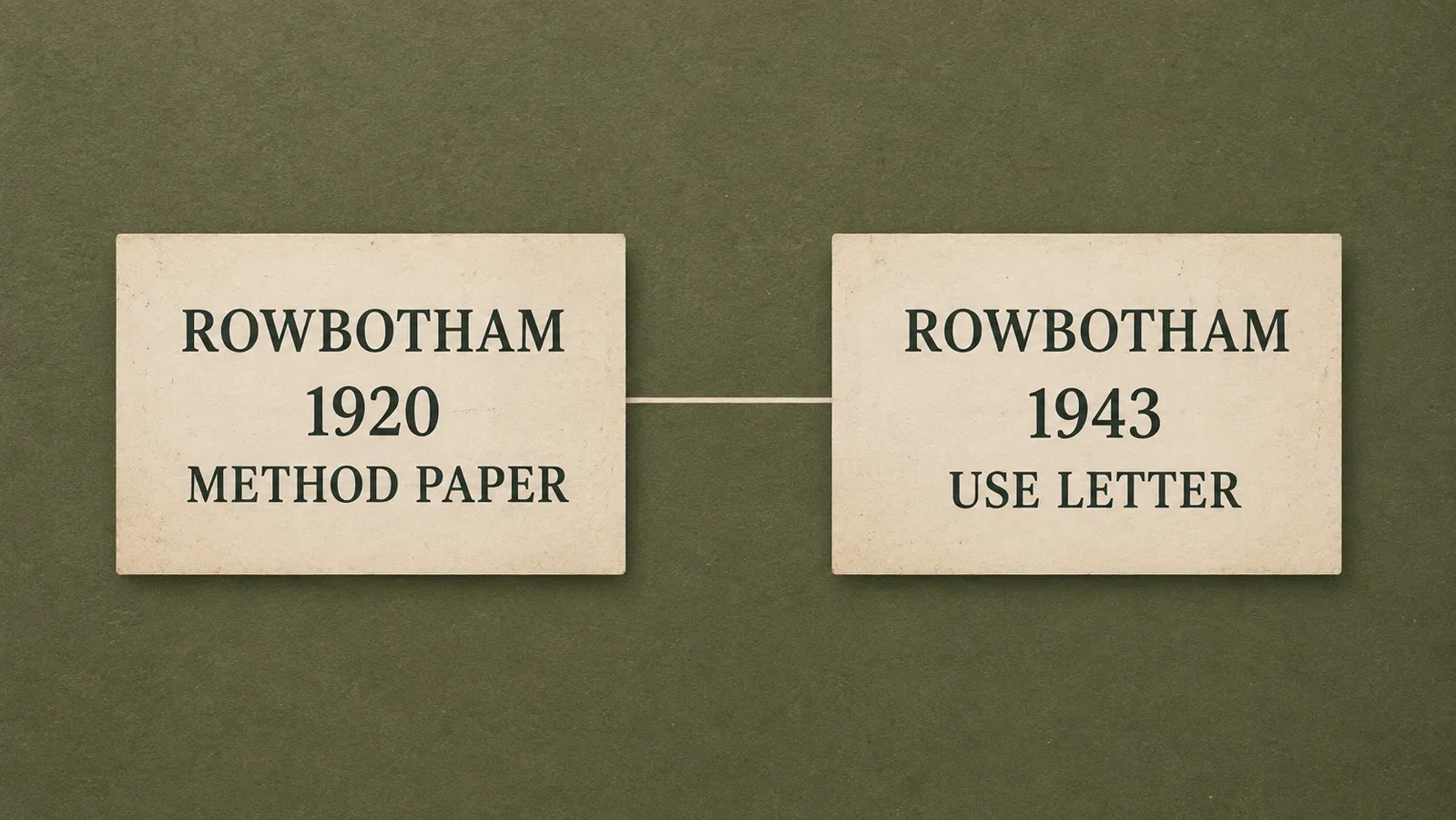
The same author appears at two stages. This comparison does not establish that Magill's forceps caused the invention of Macintosh's blade.
In 1920, Rowbotham wrote that relaxation under deep anesthesia helped catheterization. In 1943, he praised the new laryngoscope's performance under lighter anesthesia. These are revealing judgments from one clinician at different times. They are not the arms of a controlled comparison assembled across more than twenty years.[3,6]
What the favorable reports could establish
Macintosh's claim in 1943 was personal: he could expose the larynx more easily and at a lighter plane of anesthesia. He suggested that differences in the nerve supply of the contacted tissues might partly explain this. The explanation was tentative in the original; it should not become an experimentally established physiological conclusion in a historical retelling.[1]
Rowbotham supplied another user's enthusiastic assessment, but neither paper provided a patient denominator, randomized groups or comparative injury rates. Macintosh mentioned possible injury to the upper teeth or posterior pharyngeal wall with the older approach. He did not quantify a reduction in these injuries with the new blade. The sources document a favorable reception without establishing universal clinical superiority.[1,3]
A second kind of primary record
US Patent 2,354,471 preserves further mechanical detail. Filed on 18 August 1943 and granted on 25 July 1944, its two pages and six figures describe the curved blade, lateral structures, light, folding joint and electrical contacts.[4]
The application and grant dates belong to the patent's history. Its drawings help identify the design, while its claims of useful performance remain assertions in a technical document. Neither the grant nor the drawings substitute for a clinical comparison.[4]
An editorial laboratory scene. The figures do not portray Macintosh, Salt or Saher, and the room is not a reconstruction of a documented occasion. Evidence of collaboration comes from the sources, not from the illustration.
The curve gains a more precise history when these records are kept together: the different instrument of 1941, the 1943 description and user response, and the later patent. They preserve a clinical problem, the work of making an instrument, and the judgments through which its early users explained its promise.[1–5]
Sources and reading limits
- Macintosh RR. A New Laryngoscope. Lancet. 1943;241(6233):205. 13 February. DOI:10.1016/S0140-6736(00)89390-3. Original journal volume; publisher metadata. The complete article and figures 1–5 were read from the original page 205 scan. The whole volume was not read. References to Human, Hawksley and Cassels are bounded to this author's account.
- Macintosh RR. An Improved Laryngoscope. BMJ. 1941;2:914. 27 December. Original reprint held by WLM. Complete article and figures read on printed page 914; the rest of the 54-page collection is not counted as read.
- Rowbotham S. The Macintosh Laryngoscope. Lancet. 1943;241:253. 20 February. Original journal volume. Complete letter read from the original page 253 scan. Two months' use was an unquantified contemporary report.
- Macintosh RR. Laryngoscope. US Patent 2,354,471. Filed 18 August 1943; granted 25 July 1944. Original patent. Both pages, six figures and the claim read as a historical technical record.
- Wood Library-Museum of Anesthesiology. Macintosh Laryngoscope Prototype. Accession 133; date [1943?]. Catalogue body read; object provenance and later historical narrative distinguished. Object photographs were not separately reviewed.
- Rowbotham S. Intratracheal Anaesthesia by the Nasal Route for Operations on the Mouth and Lips. BMJ. 1920;2:590–591; Magill IW. Forceps for Intratracheal Anaesthesia. BMJ. 1920;2:670. Three original pages read in an archived copy of the 1920 journal to compare instrument geometry and visual access.
Sources and reading limits are stated above. Illustrations are labelled as original source images or AI-made. Historical accounts are educational; they are not current treatment instructions.
Continue exploring
Related reading connects shared questions and contexts; it does not by itself establish historical influence.