Anesthesia Epochs
About this film
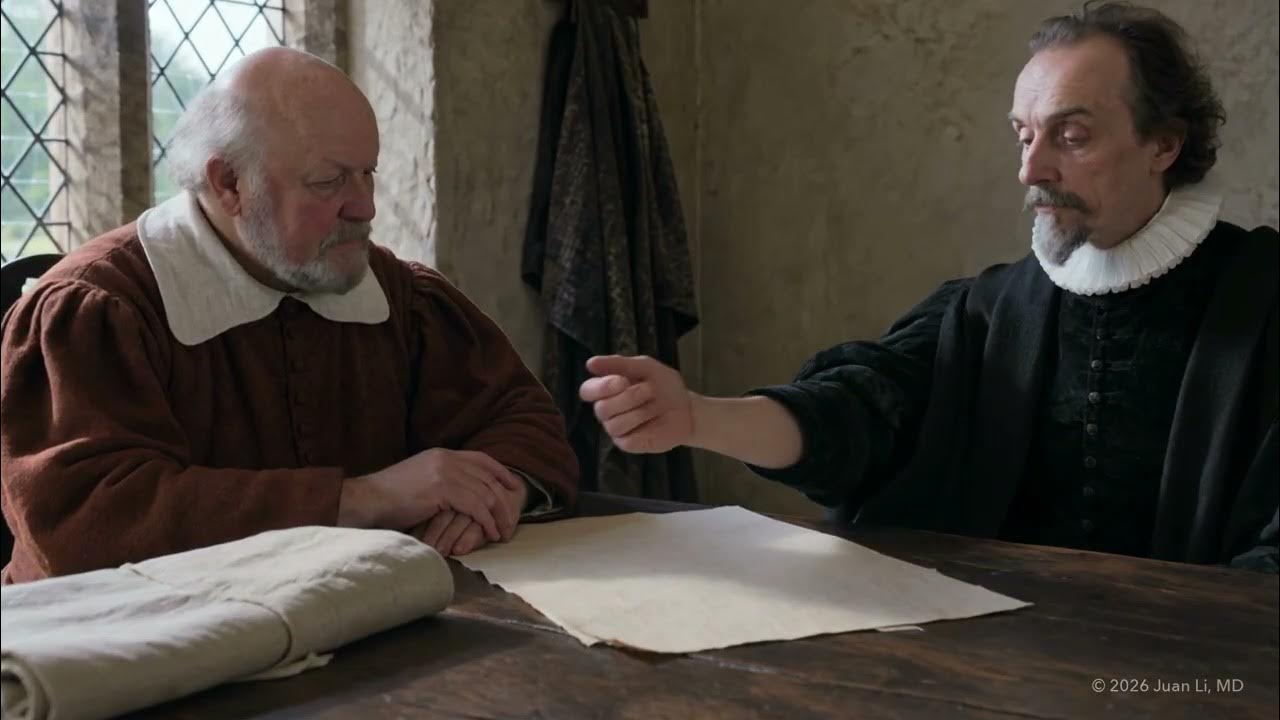
As heartbeats accumulate, where can the continuing supply of blood come from? In his 1628 publication, William Harvey brought estimates of quantity, the heart's action, and venous return into an argument for circulation. This film follows the reasoning that connected outward and returning paths of blood. It also preserves what remained unseen: the argument required a connection, but that did not mean Harvey had directly observed capillaries or measured cardiac output in its modern sense.
Read the companion essay · 1628: Harvey Connects the Outward and Returning Paths of Blood
Scientific takeaway
An explanatory argument can connect observations while leaving a proposed mechanism beyond direct observation.
Sources
- Harvey W. Exercitatio anatomica de motu cordis et sanguinis in animalibus. Frankfurt: William Fitzer; 1628. Read the cited edition
- Harvey W. On the Motion of the Heart and Blood in Animals. Willis R, trans. London: JM Dent & Co.; 1906. Read the cited edition
- Whitteridge G. William Harvey and the Circulation of the Blood. London: Macdonald; 1971. 1971 edition — catalogue and snippet preview
Notes on reconstruction
Historical performances and natural analogies are reconstructions or explanatory devices; they are not direct records of Harvey's experiments or additional experimental evidence.
Read beyond the film
1628: Harvey Connects the Outward and Returning Paths of Blood
Explore the longer account, original references, reading limitations and connected stories.