Anesthesia Epochs
About this film
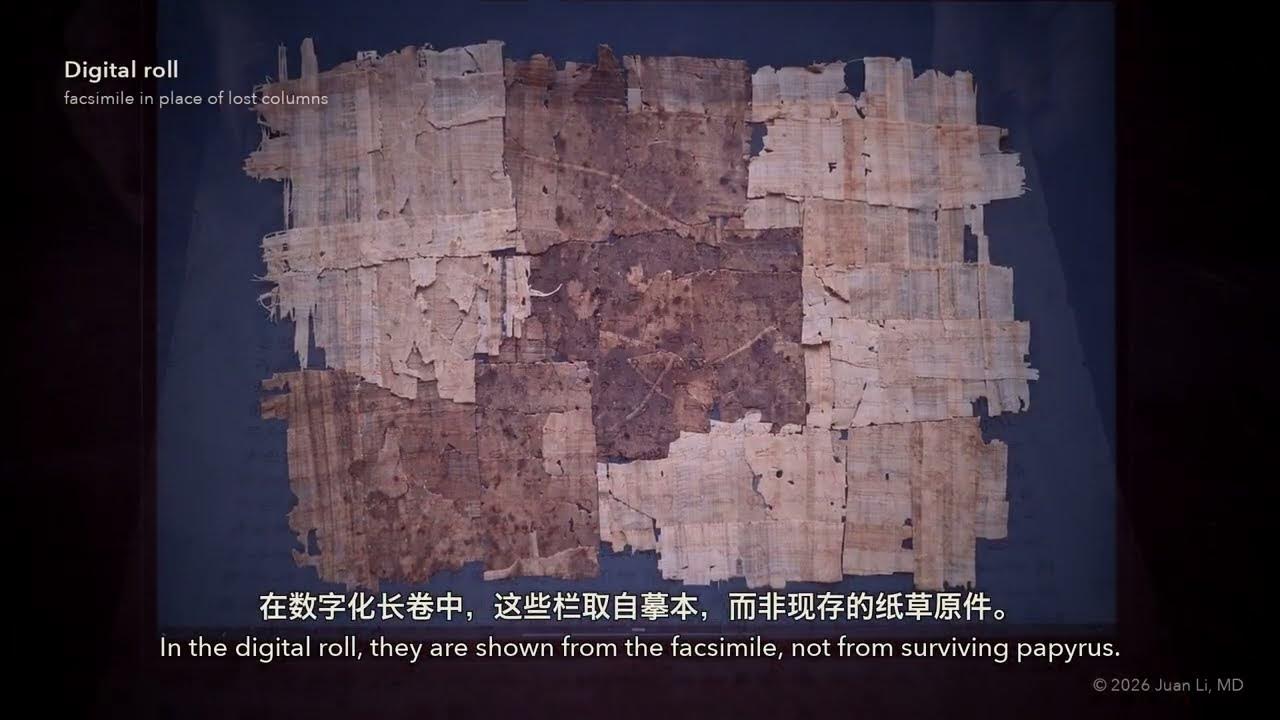
A medical compilation from the sixteenth century BCE preserves attempts to relieve suffering. Several Ebers Papyrus entries concern a painful head, while another names a plant in a remedy for a child's plaintive cries. That plant's identity remains unresolved in the current scholarly reading. This film asks what the manuscript can tell us without turning therapeutic intention into demonstrated pharmacology. Surviving originals and facsimile-based replacements also need to be distinguished when reading images of the scroll.
Read the companion essay · c. 1550 BCE: The Ebers Papyrus and an Uncertain Plant Name
Scientific takeaway
Therapeutic intention, plant identification, pharmacological effect, and demonstrated anesthesia require different evidence.
Sources
Leipzig University Library collection record
The Ebers Papyrus at Leipzig University Library (illustrated account in German, pp. 40–41) · Library description in English (archived)
1875 Ebers facsimile, volume I
View the digitized volume at Göttingen
Scholarly translation and commentary
Read entry Eb 782 in the German edition (v475, archived) · Alternative capture · Earlier German edition (v113, 2021)
Notes on reconstruction
Reconstructed scenes do not prove a plant's identity or anesthetic effect, and facsimile-based replacements must not be mistaken for surviving original papyrus sections.
Read beyond the film
c. 1550 BCE: The Ebers Papyrus and an Uncertain Plant Name
Explore the longer account, original references, reading limitations and connected stories.