
ITL-8b72791ec491
Watch the video

Figure 1. Risk estimation supports an individualized decision; it does not replace it. Conceptual illustration.
Key points
- Describe liver disease clinically: portal hypertension, prior decompensation, renal function, nutrition, and frailty matter alongside laboratory scores.
- Higher MELD scores identify higher-risk cardiac surgical populations, but a score is neither a diagnosis of cirrhosis nor a universal threshold for refusing surgery.
- VOCAL-Penn predicted mortality more closely than the Mayo model in a recent selected cardiac surgery cohort; both overestimated average mortality.
- Discuss complications and recovery as well as death, and include the 90-day horizon when available.
- Combine cardiac and hepatic assessment with the proposed operation, urgency, alternatives, and the patient's priorities.
A patient with cirrhosis needs valve surgery. One calculator predicts a worrying mortality risk, while the cardiac team believes the lesion is treatable. The useful next step is to understand what produces that estimate and whether the patient resembles the population behind it. A single percentage cannot capture the consequences of either operating or leaving the cardiac disease untreated.
Establish what the score leaves out
Cirrhosis affects more than hepatic synthetic function. Portal hypertension, ascites, encephalopathy, renal dysfunction, impaired nutrition, and frailty can influence tolerance of cardiac surgery and recovery. The cardiac anesthesia review by Yoon and colleagues emphasizes assessment of this organ involvement and coordination across the treating teams.[1]
Start with a clinical description: compensated disease or previous/current decompensation; evidence of portal hypertension; renal trajectory; functional reserve; and nutritional status. Then add laboratory scores. MELD uses laboratory variables, whereas Child–Pugh also incorporates ascites and encephalopathy. Neither, by itself, describes the complexity of the intended cardiac operation.[1]
This changes the consultation from “What is the MELD?” to “Which risks are present, which can improve, and how much time does the heart condition allow?” It also prevents a reassuring laboratory profile from obscuring clinically important decompensation.
What higher MELD actually tells us
A 2025 ACS-NSQIP analysis included 25,845 elective isolated CABG, aortic valve, or mitral valve operations. Observed 30-day mortality rose across MELD categories: 1.7% below 9, 3.8% at 9–15, and 8.7% above 15. Major morbidity was also higher: 25.1%, 33.3%, and 45.7%, respectively.[2]
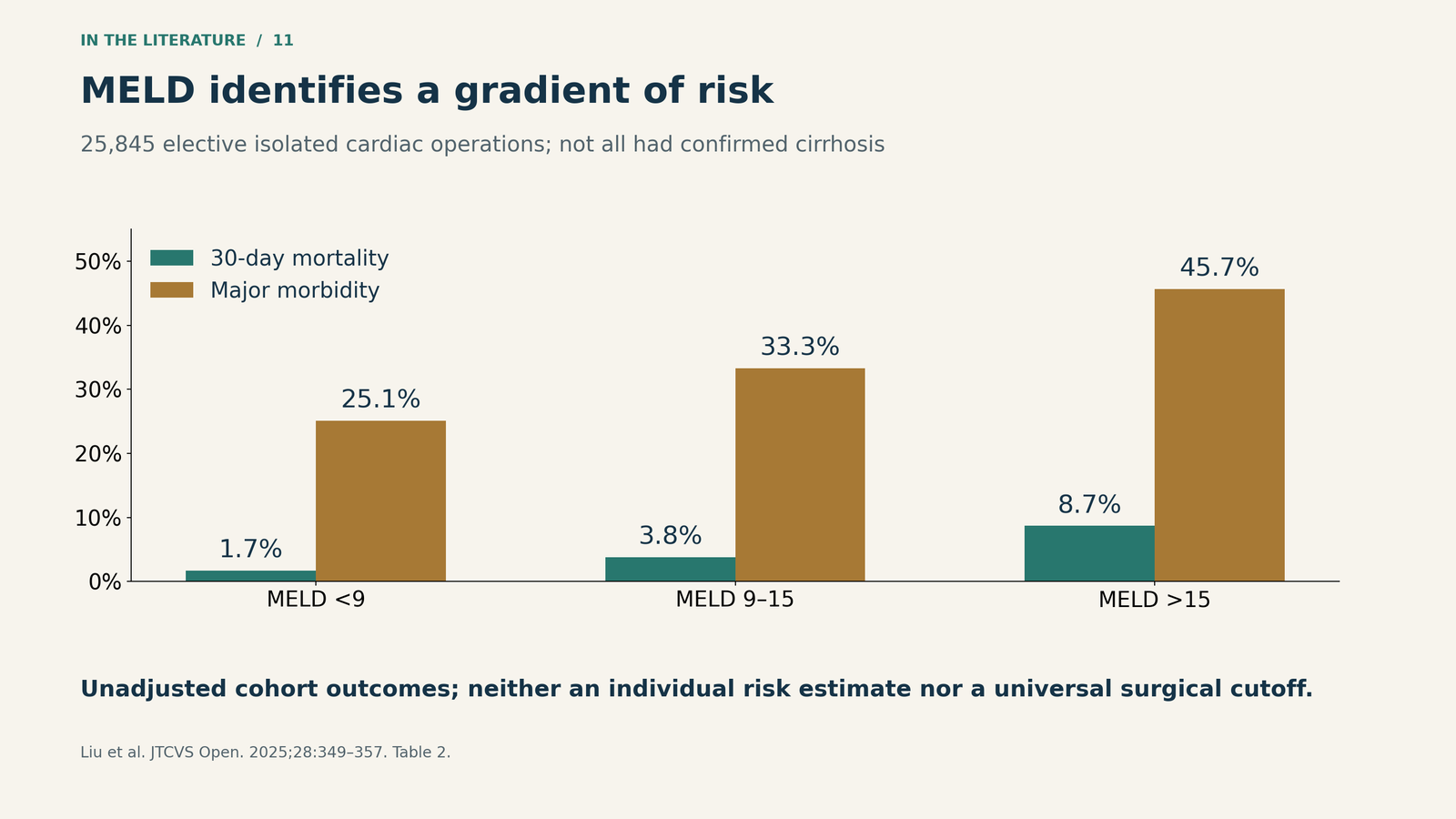
Figure 2. Unadjusted outcomes from the 2025 ACS-NSQIP study. Major morbidity is the study's composite outcome. These were cardiac surgical patients with calculable MELD scores, not a cohort restricted to confirmed cirrhosis.[2]

The clinically useful message is the gradient of risk, including substantial morbidity even when mortality appears relatively modest. The study could not establish the cause or clinical severity of liver disease, and its elective, isolated procedures do not represent emergency or complex combined surgery. Higher MELD was associated with worse outcomes; the analysis did not validate an automatic “operate below this number, refuse above it” rule.[2]
These percentages therefore help explain why liver-related assessment matters. They should not be presented as the personal mortality estimate for every patient with cirrhosis and the same MELD.
Why a high predicted risk needs interpretation
A 2026 single-center study evaluated 220 patients with cirrhosis who underwent cardiac surgery with cardiopulmonary bypass. Median MELD was 10; 65% had Child–Pugh class A disease, and only four patients had class C disease. The cohort included urgent operations, reoperations, and combined procedures.[3]
At 30 days, the mean predicted mortality was 20.9% with the Mayo model and 9.0% with VOCAL-Penn, compared with 4.1% observed mortality. At 90 days, the corresponding values were 29.6%, 14.0%, and 12.6%.[3]
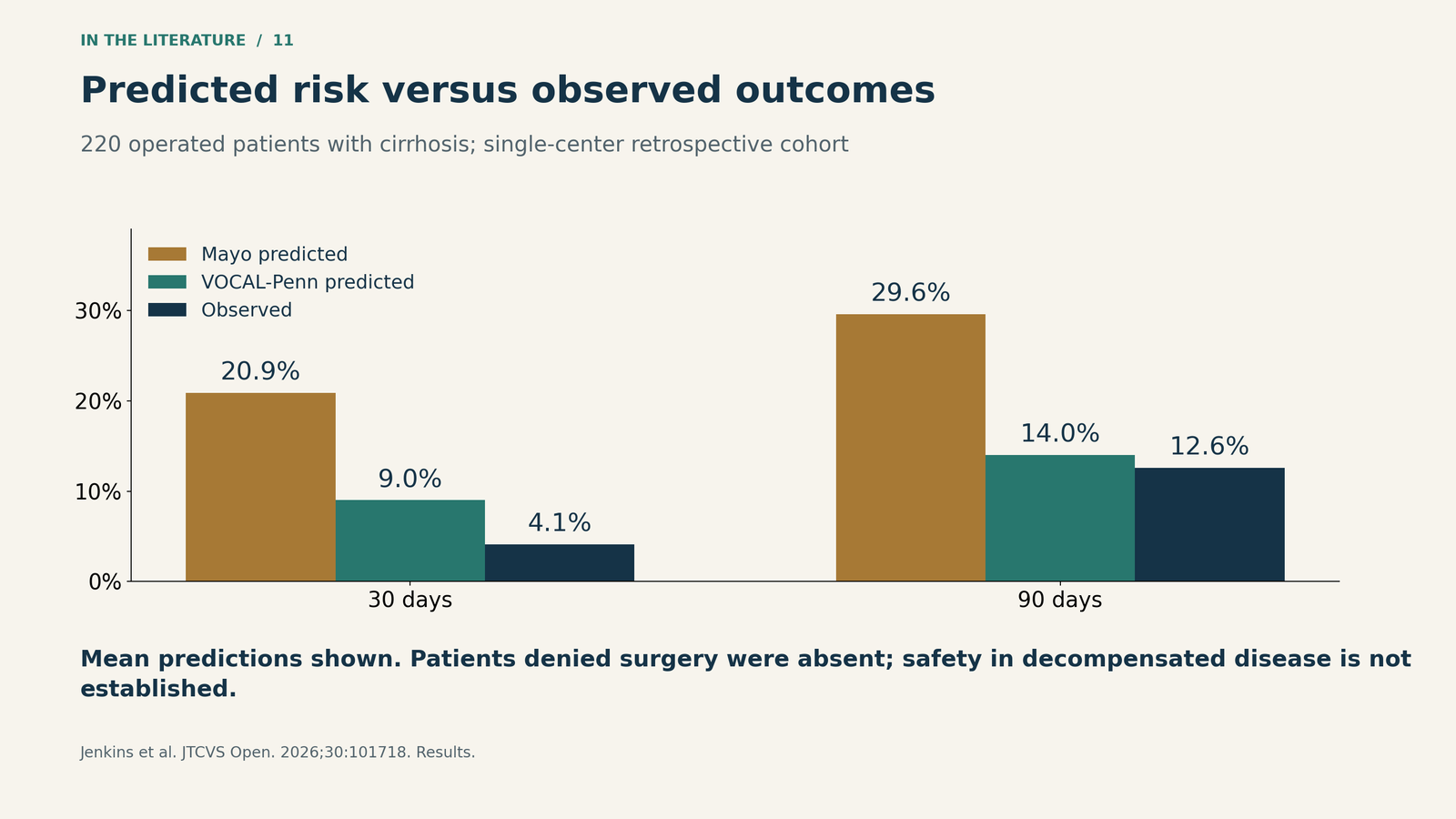
Figure 3. Cohort-level predictions and observed outcomes from Jenkins et al. VOCAL-Penn was closer to observed mortality. These averages are not interchangeable with an individual patient's risk.[3]

The findings support questioning an apparently prohibitive prediction, particularly from the Mayo model. They do not establish that cirrhosis is low risk: the study included only patients who actually underwent surgery, omitting those considered too high risk. Its very small class C subgroup cannot establish safety in advanced decompensated disease. Nor can the difference between predicted and observed mortality be subtracted mechanically from the next patient's estimate.[3]
The increase from 30- to 90-day mortality also matters for consent. Surviving the operation and initial hospitalization does not describe the whole early recovery period.
Turn the estimate into a joint plan
Use the cardiac surgical assessment and liver-specific assessment together, then reconcile disagreement in a discussion involving cardiac surgery, cardiology, anesthesia, and hepatology. Establish the benefit expected from the cardiac intervention, plausible alternatives, and the consequences of delay. Identify reversible problems—such as uncontrolled ascites, encephalopathy, infection, renal dysfunction, or inadequate nutrition—and address them when the cardiac urgency permits.[1, 3]
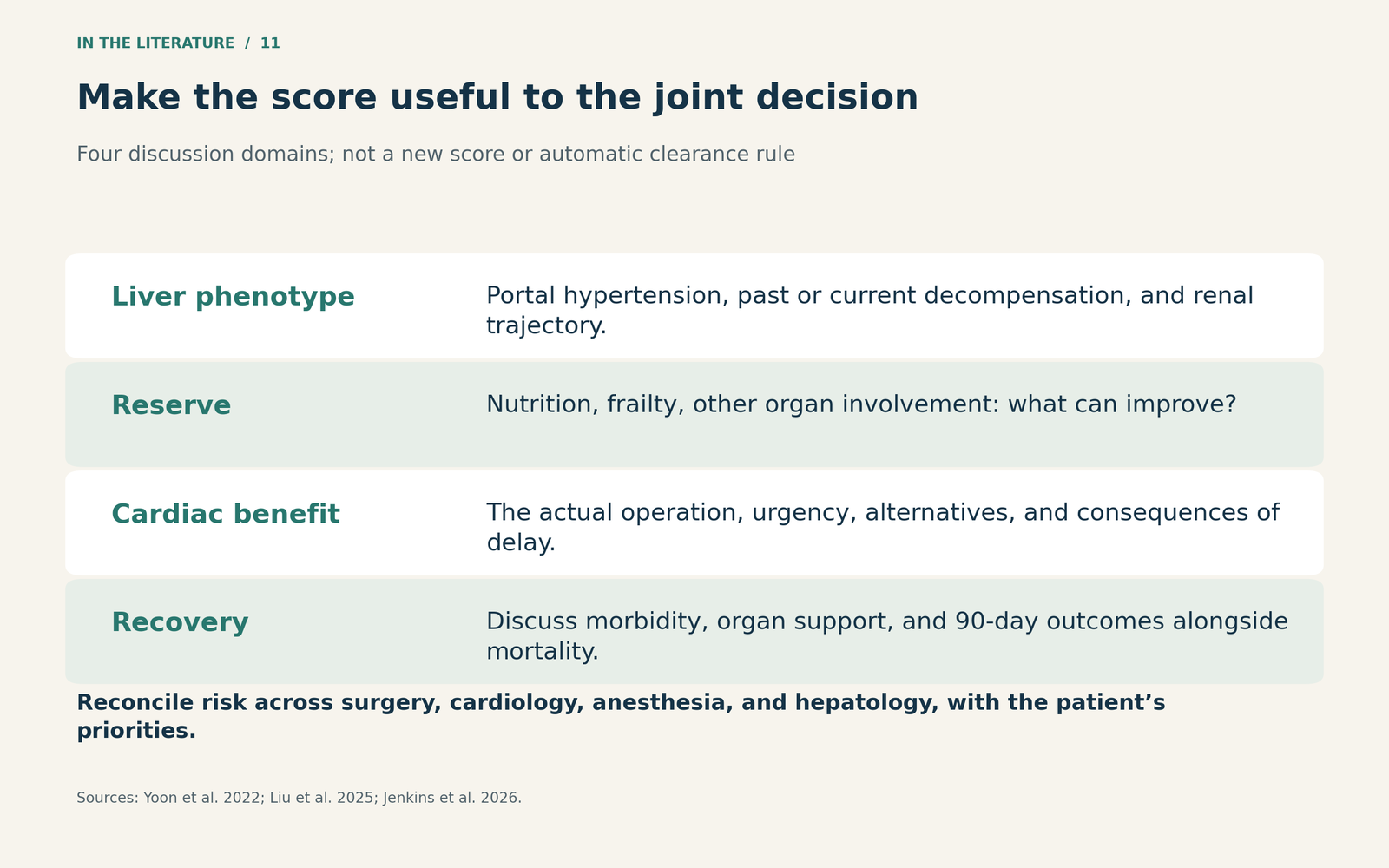
Figure 4. A practical synthesis of the clinical assessment and risk-model evidence. The four domains organize discussion; they are not a validated new scoring system.[1, 2, 3]

The resulting plan should explain more than a predicted death rate. It should describe anticipated organ support, possible prolonged recovery, the factors being optimized, and why proceeding, postponing, or choosing another treatment best fits this patient. A model is most helpful when it makes that reasoning more explicit.
Three takeaways
- Describe the liver phenotype before interpreting the number. Decompensation, portal hypertension, renal function, nutrition, and frailty add information that a laboratory score cannot replace.
- Use risk estimates to inform candidacy, not determine it alone. MELD-related risk gradients and model overprediction can coexist; neither supplies a universal surgical cutoff.
- Make the discussion about the whole recovery. Include morbidity and 90-day outcomes, then connect cardiac benefit, modifiable risks, urgency, and patient priorities.
References
- Yoon U, Topper J, Elia E, Goldhammer J. Preoperative evaluation and anesthetic management of patients with liver cirrhosis undergoing cardiac surgery. J Cardiothorac Vasc Anesth. 2022;36(5):1429–1448. doi:10.1053/j.jvca.2020.08.022.
- Liu T, Chen Z, Jacobs RC, Logan CD, Whippo B, An S, et al. Association of mild-to-moderate Model for End-Stage Liver Disease scores on short-term cardiac surgery postoperative outcomes. JTCVS Open. 2025;28:349–357. doi:10.1016/j.xjon.2025.09.034.
- Jenkins H, Awad AK, Poddi S, Rosinski B, O'Shea R, Xu B, et al. Validation of current mortality risk prediction models in patients with cirrhosis undergoing cardiac surgery. JTCVS Open. 2026;30:101718. doi:10.1016/j.xjon.2026.101718.