
ITL-f70a63c08a03
Watch the video

Figure 1. Elapsed time belongs in a team assessment. Conceptual illustration, not a demonstration of resuscitation technique.
Key points
- The reported “below 1%” times are not stopping rules. In a large registry analysis, survival and favorable functional-outcome estimates fell below 1% at 39 and 32 minutes, respectively, under a specific analytical assumption. [1]
- The denominator changes the interpretation. The primary analysis retained patients whose resuscitation had already ended; an analysis restricted to patients still receiving CPR described a selected population with higher outcome estimates. [1]
- A promising termination rule can fail elsewhere. In a 2026 US validation, 311 of 6,084 patients meeting one proposed rule nevertheless survived to hospital discharge under the care actually delivered. [2]
- Make a clinical, team-based decision. ERC 2025 guidance considers patient preferences, reversibility and response to advanced life support together with time; it advises against using termination rules for in-hospital cardiac arrest. [3]
Forty minutes have passed since chest compressions began, and the patient has not had a first return of spontaneous circulation (ROSC). Someone recalls a study reporting less than 1% survival. That finding is relevant, but before using it to recommend stopping, the team needs to know whose probability was estimated—and what the study could not observe. [1]
What the large duration study measured
Okubo and colleagues analyzed 348,996 adults with an index in-hospital cardiac arrest in the US Get With The Guidelines–Resuscitation registry, from 2000 through 2021. Duration ran from the start of compressions to the first ROSC or termination of resuscitation. The study assessed survival to hospital discharge and favorable functional outcome, defined as Cerebral Performance Category (CPC) 1 or 2 at discharge. CPC 2 permits moderate cerebral disability; it does not mean complete recovery. [1]
The primary analysis estimated subsequent outcomes among patients who had not yet achieved first ROSC at each minute. Survival estimates were 22.0% at one minute, 4.0% at 20 minutes and 0.9% at 40 minutes. The reported threshold below 1% occurred at 39 minutes for survival and 32 minutes for favorable functional outcome. These are different endpoints, not interchangeable definitions of successful resuscitation. [1]
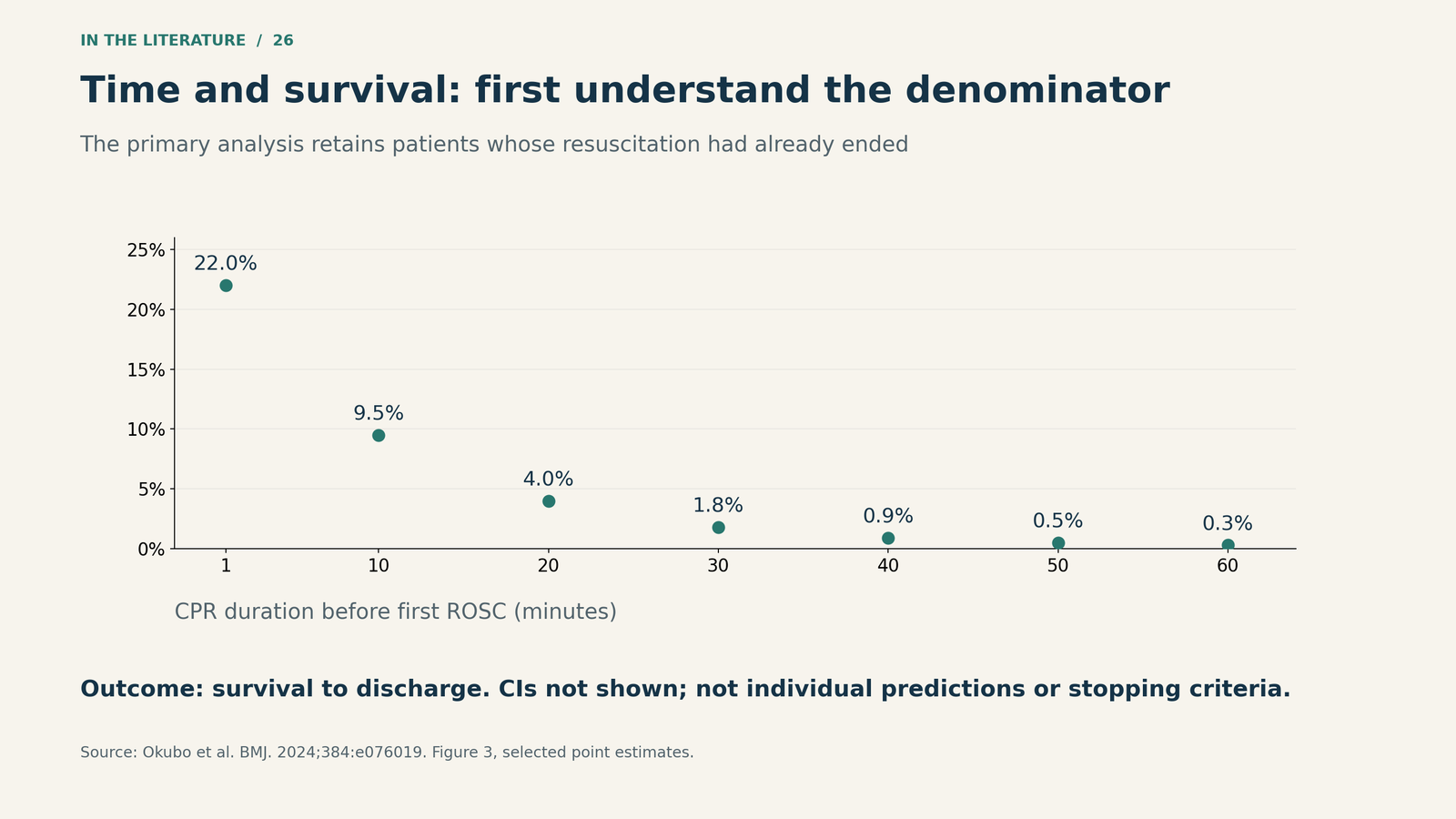
Figure 2. Selected point estimates printed in the original Figure 3; intervals between points do not provide additional estimates, and confidence intervals are not reproduced here. The denominator includes patients whose resuscitation had already been terminated. These are not individual predictions or stopping thresholds. [1] Enlarge figure.

Patients receiving ECMO before or after CPR began were excluded. The results therefore do not establish an ECPR selection threshold. They also concern the interval before first ROSC, not simply the accumulated compression time across repeated arrests, and they should not be repurposed as neurological prognostication after ROSC. [1]
Why the denominator matters at the bedside
In the primary analysis, a patient whose resuscitation had already been terminated remained in the denominator at later times. The analysis assumed that this patient would never have survived even if CPR had continued. That counterfactual cannot be verified from the registry: once treatment ends, we cannot observe what a longer attempt would have achieved. [1]
The investigators also analyzed only patients still receiving CPR at each time point, excluding those with earlier termination. In that selected group, survival estimates plateaued at 5.4–6.3% between 20 and 60 minutes; favorable functional-outcome estimates were 3.2–3.8%. This does not prove that everyone would benefit from continuing to 60 minutes. Clinicians had already selected whom to continue treating, using information and judgments not fully captured in the dataset. [1]
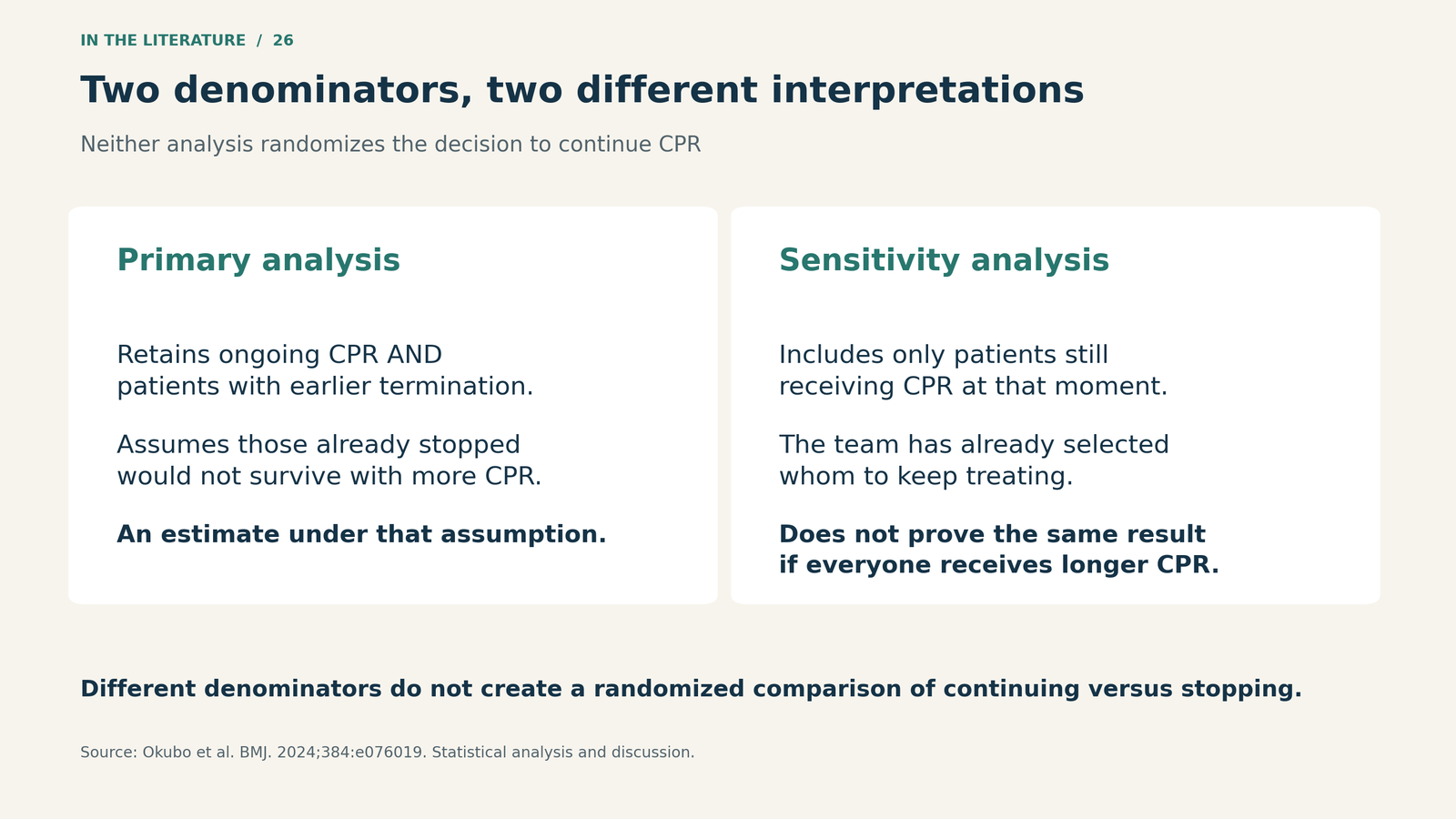
Figure 3. Two analyses answer different questions. Neither randomizes the decision to continue CPR, and neither establishes a universal duration for termination. [1] Enlarge figure.

The finding that younger patients, witnessed arrests and initially shockable rhythms had higher estimates further argues against treating one pooled percentage as the prognosis of every patient. These features describe associations; they are not, by themselves, instructions to continue or stop. [1]
External validation exposes the risk of a simple rule
Moskowitz and colleagues evaluated previously proposed in-hospital termination rules in 359,686 adults across 703 US hospitals, using 2012–2024 registry data. For the rule designated Rule 1, 6,084 patients (1.7%) met its criteria; 311 of those patients (5.1%) survived to discharge. The rule was applied retrospectively to the data, not prospectively to stop their treatment. [2]
The denominator is again crucial. The 5.1% represents survivors among people meeting the rule, not 5.1% of all arrests or all survivors. The study's reported false-positive rate of approximately 0.4% uses a different denominator—all actual survivors. A small value on that latter metric does not mean that almost nobody flagged for termination could survive. [2]
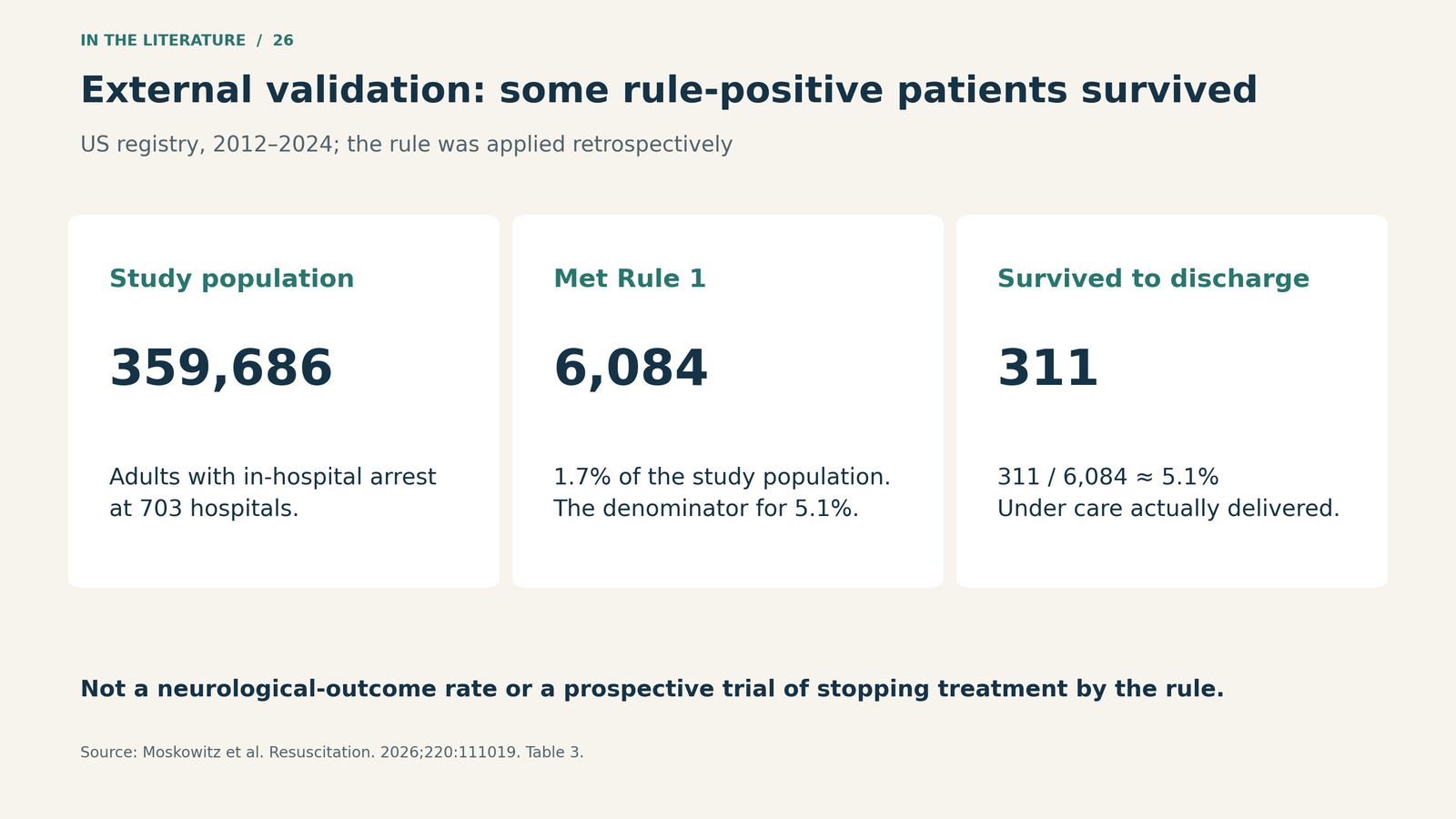
Figure 4. Retrospective rule performance under the care actually delivered. The 5.1% denominator is the 6,084 rule-positive patients. Discharge survival was measured; favorable neurological survival was not evaluated because of missing data. [2] Enlarge figure.

The original Scandinavian work assessed 30-day survival, whereas this validation assessed discharge survival. Differences in populations, care and outcomes matter. The US findings support caution about transferring a rule into practice; they do not quantify the effect of implementing it in a randomized trial. [2]
What should the team discuss instead of a deadline?
ERC 2025 recommends a combined assessment of patient values and preferences, CPR duration, reversible causes and response to advanced life support. Termination should be planned, with an opportunity for team members to contribute. The guideline advises against applying termination rules to in-hospital cardiac arrest because the evidence is insufficient. It also warns against using persistently low end-tidal CO₂ in isolation; cardiac standstill on ultrasound is not a reliable declaration that survival is impossible. [3]
For the team leader, the practical discussion is therefore:
- What has actually happened? Confirm the timeline, rhythm and whether any ROSC occurred, rather than relying on a single elapsed-time announcement.
- What remains treatable, and what response have we seen? Summarize the suspected cause, treatment delivered and response to advanced life support.
- What decision fits this patient? Bring known preferences, the combined clinical picture and team observations into the recommendation; explain uncertainty honestly. [1, 3]
This is not an argument for indefinite CPR. It is an argument for explaining the clinical basis of the decision. The clock helps describe the prognosis; it cannot supply the entire decision. [1, 3]
Three takeaways
- Do not convert 32, 39 or 40 minutes into an automatic stop. Understand the endpoint, population and assumptions behind the estimate.
- Ask who is in the denominator. Patients already declared beyond further treatment differ from those selected for continued CPR; rule-positive patients differ from all survivors.
- Use time within a shared team assessment. Reversibility, treatment response and the patient's preferences remain central. [1–3]
References
- Okubo M, Komukai S, Andersen LW, Berg RA, Kurz MC, Morrison LJ, et al. Duration of cardiopulmonary resuscitation and outcomes for adults with in-hospital cardiac arrest: retrospective cohort study. BMJ. 2024;384:e076019. doi:10.1136/bmj-2023-076019.
- Moskowitz A, Holmberg MJ, Kimbrell JM, Granfeldt A, Andersen LW, Johnson NJ, et al. External validation of rules for termination of resuscitation in in-hospital cardiac arrest. Resuscitation. 2026;220:111019. doi:10.1016/j.resuscitation.2026.111019.
- Raffay V, Wittig J, Bossaert L, Djakow J, Djärv T, Estella Á, et al. European Resuscitation Council Guidelines 2025 Ethics in Resuscitation. Resuscitation. 2025;215:110734. doi:10.1016/j.resuscitation.2025.110734.