ITL-3f9392d8b7f5
Watch the video
Key points
- Better LVEF at the usual pump speed is a screening finding. Withdrawal assessment must examine native-heart performance with reduced support, using clinical, echocardiographic and hemodynamic information together.[1], [2]
- RESTAGE-HF demonstrated the possibility of sustained remission in selected nonischemic HeartMate II recipients; its nonrandomized results do not give every LVAD patient the same chance of withdrawal.[3]
- “Full recovery” in a registry may describe an LVEF category, rather than independently verified readiness for pump removal.[4]
- Removing support does not end heart-failure care. Long-term RESTAGE-HF follow-up documents the need to consider recurrence and the consequences of retained hardware.[5]
An LVAD recipient feels better, the LV has become smaller and LVEF has risen. The next question is tempting: can the device come out? The clinically useful question is more precise: can this heart maintain adequate circulation when the pump contributes little, and is that improvement sufficiently stable to justify withdrawal? A good image under support cannot answer both parts.[1], [2]
Start by identifying what “recovery” means
RESTAGE-HF combined optimized unloading, pharmacological therapy and repeated assessment in 40 patients with nonischemic cardiomyopathy receiving HeartMate II support. It was a prospective multicenter nonrandomized study. The formal abstract reports that 16 of all 40 enrolled patients met its primary endpoint: reaching explant criteria within 18 months and remaining free from transplantation, another ventricular assist device or death at 12 months after explantation. That is different from simply counting patients whose pumps were removed.[3]
Among 36 patients who underwent the protocol, 18 were explanted within 18 months and 19 were explanted overall. These are different denominators and observation windows. Only the formal abstract of the 2020 report was available; these results establish feasibility in its selected cohort, not a randomized estimate of treatment benefit or a predicted withdrawal rate for current HM3 practice.[3]
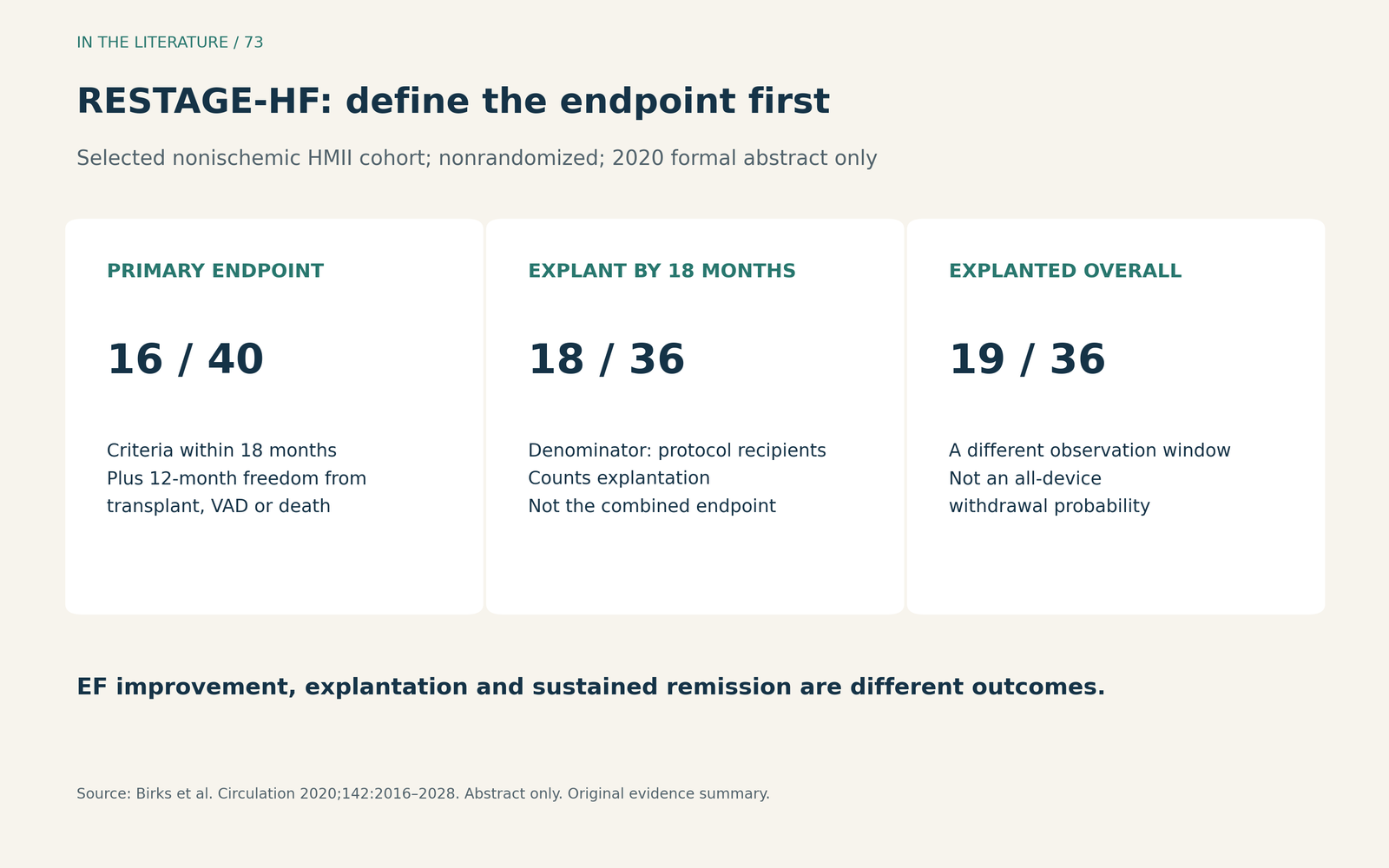
Figure 1. Three counts answer different questions. The primary endpoint includes a post-explant outcome, whereas the other counts describe explantation. The 2020 source is available here as a formal abstract only; do not combine these counts into a generic recovery percentage.[3] View larger.

The 2026 EUROMACS analysis illustrates a second distinction. It defined “full recovery” as LVEF at least 50% with an absolute increase of at least 5 percentage points. In the 1-year landmark cohort of 1,029 patients, 20 met that category; six subsequently underwent explantation. This observational classification describes ventricular improvement. It is not a validated withdrawal test, and the remaining patients cannot be assumed either eligible or ineligible from that label alone.[4]
Test reserve under controlled reduction of support
A recovery study differs from an ordinary ramp test performed to improve unloading. Here the team asks how the native heart behaves when pump assistance is reduced. ISHLT recommends measurements at usual support and after a supervised, device-specific reduction toward net-zero flow. The assessment includes LV dimensions and LVEF, mitral and aortic regurgitation, RV performance and invasive filling pressures; resting cardiac output must also remain adequate.[1]
The 2023 ISHLT criteria for considering explantation, measured after 15 minutes at net-zero flow, include:
Domain | Findings supporting consideration |
LV size and systolic function | LV end-diastolic diameter <60 mm; end-systolic diameter <50 mm; LVEF >45% |
Filling pressure | LV end-diastolic pressure or pulmonary capillary wedge pressure ≤15 mmHg |
Resting output | Cardiac index >2.4 L/min/m² |
These are Class IIa, level C consideration criteria within a comprehensive assessment—not a guarantee of durable recovery. A maximal oxygen consumption of at least 16 mL/kg/min can strengthen the decision, but ISHLT does not make that value mandatory. Symptoms, arrhythmias, pressure changes and the trajectory on repeated assessment matter; continuing improvement may justify waiting for maximal recovery.[1]
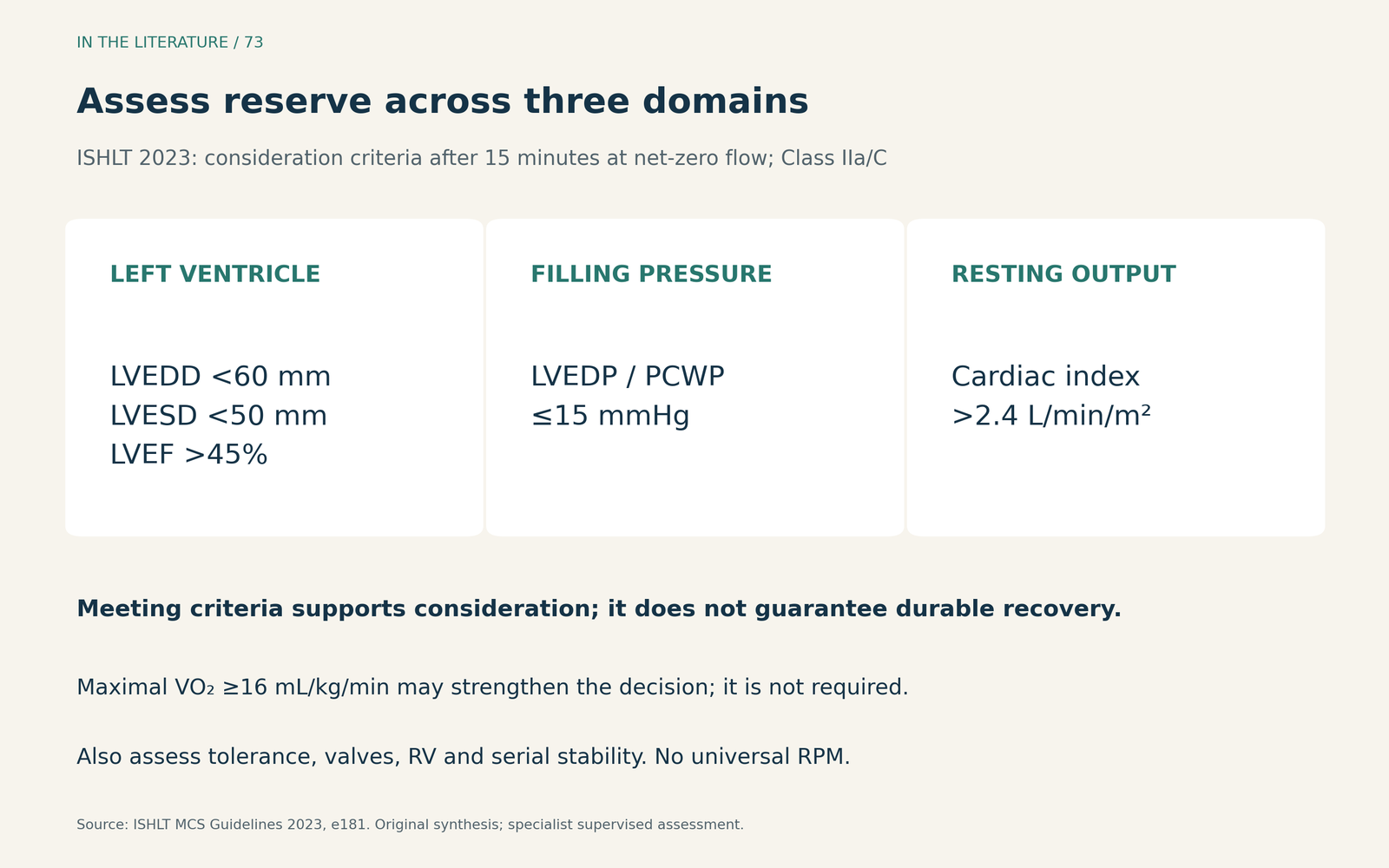
Figure 2. A combined assessment of reserve. The thresholds come from the ISHLT durable-MCS recovery recommendations, not from temporary-support weaning criteria. They require specialist testing and do not prescribe a universal RPM setting.[1] View larger.

This is a planned test with safeguards. ASE specifies adequate anticoagulation for low-speed studies. Its examination worksheet identifies aortic-root thrombus as a reason not to proceed with a speed change that could open the aortic valve, and deterioration or new device alarms as reasons to stop the examination. The testing conditions and stopping plan belong in the decision, just as the final LVEF does.[2]
Decide what withdrawal will leave behind
Explantation and decommissioning are not interchangeable descriptions. Complete explantation removes the system; partial explantation leaves selected components, while decommissioning stops support with hardware retained. The operation must therefore be discussed separately from the evidence that the heart can tolerate withdrawal.[5]
Nickel and colleagues' 2026 report follows the same RESTAGE-HF cohort, rather than providing an independent replication. The 19 deactivated patients included eight complete explants, ten partial explants and one percutaneous decommissioning; median follow-up was 7.9 years. Surgical approach was selected by the treating team. The small, nonrandom comparison cannot establish that one approach is superior or that the approaches are equivalent, and the older HMII experience does not directly predict HM3 outcomes.[5]
Clinically, readiness for withdrawal and selection of the procedure should remain two explicit decisions. The first depends on sustained native-heart reserve; the second includes operative burden and the implications of retained material. After either route, close follow-up at an LVAD center and ongoing heart-failure treatment remain part of the recovery strategy.[1], [5]
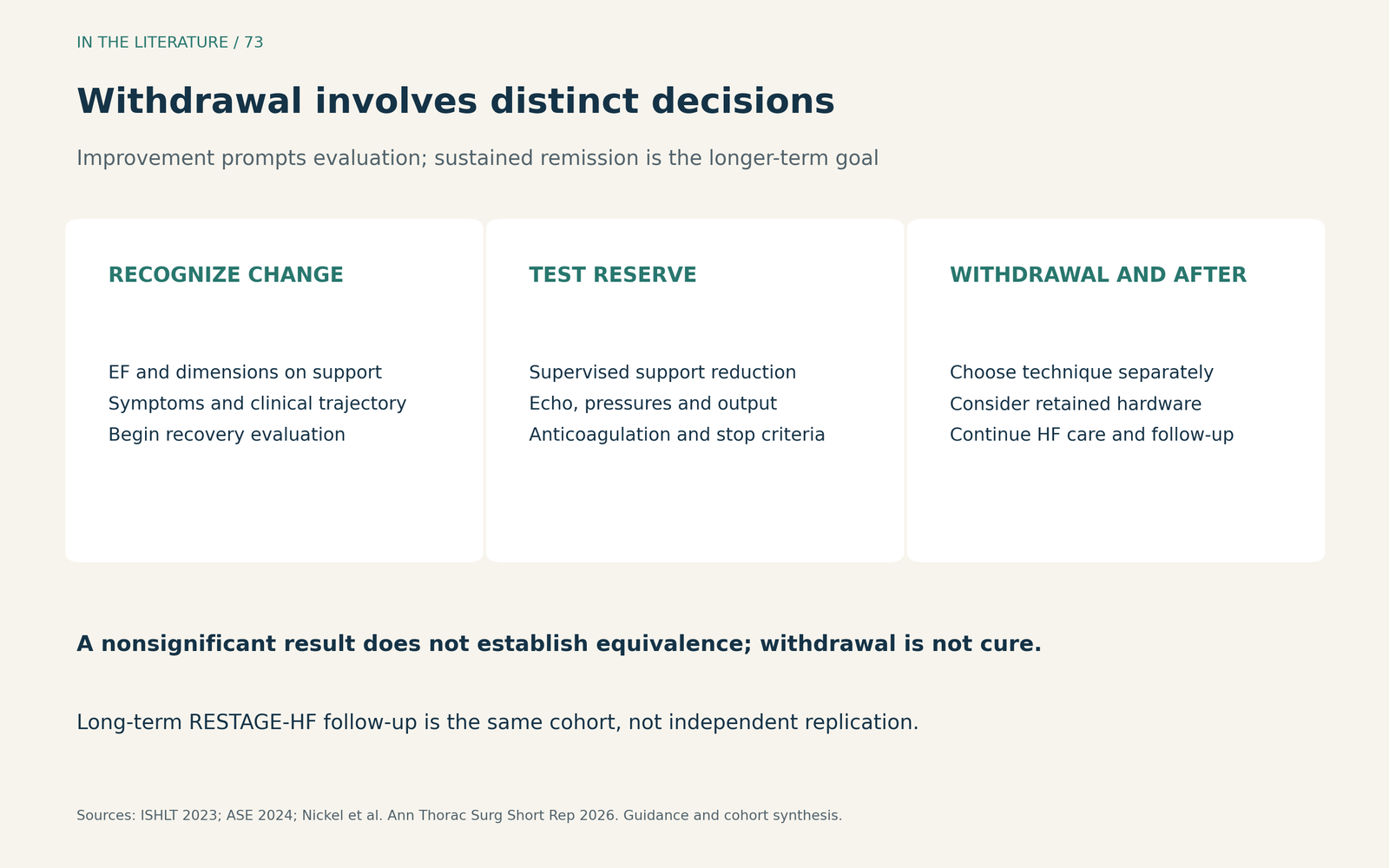
Figure 3. Keep the decisions distinct. Apparent improvement prompts assessment; adequate reserve supports a team discussion of withdrawal; successful withdrawal begins continued surveillance. This is a synthesis of guidance and observational evidence, not a validated prediction rule.[1], [2], [5] View larger.

Three takeaways
- Name the endpoint before quoting a recovery rate. Improved EF, meeting explant criteria, undergoing withdrawal and remaining free of recurrent advanced HF are different outcomes.
- Assess the native heart under the conditions relevant to withdrawal. Combine supervised reduced-support imaging, hemodynamics, clinical tolerance and serial stability; a single EF threshold is insufficient.
- Plan beyond the operation. Choose the withdrawal technique with the LVAD team, acknowledge the limited comparative evidence and continue HF therapy and surveillance afterward.[1], [2], [5]
References
- Saeed D, Feldman D, Banayosy AE, et al. The 2023 International Society for Heart and Lung Transplantation Guidelines for Mechanical Circulatory Support: A 10-Year Update. J Heart Lung Transplant. 2023;42(7):e1-e222. doi:10.1016/j.healun.2022.12.004
- Estep JD, Nicoara A, Cavalcante J, et al. Recommendations for Multimodality Imaging of Patients With Left Ventricular Assist Devices and Temporary Mechanical Support: Updated Recommendations from the American Society of Echocardiography. J Am Soc Echocardiogr. 2024;37(9):820-871. doi:10.1016/j.echo.2024.06.005
- Birks EJ, Drakos SG, Patel SR, et al. Prospective Multicenter Study of Myocardial Recovery Using Left Ventricular Assist Devices (RESTAGE-HF [Remission from Stage D Heart Failure]): Medium-Term and Primary End Point Results. Circulation. 2020;142(21):2016–2028. doi:10.1161/CIRCULATIONAHA.120.046415 Abstract only.
- Sener YZ, Jahangiri P, Veen K, et al. Left ventricular recovery and outcomes in patients with a durable left ventricular assist device: the EUROMACS registry. Eur Heart J. 2026:ehag477. doi:10.1093/eurheartj/ehag477
- Nickel I, Birks E, Li H, et al. Surgical Approaches to Left Ventricular Assist Device Deactivation: Lessons From Remission From Stage D Heart Failure. Ann Thorac Surg Short Rep. 2026;4(3):1023–1026. doi:10.1016/j.atssr.2026.02.001