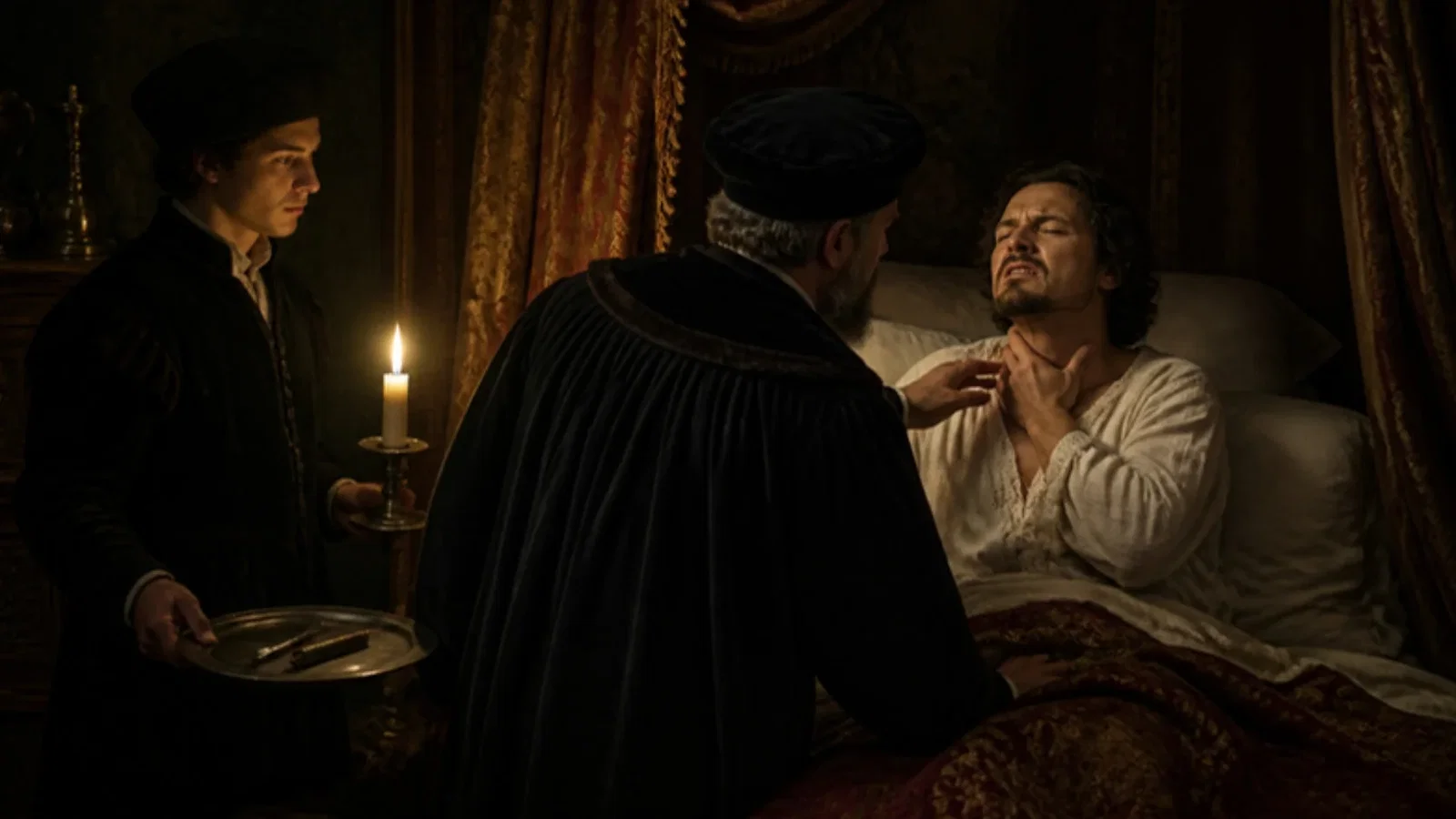
In a commentary printed in 1546, the Ferrara physician Brasavola wrote that when a throat abscess blocks the windpipe and all else has failed, the throat should be cut below it, and that he had done so himself and the patient recovered.
Reading Library · Anesthesia Epochs · 中文版
Watch the education video (for clinicians)
1546: Brasavola's Tracheotomy — Cut Below the Obstruction · Anesthesia Epochs Education Series
Opening the windpipe is one of the oldest operations in the medical books and, for a long time, one of the least performed. Ancient and medieval authors explained how it might be done; very few left a record of having done it. The commentary that the Ferrara physician Antonio Musa Brasavola published in 1546, on the Hippocratic and Galenic books on regimen in acute diseases, contains such a record in the author's own words. This article reads the discussion of the surgical treatment of angina in that book, pages 113 to 115, in the page images of a copy now in Rome, and then follows how the episode reached later histories. [1][2]
The book
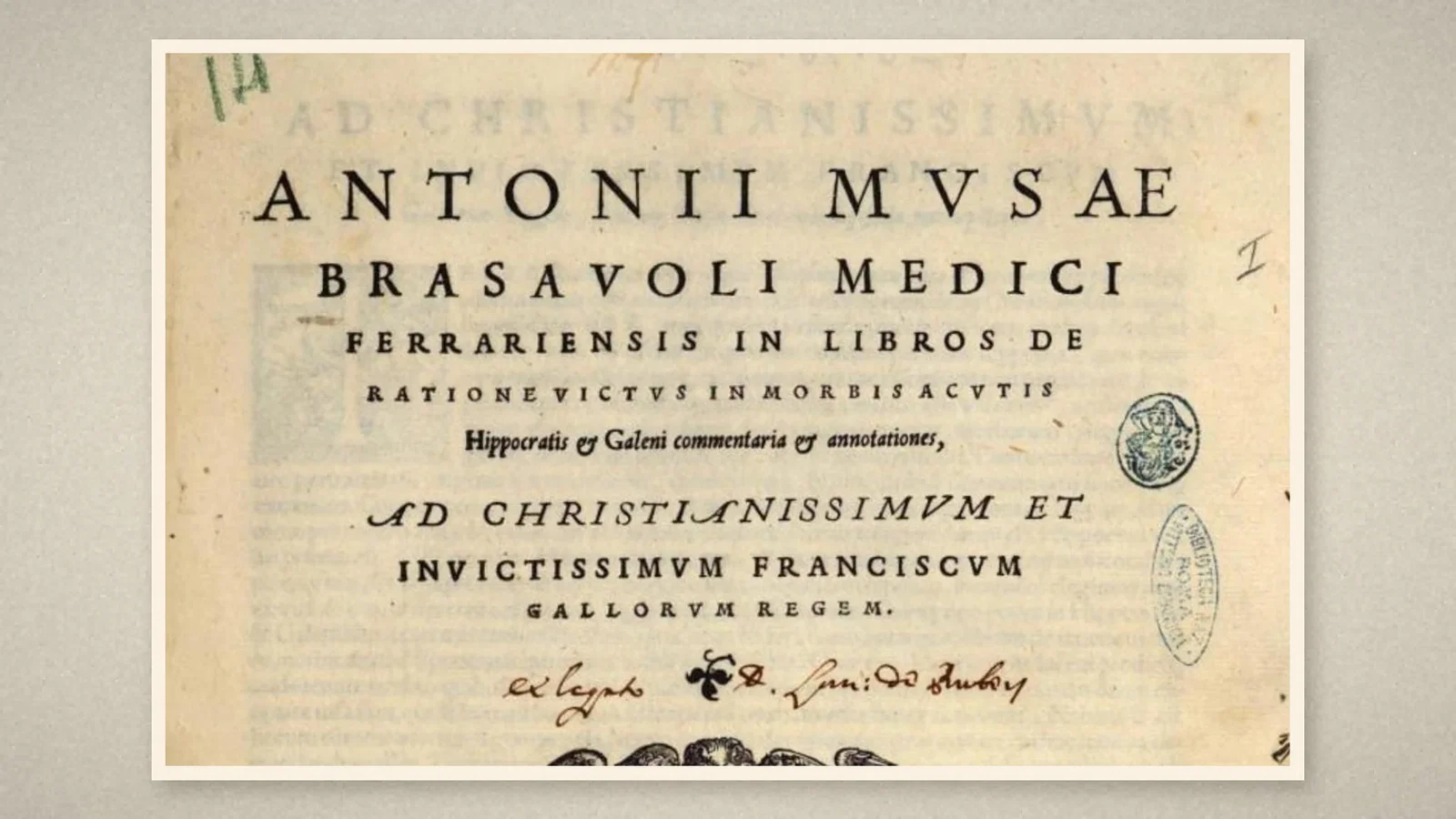
The title page announces the commentaries and annotations of "Antonius Musa Brasavolus, physician of Ferrara", on the books De ratione victus in morbis acutis of Hippocrates and Galen, and dedicates them to Francis, the "most Christian and unconquered" King of the French. The lower part of the title page is lost in this copy, so the printer and the year are taken from the library record, which gives Hieronymus Scotus and 1546. The passage on the windpipe comes in the comment on the fourth book, at the end of a long discussion of angina, the old name for a dangerous inflammation of the throat. Brasavola works through the usual remedies first: bleeding, cupping, scarifying the legs, feeding by enema when the patient cannot swallow. Only then does the text turn to the last resort. [1]
"With these hands"
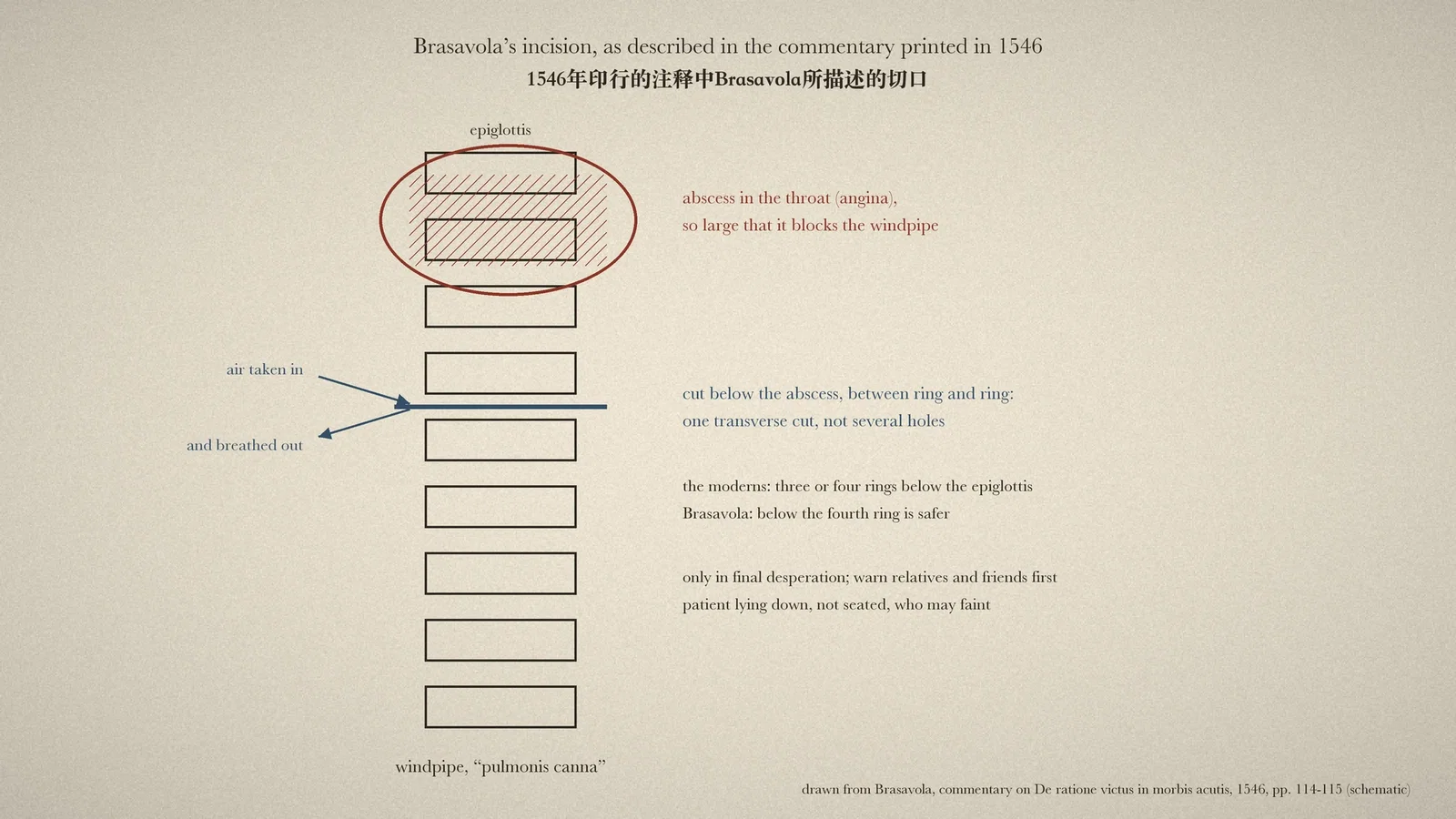
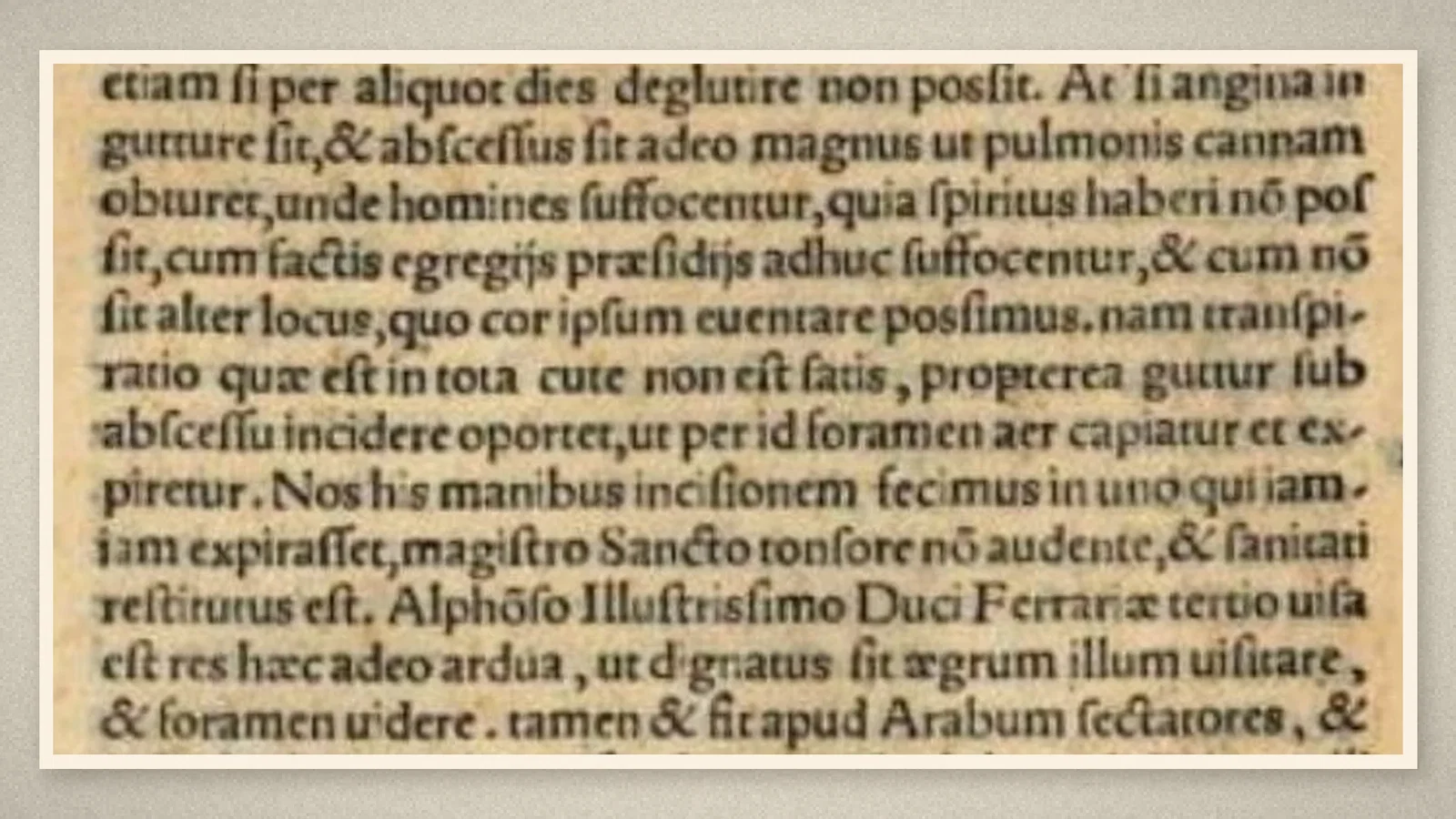
The key paragraph is on page 114. In this article's translation: "But if the angina is in the throat, and the abscess is so large that it blocks the windpipe" (literally "the pipe of the lung"), "so that people suffocate because breath cannot be had, and if after excellent remedies have been tried they are still suffocating, and there is no other place through which we can ventilate the heart itself", since breathing through the skin is not enough, "then the throat must be cut below the abscess, so that through that opening air may be taken in and breathed out." [1]
The next sentence is the reason this book matters: "We made the incision with these hands in one who was on the point of expiring, the barber, Master Sancto, not daring; and the patient was restored to health." The thing seemed so remarkable to Alfonso, "third Duke of Ferrara", the text goes on, that the duke came to visit the patient and to see the opening. The commentary does not say when this happened, how old the patient was, or where exactly the abscess lay. [1]
Old authorities, old fears
Brasavola did not present the operation as new. The text says it was done among the followers of the Arabs and was known to the Greeks: Paul of Aegina gives it, with the method of cutting "according to Antyllus"; Rhazes teaches the incision; Avicenna says to cut when everything else has failed. Albucasis, the text adds, did not deny that it should be done but reported that no one practised it, because physicians were "inexperienced, fearful, dreading danger and disgrace". [1]
The commentary then answers the objections one by one. The operation is dangerous: so it is done only "in final desperation", after a good physician has tried every other remedy, and with a warning first, for "relatives and friends must be told" that the patient is dying and that nothing else remains; if they agree, it should be done boldly, and if not, the patient is left to rest in peace. Cut cartilage cannot heal: but between ring and ring there is muscle, through which the wound can close, and "we have seen several restored to health by this incision who were quite lost". Blood will run down into the lung: the bleeding is small, the place is not fleshy, and the opening need only be large enough to let air pass. As further evidence the text offers animals that are hanged, which do not suffocate if the windpipe is opened before they are fully strangled, and a prisoner who had tended the duke's oxen: facing torture, the man cut into the throat with an iron plate torn from a cuirass, through five rings, and still recovered. [1]
How to cut
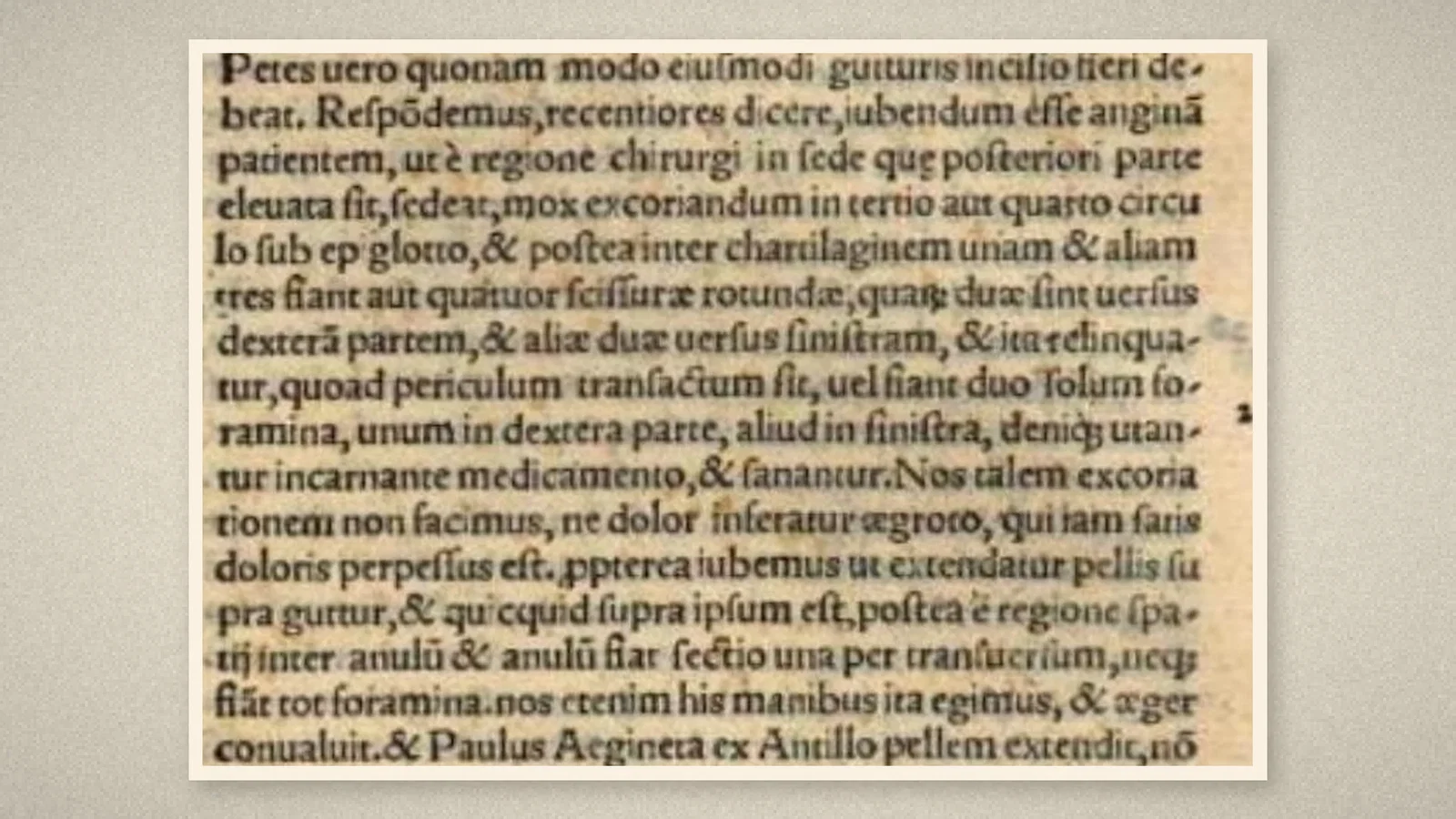
On page 115 Brasavola compares methods. "The moderns", the text reports, seat the patient facing the surgeon, flay the skin at the third or fourth ring below the epiglottis, and make three or four round openings between the cartilages, or two holes. Brasavola rejected the flaying, to spare a patient already in great pain: the skin over the throat is to be stretched, and "one cut made across, in the space between ring and ring, and not so many openings. For we did it so with these hands, and the patient recovered." Because the abscess cannot be seen, the text advises opening lower, below the fourth ring, since a cut made too high would have to be repeated; and the patient should lie rather than sit, because people who are seated "easily fall into a faint". When the cut reached the abscess, the text adds, pus came out, and a patient who for some hours could not utter a word began to speak. [1]
The paragraph ends with a summary: in angina, "in final desperation, the throat should rather be cut than the patient left to suffocate without help." Brasavola was less sure of another idea, Avicenna's cannula of gold or silver placed in the throat to help breathing, and wrote that Avicenna must forgive the doubt. [1]
How the story travelled
Later histories repeated the episode at second or third hand. Jonathan Wright's History of Laryngology and Rhinology of 1914 says that the opening of the air tube was described by many writers but "apparently practised by none whose records have reached us until the time of Brasavola", that Casserius credited Brasavola with several such operations, the first "according to Sanne" in 1546, and it quotes the key sentence through Gordon Holmes. The 2024 timeline of the Australian Society of Anaesthetists lists 1546 as the first recorded successful tracheostomy, for a peritonsillar abscess. The book itself is both more modest and more specific: 1546 is the year it was printed, not a date for the operation; the abscess is "in the throat", not more exactly placed; and the author cites a long line of predecessors rather than claiming to be first. [2][3]
What the record shows
The reasoning in this passage is still the reasoning of a surgical airway: when the obstruction is above, open the airway below it; do so when nothing else will work, not before; make the opening small and in the right place; and say plainly to the family what is being attempted. Brasavola's account adds something rarer in its century, a first-person statement that it was done and that the patient lived.
Sources and reading limits
Read: Brasavola's commentary of 1546 on the surgical treatment of angina, pp. 113-115, in the Biblioteca Nazionale Centrale di Roma copy digitized by Google, with the title page; Wright's history of 1914, pp. 130 and 156; the 2024 ASA timeline entries.
Not covered: Sanne, Casserius and Holmes, through whom Wright reports the episode; the texts of Paul of Aegina, Rhazes, Avicenna and Albucasis that Brasavola cites; the later tracheotomies the timeline lists alongside. The printer and year come from the library record because the imprint is lost in this copy. The date and details of the operation are not given in the text and are not supplied here. Translations from the Latin are this article's own.
Three illustrations are page crops from the 1546 book; one is drawn from it.
- Brasavola AM. In libros de ratione victus in morbis acutis Hippocratis & Galeni commentaria & annotationes. Hieronymus Scotus; 1546. Comment on book IV, pp. 113-115. Internet Archive
- Wright J. A history of laryngology and rhinology. 2nd ed. Philadelphia: Lea & Febiger; 1914. pp. 130, 156. Internet Archive
- Australian Society of Anaesthetists. Anaesthesia history timeline. 2024. ASA
Continue exploring
Related reading connects shared questions and contexts; it does not by itself establish historical influence.
Anesthesia Epochs · The Source Room · About & Editorial Method
Published November 2, 2026. Sources and reading limits are stated above. Illustrations are labelled as original source images or AI-made. Historical accounts are educational; they are not current treatment instructions.