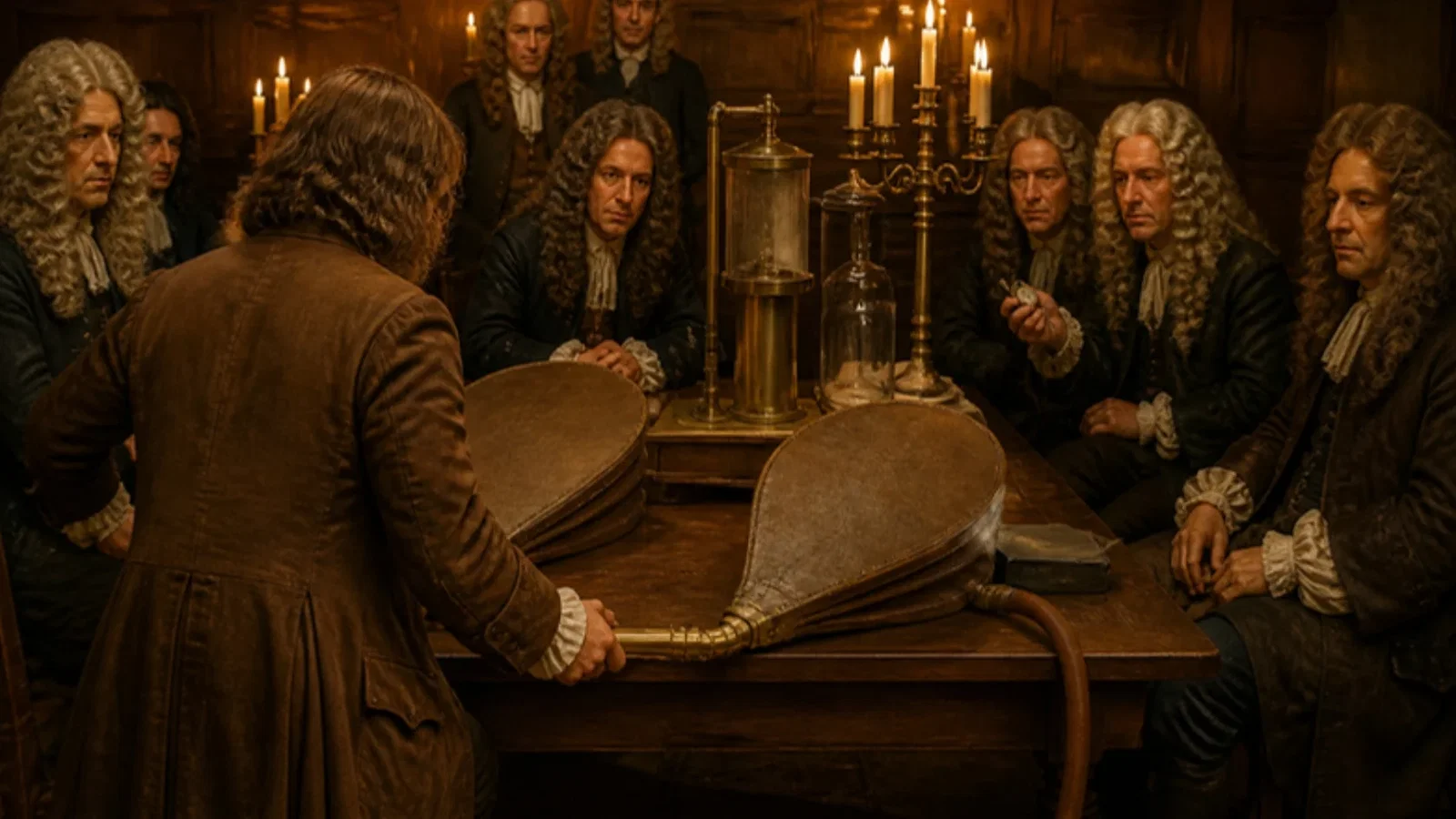
Following Vesalius's 1543 advice to blow into the trachea, Hooke used bellows in 1667 to show the Royal Society that fresh air, not lung movement, sustains life.
Reading Library · Anesthesia Epochs · 中文版
Watch the education video (for clinicians)
1543–1667: The First Ventilation Experiments — Vesalius and Hooke · Anesthesia Epochs Education Series
Every ventilator rests on an idea that is easy to state and was once hard to prove: that a body can be kept alive by pushing air into its lungs from outside, and that what matters is the fresh air, not the heaving of the chest. Two old texts mark the path. At the close of the great anatomy of 1543, Andreas Vesalius told dissectors how to revive an animal whose chest had been opened: make an opening in the trachea, slip in a reed, and blow. On 24 October 1667 Robert Hooke described to the Royal Society how a dog, its chest laid open, had been kept alive for more than an hour with bellows, and then went a step further to ask what, exactly, was keeping it alive. This article reads Hooke's two-page account in full and the Vesalius passage in Latin and in English translation. [1][2][3]
A reed in the trachea, 1543
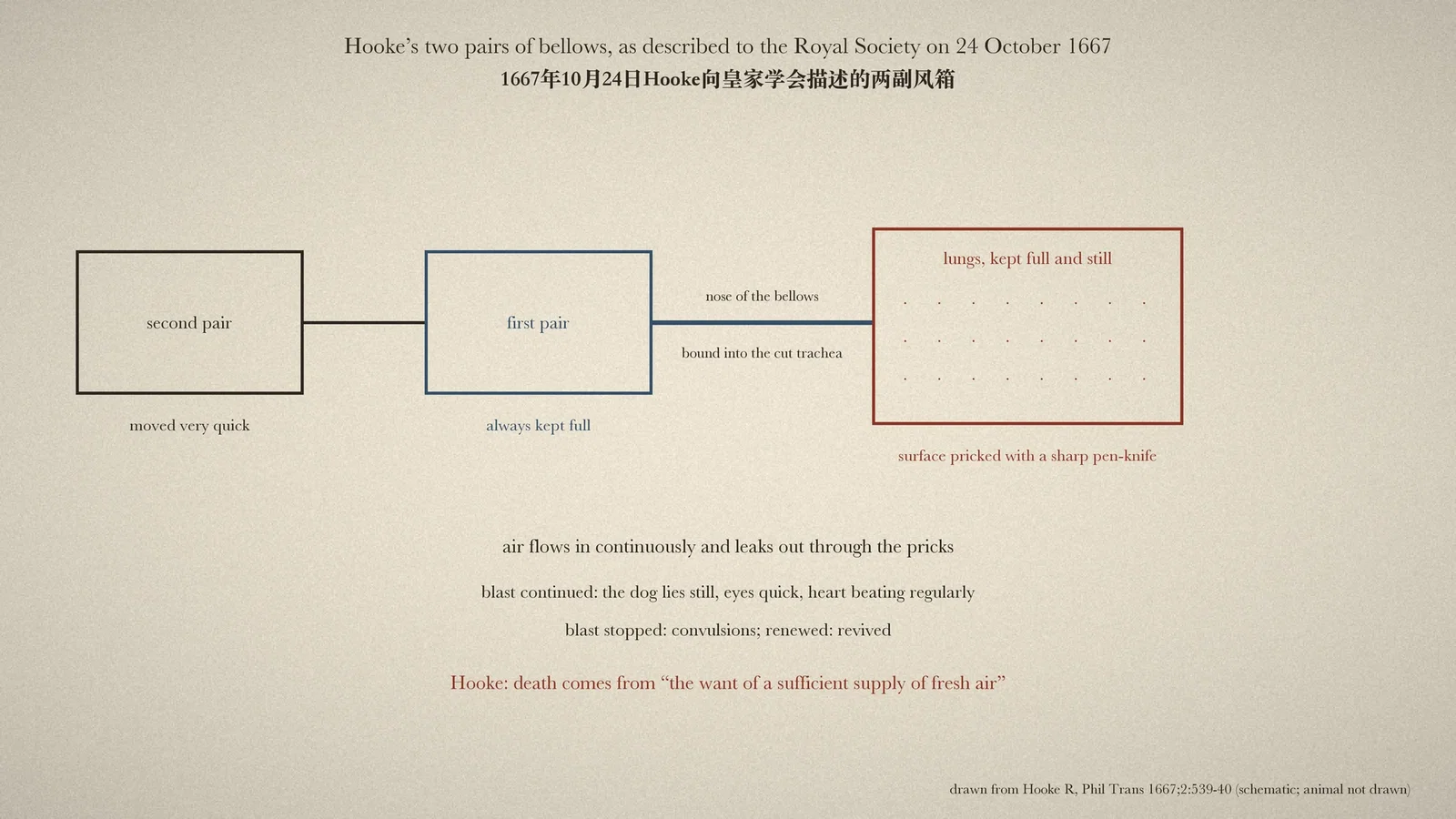
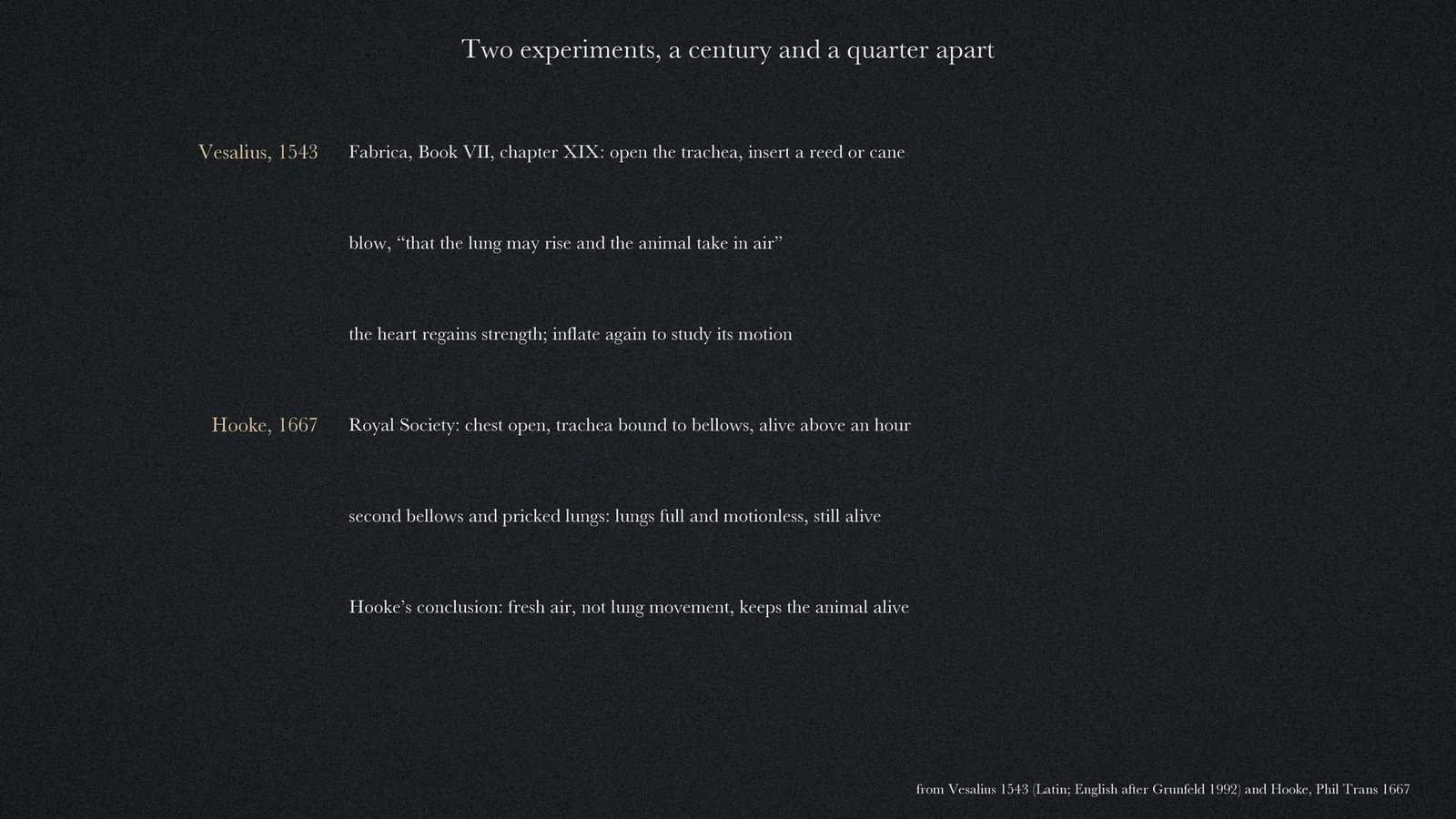
The passage comes near the end of the seventh and last book of De humani corporis fabrica, in chapter XIX, which deals with the dissection of living animals. In the copy scanned from the National Library of Medicine, the page carries the printed number 658, which a later hand has struck out and corrected to 662. In Gershon B. Grunfeld's English, the Latin says that "that life may in a manner of speaking be restored to the animal, an opening must be attempted in the trunk of the trachea, into which a tube of reed or cane should be put; you will then blow into this, so that the lung may rise again and the animal take in air." With a slight breath, the passage goes on, the lung swells to fill the chest and the heart grows strong and shows "a wondrous variety of motions"; inflating the lung once and again, the anatomist can examine the motion of the heart "by sight and touch" for as long as needed. Vesalius wrote as a teacher showing students the beating heart, not as a physician resuscitating anyone, and the Latin adds that the author had found no artifice in anatomy more pleasing, and that by it much could be learned about the differences of the pulse. [2][3]
The account of 1667
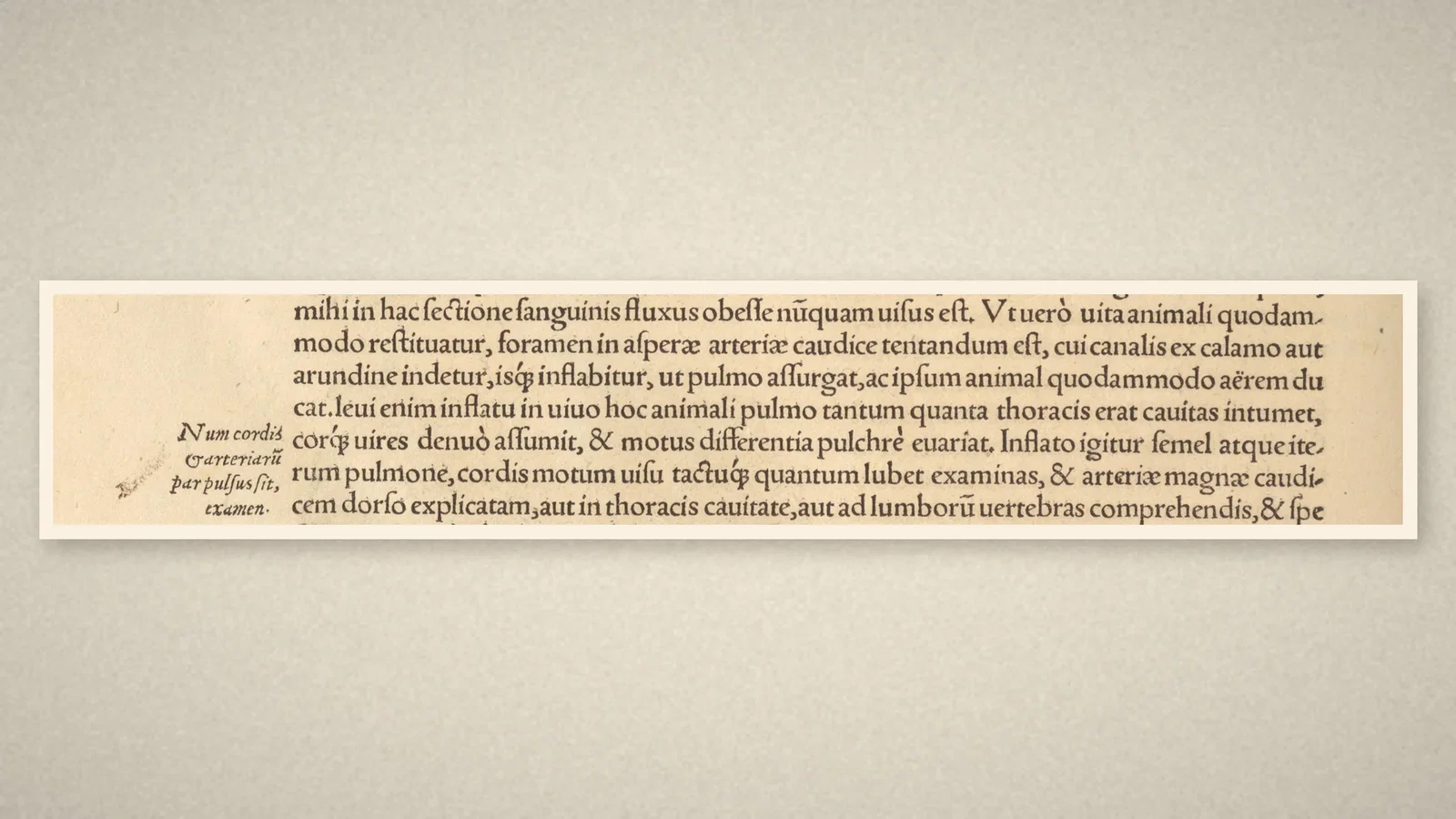
Hooke's report appears in the Philosophical Transactions for 1667, on pages 539 and 540, under the title "An Account Of an Experiment made by Mr. Hook, of Preserving Animals alive by Blowing through their Lungs with Bellows". A note from the publisher explains that it came in after the rest of the issue had gone to press, and that it is printed in the author's own words as presented to the Royal Society on 24 October 1667, the experiment having been repeated and improved "the week before" at the Society's public assembly. [1]
Hooke begins by recalling an earlier report to the Society: a dog had been kept alive after the thorax was laid open "by the cutting away of the Ribs and Diaphragme" and the pericardium removed. Some people doubted it, because trials "made by some other hands" had failed. So the experiment was shown again before the Society, with the same success. The dog was kept alive for an hour or more by the "Reciprocal blowing up" of its lungs with bellows, the lungs being allowed to subside between blasts, after the windpipe had been cut and bound "upon the nose of the Bellows". [1]
The motion, or the air?
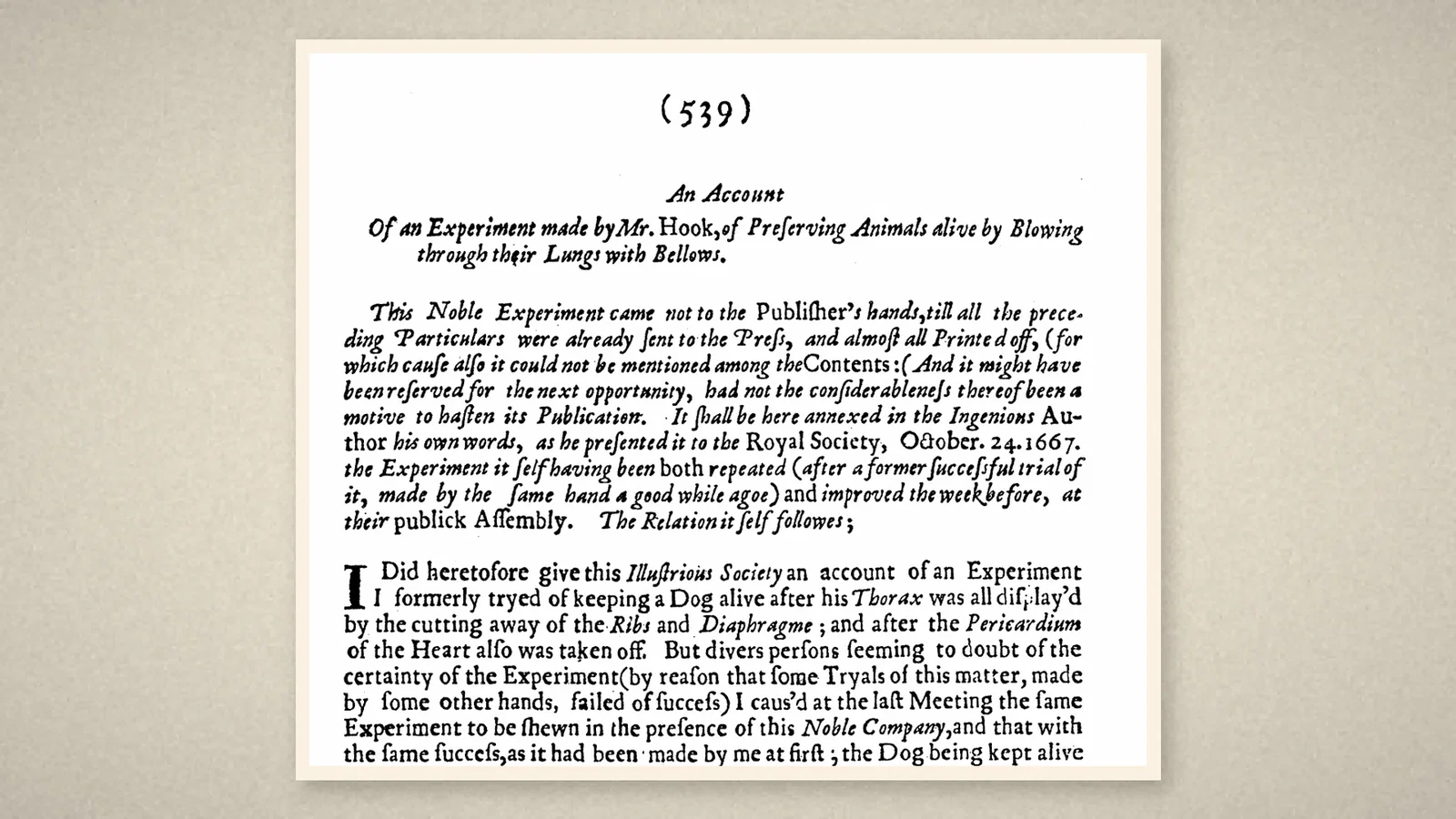
Some "Eminent Physicians", Hooke wrote, had held that the motion of the lungs was necessary to life because it promoted the circulation of the blood, and that an animal would suffocate as soon as its lungs stopped moving. To test this, Hooke had a second pair of bellows joined to the first "by a contrivance" prepared beforehand, and pricked the whole outer coat of the lungs with the point of a very sharp pen-knife. The second pair was worked very quickly, so that the first pair was always full and always blowing. Air streamed into the lungs and out through the small holes, and the lungs stayed "very full, and without any motion". The dog lay still, its eyes quick and its heart beating very regularly. When the blast stopped and the lungs fell still, it went at once into "Dying convulsive fits"; renewing the blast revived it. Near the end a piece of lung was cut off, and the blood was seen to pass freely through the lungs both when they were held extended and when they were allowed to subside. [1]
Hooke's conclusion was carefully worded. It was not the stillness of the lungs, nor any stopping of the circulation through them, that was "the immediate cause of Death", but "the want of a sufficient supply of fresh Air". The account ends with plans: to try whether blood exposed to fresh air in a vessel might suffice for the life of an animal, to make other experiments that might discover "the Genuine use of Respiration", and afterwards to consider what benefit this might be "to Mankind". [1]
What the record shows
Read together, the two texts show a change of purpose. Vesalius used a reed and a breath to make the heart visible to students; Hooke used bellows to put a question about breathing and answer it by changing one thing at a time. Neither was treating a patient, and neither would recognize the word ventilation in its modern sense. But the arrangement Hooke described, a tube tied into the trachea, an outside source that drives air in, and an animal that lives only as long as fresh air keeps coming, is recognizably the arrangement behind intermittent positive-pressure ventilation, and the timeline of the Australian Society of Anaesthetists cites Hooke for that. These were experiments on living animals; the article reports them without endorsing them.
Sources and reading limits
Read: Hooke's account in the Philosophical Transactions of 1667 (pp. 539-40) in full; the Latin passage in Book VII, chapter XIX, of the 1543 Fabrica in two scanned copies (National Library of Medicine and BIU Santé); Grunfeld's 1992 English translation of that passage, checked against the Latin; the 2024 ASA timeline entries.
Not covered: Galen's account of inflating animal lungs, which the timeline also lists; the date of Hooke's earlier trial, which the account calls "a good while agoe" without a date; later work by others. The timeline dates this topic to 1666; the printed account dates the presentation to 24 October 1667, and the article uses that date. The English of Vesalius is Grunfeld's; Hooke's words are quoted with the long s modernized.
Two illustrations are page crops from the 1543 and 1667 sources; two are drawn from them.
- Hooke R. An account of an experiment made by Mr. Hook, of preserving animals alive by blowing through their lungs with bellows. Phil Trans R Soc Lond. 1667;2:539-40. Internet Archive
- Vesalius A. De humani corporis fabrica libri septem. Basel: Oporinus; 1543. Lib. VII, cap. XIX. Internet Archive, NLM copy; Internet Archive, BIU Santé copy
- Grunfeld GB. Modern medicine and the emergence of biomedical ethics. Caduceus. 1992;8(1). Internet Archive
- Australian Society of Anaesthetists. Anaesthesia history timeline. 2024. ASA
Continue exploring
Related reading connects shared questions and contexts; it does not by itself establish historical influence.
Anesthesia Epochs · The Source Room · About & Editorial Method
Published November 2, 2026. Sources and reading limits are stated above. Illustrations are labelled as original source images or AI-made. Historical accounts are educational; they are not current treatment instructions.