
Pugh's 1754 midwifery treatise described passing a coiled-wire air-pipe towards a breech baby's larynx before the head was born, and mouth-to-mouth inflation if needed.
Reading Library · Anesthesia Epochs · 中文版
Watch the education video (for clinicians)
1754: Pugh's Air-Pipe — Air Before the Head Is Born · Anesthesia Epochs Education Series
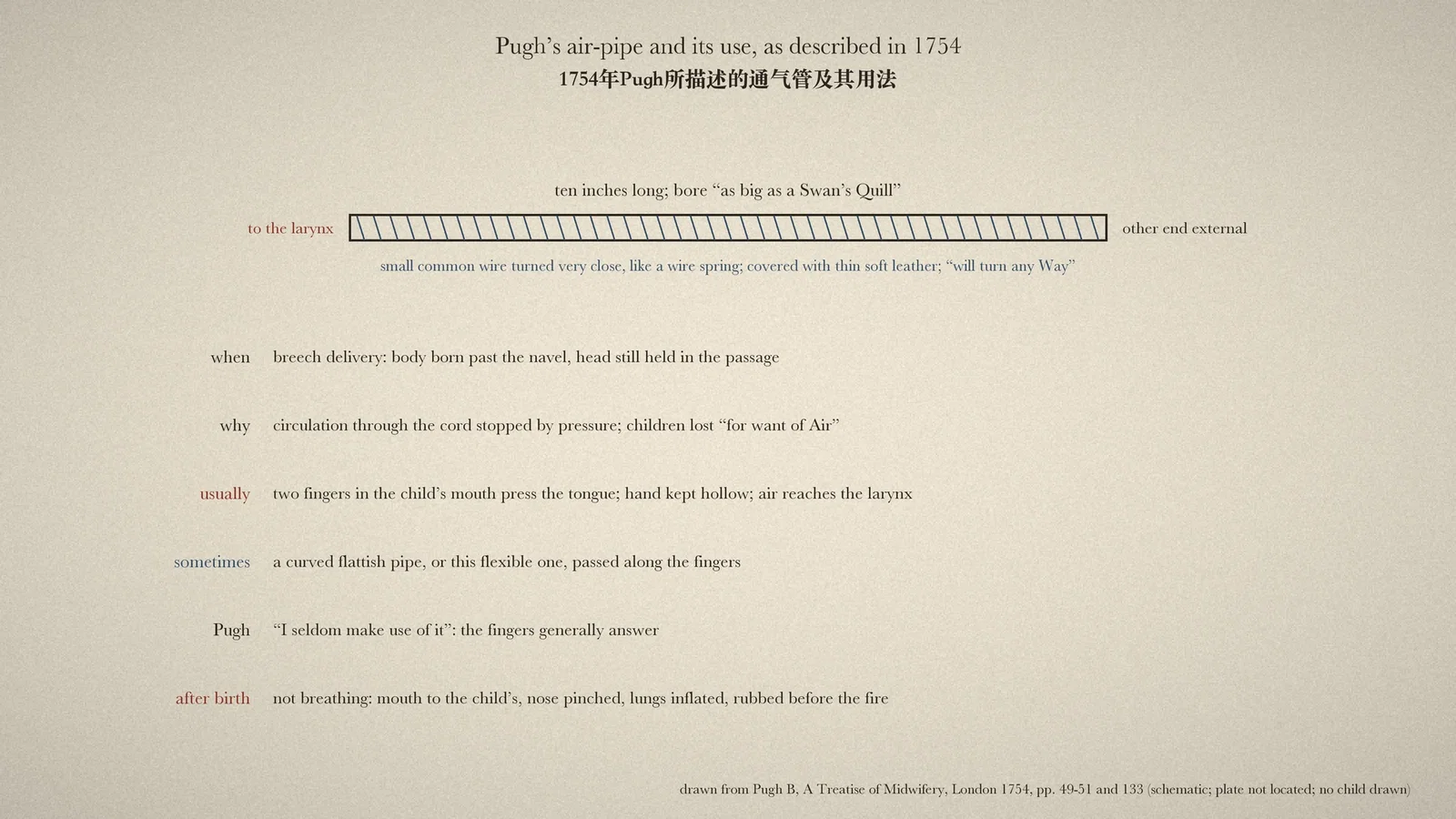
Neonatal resuscitation teaching begins with the airway and with breaths, and it is tempting to look for the first neonatal "tube". The timeline of the Australian Society of Anaesthetists finds one in 1754: an "air pipe" of coiled wire and leather described by Benjamin Pugh, a surgeon at Chelmsford in Essex, which it calls an early endotracheal tube for neonatal resuscitation. This article reads Pugh's book itself, to see when the pipe was used, what Pugh usually did instead, and what Pugh did for a child that did not breathe after birth. [1][2]
The book
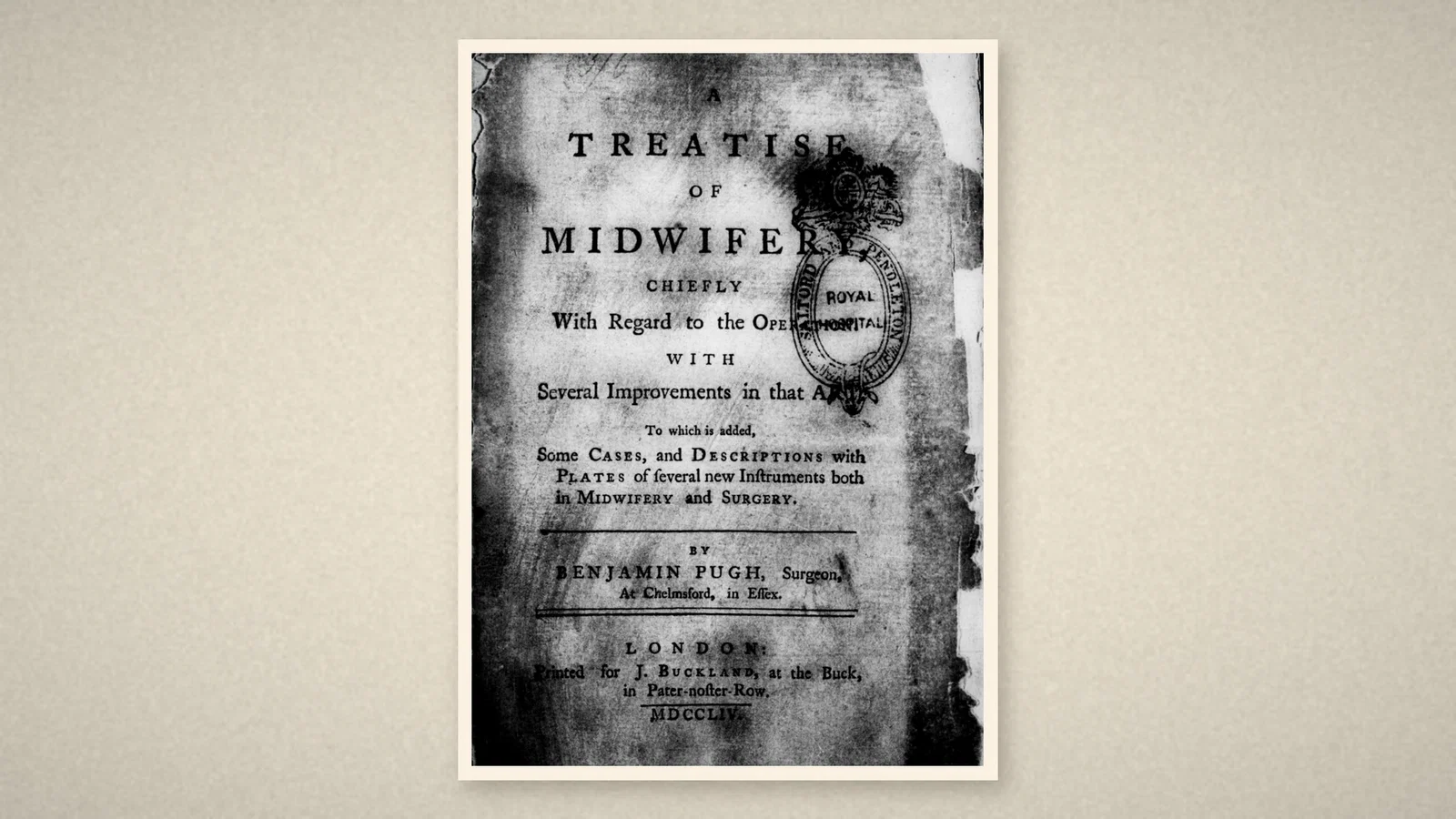
A Treatise of Midwifery, chiefly with regard to the Operation was printed in London for J. Buckland in 1754. Its title page promises "several improvements in that art" and descriptions with plates "of several new instruments both in midwifery and surgery", and names the author as "Benjamin Pugh, Surgeon, at Chelmsford, in Essex". In the preface Pugh writes of more than fourteen years of practice and of having delivered upwards of two thousand women. [1]
The problem: the after-coming head
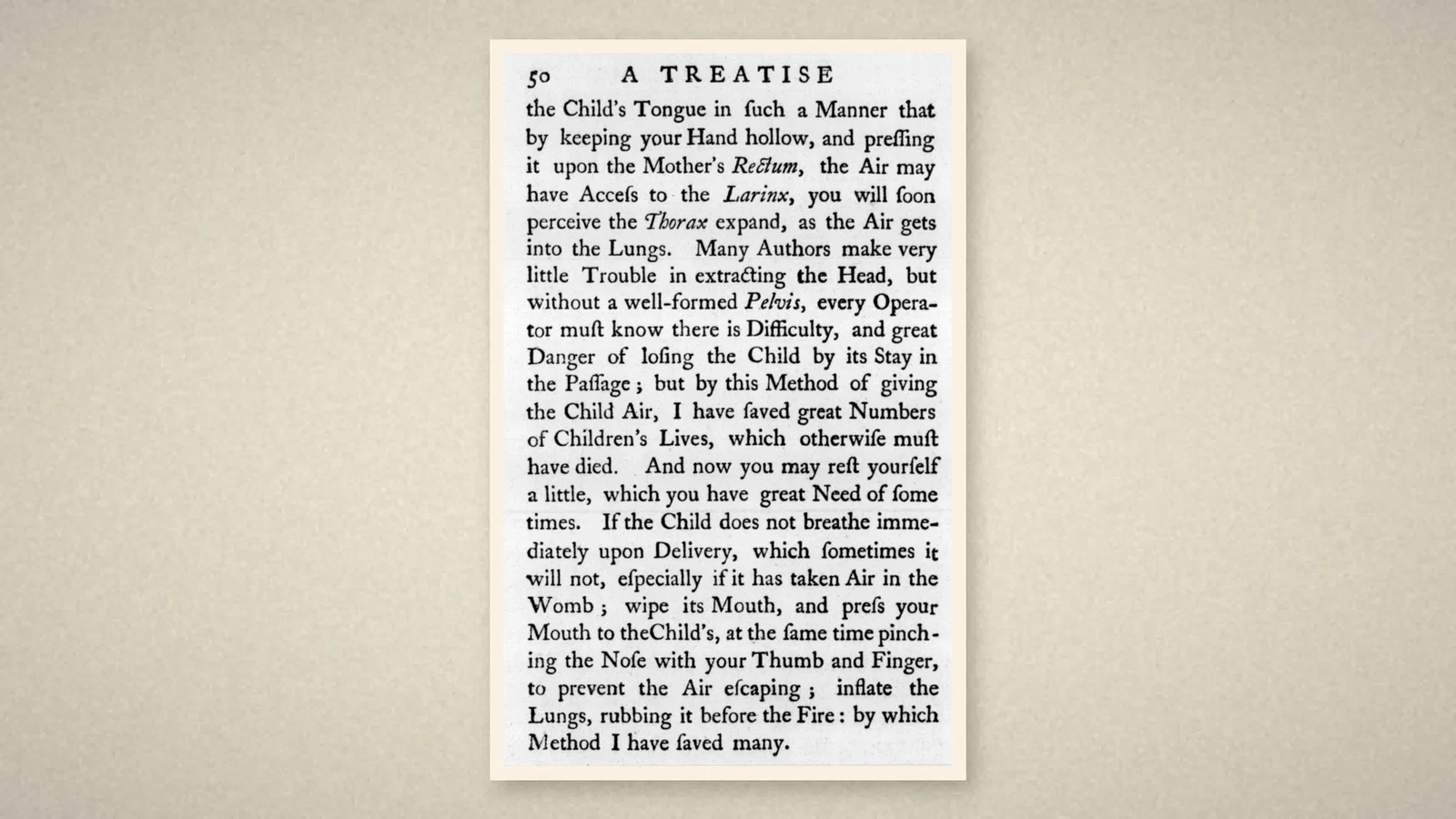
The passage that matters is in the account of breech delivery, on pages 49 to 51. Once the child "has passed the Navel", Pugh explains, the circulation between it and the mother is stopped by pressure on the umbilical cord, while the head is still held in the passage. Pugh's answer was to put two fingers of the left hand far into the child's mouth, press down the tongue, and keep the hand hollow so that "the Air may have Access to the Larinx"; then "you will soon perceive the Thorax expand, as the Air gets into the Lungs". Without a well-formed pelvis, Pugh warned, there is "great Danger of losing the Child by its Stay in the Passage; but by this Method of giving the Child Air, I have saved great Numbers of Children's Lives, which otherwise must have died." [1]
The pipe
Pugh then explains how the idea arose. Before using this method, "many Children were lost in this Situation, for want of Air", and this led to two inventions and a third, "a curve flattish Pipe, as likewise a flexible one, that I introduced into the Child's Mouth, as near to the Larinx as I could, the other End external, which I found answer; but now, as I find my Fingers will generally answer, I seldom make use of it." [1]
The flexible pipe is described among the explanations of the plates on page 133: "The Air-Pipe, as big as a Swan's Quill in the Inside, ten Inches long, is made of a small common Wire, turned very close (in the Manner Wire-Springs are made) will turn any Way; and covered with thin soft Leather, one End is introduced up the Palm of the Hand, and between the Fingers that are in the Child's Mouth, as far as the Larynx, the other End external." [1]
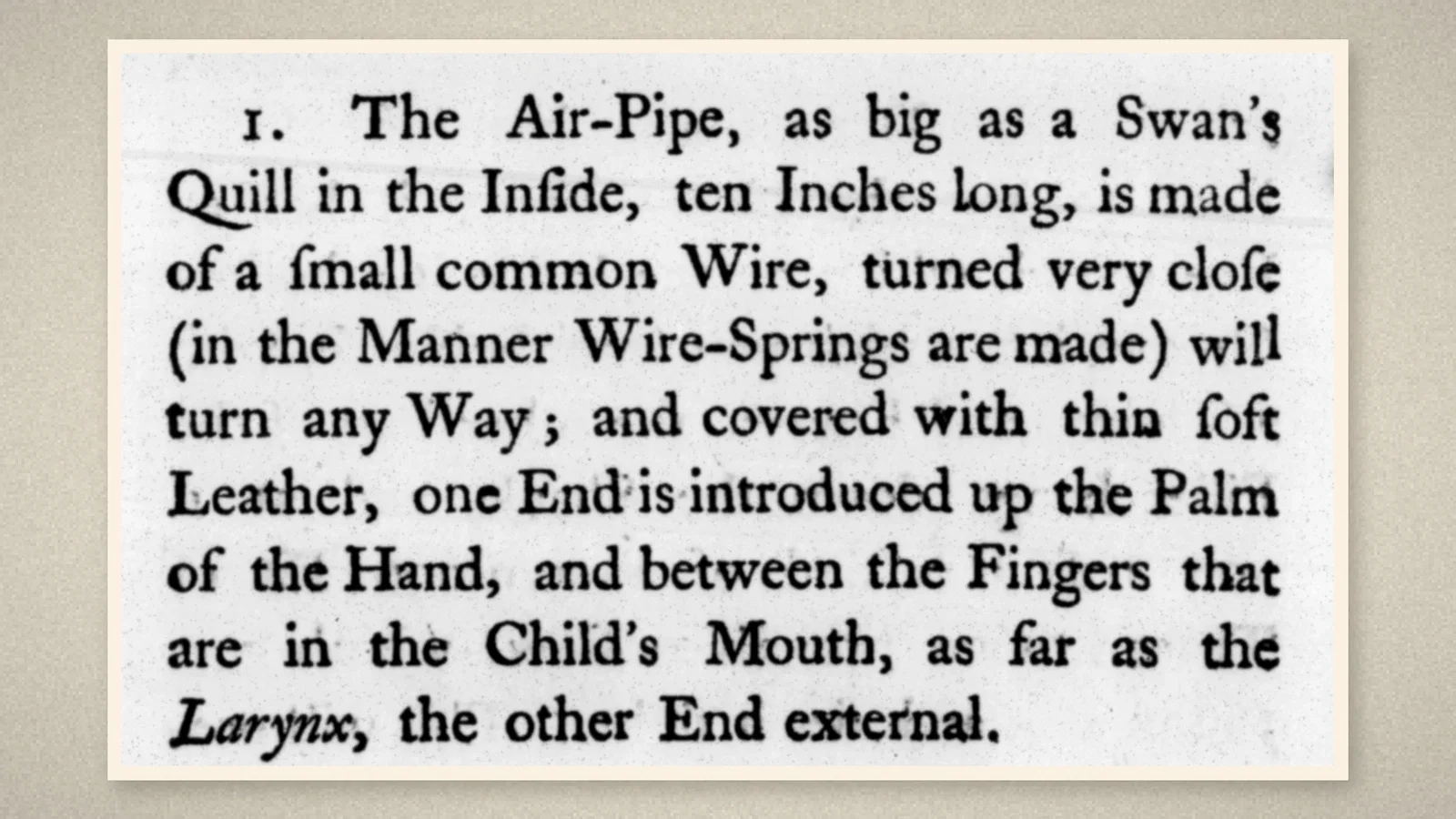
So the pipe was a way of opening an air passage to a baby's larynx inside the birth canal, during a breech delivery, guided by the fingers. Whether its tip ever went into the trachea the text does not say; "as far as the Larynx" and "as near to the Larinx as I could" are Pugh's own limits. By the time of the book, Pugh rarely used it at all.
After birth: mouth to mouth
On page 50 Pugh adds a second instruction, for a child that does not breathe immediately after delivery, "which sometimes it will not, especially if it has taken Air in the Womb": "wipe its Mouth, and press your Mouth to the Child's, at the same time pinching the Nose with your Thumb and Finger, to prevent the Air escaping; inflate the Lungs, rubbing it before the Fire: by which Method I have saved many." [1]
What the record shows
Pugh's text contains three ideas that still shape care at birth: that a baby can be starved of air while still partly in the birth canal, that the airway can be held open by displacing the tongue, and that a newborn who does not breathe can have the lungs inflated by the rescuer's own breath, with the nose sealed. The coiled-wire pipe is a striking object, but in Pugh's own account it was an occasional aid, superseded by two fingers.
Sources and reading limits
Read: Pugh's Treatise of Midwifery (London, 1754), title page, preface, pp. 49-52 and pp. 133-134; the 2024 ASA timeline entry.
Not covered: the engraved plate of the air-pipe, which was not located in this scan, so the illustration here is drawn from the text only; later neonatal airway devices, such as Chaussier's; secondary studies. The article does not call the pipe an endotracheal tube.
Three illustrations are page crops from the 1754 book; one is drawn from it.
- Pugh B. A treatise of midwifery, chiefly with regard to the operation. With several improvements in that art. London: J. Buckland; 1754. pp. 49-51, 133. Internet Archive
- Australian Society of Anaesthetists. Anaesthesia history timeline. 2024. ASA
Continue exploring
Related reading connects shared questions and contexts; it does not by itself establish historical influence.
Anesthesia Epochs · The Source Room · About & Editorial Method
Published November 2, 2026. Sources and reading limits are stated above. Illustrations are labelled as original source images or AI-made. Historical accounts are educational; they are not current treatment instructions.