Marshall Hall argued that lying supine lets the tongue and epiglottis close the glottis, so a drowned patient should be laid prone and then rolled to the side.
Reading Library · Anesthesia Epochs · 中文版
Watch the education video (for clinicians)
1856: Marshall Hall's Ready Method — Turning the Drowned · Anesthesia Epochs Education Series
Every resuscitation course teaches that an unconscious patient lying on the back can obstruct the airway with the tongue. One of the clearest early statements of that problem, and of a remedy for it, is in a pamphlet that the London physician Marshall Hall presented to the Royal Humane Society in January 1856. This article reads it. [1][2]
The pamphlet
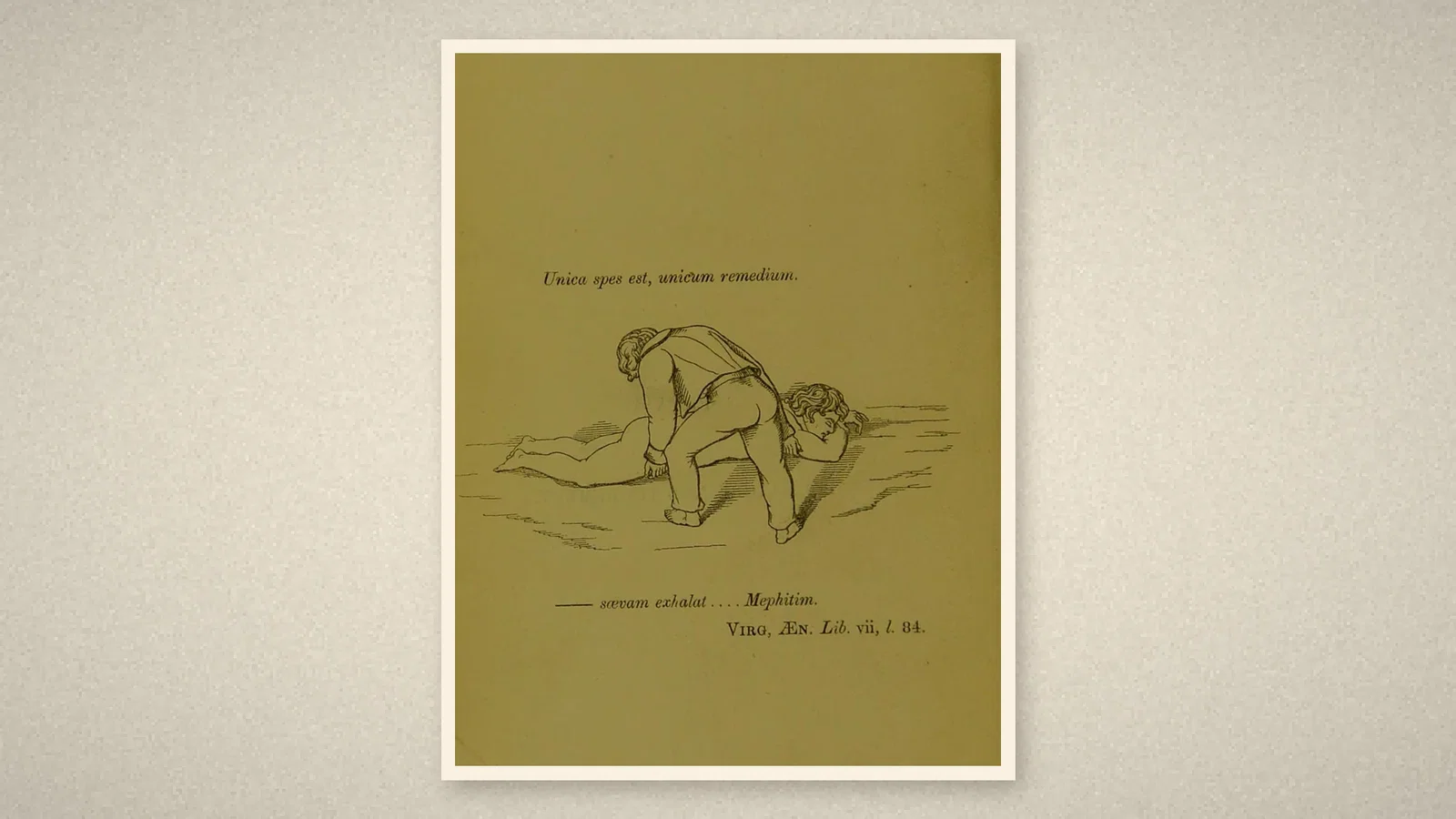
Abstract of an Investigation into Asphyxia; its Nature, Carbonic Acid Blood-Poisoning, and its Remedy, Prone and Postural Respiration was printed in London by Joseph Mallett and dated January 1856. It is "presented to the Royal Humane Society" and dedicated to the memory of Dr Hawes, the Society's founder. Its frontispiece shows the method: a person kneeling astride a body laid face down, pressing on the back, with the motto "Unica spes est, unicum remedium", the one hope, the one remedy. [1]
What goes wrong on the back
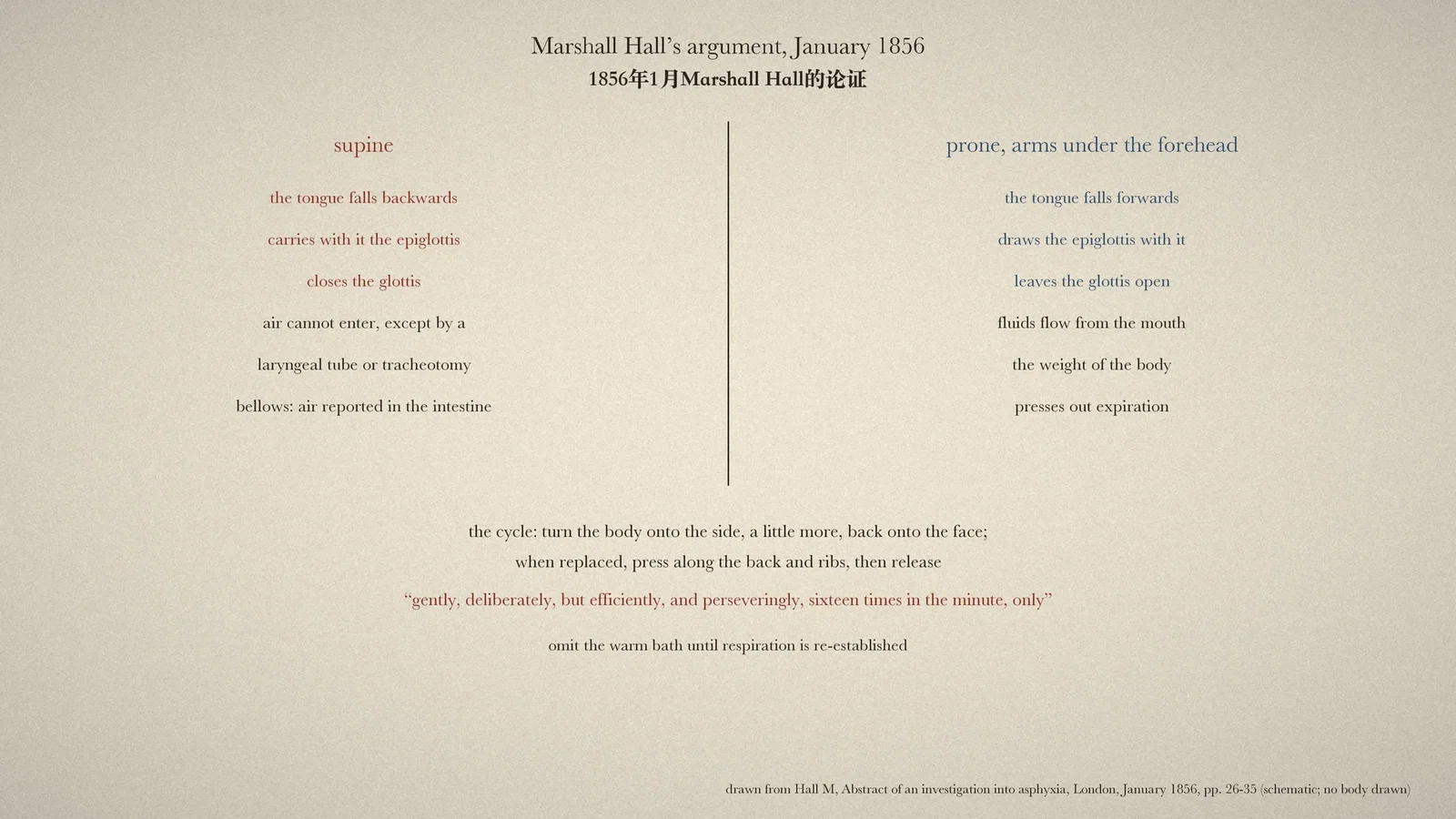
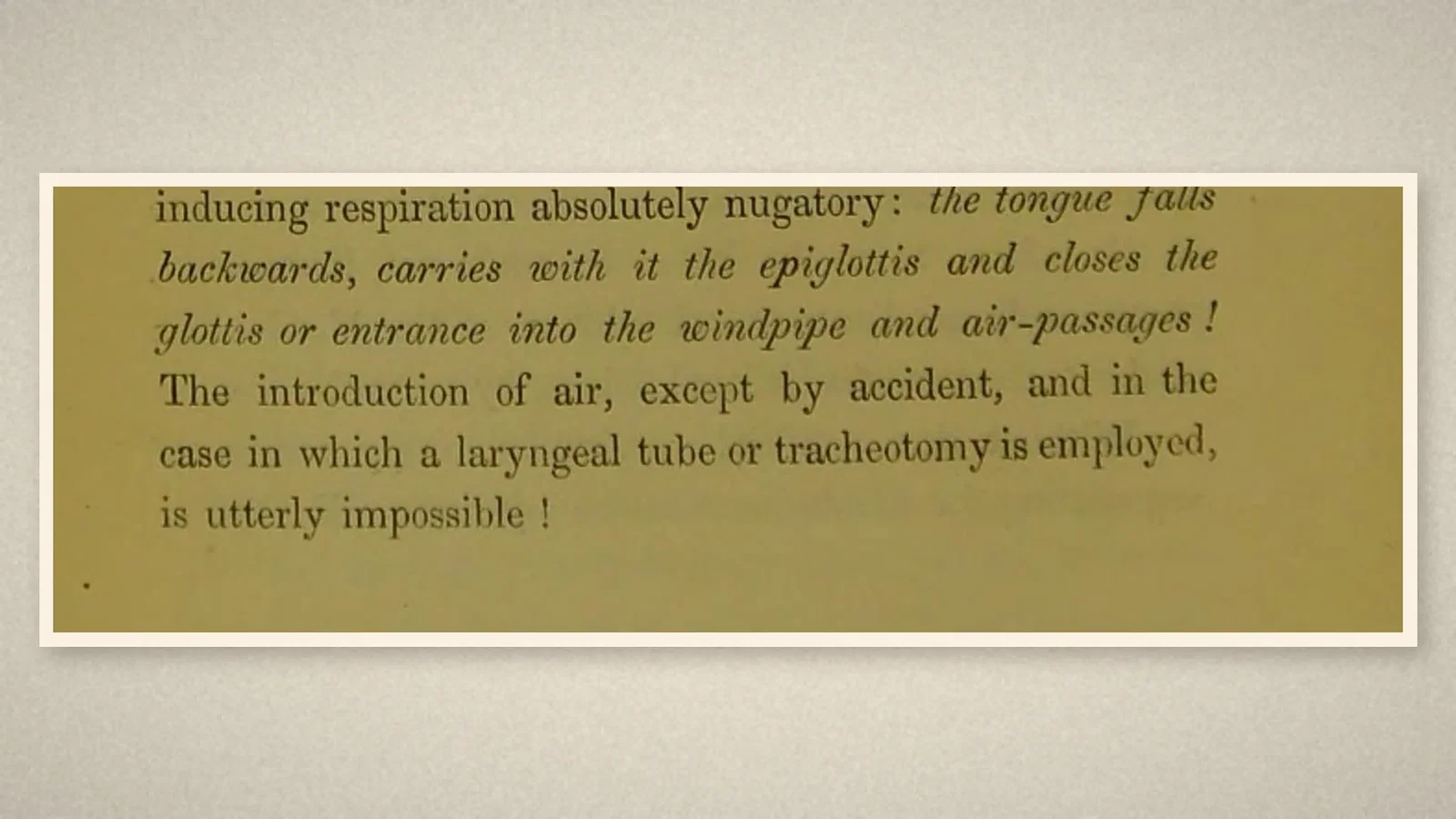
Hall's argument starts from the claim that in asphyxia the first and only essential remedy is to restore breathing, and then turns to the methods of artificial respiration in use, which worked either like a forcing pump or like a suction pump, "with a disregard to the all-essential consideration of posture". "When the subject is kept in the supine position," Hall wrote, "an event occurs which renders every attempt at inducing respiration absolutely nugatory: the tongue falls backwards, carries with it the epiglottis and closes the glottis or entrance into the windpipe and air-passages!" The introduction of air, "except by accident, and in the case in which a laryngeal tube or tracheotomy is employed, is utterly impossible". The Society's superintendent in Hyde Park, Hall added, had seen the cheeks blow out and air escape from the intestine when bellows were used. [1]
Hall tested this on dead bodies. With the subject supine, pressure on the chest produced a little gurgling in the throat but no inspiration when released; turned prone, with pressure on the spine and ribs, there was "in general free expiration and inspiration". [1]
The prone and postural method
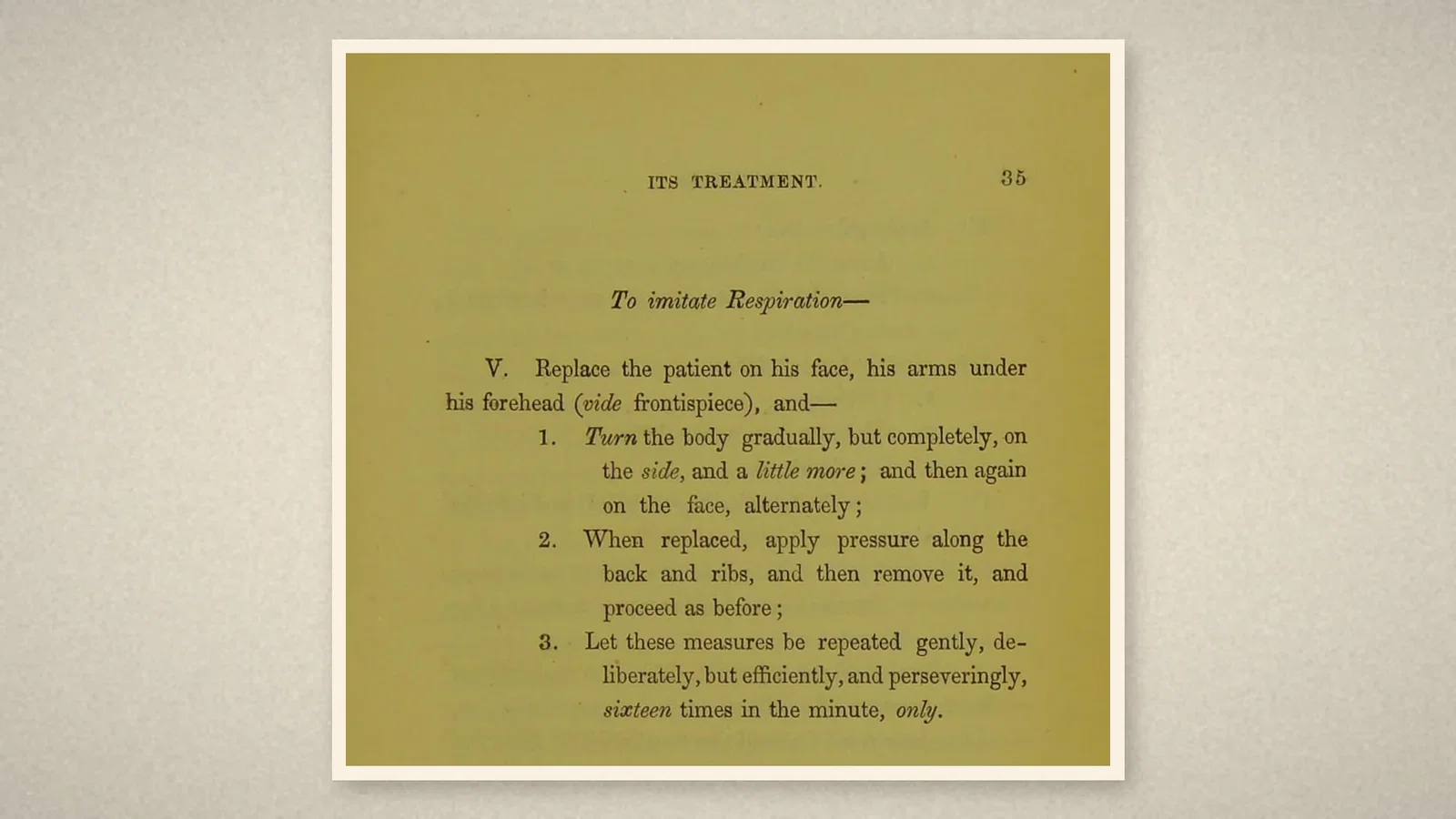
Hall's answer was to turn the patient over. "In this position, the tongue falls forwards, draws with it the epiglottis, and leaves the glottis open"; the tongue can even be drawn forward, and fluids drain from the mouth. The arms are placed under the forehead so the face does not touch the ground, and the weight of the body presses on chest and abdomen and produces expiration. The rules, set out on pages 34 and 35, begin with sending for help but losing no time, treating the patient on the spot in the open air, and trying to excite breathing first. If that fails, "to imitate respiration": replace the patient on the face, turn the body gradually but completely onto the side "and a little more", then back onto the face; when replaced, apply pressure along the back and ribs and remove it; and repeat "gently, deliberately, but efficiently, and perseveringly, sixteen times in the minute, only". The warm bath, then a standard remedy, was to be omitted until breathing had returned. [1]
What the record shows
Hall's method of rolling the body did not last; others replaced it with better ways of moving air. But the observation that drove it has lasted completely. A patient who cannot keep the airway open, lying flat on the back, may obstruct it with the tongue and epiglottis; changing position, pulling the tongue forward, or placing a tube past the obstruction opens it. Hall named all three in 1856, and the pamphlet's emphasis on gentleness and a moderate rate still reads well.
Sources and reading limits
Read: Hall's Abstract of an Investigation into Asphyxia (London, January 1856), frontispiece, title page, contents and pp. 24-36 (Wellcome copy); the History of Anaesthesia Society timeline entry.
Not covered: Hall's writings in the Lancet in 1856, to which the timeline's date of 12 April 1856 may refer; Hall's book of 1857; later methods of artificial respiration. The pamphlet is dated January 1856, and the article uses that date. Hall's experiments were on dead bodies, and the rules are Hall's proposals.
Three illustrations are from the 1856 pamphlet, including its original frontispiece engraving; one is drawn from it.
- Hall M. Abstract of an investigation into asphyxia; its nature, carbonic acid blood-poisoning, and its remedy, prone and postural respiration. London: Joseph Mallett; January 1856. Internet Archive
- History of Anaesthesia Society. Timeline. HAS
Continue exploring
Related reading connects shared questions and contexts; it does not by itself establish historical influence.
- 1788: Kite's Essay on Resuscitation and a Body That Moved
- 1812: Inflating the Lungs Outlasts Curare Poisoning
Anesthesia Epochs · The Source Room · About & Editorial Method
Published November 2, 2026. Sources and reading limits are stated above. Illustrations are labelled as original source images or AI-made. Historical accounts are educational; they are not current treatment instructions.