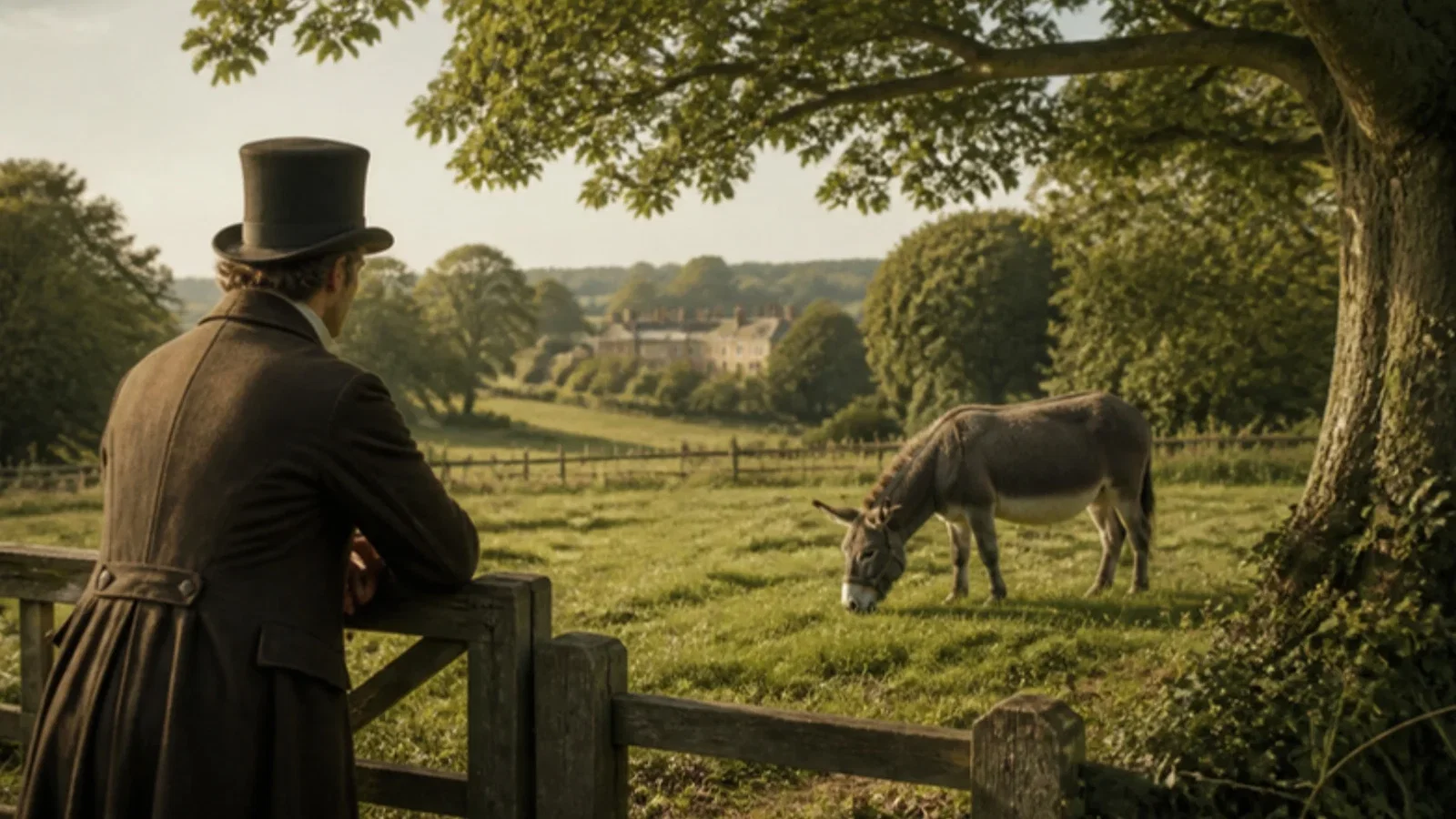
Brodie kept a cat poisoned with woorara alive by inflating its lungs for three hours; in 1825 Waterton kept a poisoned she-ass alive with bellows.
Reading Library · Anesthesia Epochs · 中文版
Watch the education video (for clinicians)
1812: Brodie and Curare — The Lungs Were Artificially Inflated · Anesthesia Epochs Education Series
Every anaesthetist who gives a neuromuscular blocking drug accepts a bargain: the patient will stop breathing, and someone else will breathe for the patient until the drug wears off. The physiology behind that bargain was first shown with the arrow poison of South America, called woorara or wourali by English writers. This article reads two experiments in London in the original: Benjamin Collins Brodie's paper to the Royal Society, read on 27 February 1812, and the account of a poisoned donkey in Charles Waterton's Wanderings in South America of 1825. [1][2][3]
Brodie's first attempt, 1811
In a paper of 1811 on how certain vegetable poisons cause death, Brodie included a few experiments with woorara supplied by Dr Bancroft, who also helped with them. In guinea pigs the animal became motionless, breathing stopped and it appeared dead, yet "the heart was found acting seventy times in a minute"; in another, "by means of artificial respiration the circulation was kept up for more than twenty minutes". Brodie's conclusion was that "this poison acts in some way or another on the brain, and that the cessation of the functions of this organ is the immediate cause of death". [2]
The cat that walked away, 1812
The 1812 paper returns to the problem. Brodie explains that an animal apparently dead from oil of bitter almonds had been recovered "by continuing respiration artificially until the impression of the poison upon the brain had ceased", but a similar attempt with woorara had failed; with a fresh supply and "certain precautions", two more experiments followed. [1]
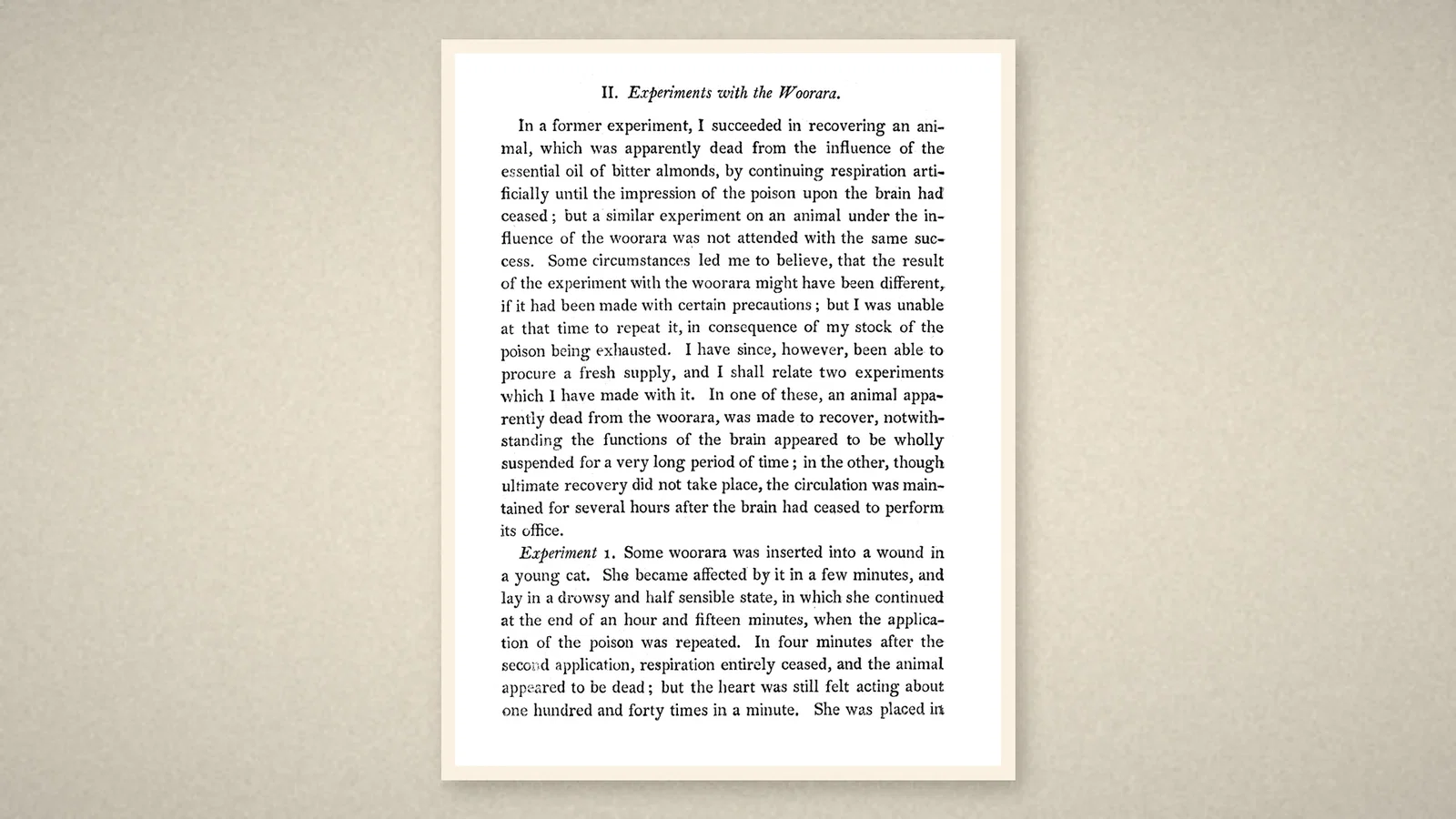
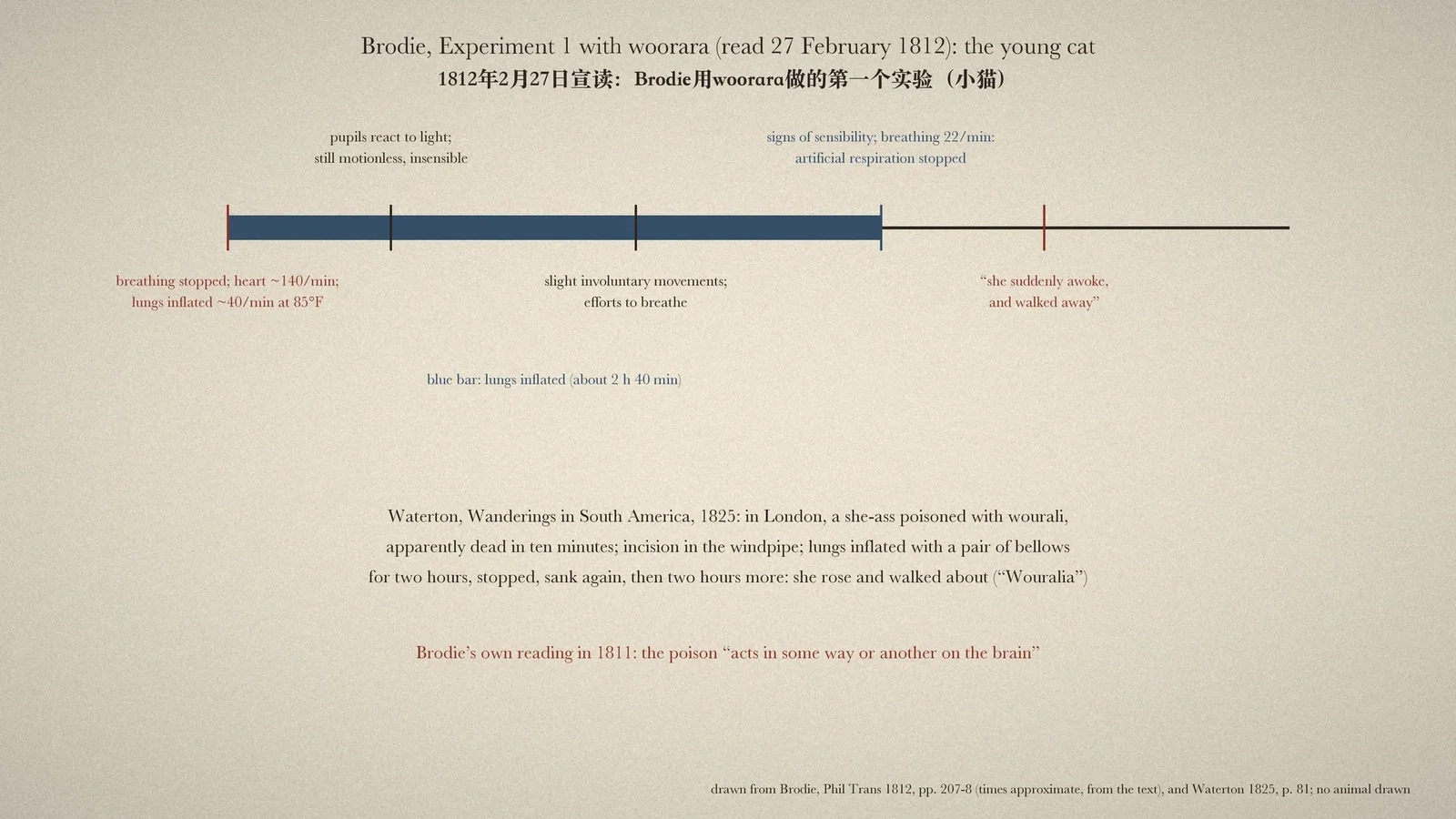
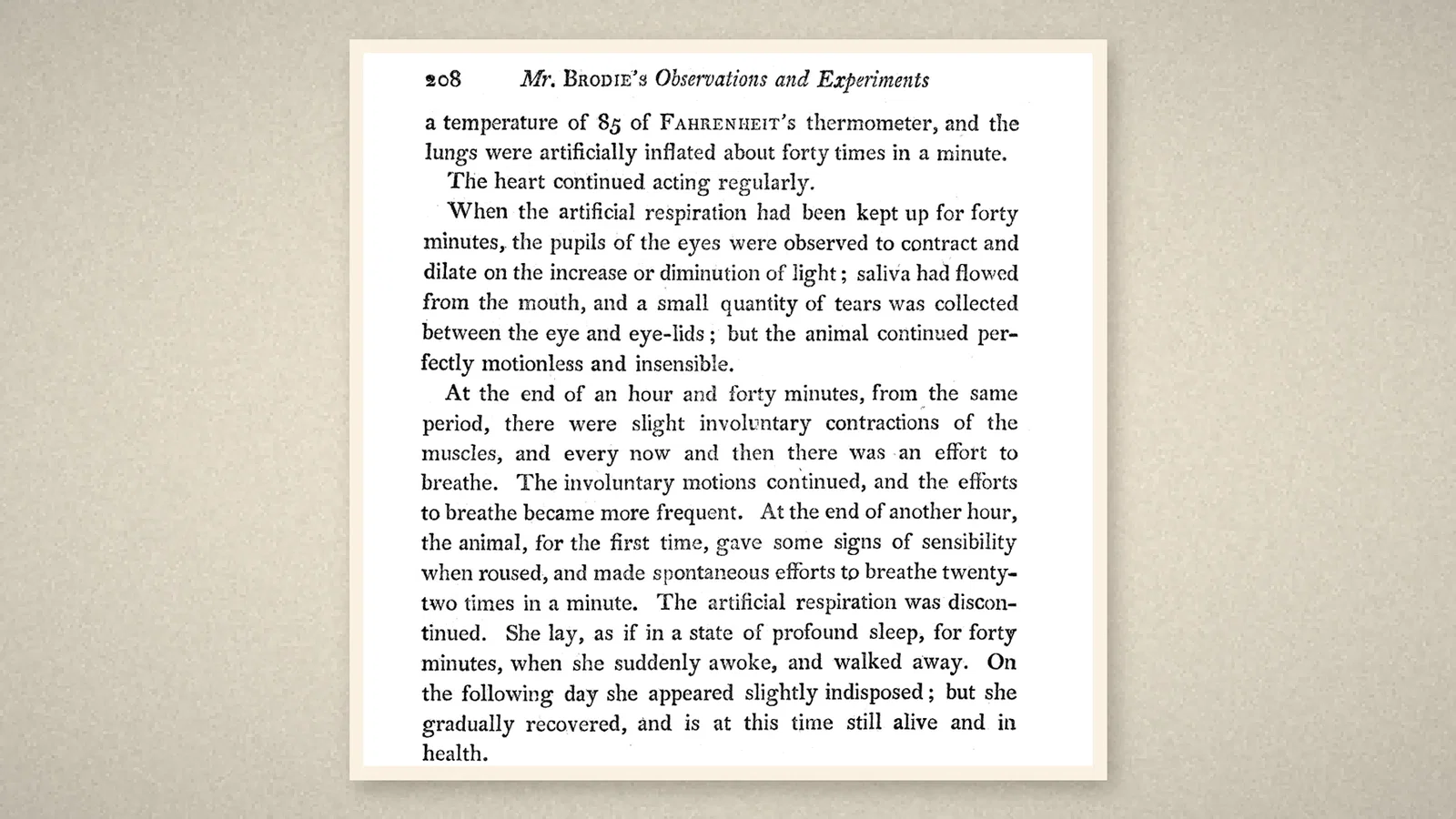
In Experiment 1, woorara was put into a wound in a young cat; after a second application, breathing "entirely ceased, and the animal appeared to be dead; but the heart was still felt acting about one hundred and forty times in a minute". The cat was kept at 85 degrees Fahrenheit and "the lungs were artificially inflated about forty times in a minute". The heart kept beating regularly. After forty minutes the pupils were seen to contract and dilate with the light, though the animal was still "perfectly motionless and insensible". At an hour and forty minutes there were slight involuntary movements and occasional efforts to breathe. An hour later came the first signs of sensibility and spontaneous breaths, twenty-two a minute, and the artificial respiration was stopped. Forty minutes after that, Brodie wrote, the cat "suddenly awoke, and walked away", and it was still alive and well when the paper was written. In Experiment 2, a rabbit, the circulation was kept going for several hours but the animal did not recover. [1]
Waterton's donkey, 1825
Charles Waterton, a naturalist who had travelled in South America, wrote about the same poison in Wanderings in South America (1825). In describing its effects in the field, Waterton noted that "It is supposed by some, that wind, introduced into the lungs by means of a small pair of bellows, would revive the poisoned patient, provided the operation be continued for a sufficient length of time", but thought it too difficult a remedy for anyone wounded far away in the forest. [3]
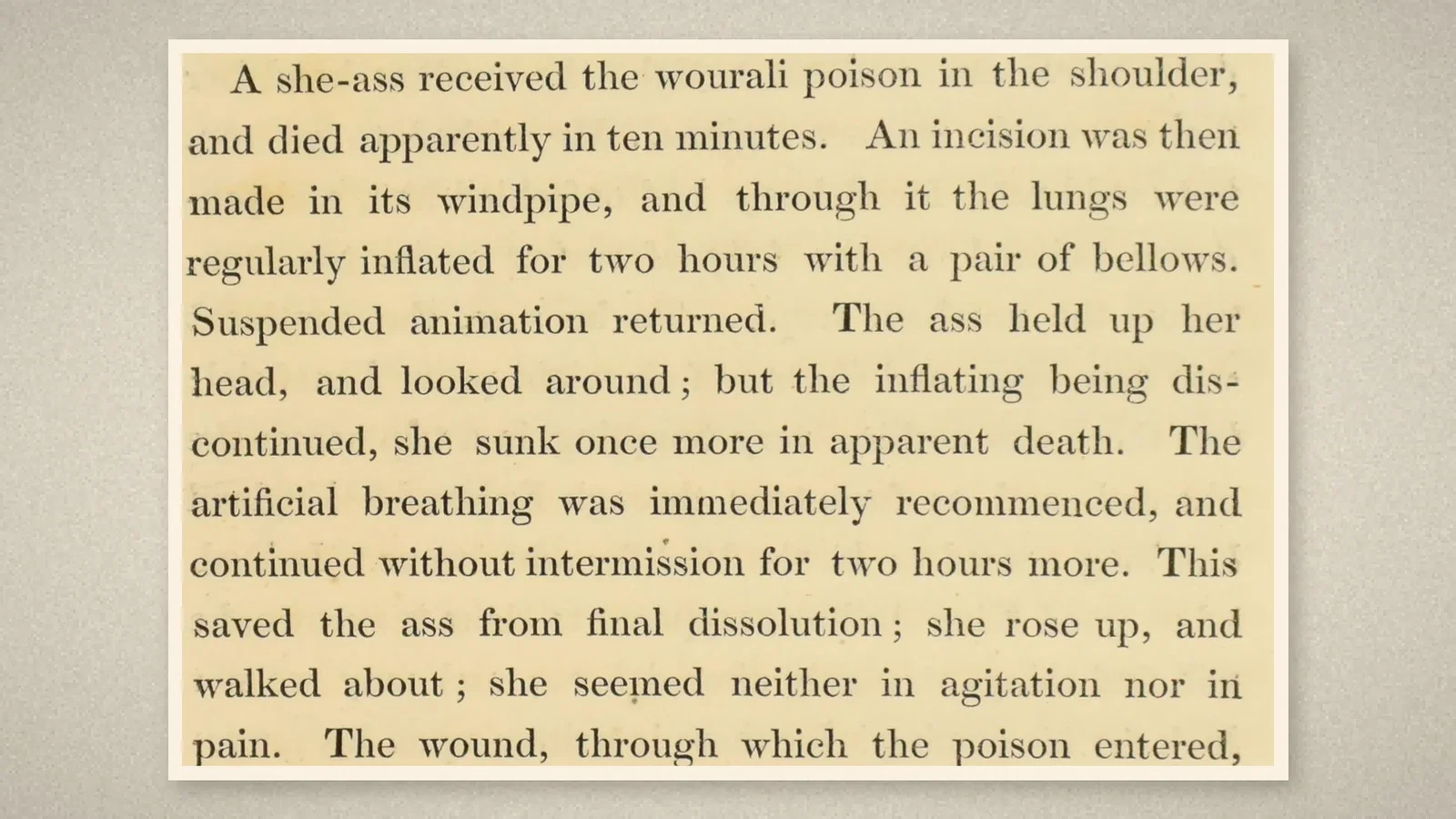
Later in the book, among experiments made in London with the wourali poison after the traveller's return, comes the best-known one: "A she-ass received the wourali poison in the shoulder, and died apparently in ten minutes. An incision was then made in its windpipe, and through it the lungs were regularly inflated for two hours with a pair of bellows. Suspended animation returned." When the inflating stopped, the animal "sunk once more in apparent death"; the artificial breathing was resumed "without intermission for two hours more", and the ass rose and walked about. It took more than a year to recover fully, and was sent by Earl Percy to Walton Hall near Wakefield, where it was known as Wouralia. Waterton's text gives no date for the experiment and does not name who performed it. [3]
What the record shows
These were cruel experiments, and their authors' explanation was wrong: Brodie thought woorara acted on the brain. But the observation was sound and has stood: an animal that cannot breathe because of this poison, with a heart still beating, can be kept alive by inflating its lungs, through the mouth or through an opening in the windpipe, until the effect wears off. That is the bargain modern anaesthesia makes every day with neuromuscular blockade, with a tube in the trachea and a ventilator in place of bellows.
Sources and reading limits
Read: Brodie's paper of 1812 in Philosophical Transactions; the woorara section of Brodie's paper of 1811 (pp. 194-195); Waterton's Wanderings in South America (1825), pp. 70-71 and 81-82; the 2024 ASA timeline entries.
Not covered: the date of the London donkey experiment and the names of those who did it, which Waterton's book does not give; Waterton's field observations as dated by the timeline (1804); later work on where curare acts, and its clinical use, which belong to other articles. Times in the illustration are approximate, from the text. These were animal experiments, reported without endorsement.
Three illustrations are page crops from the 1812 paper and the 1825 book; one is drawn from them.
- Brodie BC. Further experiments and observations on the action of poisons on the animal system. Phil Trans R Soc Lond. 1812;102:205-27. Internet Archive
- Brodie BC. Experiments and observations on the different modes in which death is produced by certain vegetable poisons. Phil Trans R Soc Lond. 1811;101:178-208. Internet Archive
- Waterton C. Wanderings in South America, the North-West of the United States, and the Antilles. London: J. Mawman; 1825. pp. 70-71, 81-82. Internet Archive
- Australian Society of Anaesthetists. Anaesthesia history timeline. 2024. ASA
Continue exploring
Related reading connects shared questions and contexts; it does not by itself establish historical influence.
- 1667: Hooke Keeps a Dog Alive with Bellows
- 1745: La Condamine Reports an Amazon Dart Poison to Paris
- 1856: Bernard Shows Curare Paralyses Movement but Not Feeling
Anesthesia Epochs · The Source Room · About & Editorial Method
Published November 2, 2026. Sources and reading limits are stated above. Illustrations are labelled as original source images or AI-made. Historical accounts are educational; they are not current treatment instructions.