
La Condamine told the Académie des Sciences of a blowpipe dart poison that killed within a minute yet left game safe to eat, and tested it on hens.
Reading Library · Anesthesia Epochs · 中文版
Watch the education video (for clinicians)
1745: La Condamine's Dart Poison — Five Hens · Anesthesia Epochs Education Series
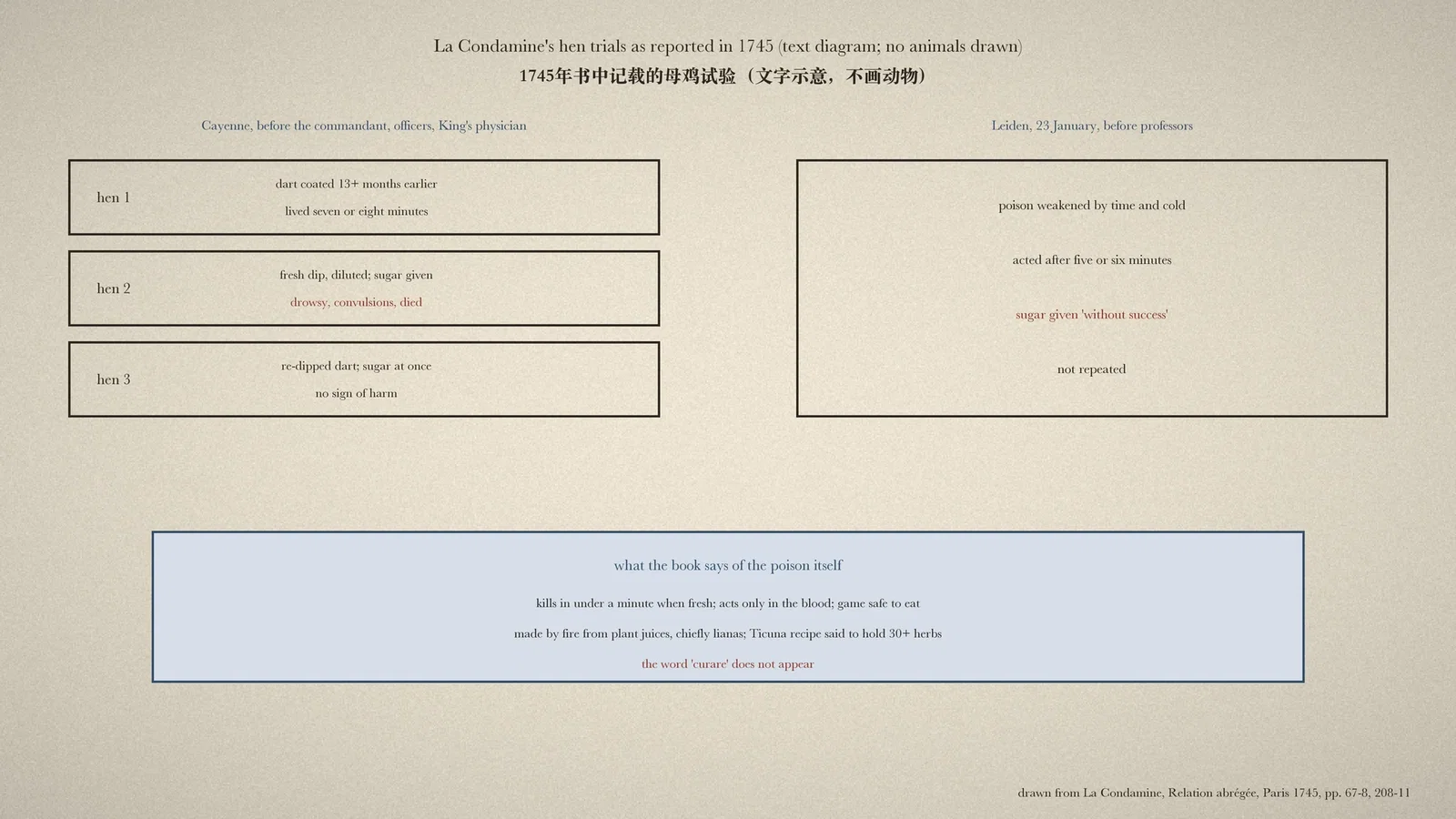
A century and a half after Ralegh, a French academician travelling down the Amazon wrote about South American arrow poison in a very different way. La Condamine noted what the poison did and what it did not do, carried poisoned darts back to a colonial town and a European city, and tried both the poison and its supposed antidote in front of witnesses. [1, pp. 67-8, 208-11]
The book
The title page of the "Relation abrégée d'un voyage fait dans l'intérieur de l'Amérique méridionale" says it was read "at the public assembly of the Académie des Sciences, on 28 April 1745", by M. de La Condamine of the same Academy. It was printed in Paris that year, and the Academy certified it fit for printing on 7 November 1745. [1, title page]
The darts
In the part of the narrative dated July 1743 in the margin, La Condamine describes the Yameos as skilled makers of long blowpipes, the commonest hunting weapon among the peoples of the river. Small darts of palm wood were fitted with a pad of cotton that filled the tube and were blown thirty or forty paces, almost never missing. [1, p. 67]
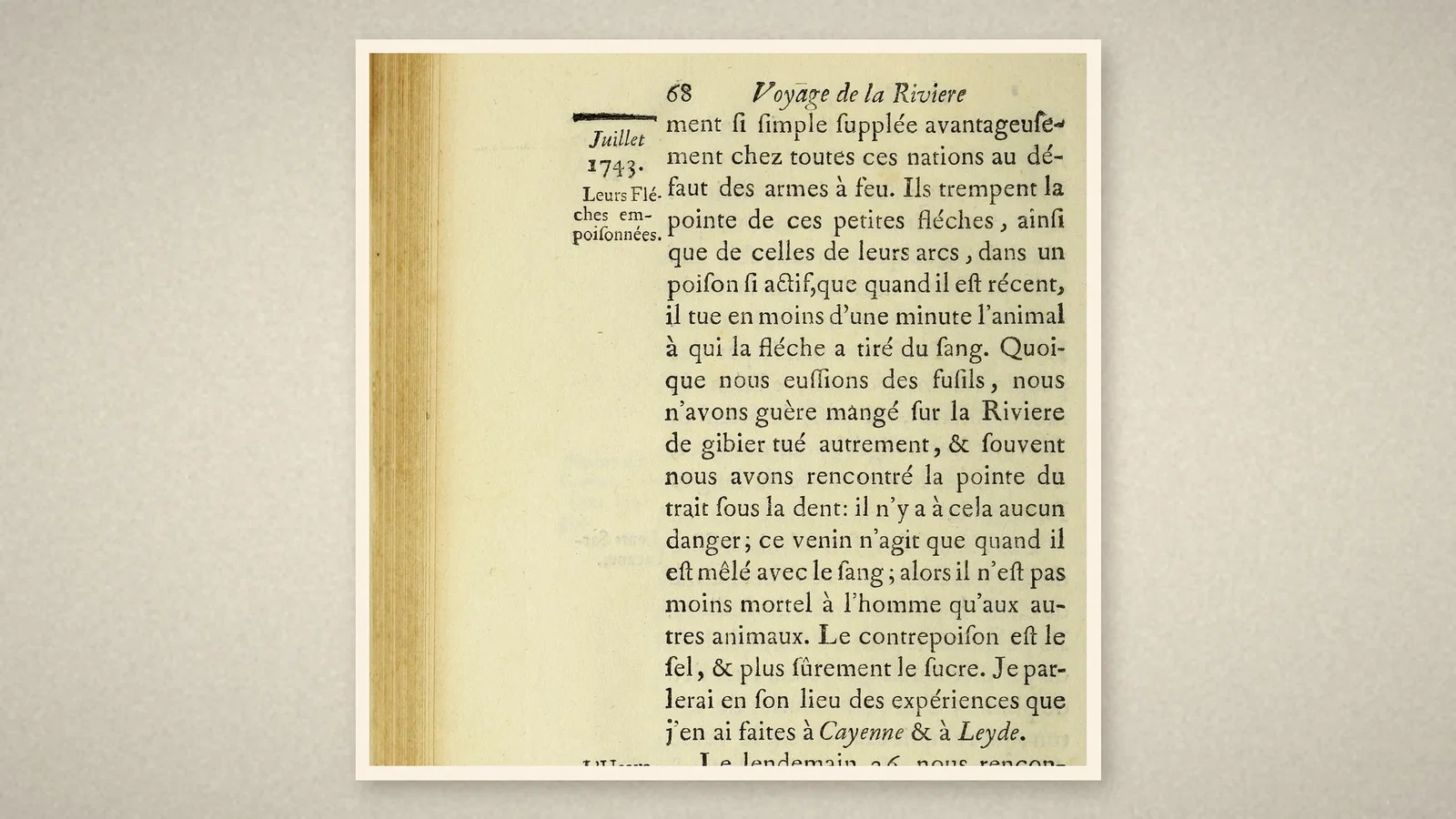
The darts, and arrows too, were dipped in a poison so strong that, when fresh, "it kills in less than a minute the animal from which the dart has drawn blood". Yet the travellers, though armed with guns, ate almost nothing on the river but game killed this way, and often found the dart point under their teeth "without any danger": "this venom acts only when it is mixed with the blood". Mixed with blood, it was as deadly to humans as to animals. The antidote was salt, "and more surely sugar". La Condamine promised to describe the experiments made later at Cayenne and Leiden. [1, p. 68]
Cayenne
The margin of p. 208 reads "February 1744: experiments on the poisoned darts". At Cayenne, La Condamine wanted to know whether darts kept for more than a year were still active, and whether sugar really was as good an antidote as claimed. The trials were made before the commandant of the colony, several officers of the garrison and the King's physician. [1, p. 208]
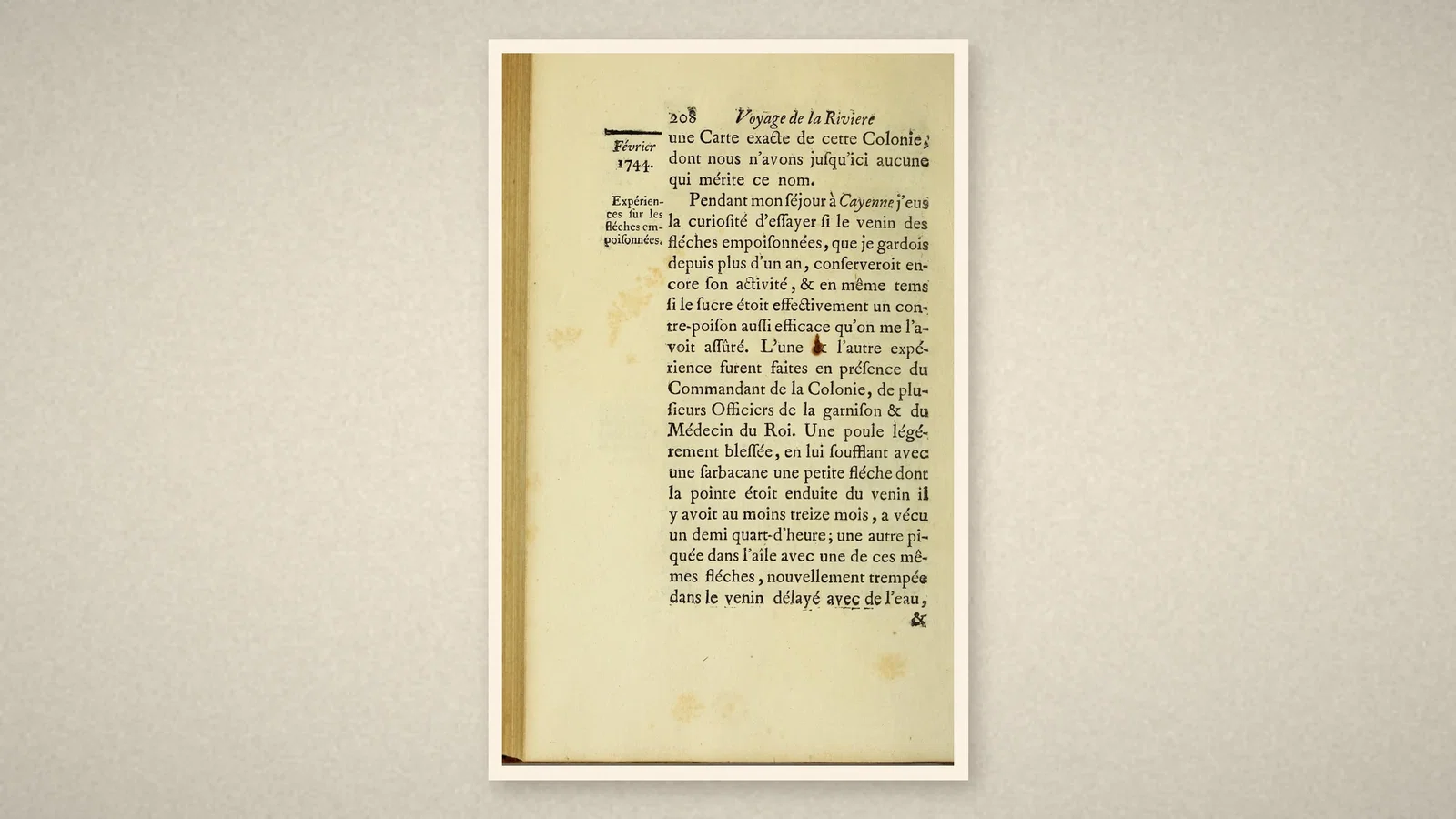
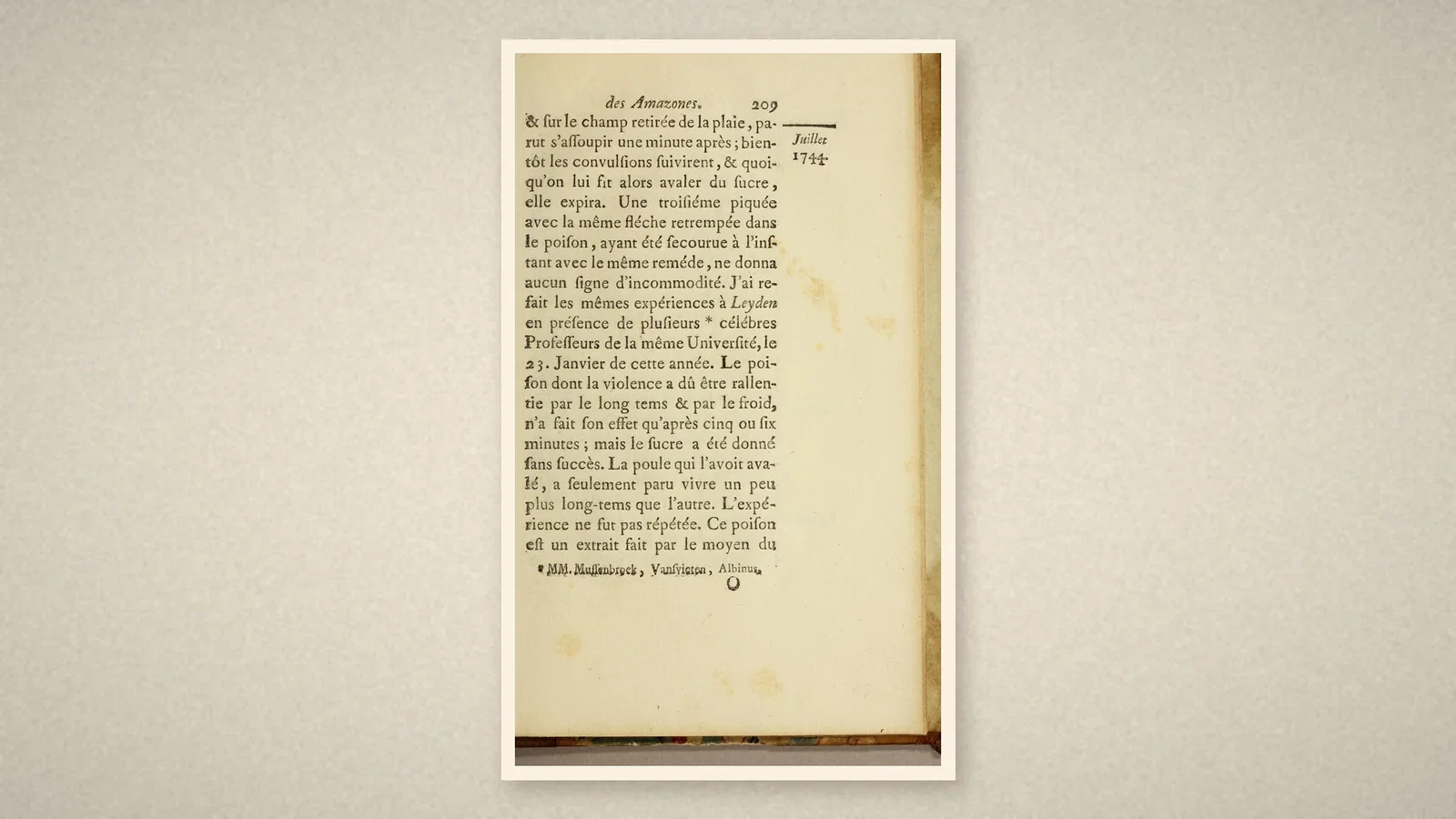
The first hen, lightly wounded by a dart from a blowpipe whose point had been coated at least thirteen months before, lived for about seven or eight minutes. The second, pricked in the wing with a dart freshly dipped in the poison diluted with water and pulled out at once, seemed to fall asleep after a minute; convulsions followed, and although it was then made to swallow sugar, it died. The third, pricked with the same dart re-dipped in the poison and given the same remedy immediately, showed no sign of harm. [1, pp. 208-9]
Leiden
La Condamine repeated the trial at Leiden on 23 January, in the presence of several professors of the university, named in a footnote as Mussenbroek, Vansvieten and Albinus. The poison, weakened by time and cold, took effect only after five or six minutes, "but the sugar was given without success": the hen that swallowed it only seemed to live a little longer than the other. "The experiment was not repeated." [1, p. 209]
The poison
La Condamine described the poison as an extract made with fire from the juices of various plants, especially certain lianas. More than thirty kinds of herbs or roots were said to go into the venom made by the Ticunas, which was the kind tested and the most highly valued along the Amazon. It was always prepared exactly as handed down from their ancestors, as scrupulously, La Condamine wrote, as European apothecaries compounded the theriac of Andromachus, and probably with as little need for so many ingredients. [1, p. 210]
What the record shows
A poison described by what it did: it killed fast through the blood and was harmless when eaten. It was then tested in front of witnesses in two places. The tests were few and small, three hens and then two, but they were reported plainly, including the failure. The antidote that seemed to work at Cayenne did not work at Leiden, and La Condamine wrote that down. The word "curare" is not used. That name, and the physiology of how the poison works, come later in this series.
Sources and reading limits
Read: La Condamine, "Relation abrégée d'un voyage fait dans l'intérieur de l'Amérique méridionale" (Paris, 1745): the title page, the Academy's approval of 7 November 1745, pp. 67-70 and pp. 208-12.
Not covered: any separate account of the Leiden trial by the professors; the version in the Academy's Mémoires; later identifications of the Ticuna poison.
Limits: the effects, the antidote and the recipe come from what La Condamine was told or saw, and the trials used three hens at Cayenne and two at Leiden, with no further controls. The title page gives no first names; the professors' names are given as the footnote prints them. The word "curare" does not appear in the book's text, and this article does not identify the poison as curare. Quotations are translated from the French.
Three illustrations are crops of the 1745 book (pp. 68, 208 and 209); one is a text diagram drawn from it, with no animals or people drawn.
- La Condamine. Relation abrégée d'un voyage fait dans l'intérieur de l'Amérique méridionale. Paris: Veuve Pissot; 1745. p. 67-8, 208-11. Internet Archive
Continue exploring
Related reading connects shared questions and contexts; it does not by itself establish historical influence.
- 1596: Ralegh Describes Guiana's Poisoned Arrows
- 1812: Inflating the Lungs Outlasts Curare Poisoning
- 1856: Bernard Shows Curare Paralyses Movement but Not Feeling
Anesthesia Epochs · The Source Room · About & Editorial Method
Published November 3, 2026. Sources and reading limits are stated above. Illustrations are labelled as original source images or AI-made. Historical accounts are educational; they are not current treatment instructions.