In a curarised frog, Claude Bernard showed that sensory nerves and muscles stay intact; only a person recovering from curare could say whether there had been pain.
Reading Library · Anesthesia Epochs · 中文版
Watch the education video (for clinicians)
1856: Bernard's Curare — Paralysis Is Not Anaesthesia · Anesthesia Epochs Education Series
A paralysed patient cannot show pain. That simple fact lies behind every concern about awareness under neuromuscular blockade, and it was stated with great clarity by the French physiologist Claude Bernard in a lecture at the Collège de France on 4 June 1856. Earlier work had shown that an animal poisoned with curare could be kept alive by inflating its lungs (see the article on Brodie, 1812). Bernard asked a different question: what exactly does curare stop? This article reads the lecture as printed in Bernard's Leçons sur les effets des substances toxiques et médicamenteuses (Paris, 1857). [1]
The lecture
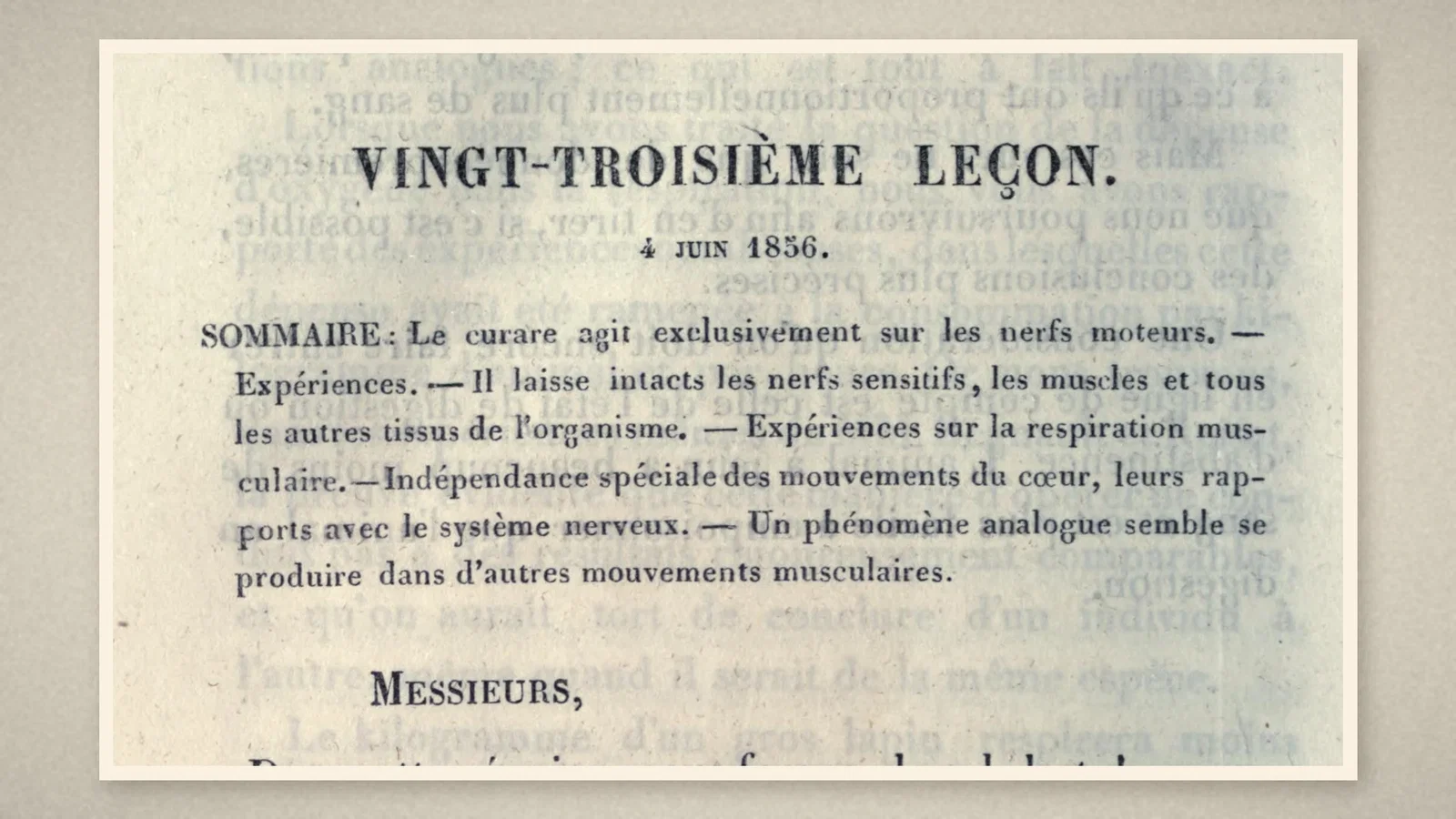
The book was published by J.-B. Baillière et fils, with its legal deposit made in Paris in April 1857. The twenty-third lecture is headed "4 juin 1856", and its printed summary reads, in this article's translation: "Curare acts exclusively on the motor nerves. Experiments. It leaves intact the sensory nerves, the muscles and all the other tissues of the organism." [1]
Bernard began by reminding the audience that the action of curare on the nervous system "proceeds from the periphery to the centre", and that, unlike strychnine, which acts first on the nerves of feeling, curare acts first, and always, on the nerves of movement. [1]
The problem of a silent animal
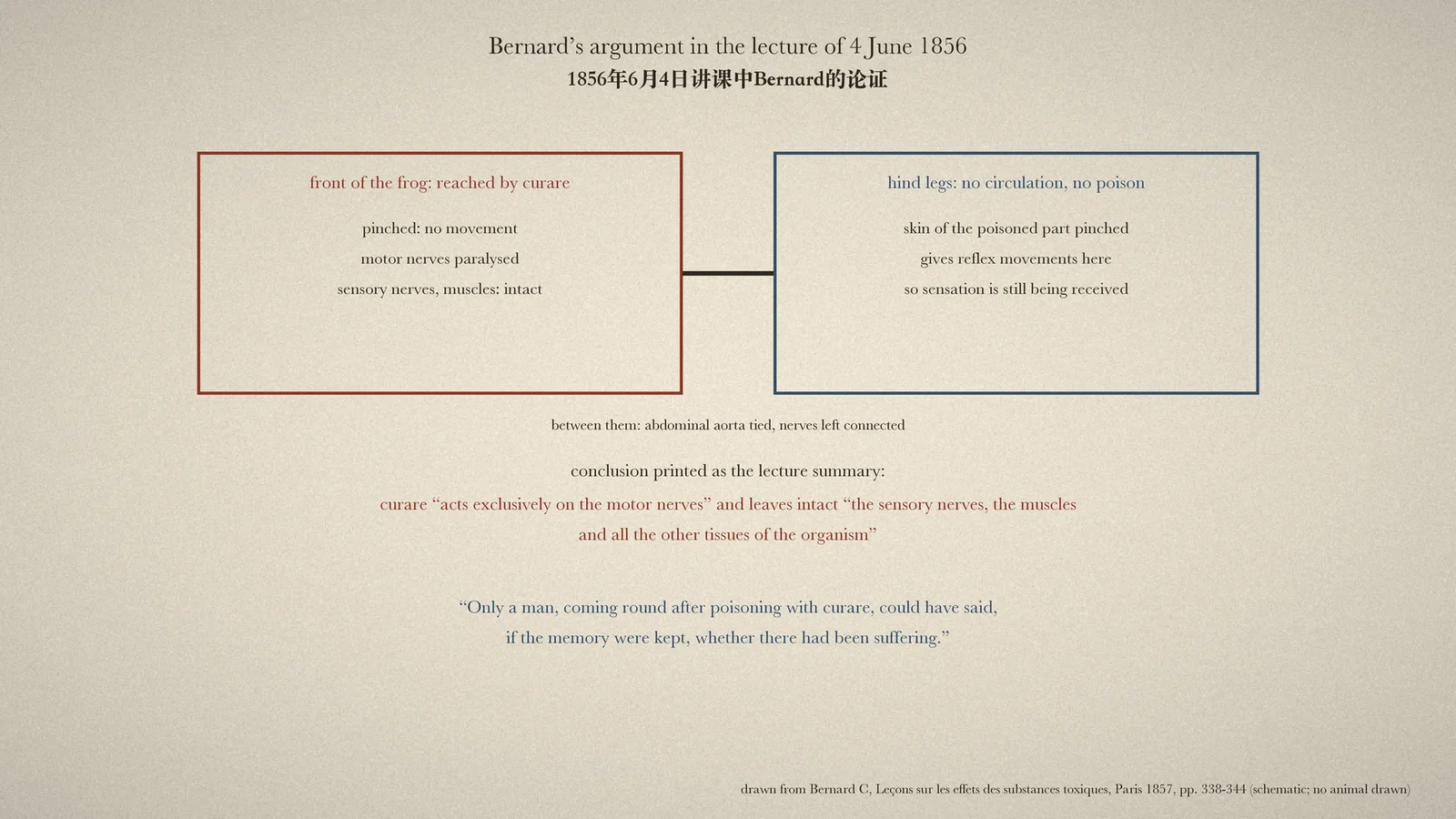
The difficulty was logical. "A frog poisoned with curare remains motionless when it is pinched," Bernard said, "but one cannot conclude from that that it has lost sensation", because animals can show what they feel only by moving. The immobility of curarized frogs when their sensory system was stimulated "is due to the paralysis of their motor nerves", a point Bernard said had already been made in those lectures in 1854. [1]
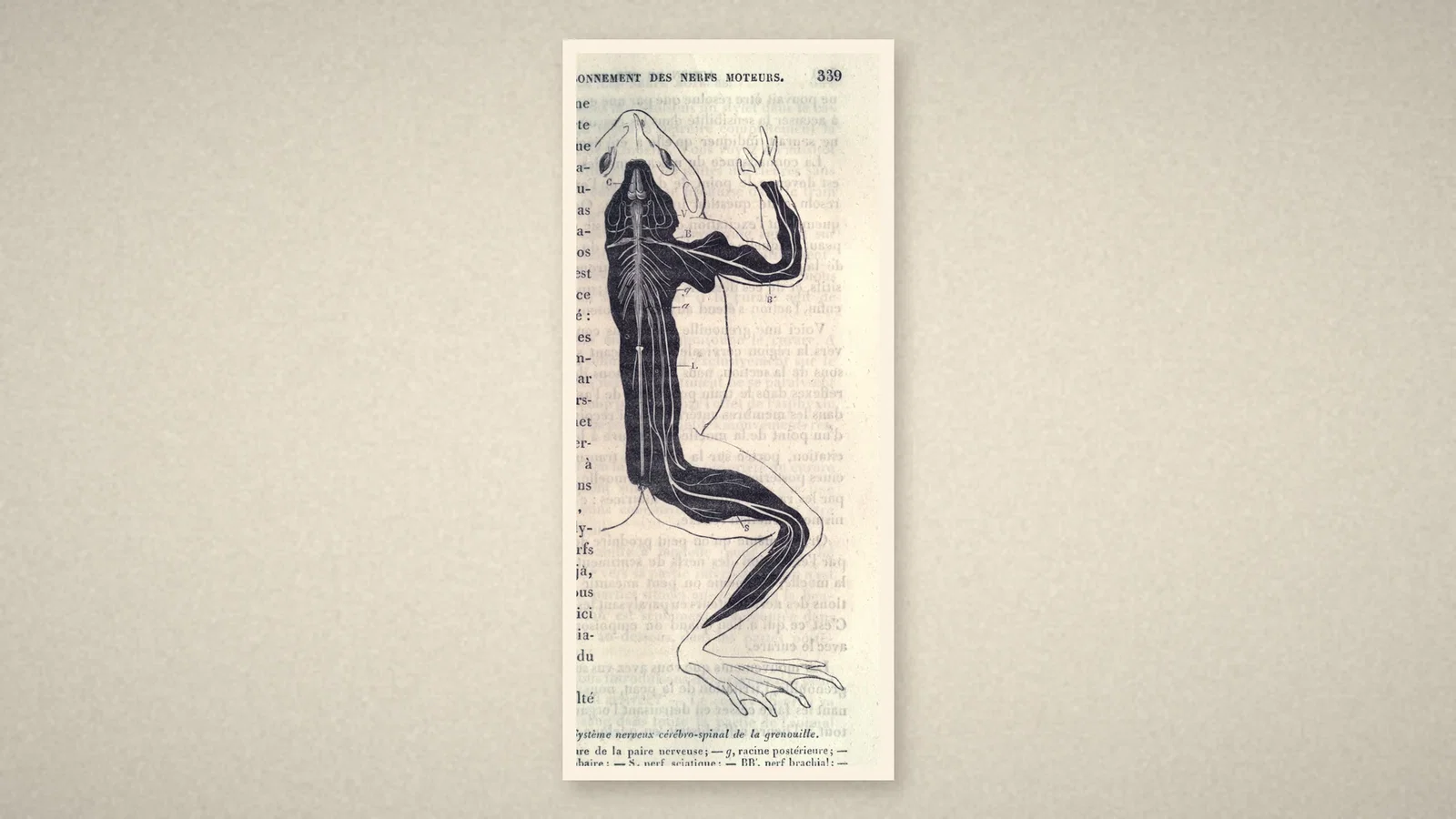
The way out was to keep part of the animal able to answer. In the experiment repeated before the audience, the abdominal aorta of a frog was tied low down, so that the circulation, and with it the poison, could not reach the hind legs, while the nerves still connected them to the spinal cord. Curare was then given. The front of the frog became paralysed, but when its skin was pinched, the protected hind legs moved by reflex. The sensory nerves of the poisoned part were still carrying impressions to the cord; only the motor side had failed. In a second, more careful version, the two crural veins beside the aorta were included in the ligature as well. Sensation, Bernard concluded, is lost only much later, "through the effect of the asphyxia which curare brings on by stopping the respiratory movements". [1]
"Only a man, coming round"
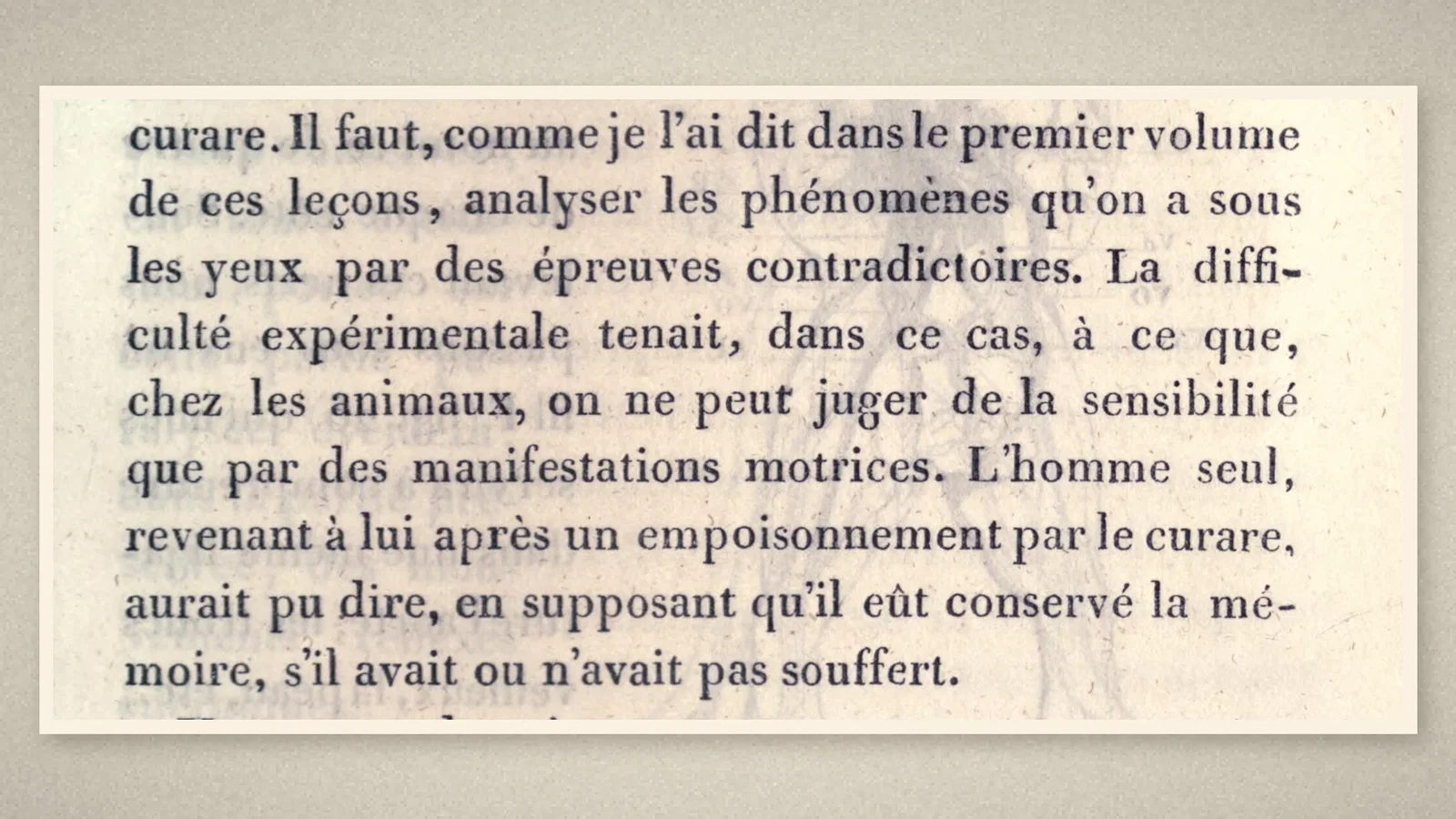
Then comes the sentence that reads today like a warning. In animals, Bernard said, sensation can only be judged by movement. "Only a man, coming round after poisoning with curare, could have said, supposing the memory had been kept, whether there had been suffering or not." [1]
Breathing for the animal
The same book also shows Bernard breathing for an animal. In an earlier lecture, a rabbit had a tube tied into its opened trachea, closed by a tap and ending in a thick rubber bladder; when the animal stopped breathing and its heart nearly stopped after breathing hydrogen, Bernard squeezed and released the bladder, acting "as a bellows" to distend and retract the lungs, until the rabbit opened its mouth, the cornea became sensitive again and breathing returned. Bernard then removed the tube and let air finish what the mechanical inflation had begun. [1]
What the record shows
Bernard's lecture gives anaesthesia two lasting lessons. Curare stops movement and leaves sensation and muscle intact; and a motionless subject tells us nothing about what it feels. The first underlies the use of neuromuscular blocking drugs only alongside anaesthesia and analgesia; the second underlies every effort to detect awareness in a patient who cannot move.
Sources and reading limits
Read: Bernard's Leçons sur les effets des substances toxiques et médicamenteuses (Paris, 1857), the twenty-third lecture of 4 June 1856 (pp. 338-344) and the passage on artificial respiration in the rabbit (pp. 232-233); the 2024 ASA timeline entries listed for this topic.
Not covered: Bernard's earlier notes in the Comptes rendus and the lectures of 1854 referred to in the text; later timeline entries on the same subject; later physiology of the nerve-muscle junction, which the article does not attribute to Bernard. The rabbit passage concerns hydrogen, not curare. Translations from the French are this article's own. These were animal experiments, reported without endorsement.
Three illustrations are page crops from the 1857 book; one is drawn from it.
- Bernard C. Leçons sur les effets des substances toxiques et médicamenteuses. Paris: J.-B. Baillière et fils; 1857. pp. 232-233, 338-344. Internet Archive
- Australian Society of Anaesthetists. Anaesthesia history timeline. 2024. ASA
Continue exploring
Related reading connects shared questions and contexts; it does not by itself establish historical influence.
- 1812: Inflating the Lungs Outlasts Curare Poisoning
- 1850: Pelouze and Bernard Show Curare Kills Injected, Not Swallowed
- 1942: Griffith and Johnson Use Curare in Twenty-Five Patients
Anesthesia Epochs · The Source Room · About & Editorial Method
Published November 2, 2026. Sources and reading limits are stated above. Illustrations are labelled as original source images or AI-made. Historical accounts are educational; they are not current treatment instructions.