Curare under the skin or in a vein killed dogs, rabbits and birds, but swallowed it was harmless, because the gut lining would not absorb it while the lung would.
Reading Library · Anesthesia Epochs · 中文版
Watch the education video (for clinicians)
1850: Pelouze and Bernard — Where Curare Gets In · Anesthesia Epochs Education Series
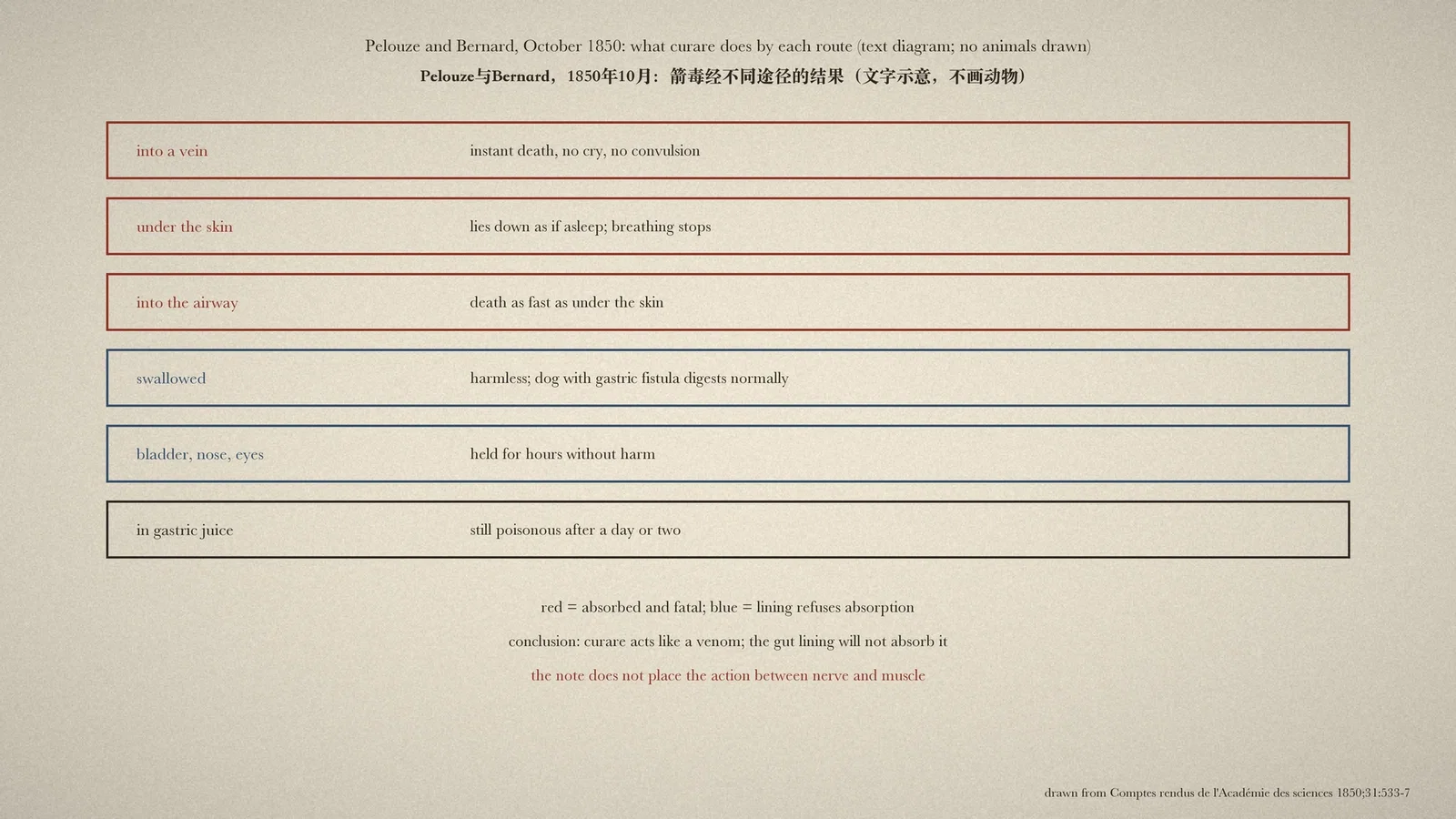
The report opens by noting that South American curare had "long been known": fatal when pricked under the skin, harmless when swallowed. In 1850 a chemist and a physiologist in Paris set out to find out why. Their answer lay not in the poison itself but in the body's doors. [1, p. 533][1, p. 537]
This report is often said to be the one in which Bernard placed curare's action between nerve and muscle. Read in the original, it is about something else.
The report
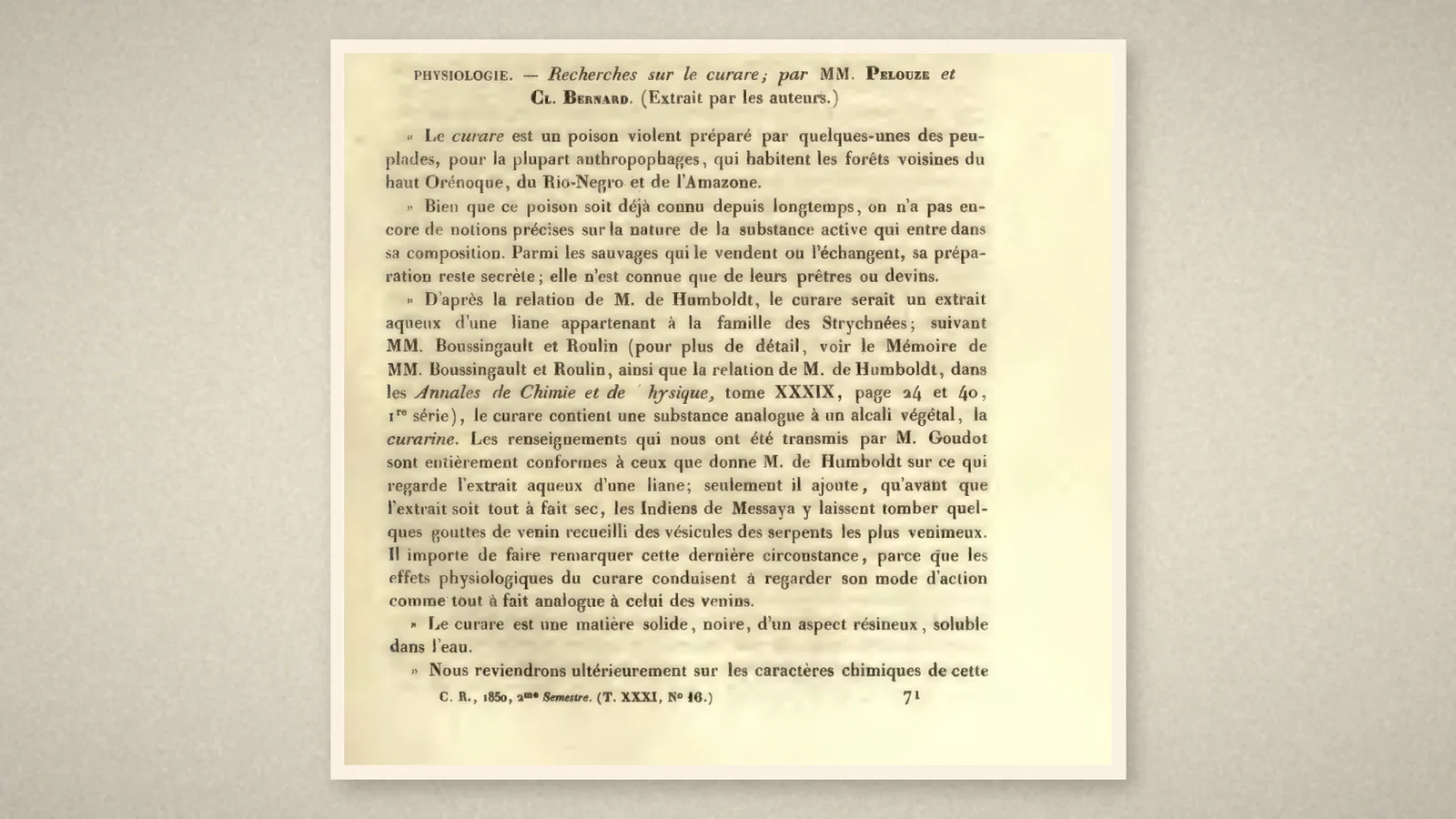
In the record of the sitting of Monday 14 October 1850, volume 31 of the Comptes rendus of the Académie des sciences prints, at pp. 533-537, "Recherches sur le curare" by the chemist Pelouze and the physiologist Cl. Bernard, marked as an abstract by the authors. [1, p. 533]
It opens with the poison's origin: made by peoples of the forests of the upper Orinoco, the Rio Negro and the Amazon, the preparation kept secret. According to Humboldt it was an aqueous extract of a liana of the Strychnos family; Boussingault and Roulin thought it contained a substance like a vegetable alkali, which they called "curarine"; and Goudot told the authors that the Indians of Messaya dropped in venom from the glands of the most venomous snakes before the extract dried. Curare's effects, the authors wrote, made its action seem entirely like that of venoms. [1, p. 533]
Injected and pricked
Like viper venom, the authors wrote, curare could be swallowed by man and animals without harm, while introduced under the skin through a puncture it was always quickly fatal; they had confirmed this "by a very great number of experiments". [1, p. 534]
A weak solution pushed into the jugular vein of dogs and rabbits killed instantly, with no cry and no convulsion; the organism, they wrote, was "as if struck by lightning". Under the skin the effect was slower: a bird flew as usual for a few seconds and then dropped dead without a sound; dogs and rabbits at first seemed normal, then lay down as if tired, appeared to fall asleep, and their breathing stopped and their sensation and life faded, without a cry or any sign of pain. [1, p. 534]
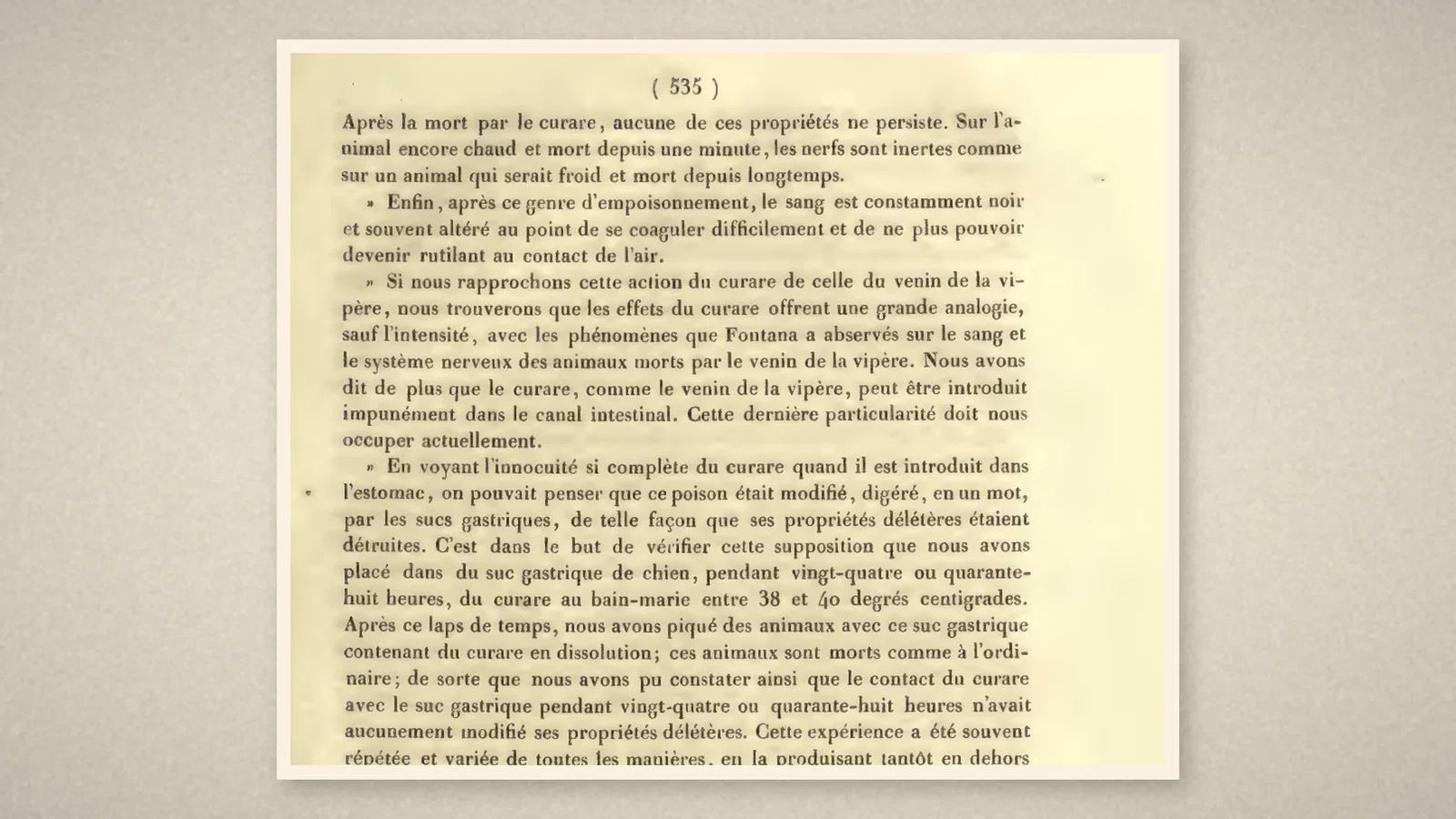
Opened immediately after death, the animals showed complete loss of every property of the nervous system. Ordinarily, after sudden death, stimulating a motor nerve still makes its muscles twitch, and pinching the skin still produces reflex movements; after death by curare, in an animal still warm and dead only a minute, the nerves were as inert as in one long dead. The blood was dark. The authors compared this with what Fontana had seen in animals killed by viper venom. [1, p. 534][1, p. 535]
Why swallowing was harmless
One idea was that gastric juice "digested" the poison. The authors soaked curare in dog's gastric juice in a warm bath for one or two days and then pricked animals with it: the animals died as usual. In a dog with a gastric fistula, fluid drawn from the stomach after the dog had swallowed curare killed other animals, while the dog itself was unaffected and digested normally. It was, the authors wrote, a "singular spectacle": a dog carrying in its stomach a liquid that killed instantly every animal around it, without feeling any harm itself. Saliva, bile and pancreatic juice did not disarm the poison either. [1, p. 535][1, p. 536]
The explanation, the authors argued, was that the lining of the stomach and intestine does not let the active principle of curare through, although it is soluble. Fresh gastric lining from a newly killed dog or rabbit was made into an endosmometer: within a few hours water had crossed, but the liquid on the other side was not poisonous; once the lining was damaged, the poison passed at once. The linings of the bladder, the nose and the eyes behaved the same way: curare injected into a dog's bladder was held for hours without harm, though the urine passed afterwards was poisonous. [1, p. 536][1, p. 537]
The one exception: the lung
The only exception was the lung. When a few drops of solution were carefully put into the airway, the animal died as quickly as if pricked under the skin. The lining of the lungs, made for the passage of air, lacks the protective mucus of the other linings, the authors suggested, in keeping with Magendie's observations on the bronchial lining. [1, p. 537]
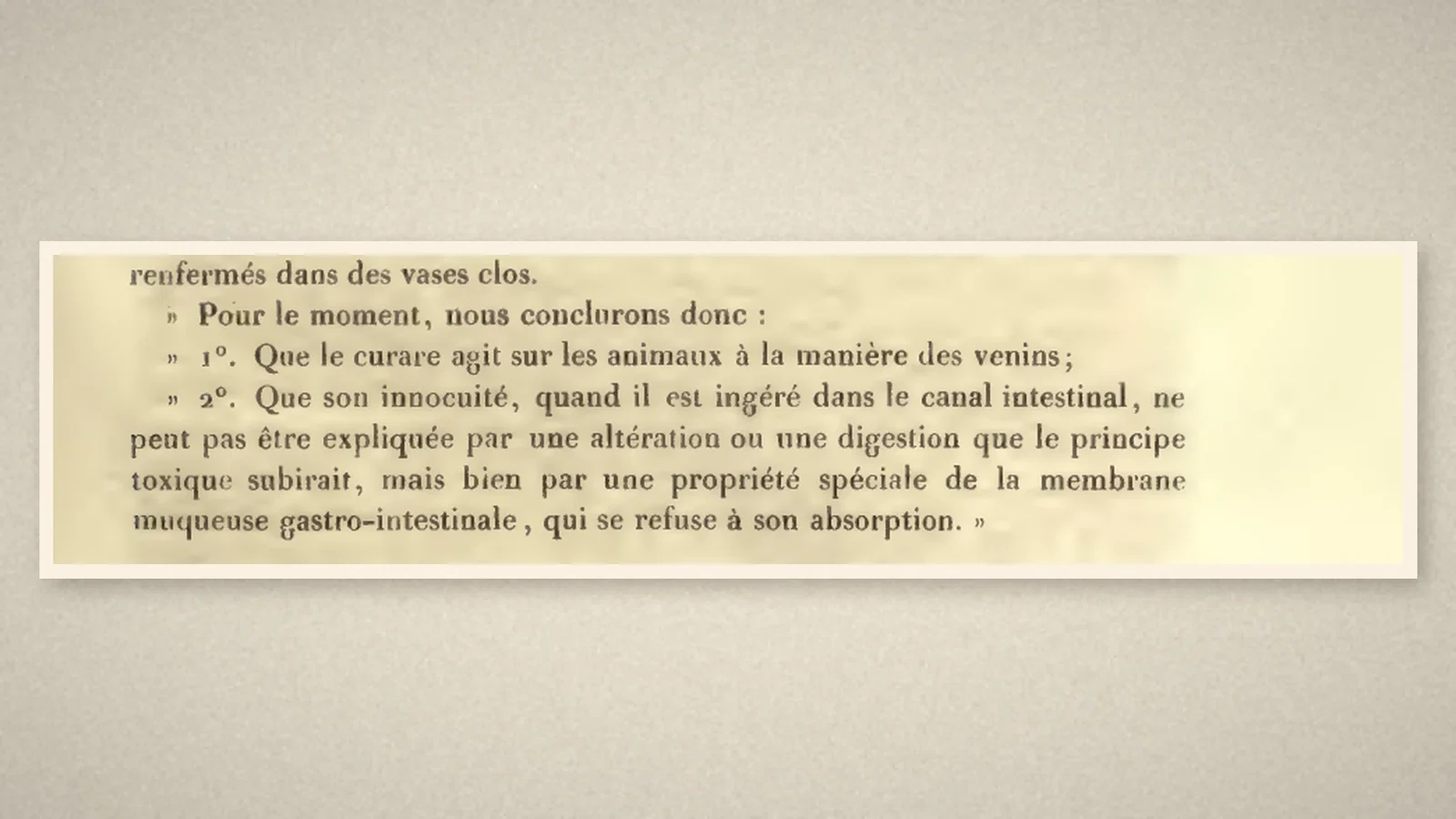
The conclusions were just two: curare acts on animals in the manner of venoms; and its harmlessness when swallowed is explained not by any change or digestion of the poison but by a special property of the gastro-intestinal lining, "which refuses its absorption". [1, p. 537]
What the record shows
A report about doors: the same poison is fatal through the skin, a vein or the airway, and harmless through the stomach, bladder or eye, the difference lying in whether the lining absorbs it. The phrase "between nerve and muscle" is not in it; that came from Bernard's work of the following years.
Sources and reading limits
Read: Pelouze and Cl. Bernard, "Recherches sur le curare" (abstract by the authors), Comptes rendus de l'Académie des sciences 1850;31:533-7, sitting of 14 October 1850, in full.
Not covered: any fuller memoir by the two authors on curare; Bernard's laboratory notes of 1850; the accounts by Humboldt and by Boussingault and Roulin cited in the note; a Canadian Anesthesiologists' Society article.
Limits: a published timeline places "curare's site of action between nerve and muscle" in 1850; this note does not say that. It describes total loss of nerve excitability after death, likens curare to venom, and deals mainly with absorption. The localisation is Bernard's later work and is treated in another article. The authors' description of the peoples who made curare is theirs and is not repeated. The number of animals is not given beyond "a very great number of experiments". Amounts and temperatures are not repeated.
Three illustrations are crops of the Comptes rendus, vol. 31 (pp. 533, 535 and 537); one is a text diagram drawn from the note, with no animals drawn.
- Pelouze, Bernard C. Recherches sur le curare. C R Hebd Seances Acad Sci. 1850;31:533-7. Internet Archive
Continue exploring
Related reading connects shared questions and contexts; it does not by itself establish historical influence.
- 1745: La Condamine Reports an Amazon Dart Poison to Paris
- 1596: Ralegh Describes Guiana's Poisoned Arrows
- 1856: Bernard Shows Curare Paralyses Movement but Not Feeling
Anesthesia Epochs · The Source Room · About & Editorial Method
Published November 3, 2026. Sources and reading limits are stated above. Illustrations are labelled as original source images or AI-made. Historical accounts are educational; they are not current treatment instructions.