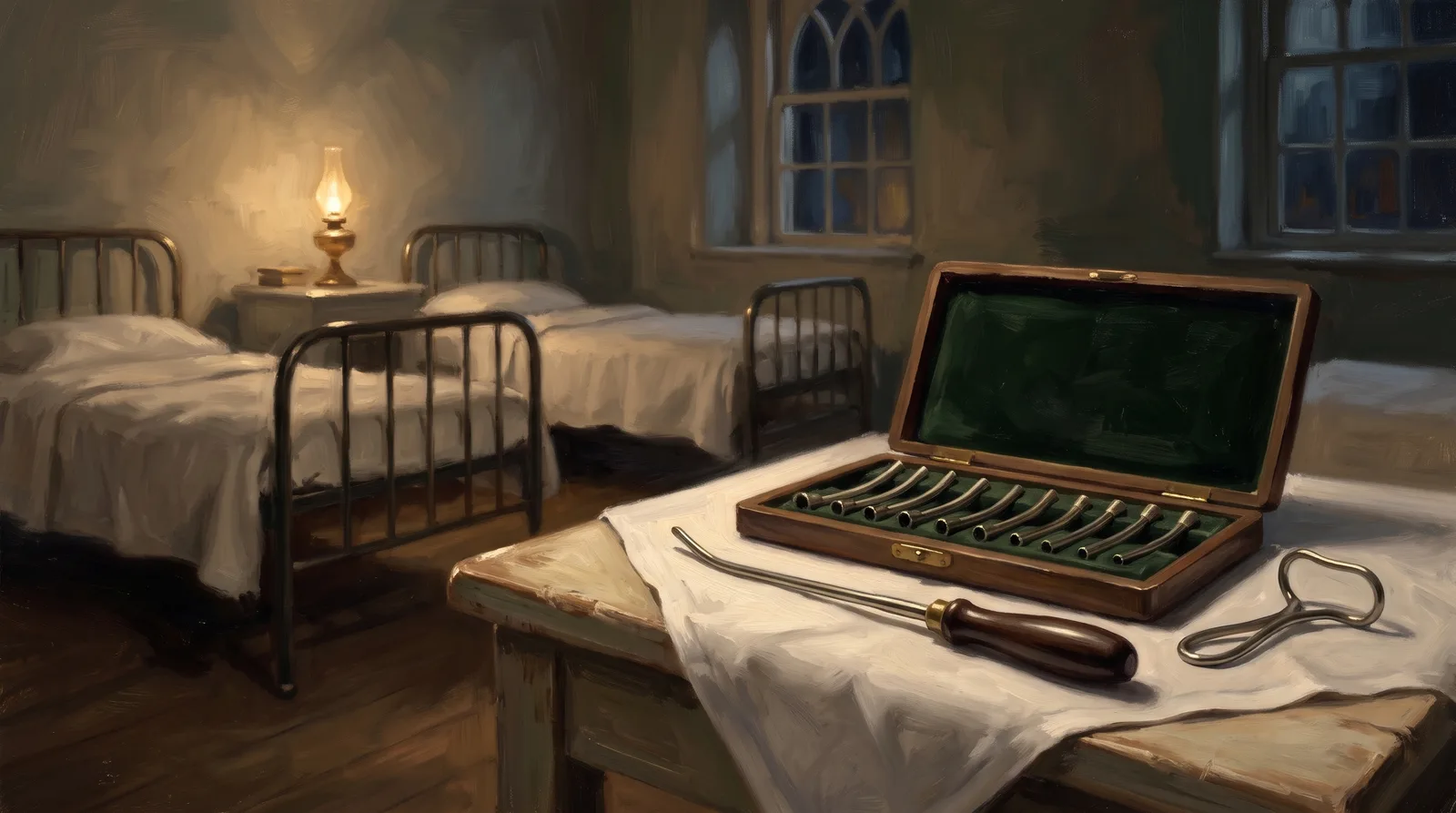
In August 1885 Joseph O’Dwyer described a short metal tube, widened at its centre and passed through the mouth on an introducer, that stayed in a child’s larynx to relieve diphtheritic croup.
Reading Library · Anesthesia Epochs · 中文版
Watch the education video (for clinicians)
1885: O'Dwyer's Intubation of the Larynx — A Tube That Stays · Anesthesia Epochs Education Series
In diphtheritic croup, membrane and swelling could close a child's larynx. The operation O'Dwyer's article keeps in view is tracheotomy, a cut into the neck. On 8 August 1885 the New York Medical Journal printed three pages that proposed another route: a short metal tube, passed through the mouth on an introducer, that would sit in the larynx by itself and keep it open. The author was Joseph O'Dwyer, and most of the work had been done at the New York Foundling Asylum. [1, pp. 145-7]
Why publish now
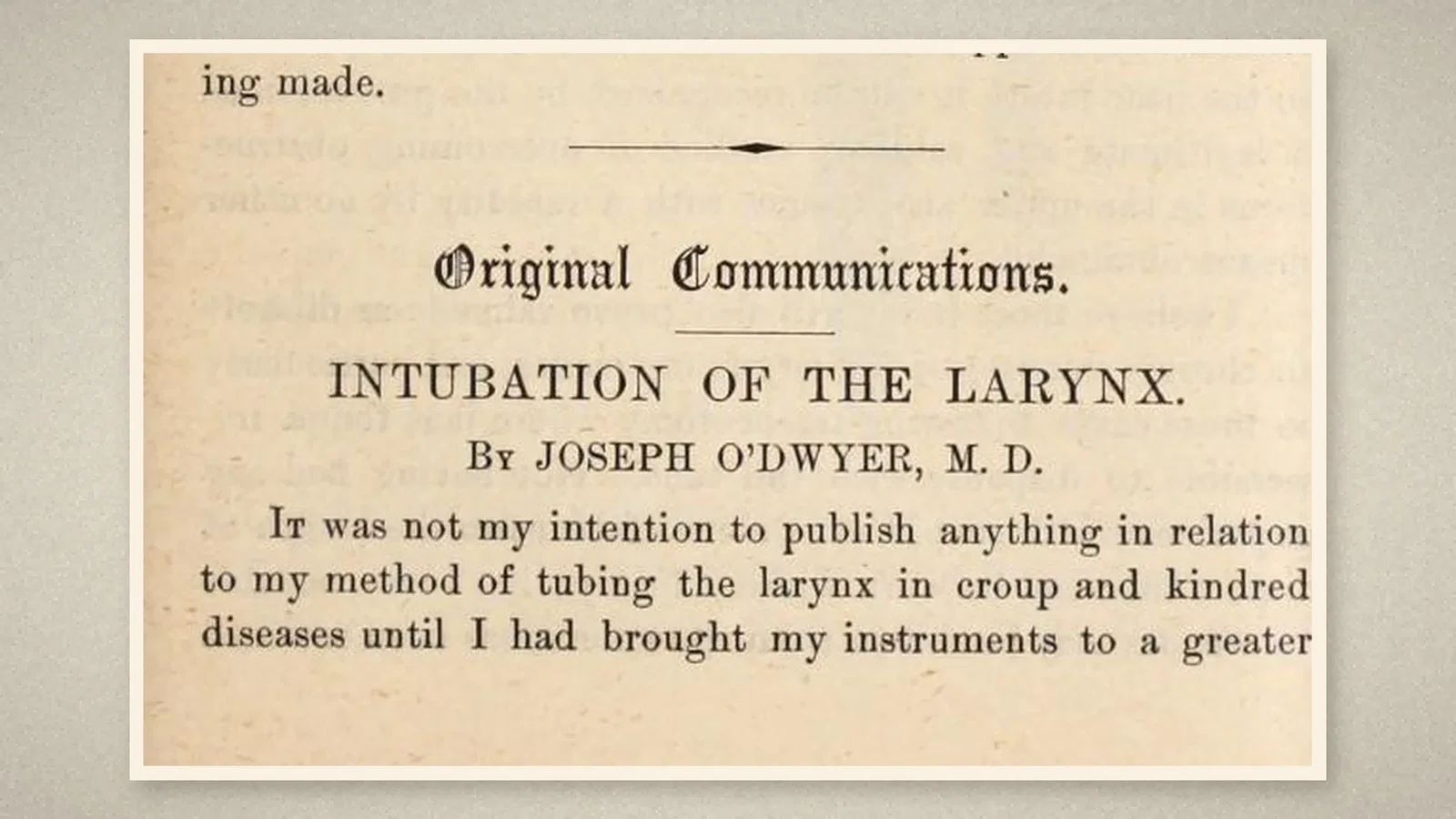
The article opens with a reluctance. "It was not my intention to publish anything in relation to my method of tubing the larynx in croup and kindred diseases" until the instruments were more perfect, O'Dwyer wrote; but references to the subject had appeared in journals and society reports, so the profession would get "a brief account of the progress I have made", with the instruments and the method of using them. [1, p. 145]
The experiments had begun "almost five years ago". For more than a year O'Dwyer had not known of "Bouchut's similar attempt and failure in 1858", seven cases of croup treated with very imperfect instruments. O'Dwyer put Bouchut's abandonment of the idea down to Trousseau's condemnation before the Paris Academy of Medicine, made, as O'Dwyer read it, on theoretical grounds, and blamed much of the irritation in Bouchut's cases on the silk thread left running out of the mouth. [1, p. 145]
Five tubes
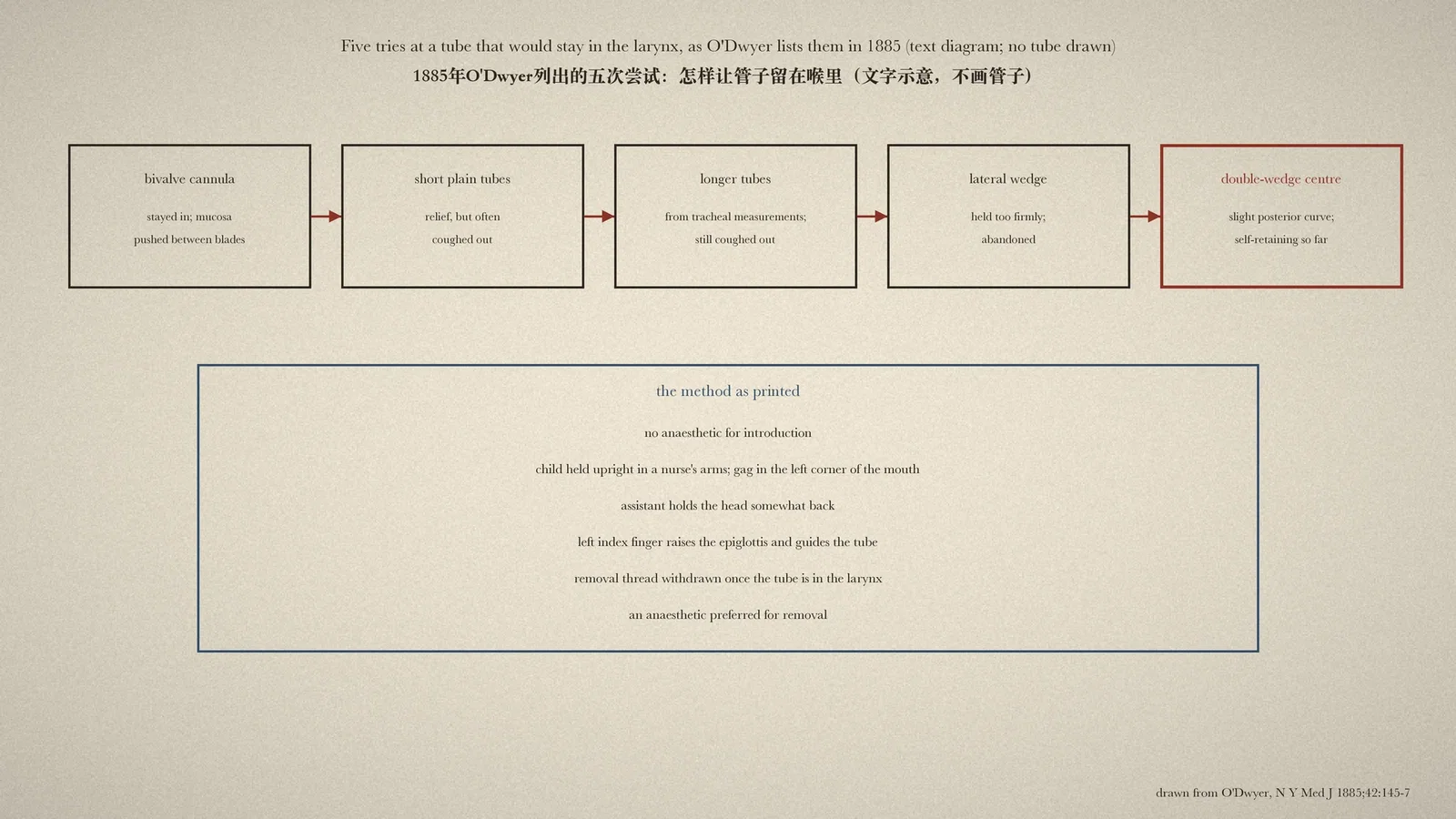
The problem was to make a tube that would stay. The first design was a bivalve, "similar to the bivalve speculum but elliptical in shape", whose blades closed for introduction and opened once released. It was always retained and gave prompt relief, but the relief did not last: the swollen mucous membrane pushed in between the blades. [1, p. 145]
Next came short plain tubes, also elliptical. The first patient was "an infant aged two months and twenty-four days, in the suffocative stage of diphtheritic croup". The breathing eased at once and the infant slept, and died seventeen hours later without visible suffering. The second, a child of three and a half under the care of J. Lewis Smith at the Foundling Asylum, got prompt relief; the tube was taken out on the fourth day, had to go back in five hours later when the obstruction returned, was coughed out on the seventh day, and the child recovered with a normal voice. In the third, a boy of four, the tubes were coughed out one after another; the largest stayed, the child died, and at autopsy the lower end of the tube was blocked by false membrane. [1, pp. 145-6]
"This case proved the necessity for longer tubes". O'Dwyer had a set made "in accordance with a large number of measurements of the trachea at different ages", long enough to reach close to the bifurcation; a short curve on the introducer let them pass as easily as the short ones, but most were still coughed out. A wedge-shaped piece of metal on the side held the tube under the vocal cords, and held it so firmly that removal became very difficult, so it was dropped. [1, p. 146]
The tubes in use in 1885 had two changes. The top was given "a slight posterior curve", to let the epiglottis cover the opening when the child swallowed, although O'Dwyer admitted that "the deglutition of fluids can never be perfect with any form of tube in the glottis". And the middle was widened, "somewhat in the shape of a double wedge", so that the larynx itself held the tube in place. In the few cases tried, it had stayed. [1, p. 146]
The method
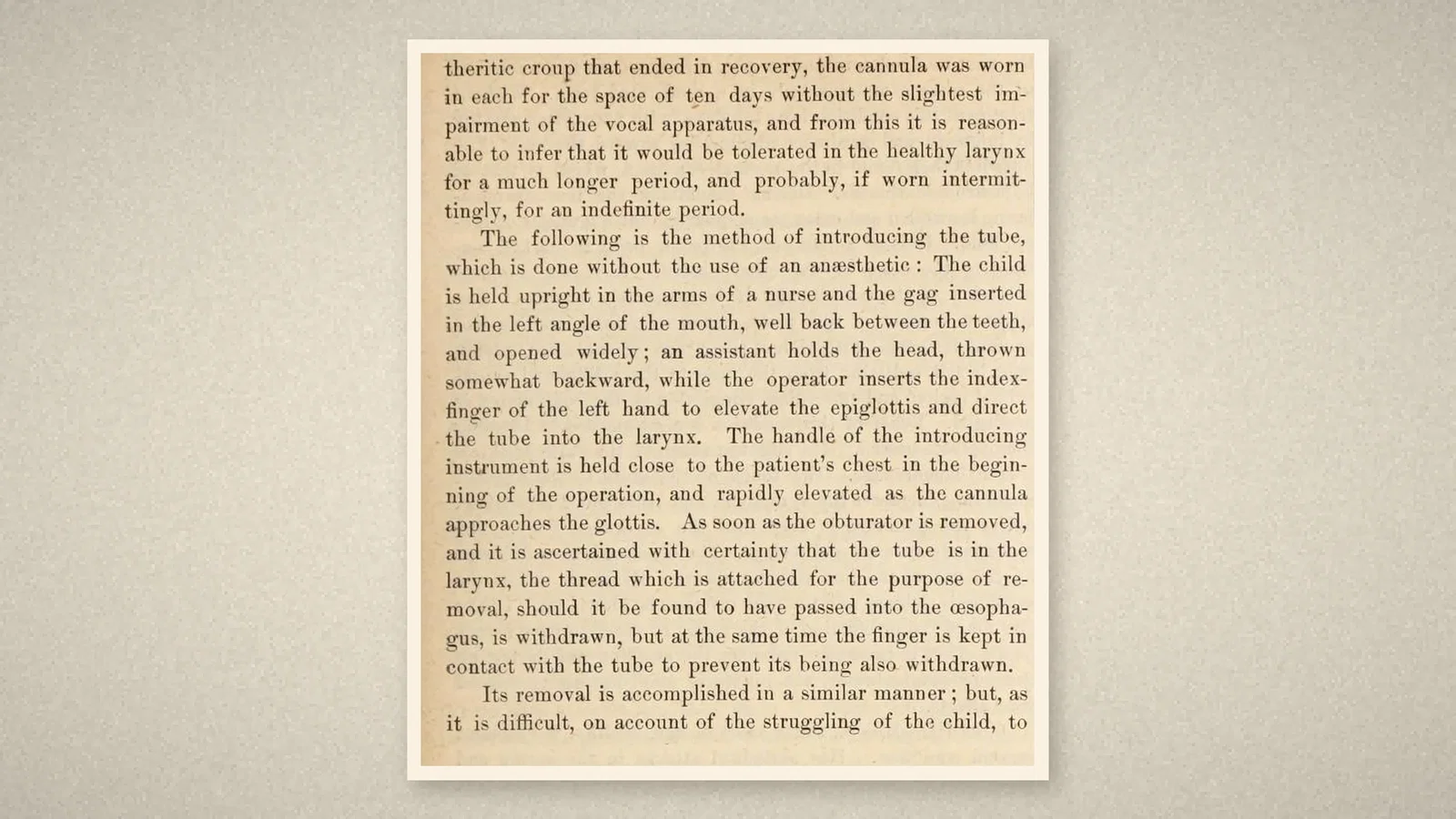
The introduction "is done without the use of an anaesthetic". The child is held upright in a nurse's arms; a gag goes in at the left corner of the mouth and is opened widely; an assistant holds the head tilted back; the operator puts the left index finger in to lift the epiglottis and guide the tube into the larynx, raising the handle of the introducer from the chest as the tube nears the glottis. Once the tube is surely in the larynx, the thread kept for retrieval from the oesophagus is pulled out while the finger holds the tube. Removal is done the same way, but because the child struggles, O'Dwyer preferred "to give an anaesthetic for this purpose". [1, p. 147]
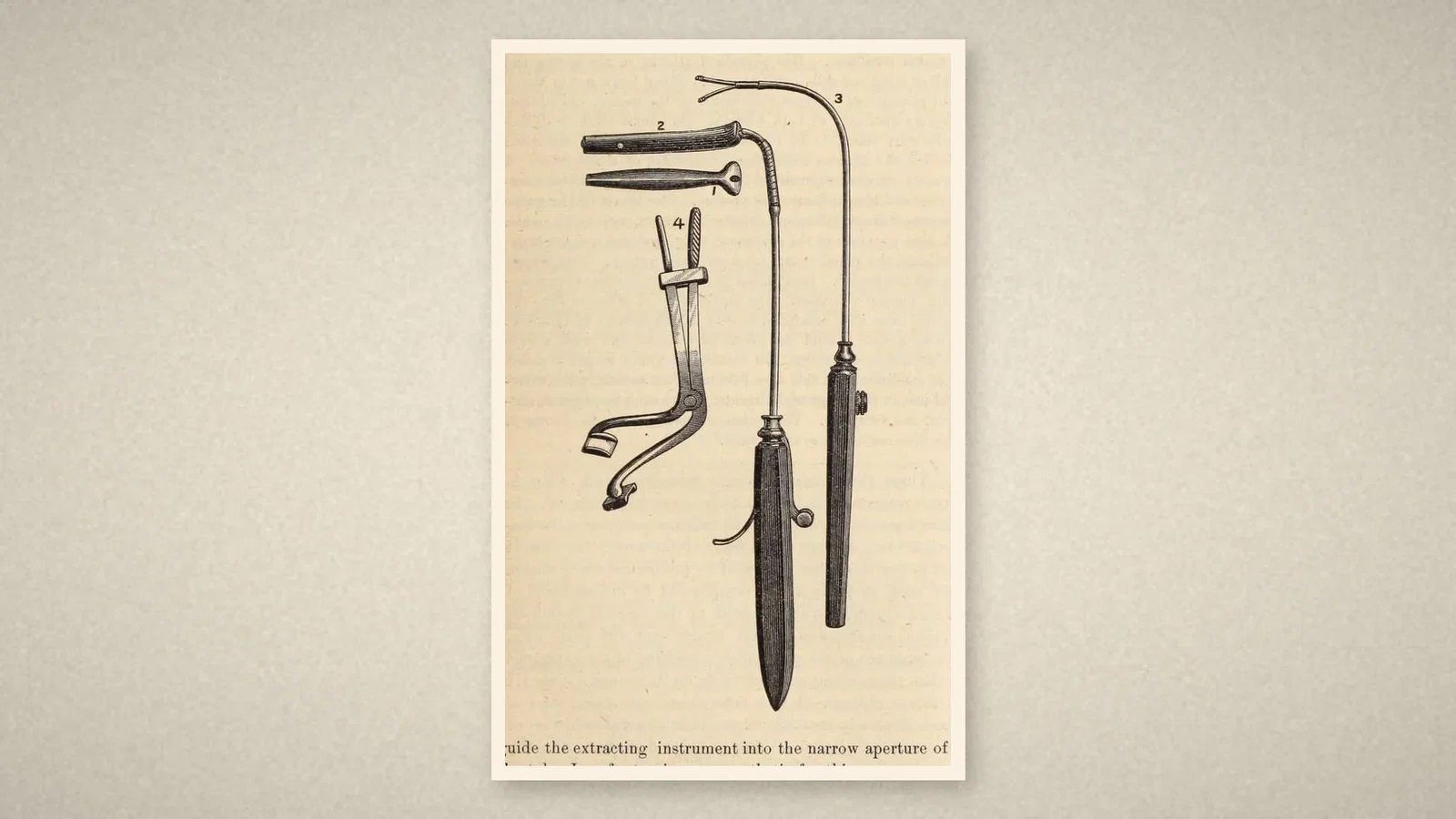
The engraving shows the tube from the front, the tube on its introducer, the extracting instrument and the mouth gag. The instruments were made by H. Keller of New York. [1, p. 147]
A prediction, not a verdict
O'Dwyer did not claim a result. The work had been "of a purely experimental character" until very recently, and the value of the method was left to a wider trial. The article still ventured a forecast: that the method would come to be seen as "a legitimate and valuable method of overcoming obstructions in the upper air-passages", and might also serve as a dilator in chronic stenosis. The evidence offered for tolerance was two recovered children who had worn the tube for ten days each without harm to the voice. [1, pp. 146-7]
What the record shows
A tube that goes into the larynx through the mouth and stays there, put in by feel with a finger on the epiglottis, without anaesthesia, to keep a child breathing. The paper shows the route by which O'Dwyer got there, design by design, and how each failure decided the next shape.
Sources and reading limits
Read: O’Dwyer, “Intubation of the larynx”, New York Medical Journal, 8 August 1885;42:145–7, in full.
Not covered: Bouchut’s 1858 report and Trousseau’s response; J. Lewis Smith’s article on croup in the American Journal of the Medical Sciences; O’Dwyer’s later papers and the books on intubation that followed; the Wood Library-Museum item; any later follow-up of the children, whose total number the article does not give.
The cases are O’Dwyer’s own, and the forecast about the method’s value is the author’s. Tube lengths and sizes given in the article are not repeated here. The only earlier attempt discussed is the one O’Dwyer names, Bouchut’s.
Three illustrations are crops of the New York Medical Journal (pp. 145 and 147); one is a text diagram drawn from the article, with no tube drawn.
- O'Dwyer J. Intubation of the larynx. N Y Med J. 1885;42:145-7. Internet Archive
Continue exploring
Related reading connects shared questions and contexts; it does not by itself establish historical influence.
Anesthesia Epochs · The Source Room · About & Editorial Method
Published November 3, 2026. Sources and reading limits are stated above. Illustrations are labelled as original source images or AI-made. Historical accounts are educational; they are not current treatment instructions.