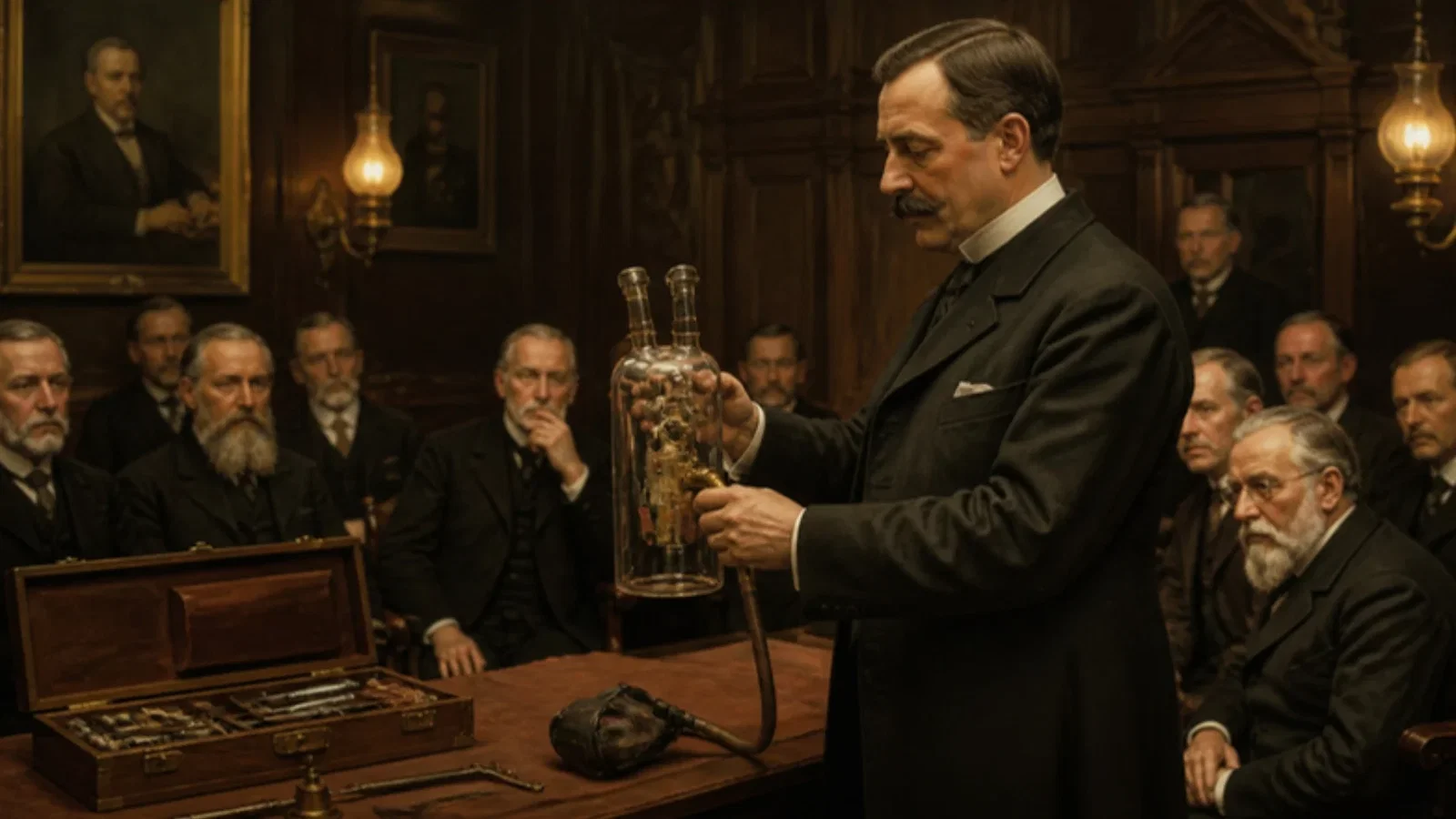
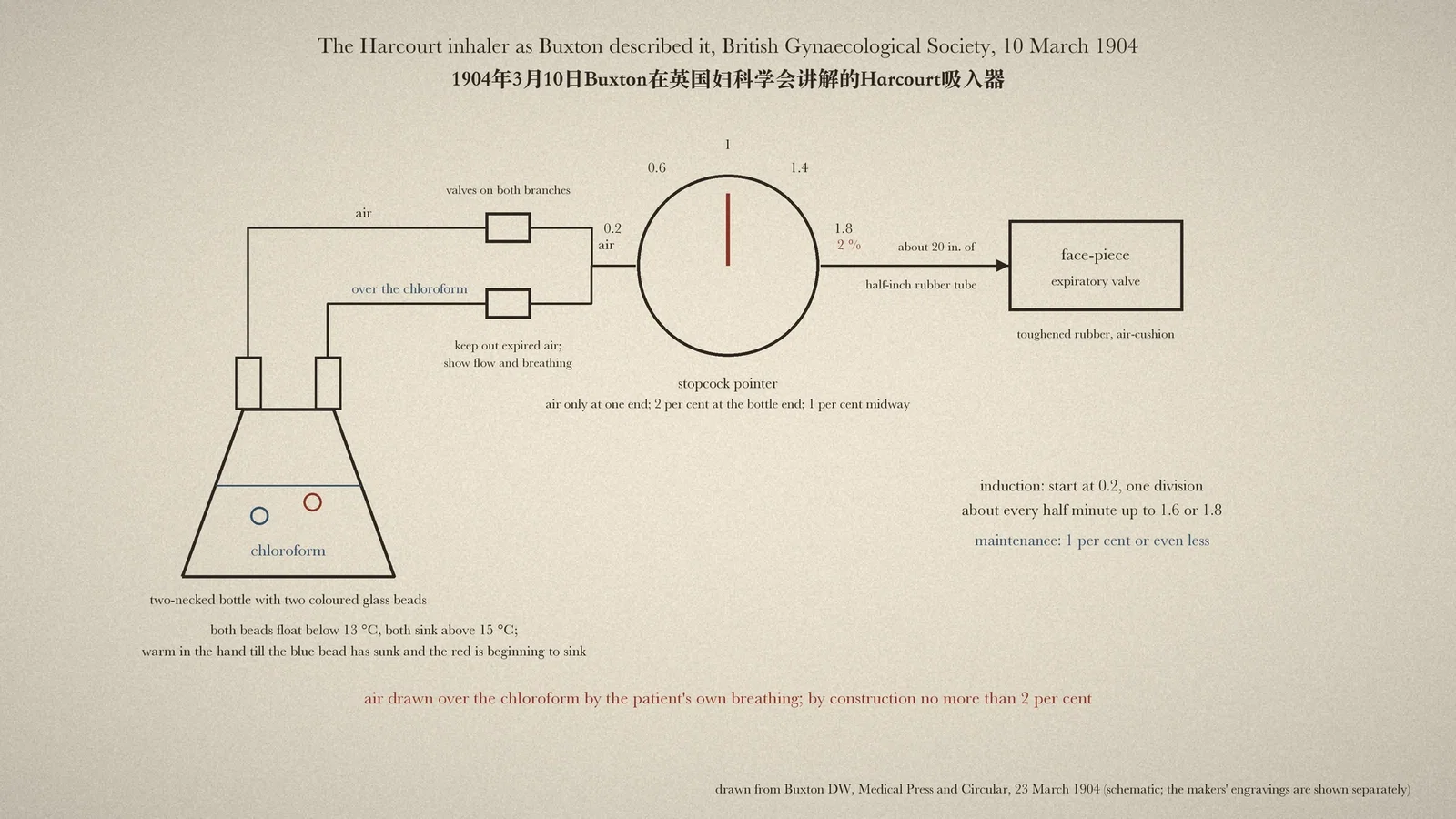
On 10 March 1904 Dudley W. Buxton described to the British Gynaecological Society the inhaler A. Vernon Harcourt had designed for the BMA Chloroform Committee, built to deliver no more than 2 per cent chloroform vapour, with a pointer to set the strength, beads to show the temperature and valves to show the flow.
Reading Library · Anesthesia Epochs · 中文版
Watch the education video (for clinicians)
1904: The Vernon Harcourt Chloroform Inhaler · Anesthesia Epochs Education Series
Every modern vaporizer has a dial marked in per cent and a maximum it cannot exceed. Early in the last century, British anaesthetists argued over whether chloroform deaths came from a mysterious "idiosyncrasy" or simply from too much vapour. The Australian Society of Anaesthetists (ASA) timeline lists "Harcourt's Chloroform Inhaler" under 1904, with temperature beads, a dial and valves, and a later Harcourt apparatus under 1912. This article reads how the inhaler was presented to clinicians: a paper by Dudley W. Buxton, read at the British Gynaecological Society on 10 March 1904 and reprinted from the Medical Press and Circular of 23 March, with the makers' illustrated price list bound in. [1][2]
From a committee to an inhaler
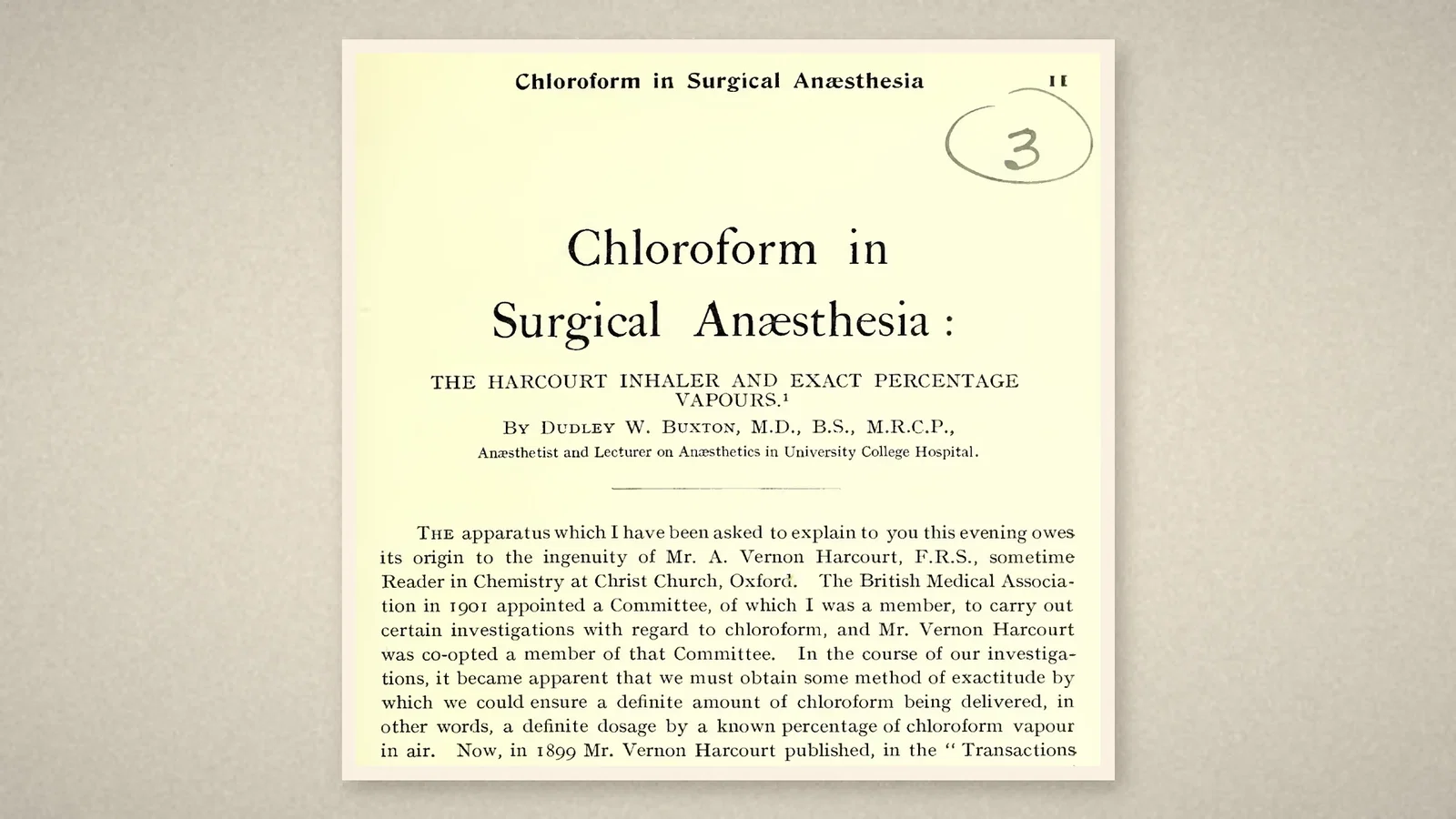
Buxton, anaesthetist and lecturer at University College Hospital, explained that the apparatus "owes its origin to the ingenuity of Mr. A. Vernon Harcourt, F.R.S., sometime Reader in Chemistry at Christ Church, Oxford." In 1901 the British Medical Association had appointed a committee, of which Buxton was a member, to investigate chloroform; Harcourt "was co-opted a member". The committee found that it needed "a definite dosage by a known percentage of chloroform vapour in air". Harcourt had described a laboratory method for mixing air with any proportion of chloroform in the Transactions of the Chemical Society in 1899, and two methods in a communication to the Royal Society in June 1902; the committee adopted the second as applicable to people, and Harcourt's report appeared in the BMJ of 18 July 1903. [1]
Why 2 per cent
The principle was simple: "air passes over the surface of chloroform by the aspiration of the patient's respiration", and "by its construction the apparatus delivers a maximum strength of 2 per cent". Buxton admitted having doubted at first that 2 per cent would satisfy surgery, and then argued the case. Clover's dosage method had allowed 4 to 5 per cent, "too dangerous for operations lasting any time"; in large bags of mixed air and vapour, "the heavy chloroform vapour sinks", so the mixture was not what it seemed. Dubois's apparatus in France also gave 2 per cent but was "too cumbersome and costly". Buxton cited animal work by Embley in which vapour over 2 per cent repeatedly caused fatal vagal inhibition of the heart, and argued that a low, uniform tension made the known dangers of chloroform survivable. [1]
The apparatus
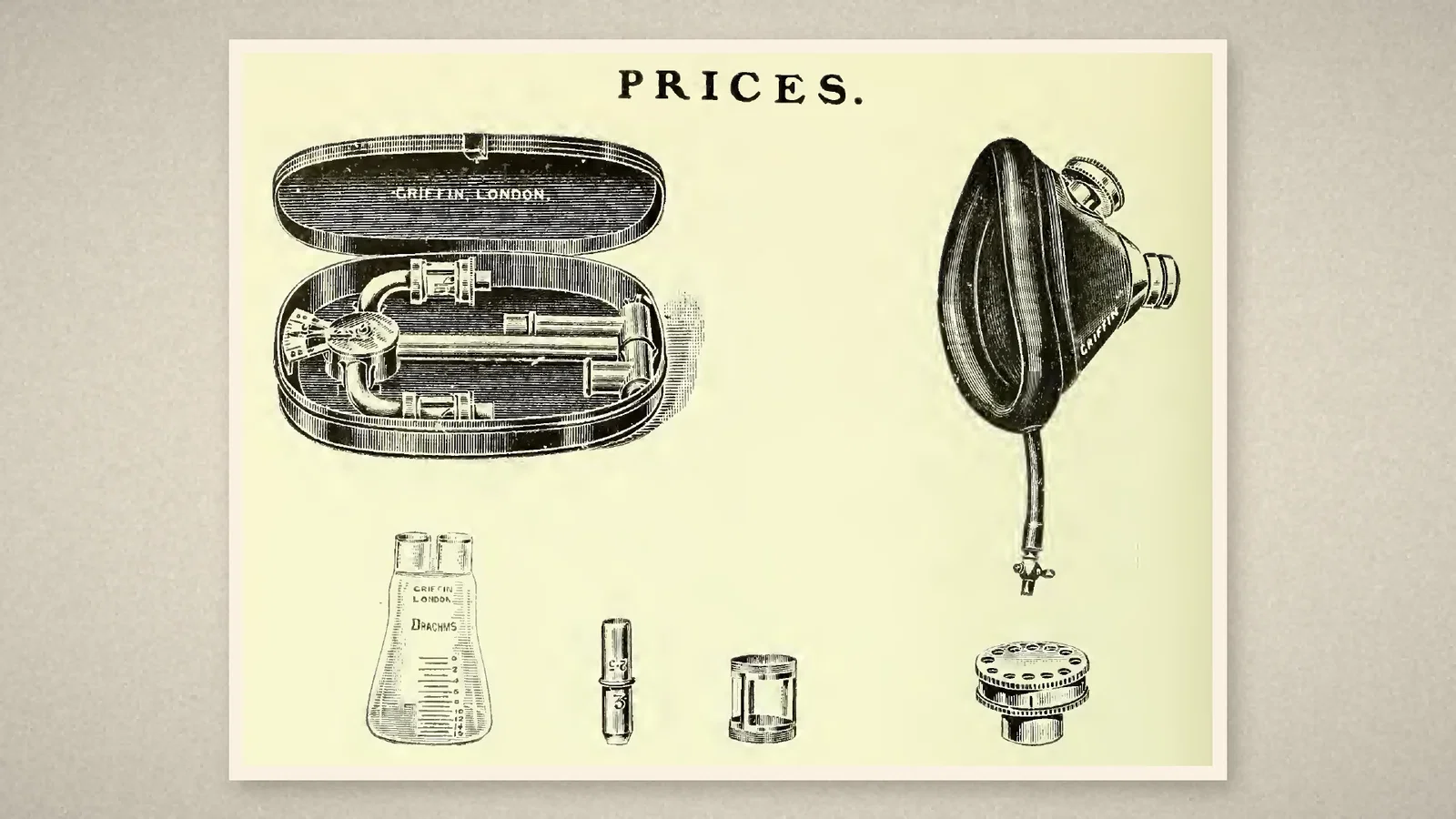
The inhaler was "a two-necked bottle", filled with chloroform to near the top of its conical part. "Two coloured glass beads are dropped into the liquid to indicate when the temperature is within the range 13°-15°C." Below 13 °C both floated and the patient received less than the pointer showed; above 15 °C both sank and the patient received more. Since evaporation cooled the liquid, the anaesthetist held the bottle in the hand from time to time "till the blue bead has sunk and the red bead is beginning to sink". [1]
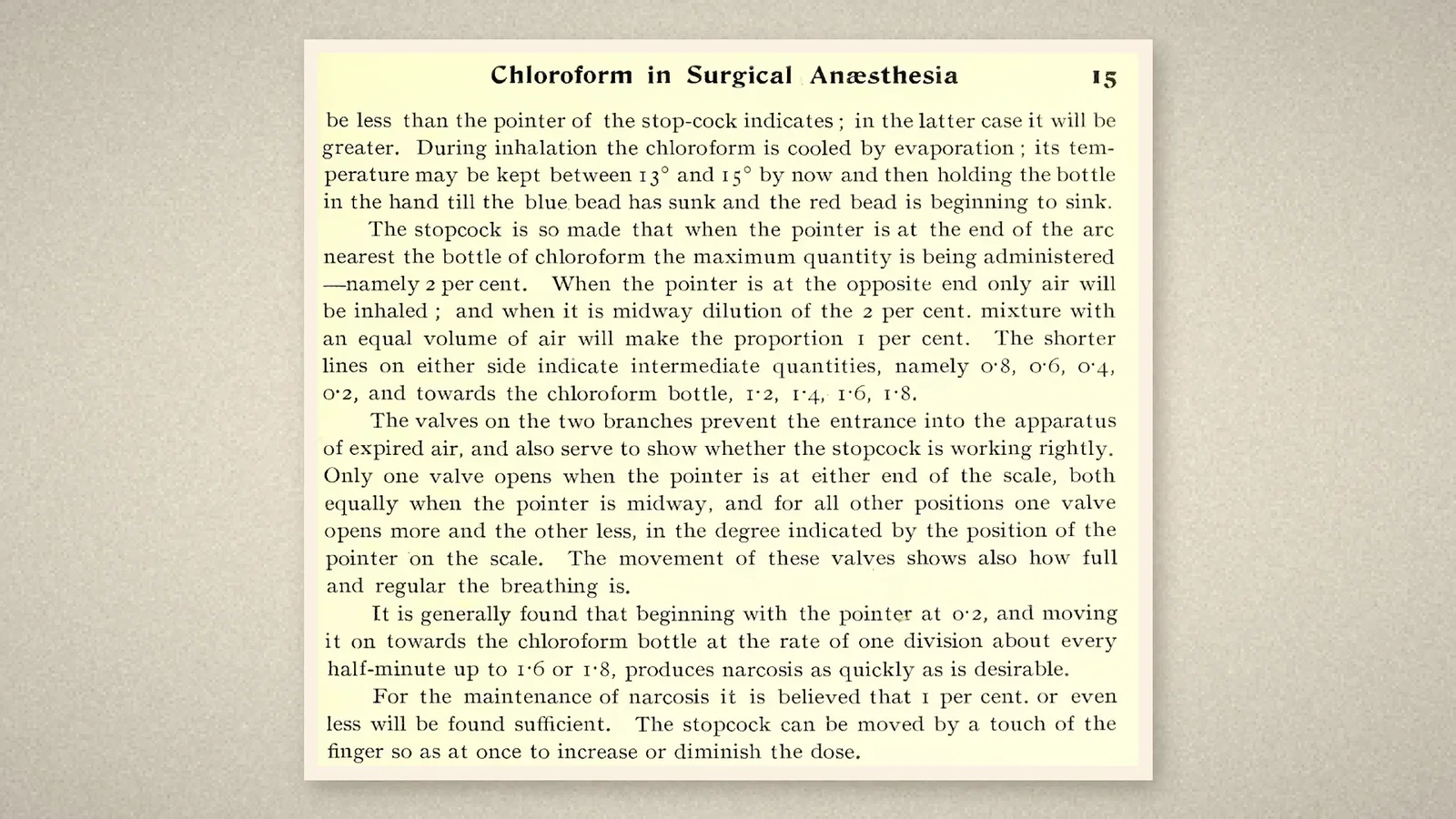
A stopcock divided the patient's breath between two branches. With the pointer at the end of the arc nearest the bottle, the maximum was being given, "namely 2 per cent"; at the opposite end only air was inhaled; midway, the 2 per cent mixture was diluted with an equal volume of air, giving 1 per cent; shorter lines marked 0.2 to 0.8 on one side and 1.2 to 1.8 on the other. Valves on the two branches kept expired air out of the apparatus and showed whether the stopcock was working: only one opened at either end of the scale, both equally at the midpoint. "The movement of these valves shows also how full and regular the breathing is." [1]
For induction, the pointer usually began at 0.2 and moved toward the bottle about one division every half-minute up to 1.6 or 1.8; for maintenance "1 per cent or even less" was expected to suffice. The face-piece, of toughened rubber with an air cushion and an expiratory valve, could be fixed directly to the inhaler held in the hand or joined by about 20 inches of half-inch rubber tubing, the inhaler then hanging on a stand or the back of the bed. [1]
Results and the trade
Buxton had used the inhaler in "some hundreds of cases", including gastric resections, colectomies, cholecystectomies, cerebral tumours and Gasserian ganglion resection, usually inducing at 2 per cent and maintaining at 1 or 0.5 per cent. Only once had the inhaler been supplemented, for a minute at a critical moment of a gall-bladder operation, and Buxton had never needed artificial respiration or tongue traction. Poor-risk patients, such as the very obese, those with goitre, empyema, severe heart disease or intestinal obstruction, were where the ability to reduce the percentage mattered most. Buxton insisted no one could invent "a penny-in-the-slot chloroform machine": the user still had to choose the strength for each patient. The makers' page offered the complete apparatus at five guineas, an "increase tube" raising the possible maximum to 2.5 and 3 per cent, spare beads, valves and face-pieces, and noted patents granted in Great Britain, Belgium, France and the United States. [1]
What the record shows
The Harcourt inhaler joined several ideas that vaporizers still carry: a calibrated control in per cent, an upper limit built into the construction, compensation for the cooling of the liquid, and a visible sign that gas is flowing. Its weak point is also visible in the text: the reading was only true if the anaesthetist kept the liquid in a narrow temperature band by hand, a problem later vaporizers solved with temperature compensation.
Sources and reading limits
Read: Buxton's paper as reprinted from the Medical Press and Circular of 23 March 1904, in full, with the Griffin price page; the ASA timeline entries for 1904 and 1912.
Not covered: Harcourt's own papers of 1899 and 1902 and the report in the BMJ of 18 July 1903; the reports of the BMA Chloroform Committee; patent specifications; the 1912 "Harcourt's Anaesthesia Apparatus", which the ASA describes as warmed by a candle. The ASA gives bead limits of 16 and 18 °C; Buxton gives 13-15 °C, and the article follows Buxton. The ASA's full name "Augustus George Vernon Harcourt" is not printed in Buxton's paper, which uses "A. Vernon Harcourt". Buxton was a committee member and the reprint carries the makers' prices; the clinical results and safety claims are Buxton's. Percentages are historical, not dosing guidance. The article makes no "first" claim.
Three illustrations are crops of the 1904 reprint and the makers' price page; one is drawn from Buxton's description.
- Buxton DW. Chloroform in surgical anaesthesia: the Harcourt inhaler and exact percentage vapours. Med Press Circ. 1904 Mar 23. Reprint, pp. 11-17, with price list of John J. Griffin & Sons. Internet Archive
- Australian Society of Anaesthetists. Anaesthesia history timeline. 2024. ASA
Continue exploring
Related reading connects shared questions and contexts; it does not by itself establish historical influence.
Anesthesia Epochs · The Source Room · About & Editorial Method
Published November 2, 2026. Sources and reading limits are stated above. Illustrations are labelled as original source images or AI-made. Historical accounts are educational; they are not current treatment instructions.