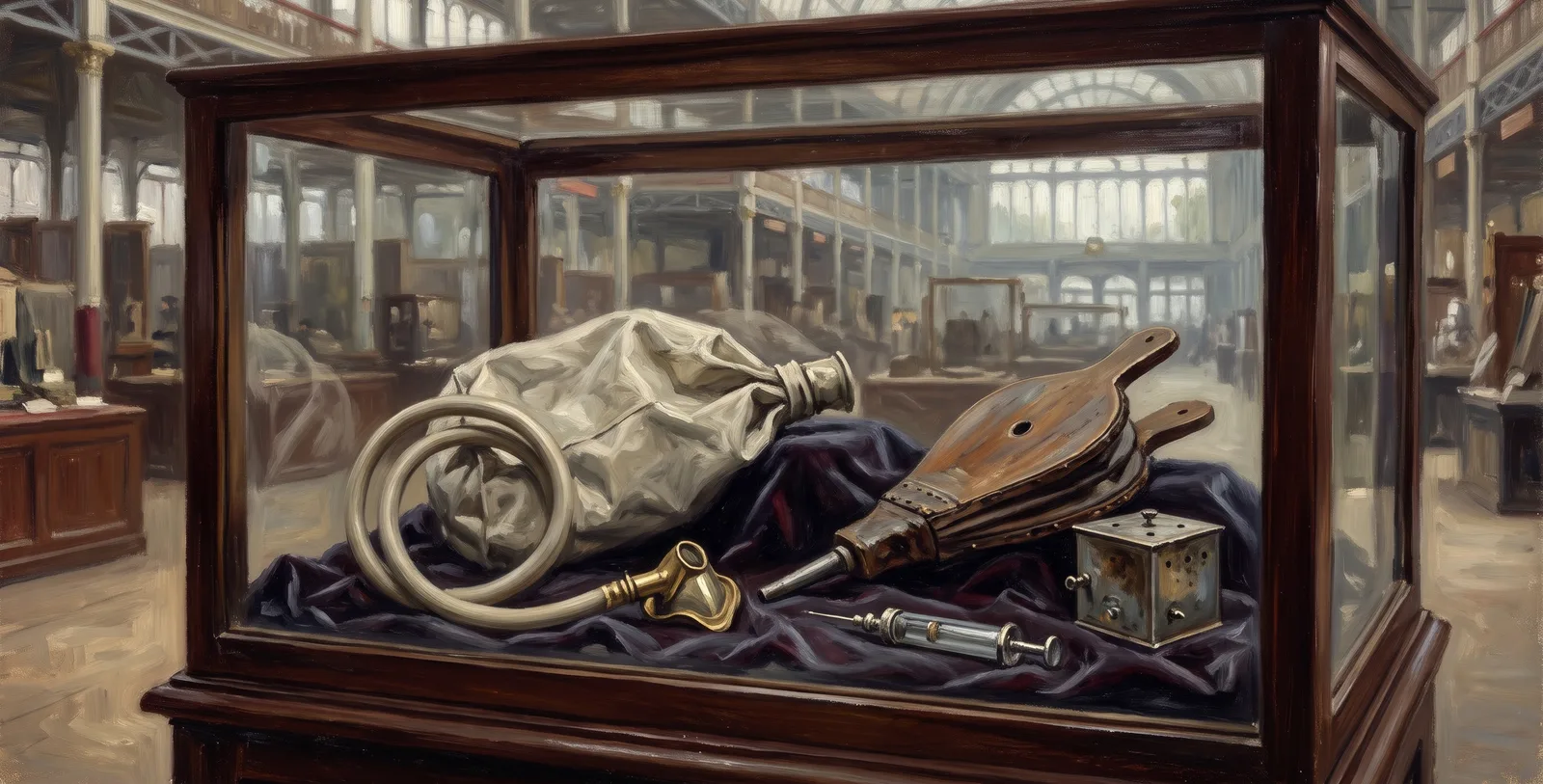
Clover's inhaler used bellows and a measured syringe of chloroform to fill a bag, hung from the administrator's collar, with a four and a half per cent mixture.
Reading Library · Anesthesia Epochs · 中文版
Watch the education video (for clinicians)
1862: Clover's Chloroform Bag — A Ceiling at 4.5 Per Cent · Anesthesia Epochs Education Series
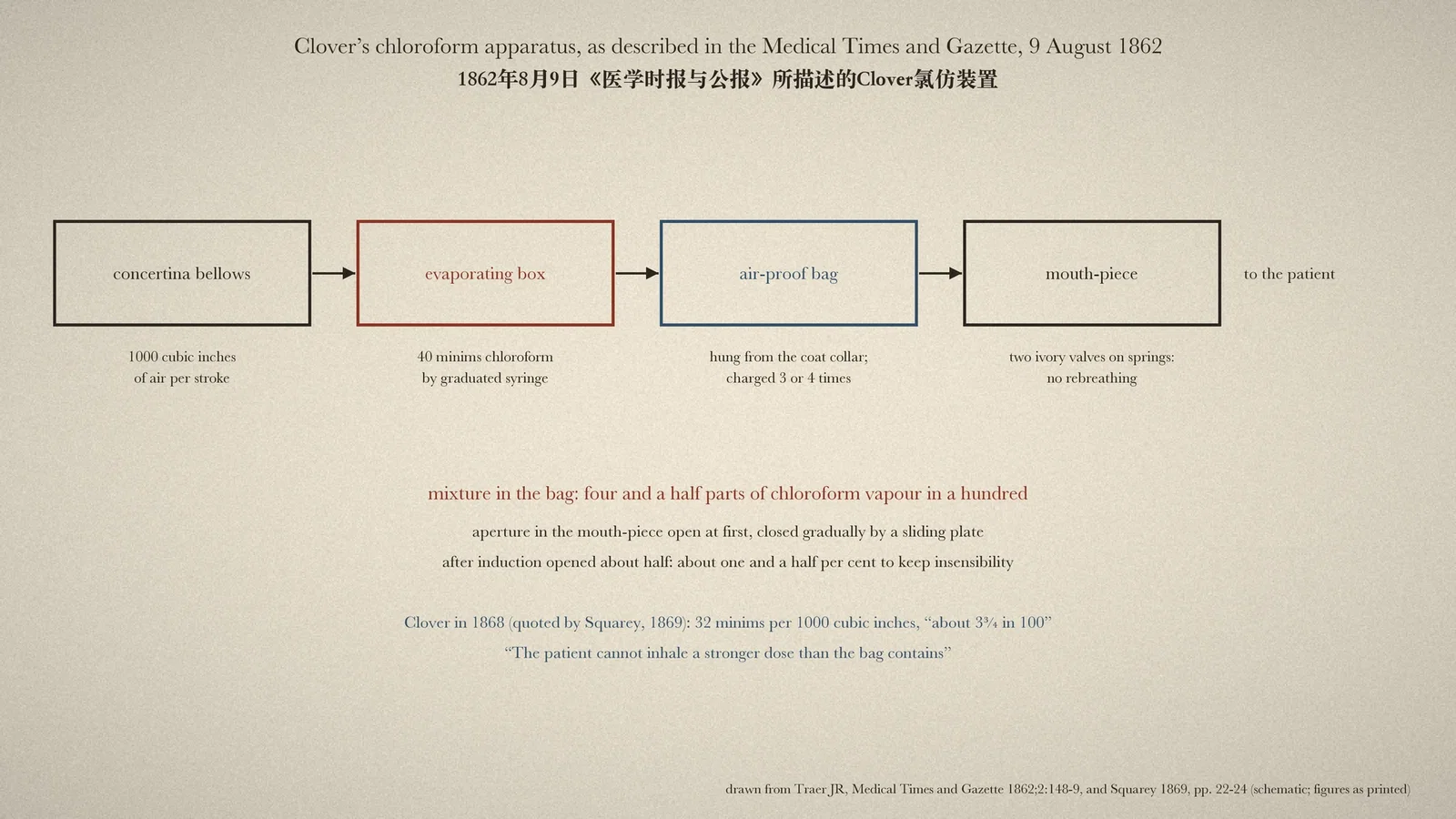
Chloroform killed patients when it was given too strong, and much of it was still given on a folded napkin, as a letter of 1862 complains. One answer was to make the strength of the vapour a matter of measurement. This article reads the description of Joseph Thomas Clover's chloroform apparatus published in London in August 1862, when it was shown at the International Exhibition, and compares it with Clover's own account of 1868. [1][2][3]
The 1862 description
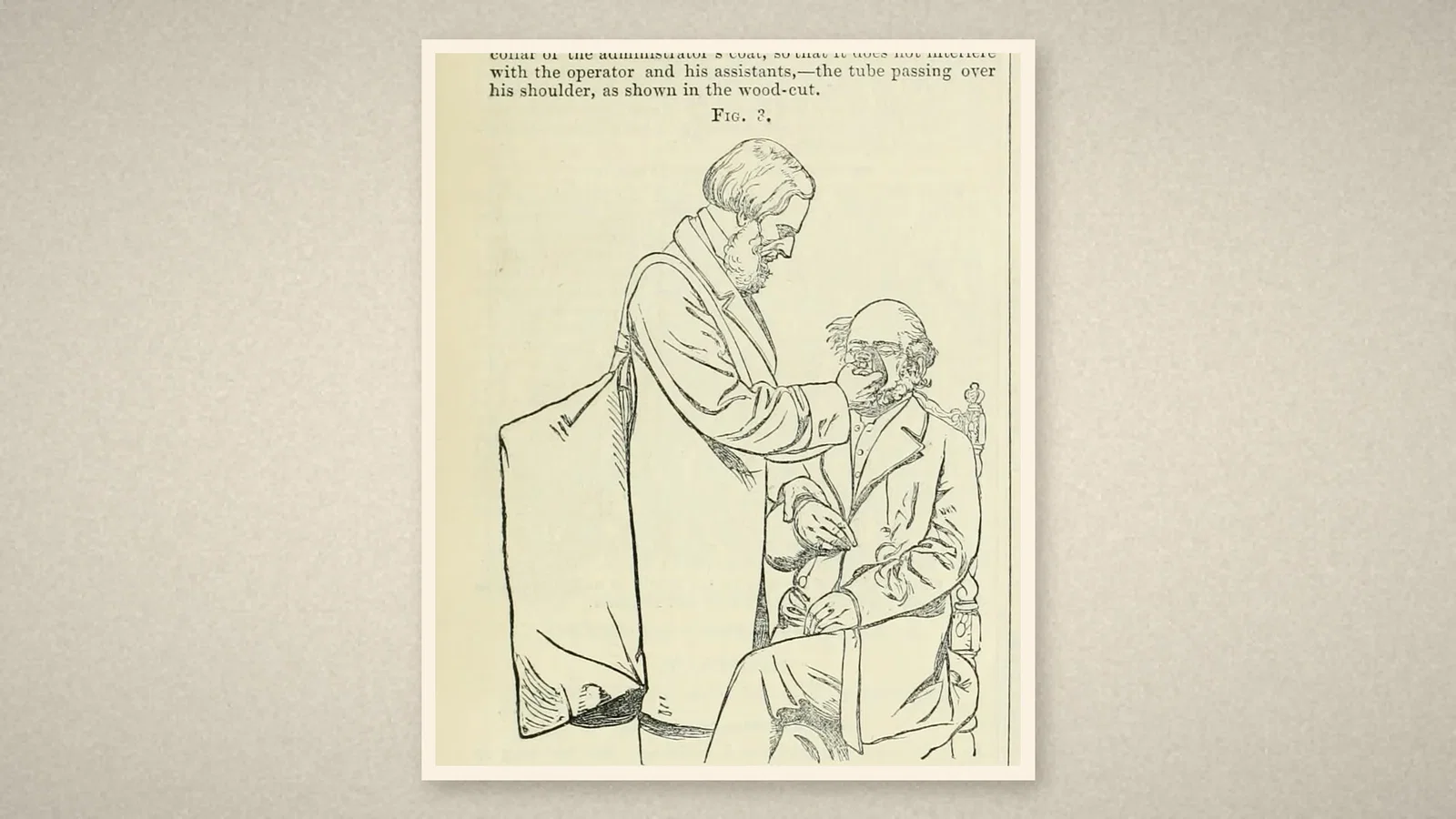
In 1862 the Medical Times and Gazette ran a series by James Reeves Traer, FRCS, on the surgical, medical and obstetrical instruments at the International Exhibition. The instalment of 9 August describes "Mr. Clover's chloroform inhaler", shown in a woodcut. The instrument "has been contrived in order to regulate with precision the mixture of air and chloroform vapour, and to limit the proportion of the latter to four and a-half parts in a hundred". It consists of a bag of air-proof cloth, a flexible tube with a bayonet joint, and a mouth-piece with two valves made of thin plates of ivory on spiral springs, which "render it impossible for the patient to breathe the expired air a second time". The bag hangs from the collar of the administrator's coat, so that it does not get in the way of the surgeon, with the tube passing over the shoulder. [1]
How the bag was charged
To fill the bag, a bellows "in shape like a concertina" was fastened to the edge of a table, its nozzle joined to a metal box in which a bottle of hot water, covered with blotting paper, spread out the chloroform to evaporate. A glass syringe, limited by a screw-nut to forty minims, fed chloroform through a cork in the lid. The bellows held 1000 cubic inches: with the left hand the operator pushed this volume of air through the box, while with the right the syringe delivered forty minims, "the equivalent of 45 cubic inches of chloroform vapour". This was repeated three or four times, and the mixture in the bag was then four and a half parts in a hundred. [1]
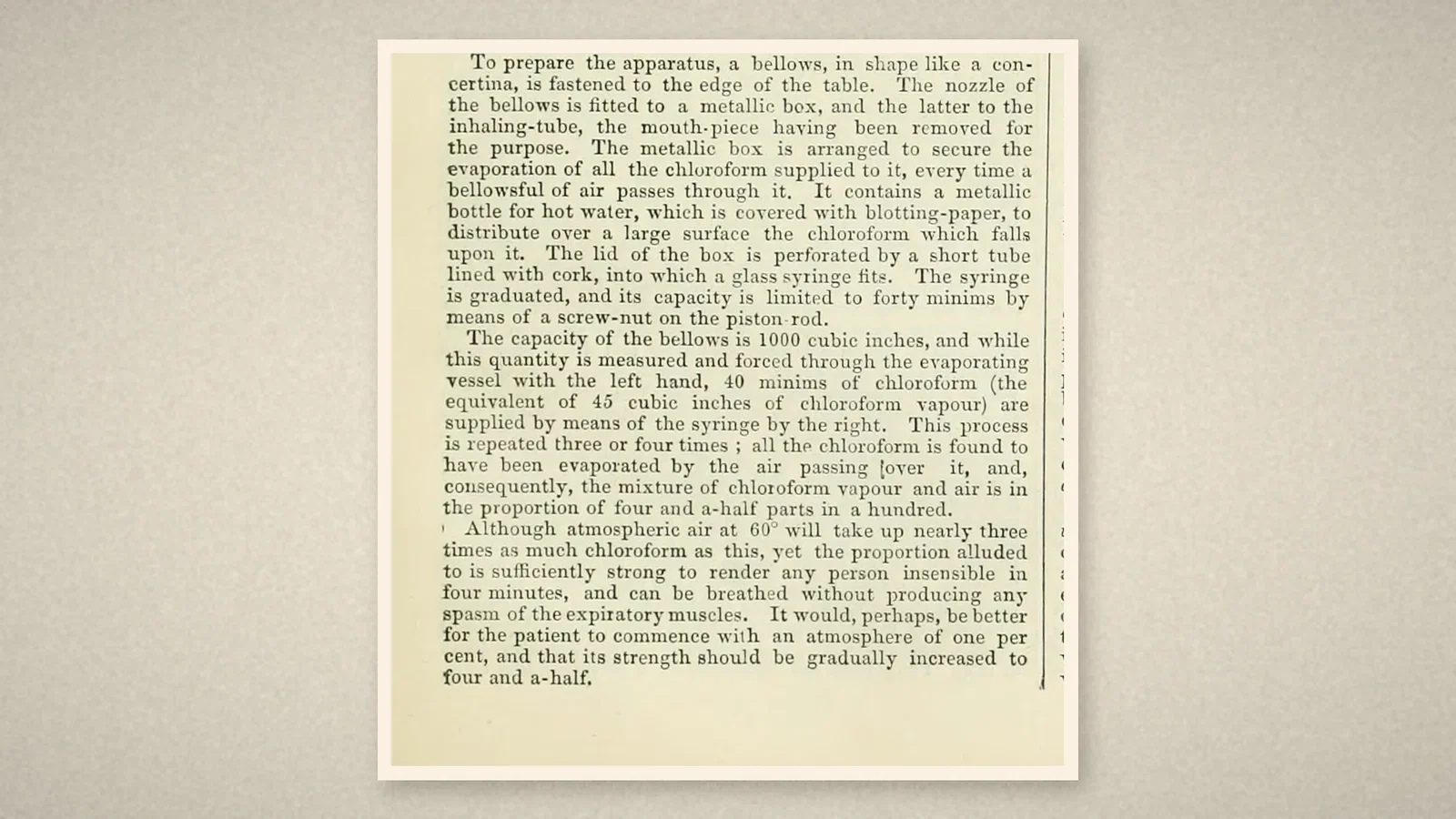
Traer noted that air at 60 degrees could hold nearly three times as much chloroform, yet this proportion was strong enough "to render any person insensible in four minutes", and could be breathed without spasm. An aperture in the mouth-piece let in air to dilute the vapour; it was left open at first, closed gradually by a sliding plate as the patient breathed freely, and after induction opened again to about half, so that the patient breathed "about one and a-half per cent., which is sufficiently strong to keep up perfect insensibility". [1]
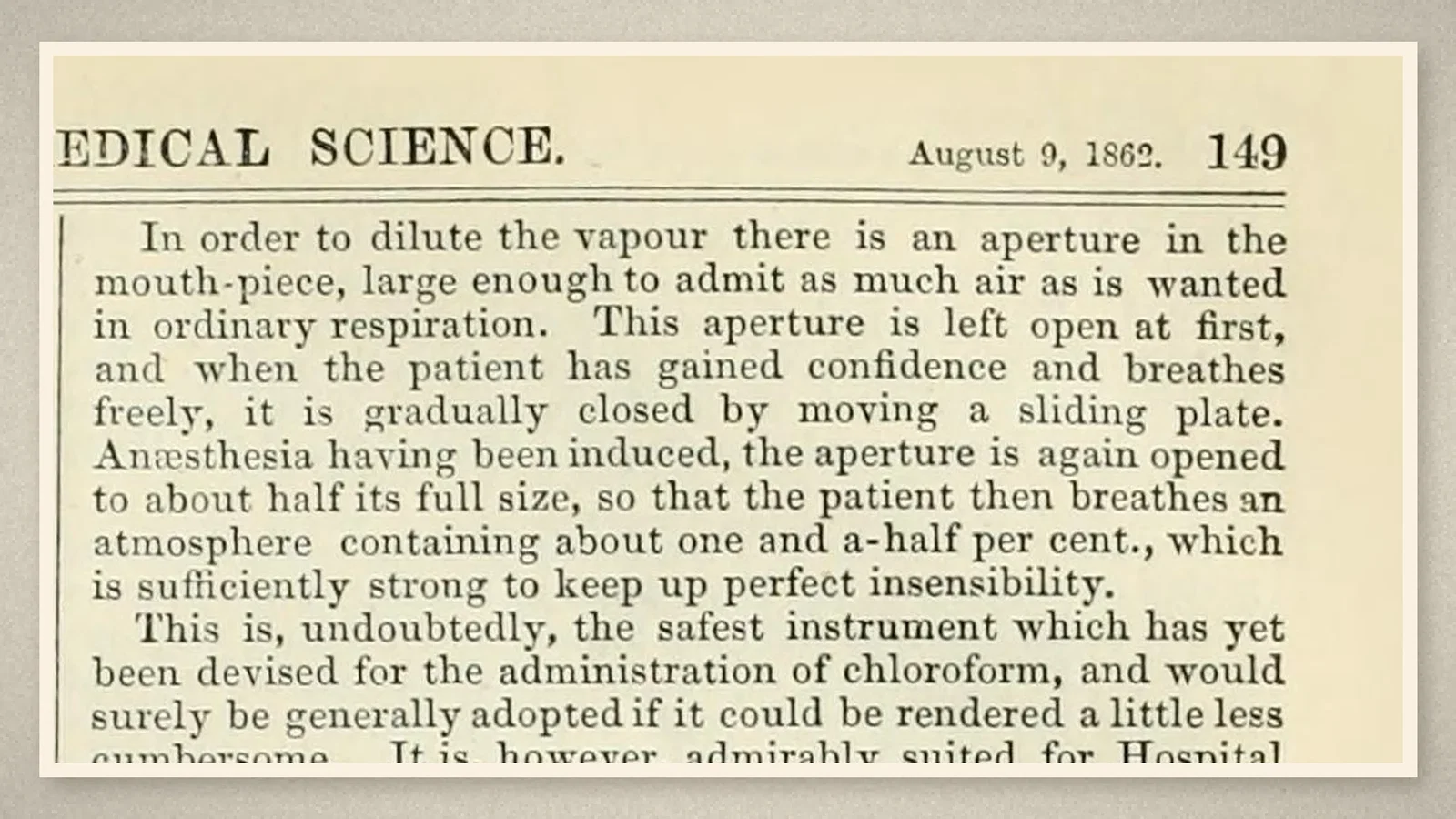
"This is, undoubtedly, the safest instrument which has yet been devised for the administration of chloroform," Traer concluded, "and would surely be generally adopted if it could be rendered a little less cumbersome." In the same volume, the physician Francis Anstie, writing about chloroform deaths, made the same point: with the apparatus of Snow and its modifications a roughly uniform atmosphere of four per cent could be secured, but "with the apparatus invented by Mr. Clover this can be effected exactly". [1]
Clover's own account, 1868
Clover described the apparatus to the Odontological Society in March 1868, in words quoted by Charles Squarey in 1869. By then the syringe took thirty-two minims per bellowsful, repeated six or seven times, giving "a uniform mixture of about 3¾ inches of chloroform with each 100 inches of air"; the sliding door in the face-piece could reduce it to three, two or one per cent. The key sentence is Clover's: "The patient cannot inhale a stronger dose than the bag contains." [2]
What the record shows
Clover's bag did what a modern calibrated vaporizer does by other means: it set a ceiling on the concentration the patient could breathe, and let the anaesthetist dilute below it. Its one-way valves kept expired gas out of the reservoir. Its weakness was the one Traer named: it was cumbersome. The principle, measure the agent and limit the strength, outlasted the bag.
Sources and reading limits
Read: Traer's description of Clover's inhaler in the Medical Times and Gazette of 9 August 1862 (pp. 148-149), with the woodcut; Anstie's letter in the same volume; Clover's 1868 description as quoted by Squarey (1869), pp. 22-24; the 2024 ASA timeline entry.
Not covered: any paper by Clover from 1862; the exhibition jury reports; Snow's apparatus, which the timeline says Clover's was based on. The 1862 and 1868 figures differ (forty minims and four and a half per cent; thirty-two minims and about three and three-quarters per cent), and both are given as printed, not as guidance.
Three illustrations are crops of page 149 of the 1862 journal, including its woodcut; one is drawn from the descriptions.
- Traer JR. [Instruments in the International Exhibition of 1862]. Medical Times and Gazette. 1862;2:148-9. Internet Archive
- Squarey C. On the administration of chloroform and nitrous oxide. London: James Walton; 1869. pp. 22-24. Internet Archive
- Australian Society of Anaesthetists. Anaesthesia history timeline. 2024. ASA
Continue exploring
Related reading connects shared questions and contexts; it does not by itself establish historical influence.
- 1848: Snow Warns That Chloroform Keeps Deepening After Inhalation
- 1856: Snow Tries Amylene at King's College Hospital
Anesthesia Epochs · The Source Room · About & Editorial Method
Published November 2, 2026. Sources and reading limits are stated above. Illustrations are labelled as original source images or AI-made. Historical accounts are educational; they are not current treatment instructions.