
Snow told the Westminster Medical Society that chloroform's effect deepens after inhalation stops, urged plenty of air with the vapour, and described a portable inhaler.
Reading Library · Anesthesia Epochs · 中文版
Watch the education video (for clinicians)
1848: John Snow's Chloroform Inhaler — The Cumulative Property · Anesthesia Epochs Education Series
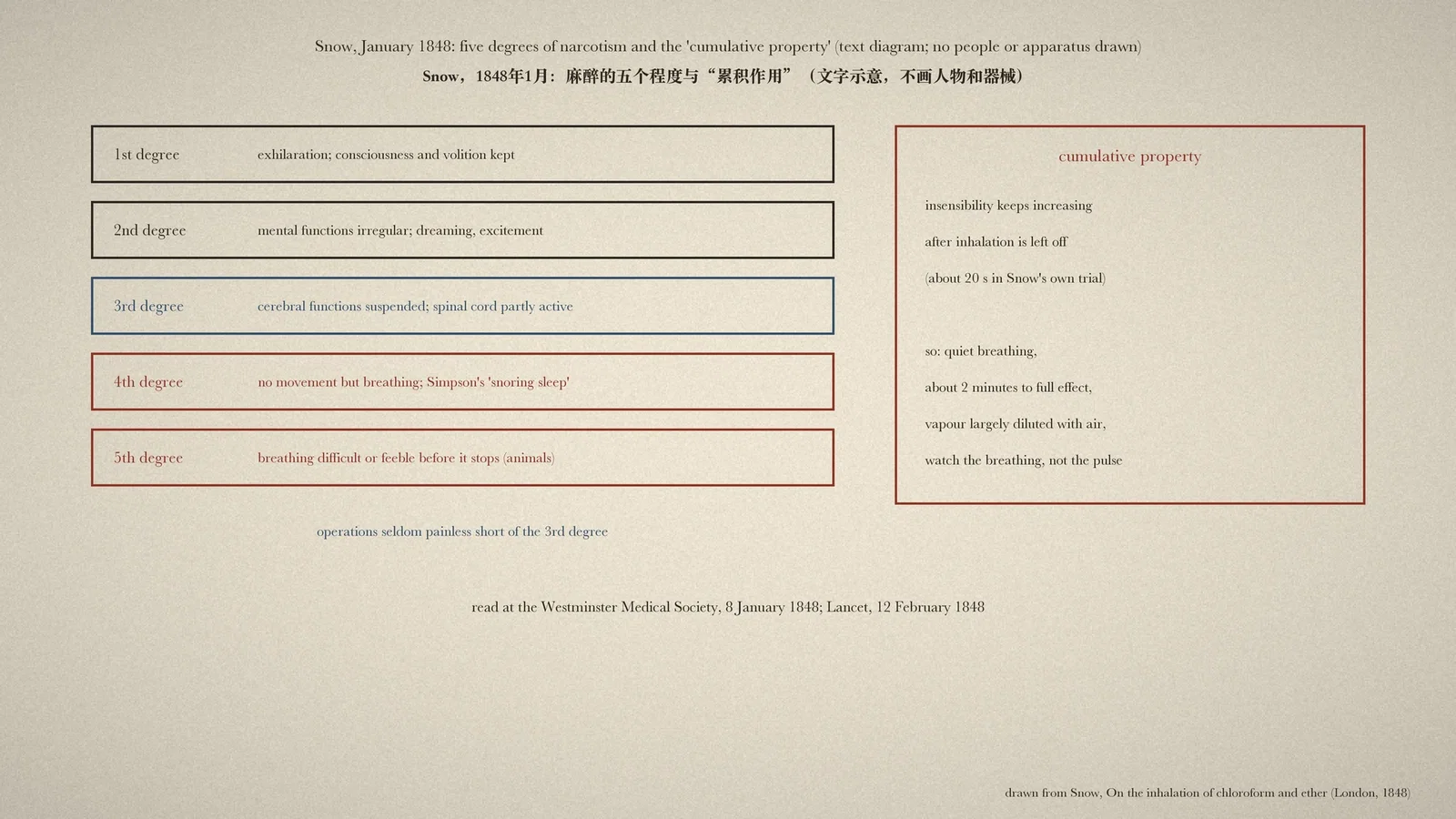
Chloroform was barely two months old when John Snow, in London, set it beside ether in a single report. Snow granted its advantages but singled out a property few had mentioned: after inhalation stops, insensibility goes on deepening. From that came a method of giving it slowly, diluted, with an eye on the breathing, and a new inhaler to do it with. [1, p. 8][1, p. 10]
The paper
On 8 January 1848 Snow read "On the inhalation of chloroform and ether" to the Westminster Medical Society in London; it appeared in the Lancet on 12 February. The same year T. C. Savill printed it as a pamphlet, the text as in the Lancet with footnotes added, signed "Frith-street, Soho, Jan. 1848". [1, title page][1, p. 16]
Five degrees
Snow begins with earlier work: an apparatus shown to the Society the previous January for regulating the proportions of ether vapour and air, and a division of etherization into five degrees, set out in the autumn and held to apply equally to chloroform. In the first degree there is exhilaration, with consciousness and volition kept; in the second, the mind works irregularly, there may be dreaming, and excitement mostly belongs here; in the third, the functions of the cerebral hemispheres seem suspended while those of the spinal cord and nerves partly continue; in the fourth, nothing moves but the breathing; the fifth, seen by Snow in animals, is breathing that becomes difficult or feeble before it stops. [1, p. 3][1, p. 4]
An operation, Snow held, can seldom be done without signs of pain unless narcotism reaches the third degree. Snow had notes of fifty cases with chloroform, and found it less pungent and easier to inhale than ether, taking up less space and not causing the flow of saliva ether sometimes did. [1, p. 4][1, p. 6][1, p. 7]
The cumulative property
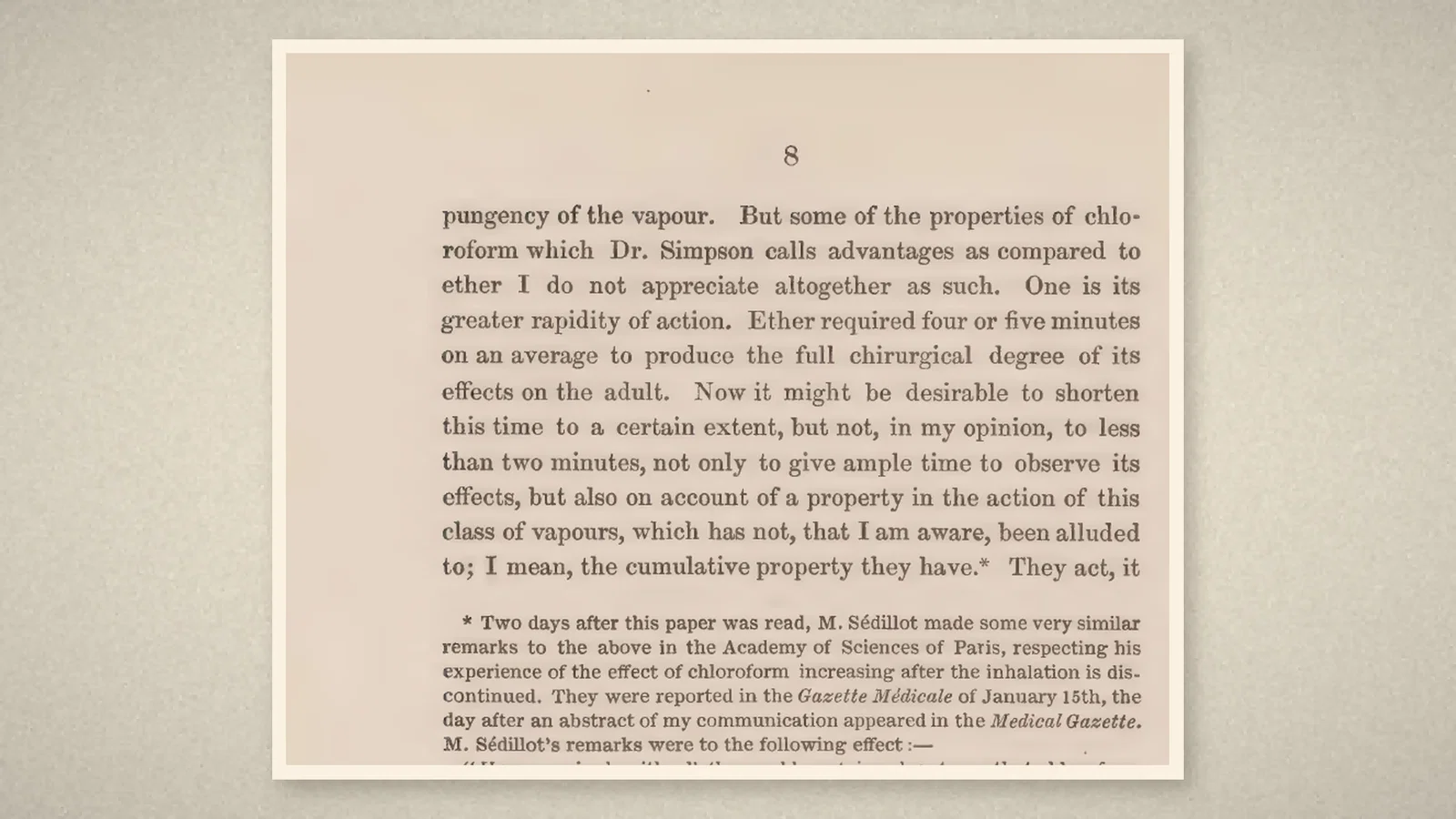
Another of the "advantages" Simpson claimed for chloroform, its greater speed, Snow did not fully accept. These vapours, Snow wrote, have "the cumulative property": it takes a little time for vapour taken into the blood to pass through the heart and reach the nerve centres, so insensibility goes on increasing after inhalation is left off. In trials on Snow's own person, taking a few breaths, stopping and watching a clock, the increase lasted about twenty seconds. Snow therefore liked about two minutes to bring a patient to full insensibility, whereas chloroform given by Simpson's handkerchief method often acted much faster. What Simpson called "a snoring sleep", Snow called the fourth degree, only one degree from the cessation of breathing. [1, p. 8][1, p. 9]
The way to avoid danger with chloroform, Snow wrote, besides watching its effects closely, was to see that the vapour was largely diluted with air. Snow always told patients to breathe quietly, and if the breathing became deep, opened the valve to let in more outside air. [1, p. 8][1, p. 10]
A footnote
A footnote in the pamphlet adds that two days after the paper was read, Sédillot made very similar remarks at the Academy of Sciences in Paris: after chloroform was stopped, pallor, small pulse, feeble breathing and coldness could go on increasing; Sédillot had twice been seriously alarmed; and in unskilful hands chloroform was far more dangerous than ether. Snow feared Sédillot's rule would not always prevent danger, nor would it have prevented "the unfortunate occurrence near Newcastle a few days ago". From the reported evidence, and from Meggison's reply to Snow's questions, Snow judged that death to be due to the effect increasing after the cloth was taken from the patient's face. [1, p. 8]
The inhaler
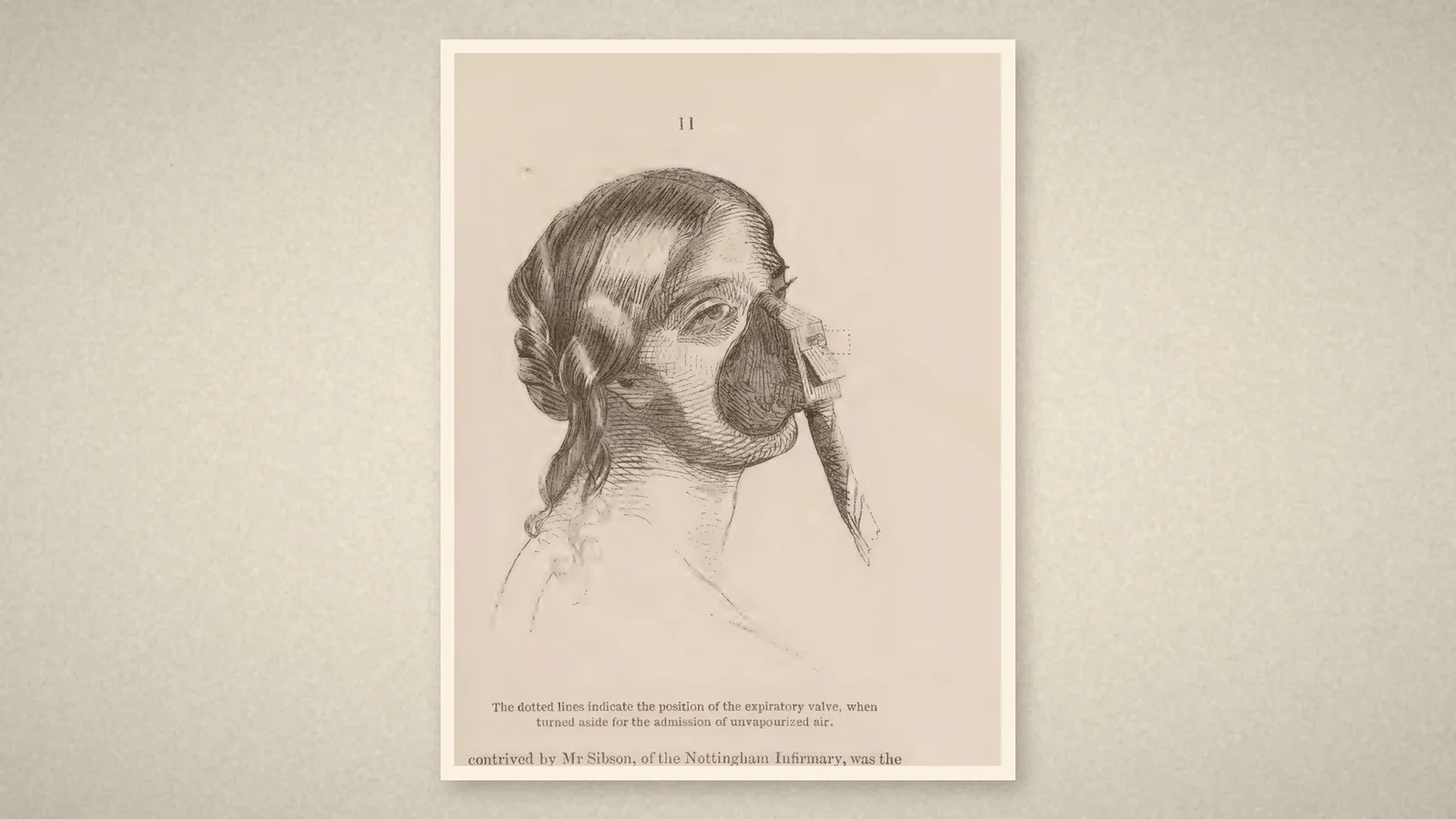
For some weeks, Snow writes, chloroform was given with the apparatus used for ether; then a more portable one was made. It kept the same face-piece, with sides of thin sheet lead that could be moulded to the patient's features, and an expiratory valve that turned on a pivot so that outside air could be let in at the start or whenever needed. Snow understood that Hawkesley had been the first to make a face-piece of flexible metal covering both mouth and nostrils, and wrote that the one which suggested this design was contrived by Sibson of the Nottingham Infirmary; Robinson and Coxeter had built inhalers from it too. [1, p. 10][1, p. 11]
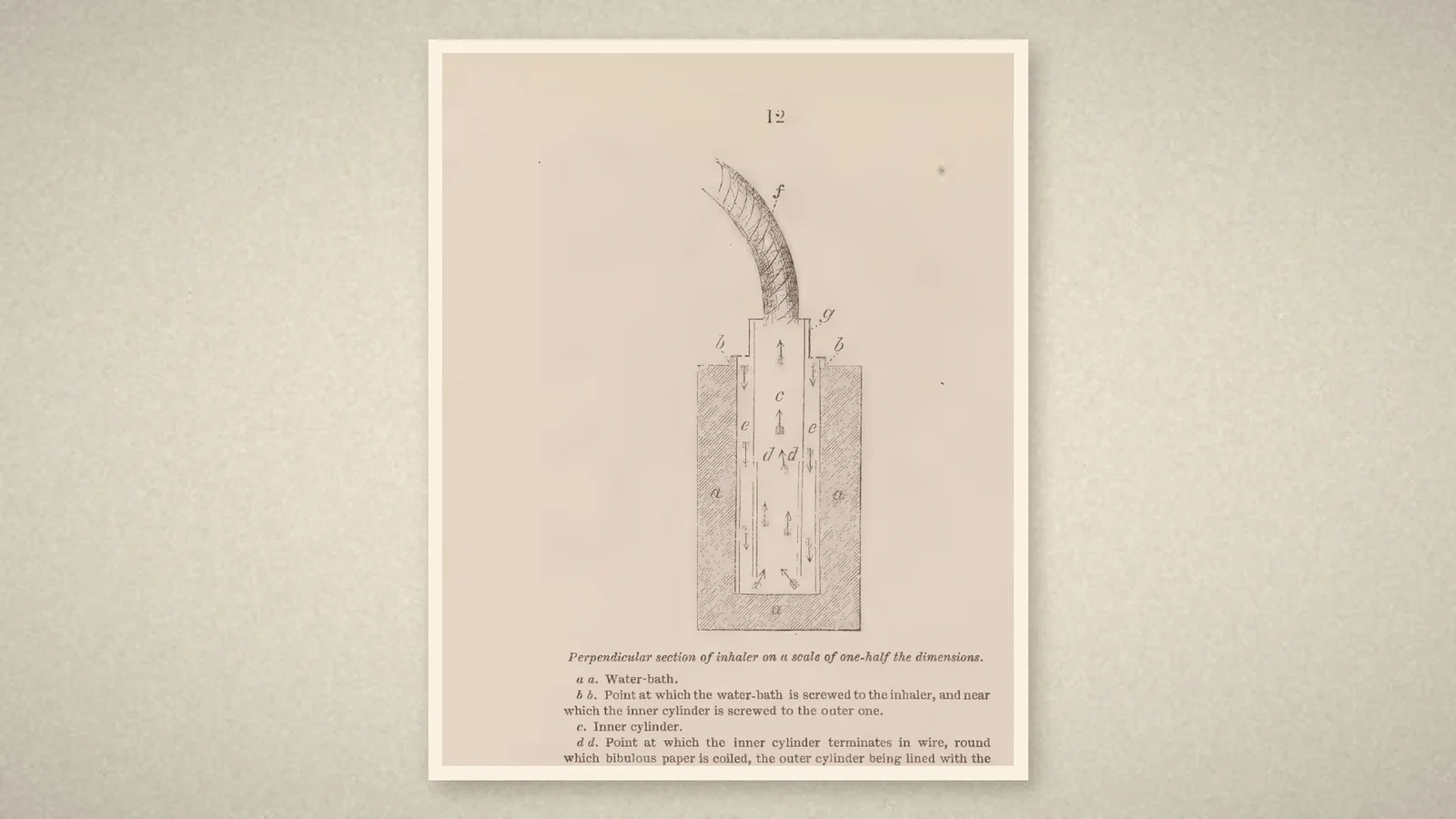
The inhaler itself was a pair of cylinders, one inside the other, surrounded by a small water-bath and lined with bibulous paper only halfway up, hung from the face-piece by a short elastic tube so that it could be used in any position of the patient. [1, p. 12][1, p. 13]
Chloroform or ether
On the whole, Snow concluded, chloroform was superior to ether for adults, and the profession was greatly indebted to Simpson for introducing it; for children Snow preferred ether, given with apparatus that let the vapour into the air gradually, since otherwise children hold their breath. The paper also records Snow's trials of benzin at St George's Hospital, and a difficult lithotomy of three quarters of an hour under chloroform that Brodie and the others present thought could not have been done without it. [1, p. 13][1, p. 14][1, p. 15]
Finally, Snow knew of no disease or state of health that forbade inhalation; for patients with heart or lung disease who needed an operation, the vapour might do less harm than the pain. In giving vapours, attention should be paid to the breathing rather than the pulse. [1, p. 15][1, p. 16]
What the record shows
With chloroform barely in hand, Snow was already looking for where its danger lay: an effect that kept deepening after inhalation stopped, an onset that was too fast, vapour that was too strong. Snow's answer was a slower, more dilute method with the breathing watched, and an inhaler built to allow it.
Sources and reading limits
Read: John Snow, "On the inhalation of chloroform and ether" (London: T. C. Savill, 1848), reprinted from the Lancet of 12 February 1848 with footnotes added, in full, pp. 3-16 with the title page and both engravings (Wellcome Library copy on the Internet Archive).
Not covered: the Lancet issue of 12 February 1848 itself; the Medical Gazette abstract of January 1848; Sédillot's own words in the Gazette médicale and the Comptes rendus; the inquest reports on the Newcastle death; Sibson's later chloroform inhaler, not covered here.
Limits: this is Snow's own account of Snow's methods and apparatus, and the case notes behind it are not given. The Newcastle death appears only in Snow's footnote, which does not name the patient, and the patient is not named here. The vapour proportion Snow recommends, the weights and the water temperature are not repeated. Snow's "I believe, first" about the ether apparatus and "the first to invent" about Hawkesley are Snow's words.
Three illustrations are taken from the 1848 pamphlet (pp. 8, 11 and 12), two of them its own engravings; one is a text diagram drawn from the pamphlet, with no people or apparatus drawn.
- Snow J. On the inhalation of chloroform and ether. London: T. C. Savill; 1848. (Reprinted from Lancet. 1848 Feb 12.) Internet Archive
Continue exploring
Related reading connects shared questions and contexts; it does not by itself establish historical influence.
- 1847: Imlach Extracts Teeth Under Chloroform in Edinburgh
- 1847: Snow Makes Ether a Question of Observation and Control
- 1847: Sédillot Gives Chloroform Through Elser's Pocket Inhaler
- 1848: Hannah Greener's Death and a Changing Explanation
- 1853: The Queen's Chloroform, Relief Without an End to Debate
Anesthesia Epochs · The Source Room · About & Editorial Method
Published November 3, 2026. Sources and reading limits are stated above. Illustrations are labelled as original source images or AI-made. Historical accounts are educational; they are not current treatment instructions.