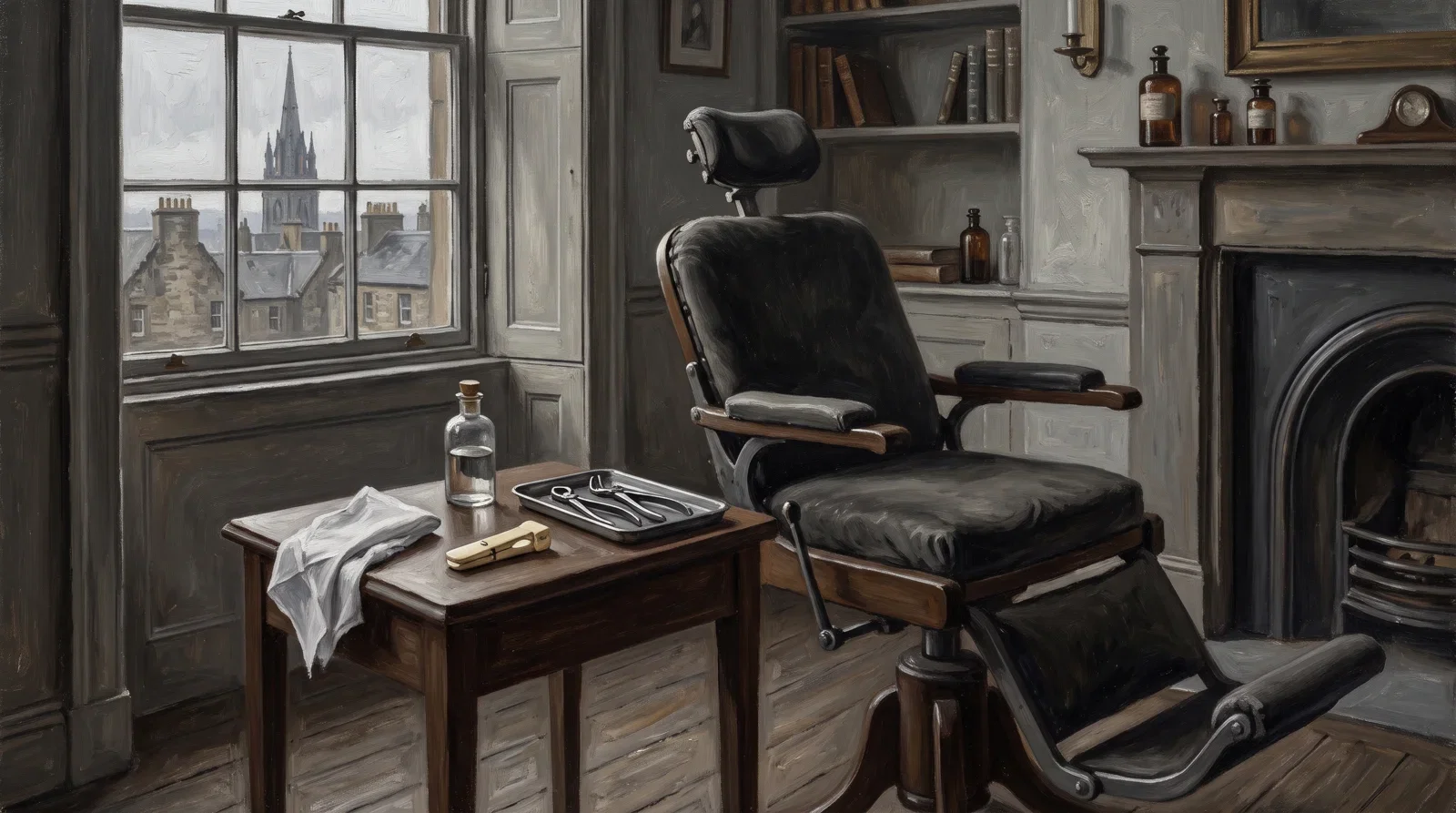
The Edinburgh dentist Imlach gave chloroform on a handkerchief with a gag placed beforehand, and in 1848 reported more than three hundred extractions.
Reading Library · Anesthesia Epochs · 中文版
Watch the education video (for clinicians)
1847: Imlach's Chloroform in Dental Surgery — The Gag Goes In First · Anesthesia Epochs Education Series
By Imlach's own account, chloroform was in use for dental extraction in Edinburgh by early November 1847. Eight months later an Edinburgh dentist reported more than three hundred cases to the local medical society. The report makes one large claim and offers many small, practical methods, among them this: before giving chloroform, put a small gag between the patient's teeth. [1, p. 165][1, p. 167]
The paper and the offprint
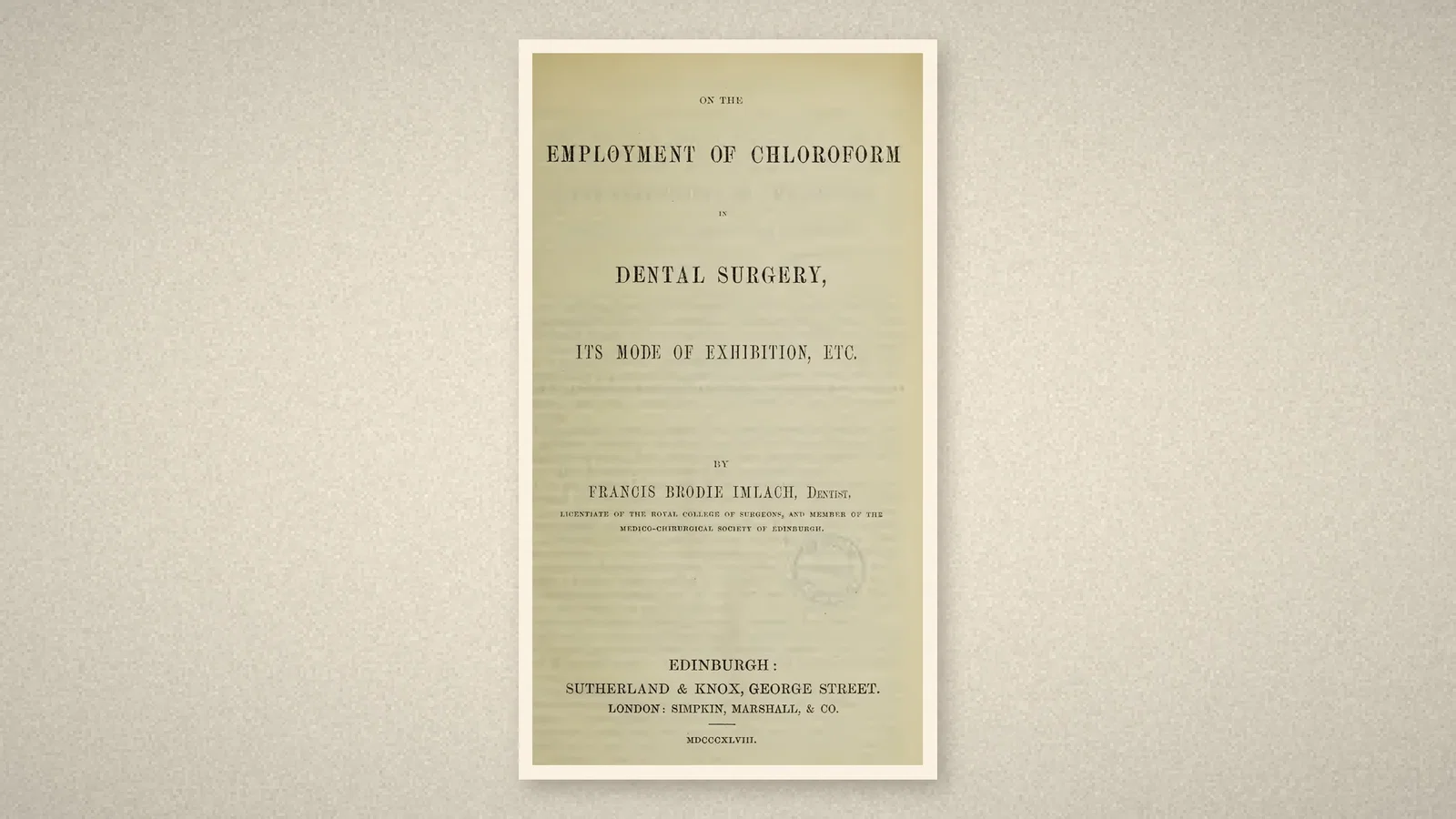
On 5 July 1848 the dentist Francis Brodie Imlach read "Observations on the employment of chloroform in dental surgery" to the Medico-Chirurgical Society of Edinburgh. It was printed in the Monthly Journal of Medical Science for September, pp. 165-171, and the same year Sutherland & Knox of Edinburgh issued it as an offprint, with Imlach styled "Dentist, Licentiate of the Royal College of Surgeons, and Member of the Medico-Chirurgical Society of Edinburgh". [1, p. 165][2, title page]
The opening claim
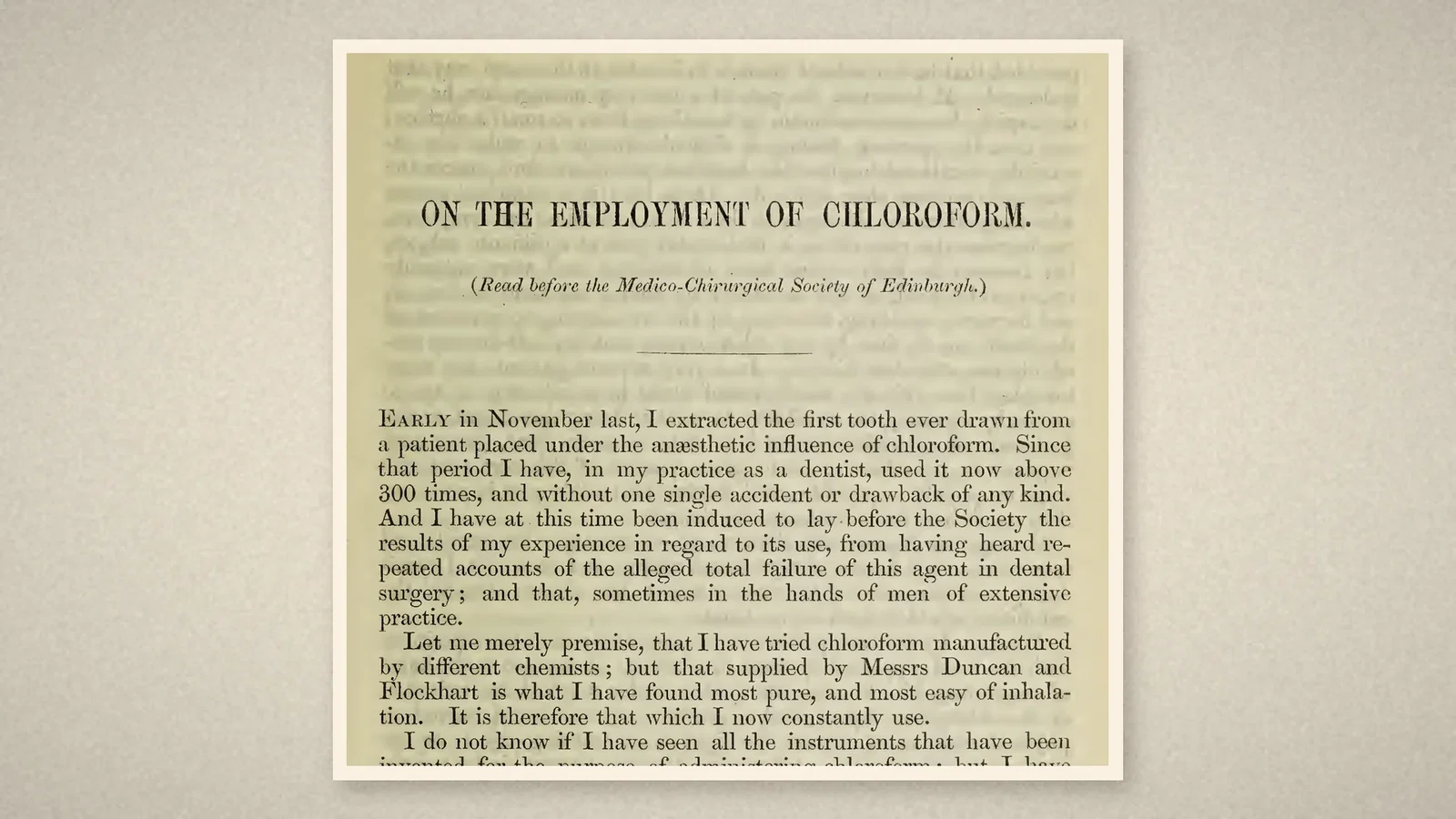
The paper opens: "Early in November last, I extracted the first tooth ever drawn from a patient placed under the anaesthetic influence of chloroform." Since then Imlach had used it above three hundred times, "without one single accident or drawback of any kind". The paper was written, Imlach explains, because of repeated reports that chloroform had failed completely in dental surgery, sometimes in the hands of men of large practice. [1, p. 165]
To be clear: "the first tooth" is Imlach's own claim, made eight months later. The paper gives no day in November and does not name the patient. [1, p. 165]
Why a handkerchief
Imlach had tried chloroform from several chemists and found that made by Duncan and Flockhart the purest and easiest to inhale. Imlach had also seen a great many inhalers, many ingeniously made to save chloroform from evaporating, but most were built to fit closely over nose and mouth so that the patient breathed no air that had not passed through the apparatus. In that, Imlach believed, lay "an insuperable objection" to ordinary instruments. Nothing seen was better than the method "first recommended by Professor Simpson": a handkerchief, simple, convenient and not frightening to the patient. [1, p. 165]
Some dentists folded cotton wadding into the handkerchief to concentrate the chloroform. With an unruly patient, Imlach argues, such a small surface works slowly, the operator pushes the handkerchief closer until it touches the face, and the patient, feeling choked, rolls the head, talks, throws up the arms or tries to leave the chair. These look like "bad symptoms" but are the fault of the method. [1, p. 166]
The rules
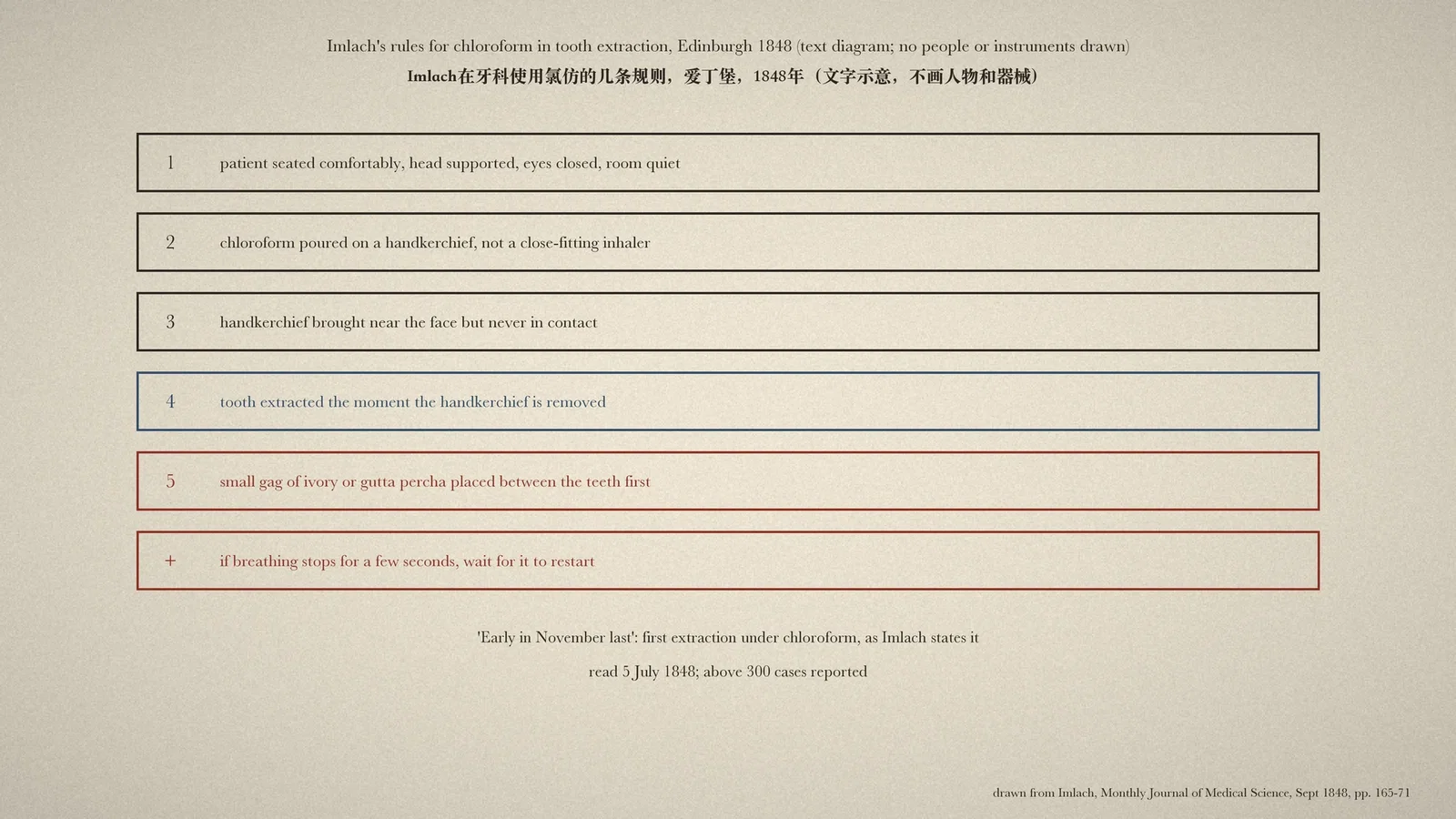
Imlach then sets out rules. First, seat the patient comfortably with the head supported, ask for the eyes to be closed, allow no noise, and warn beforehand of ringing in the head, flashes of light or giddiness. Second, pour plenty of chloroform on the handkerchief and spread it over a surface larger than the nose and mouth. Third, hold the handkerchief a little way from the mouth for a few deep breaths, then bring it nearer, but never into contact, until anaesthesia comes on, judging by no single sign. Fourth, the moment the handkerchief is removed, apply the instrument and extract; readiness and immediate extraction are "the chief secret of success". [1, p. 166][1, p. 167]
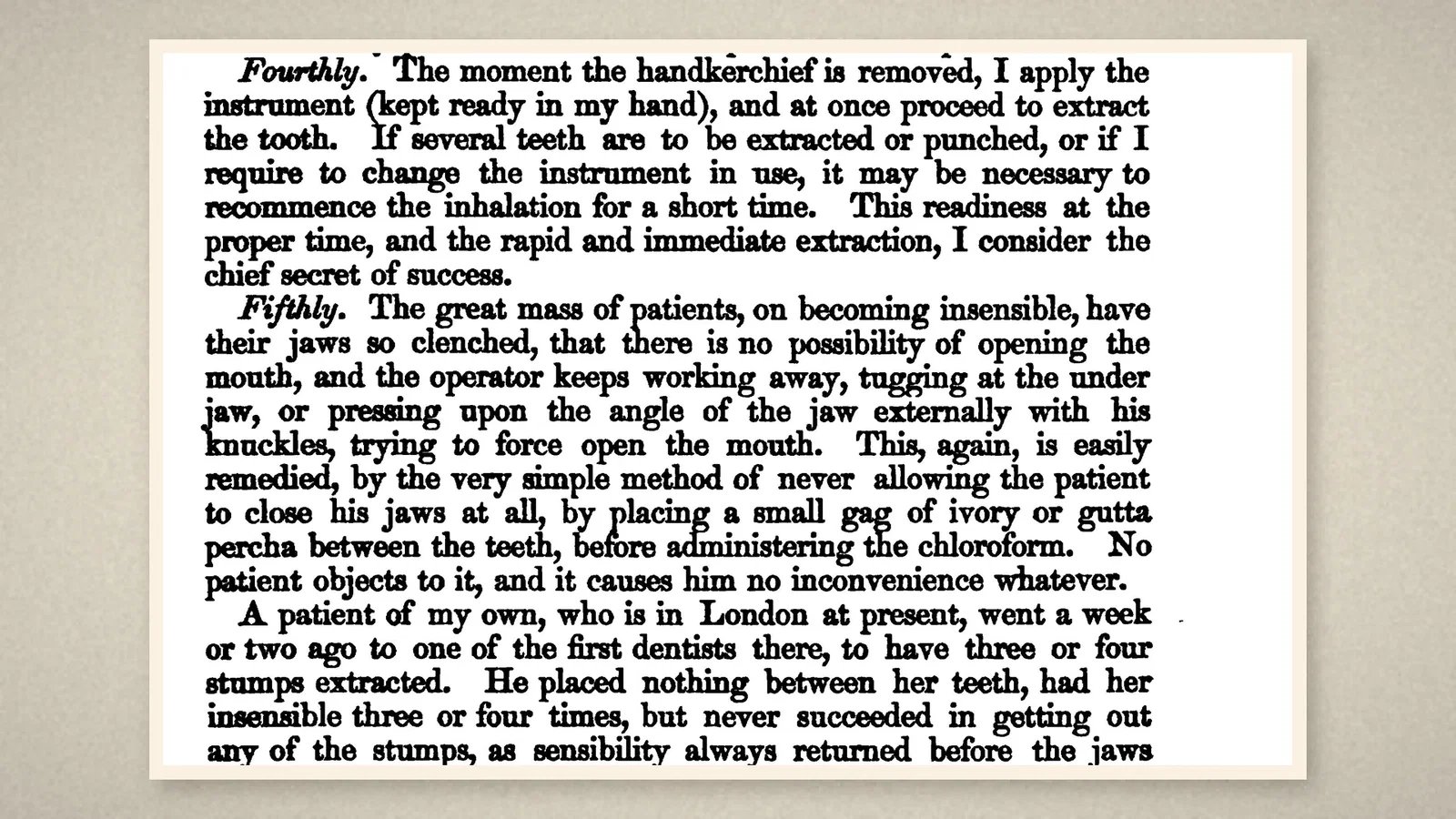
The fifth rule is about the jaws. Most patients, Imlach writes, clench their teeth on becoming insensible, and the operator is left tugging at the lower jaw or pressing on its angle with the knuckles. The remedy is never to let the jaws close at all, "by placing a small gag of ivory or gutta percha between the teeth, before administering the chloroform". No patient objects, and it causes no inconvenience. One, two or half a dozen teeth can then be taken before the gag is slipped out and the patient left to recover. Imlach cites a patient who went to a London dentist: no gag was used, the patient was made insensible three or four times, and each time sensation returned before the jaws could be forced open, so not one stump came out. Imlach had seen a patient begin to inhale, become insensible, lose the tooth and be fully conscious again in little more than a minute. [1, p. 167]
A patient who resisted
Imlach records a call made with Professor Simpson to a young lady who would not have a tooth out without anaesthesia, but whom another practitioner had failed to put under in half an hour. The patient held the breath, took shallow breaths, and when short of air pulled the handkerchief away to take a few full breaths. Simpson saw the trick and followed the patient's face with the handkerchief; the patient asked to speak, the vapour inhaled while speaking was enough, and within a minute or two the patient was insensible and the tooth out. [1, p. 167][1, p. 168]
Cautions
Sickness after waking, Imlach found, came mostly from a full stomach. Three or four patients had been slightly hysterical, but since chloroform no patient had fainted in the house. In several cases breathing had stopped for a few seconds; Imlach now always waited for it to restart and let the patient take a few more breaths before operating. Sleep-walkers tended to open their eyes and try to get up under chloroform, and should be left untouched for a few seconds until quiet. Too deep a dose, with the tongue completely relaxed, got in the way of the extraction. [1, p. 168][1, p. 169]
Chloroform, Imlach says, was habitually used by Edinburgh dentists but rarely in the larger English towns, for want of a pure article; in Liverpool it was made with naphtha, smelt of it, and was almost abandoned. The conclusions: in above three hundred cases no harmful effect and no bad after-consequences had been seen, and patients who had once had a tooth drawn under chloroform invariably asked for it again. [1, p. 169][1, p. 170][2, p. 9]
What the record shows
A dentist's working method written down within months of chloroform's arrival: a handkerchief rather than a mask, judgement rather than a single sign, the mouth propped open before the patient goes under, and a pause when breathing stops. The "first tooth" and the clean record are the author's own words.
Sources and reading limits
Read: Imlach, "Observations on the employment of chloroform in dental surgery", Monthly Journal of Medical Science, September 1848 (new series vol. 3), pp. 165-171, in full; the title page and first page of the 1848 Edinburgh offprint.
Not covered: the minutes of the Medico-Chirurgical Society of Edinburgh for 5 July 1848; any record of the November 1847 extraction itself, including the patient's name and the day; any mention of dental use in Simpson's writings of November 1847.
Limits: "the first tooth ever drawn" under chloroform and "without one single accident" are Imlach's own statements, made eight months later and not checked against other records; Imlach gives no day in November and names no patient, so neither is given here. The paper records only Imlach's cases and impressions. Amounts of chloroform and handkerchief distances are not repeated.
Three illustrations are taken from the 1848 journal and offprint (offprint title page and first page; Monthly Journal p. 167); one is a text diagram drawn from the paper, with no people or instruments drawn.
- Imlach FB. Observations on the employment of chloroform in dental surgery. Monthly J Med Sci. 1848;3 (new series):165-71. Internet Archive
- Imlach FB. On the employment of chloroform in dental surgery, its mode of exhibition, etc. Edinburgh: Sutherland & Knox; 1848. Internet Archive
Continue exploring
Related reading connects shared questions and contexts; it does not by itself establish historical influence.
- 1847: Robinson Publishes a Treatise on Inhaling Ether
- 1847: Chloroform, from Self-Experiment to a Public Report
- 1846: Morton Extracts a Tooth for Eben Frost Under an Ether Preparation
Anesthesia Epochs · The Source Room · About & Editorial Method
Published November 3, 2026. Sources and reading limits are stated above. Illustrations are labelled as original source images or AI-made. Historical accounts are educational; they are not current treatment instructions.