
After trying other devices, Sédillot's Strasbourg clinic adopted a chloroform inhaler by the instrument maker Elser that covered both mouth and nose.
Reading Library · Anesthesia Epochs · 中文版
Watch the education video (for clinicians)
1847: Sédillot and Elser's Chloroform Inhaler — Strasbourg · Anesthesia Epochs Education Series
Simpson's chloroform came with a simple method: a sponge or a handkerchief held to the face. At the military teaching hospital of Strasbourg, the surgeon C. Sédillot tried that and decided to use a device instead. A local instrument maker named Elser built it. [1, pp. 15, 45]
The book
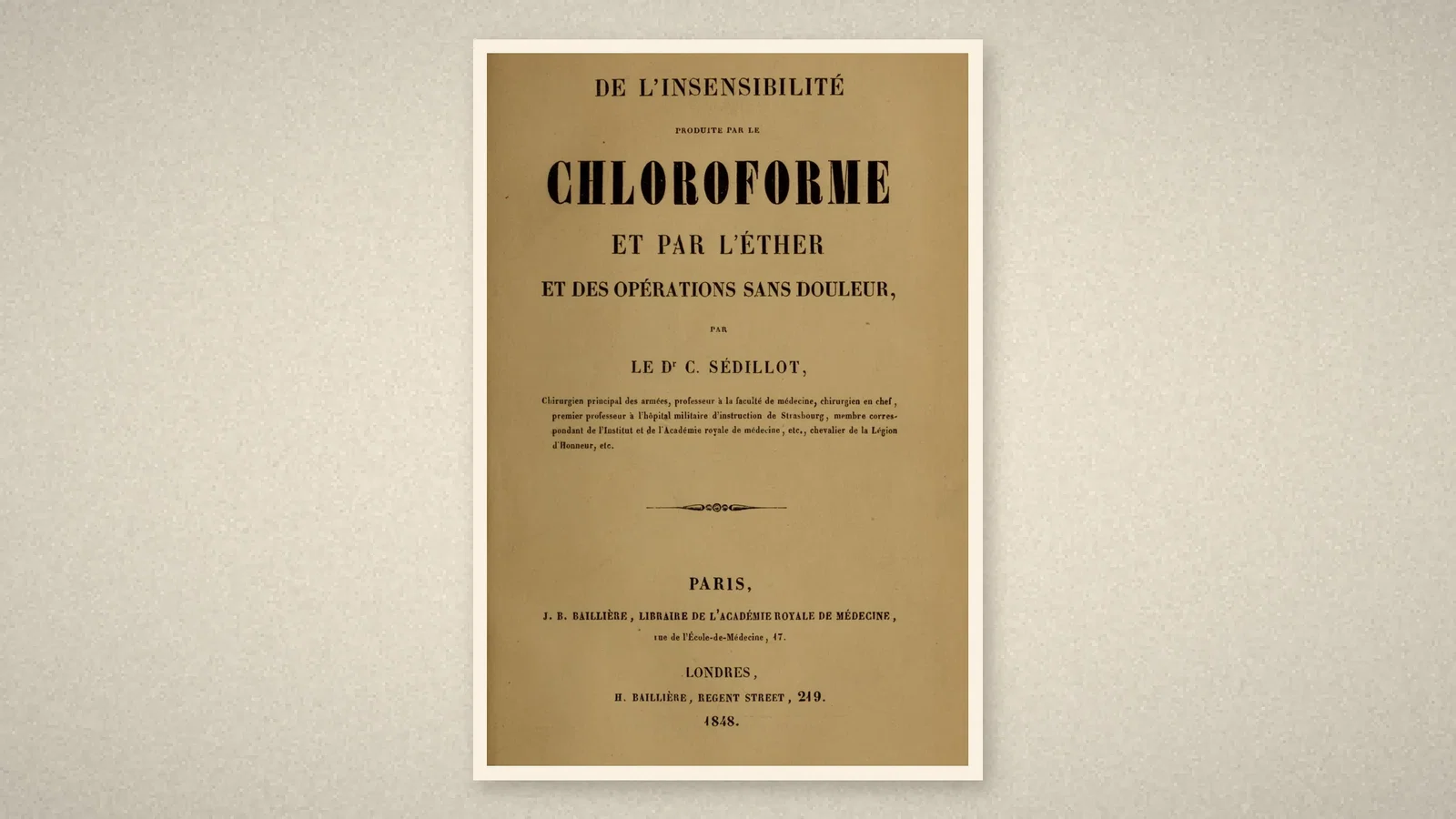
"De l'insensibilité produite par le chloroforme et par l'éther et des opérations sans douleur" was published in Paris and London in 1848 by "le Dr C. Sédillot", principal surgeon of the armies and professor at the Strasbourg faculty and the military teaching hospital. The book is dedicated to Simpson of Edinburgh. Early on, Sédillot explains the change: chloroform was substituted for ether, and "the sponge and the handkerchief recommended by the Edinburgh professor" were replaced "by a very simple apparatus, made by M. Elser". The reasons given were practical: less chloroform wasted, more constant effects, and a better view of how the patient was breathing. [1, title page; p. 15]
Elser before chloroform
Elser had already made Strasbourg's ether apparatus: a glass vessel holding pieces of sponge, a flexible tube, and a mouthpiece with an inspiratory and an expiratory valve. Its use, as Sédillot describes it, was a sequence. The nostrils were closed with a small spring clip; the patient was first made used to breathing through the mouth "while being given nothing but atmospheric air"; and once breathing went well, which could be judged from the regular movements of the expiratory valve, ether was mixed in by increasing proportions. Elser then produced "a simpler apparatus" in which a rotating plate kept the openings for plain air and etherised air in inverse proportion. [1, pp. 27-30]
The chloroform apparatus
The clinic first tried the inhaler of Jules Roux, then a compress rolled into a cone, in Vidal de Cassis's phrase, "and lastly we adopted an apparatus made by M. Elser". It had two main pieces. [1, p. 45]
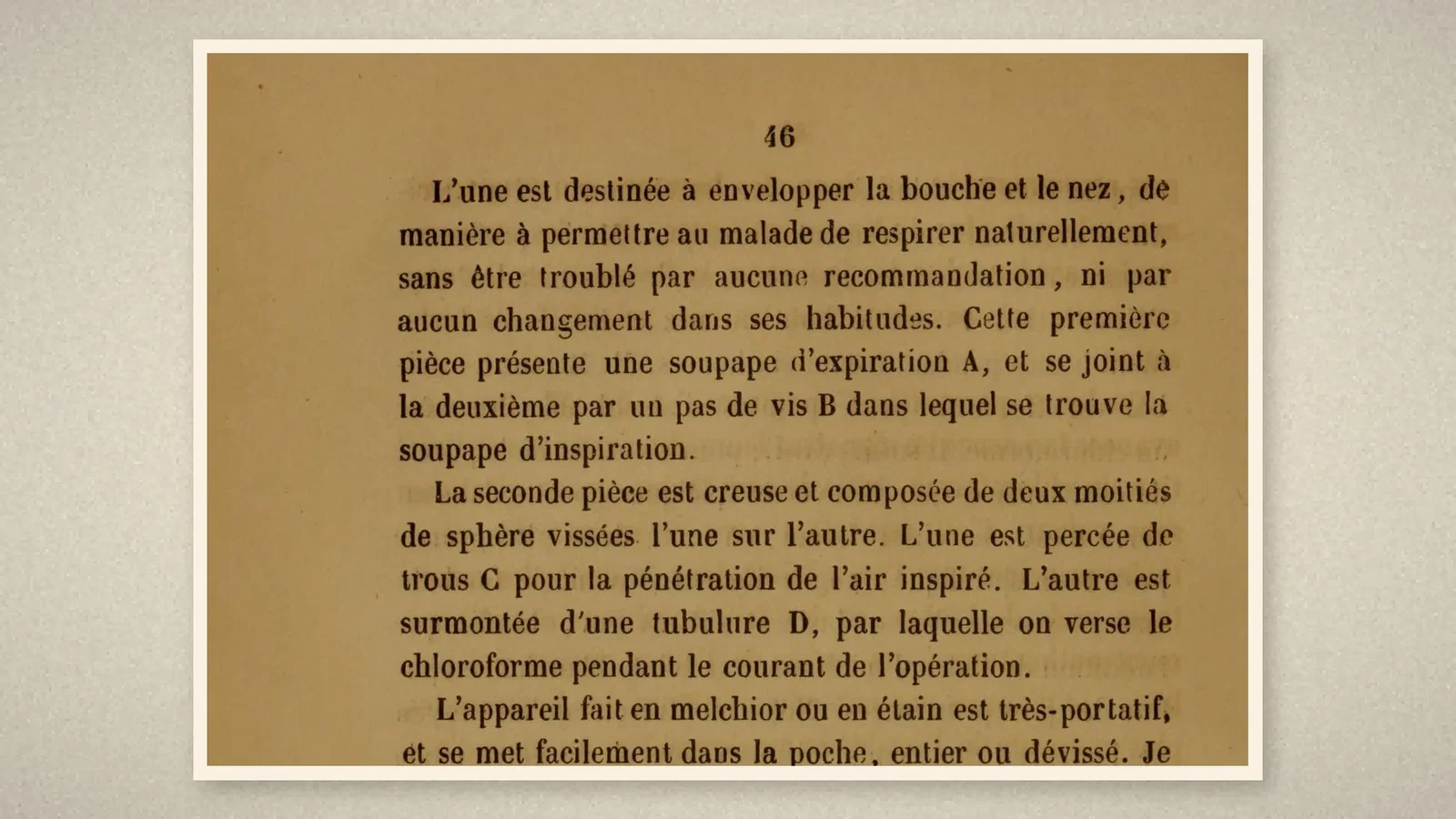
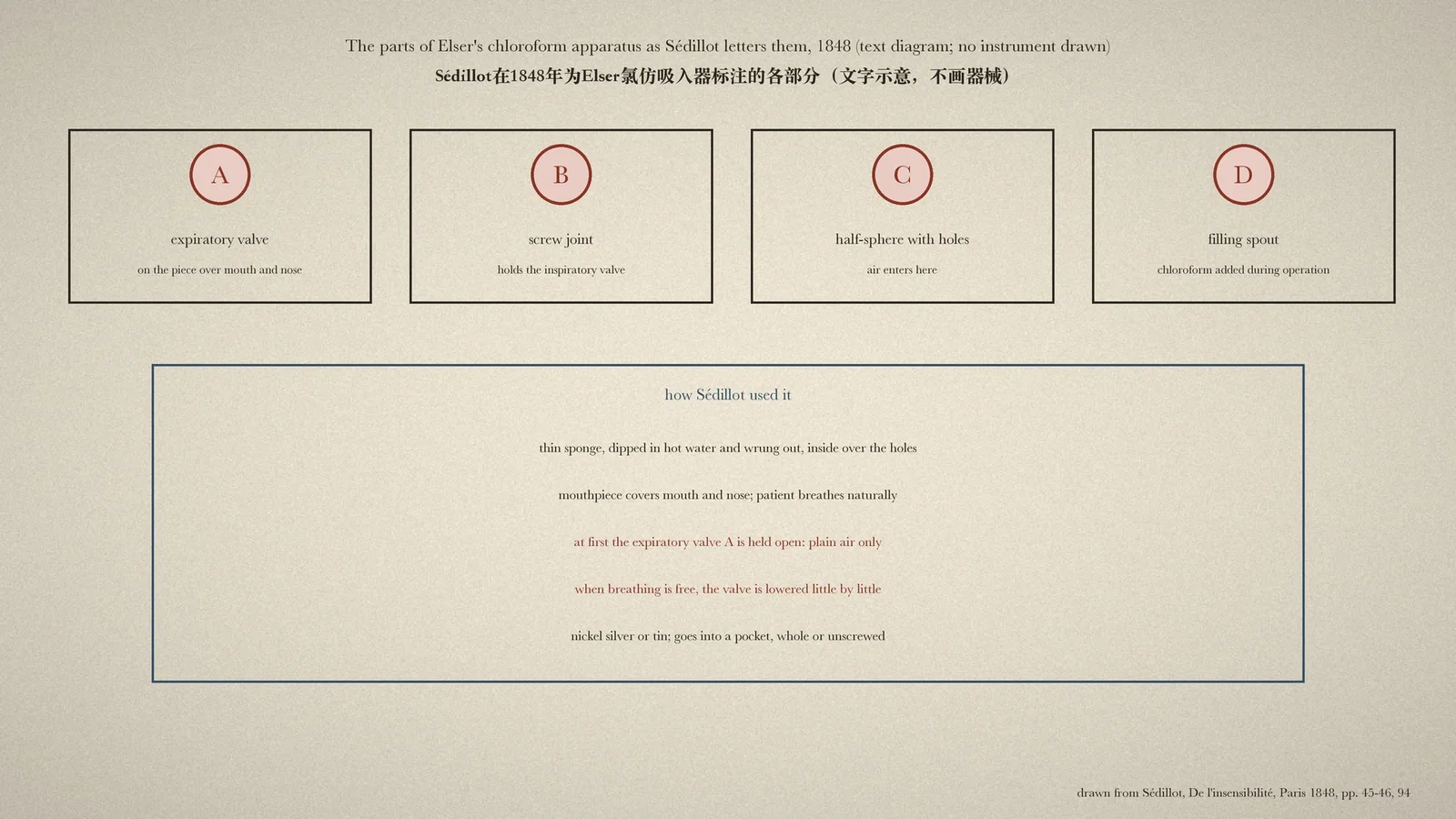
The first was meant "to envelop the mouth and the nose", so that the patient could breathe naturally, "without being troubled by any instruction". It carried an expiratory valve, A, and screwed onto the second piece at B, where the inspiratory valve sat. The second piece was hollow, made of two half-spheres screwed together: one pierced with holes, C, to let air in, the other topped by a spout, D, through which chloroform was poured during the operation. Made in nickel silver or tin, it was "very portable" and went into a pocket, whole or unscrewed. Inside, over the holes, went a thin slice of sponge dipped in hot water and wrung out hard between the fingers. [1, pp. 45-46]
The first chloroform case in the book with the Elser apparatus is dated 15 December 1847. Later Sédillot noted that slight bronchial and gastric irritation, attributed to impurities in the chloroform, was no longer seen "using the apparatus of M. Elser". [1, pp. 52, 56]
Controlling the first breaths
The concluding chapter recommends Elser's apparatus and repeats the point about the beginning of the induction. Heavy vapour from the outset brought distress in breathing and congestion of the face; the answer was to dose the first breaths carefully, either by moving the handkerchief away or by holding open the expiratory valve of Elser's apparatus. At first valve A was kept open so that the patient went on breathing plain air for a few seconds; when breathing was free, the valve was lowered little by little. [1, pp. 91, 94]
Twenty years later
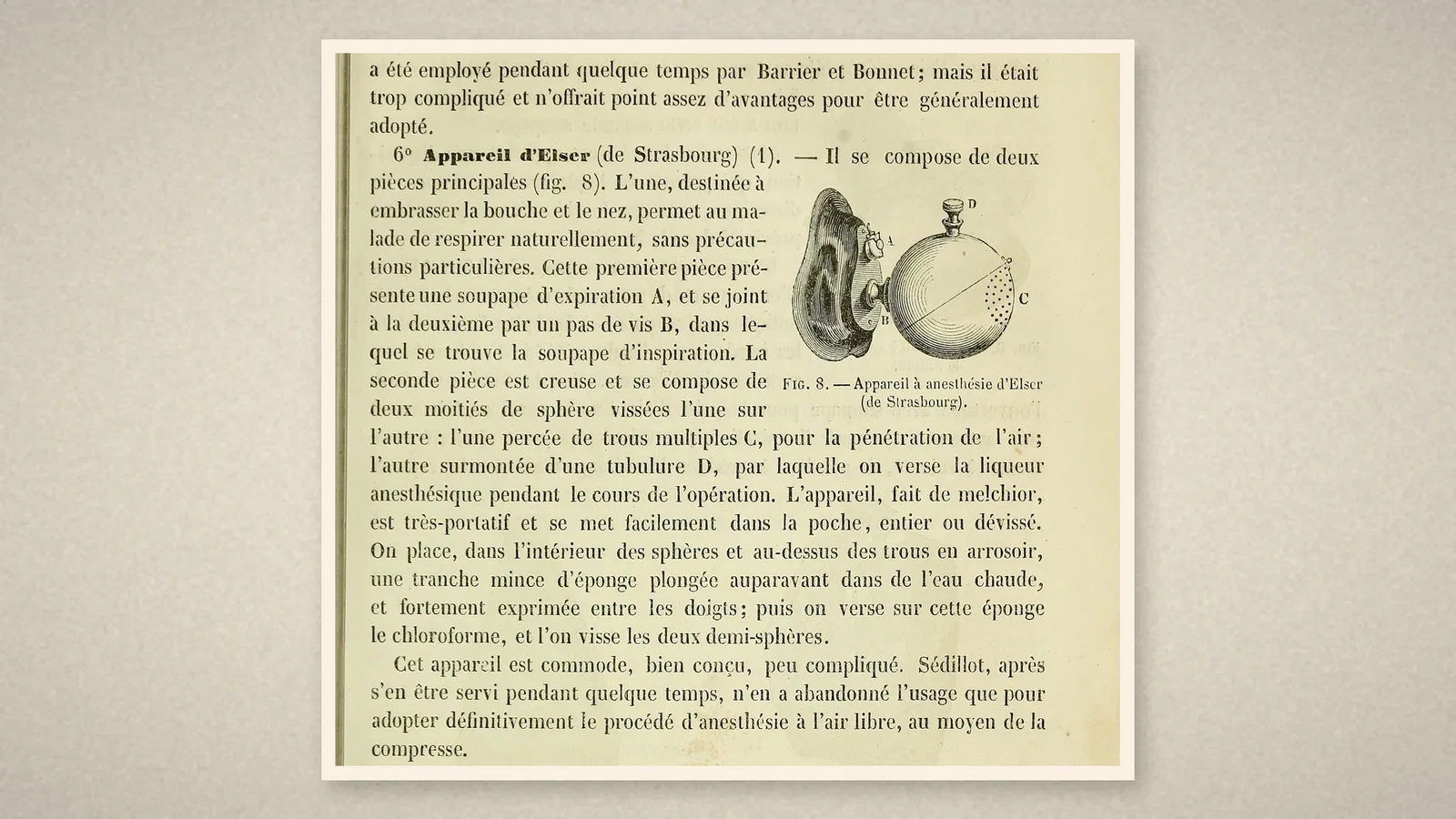
In 1867 Gaujot and Spillmann's "Arsenal de la chirurgie contemporaine" engraved the instrument as fig. 8, "Appareil à anesthésie d'Elser (de Strasbourg)", with the same letters A to D. They counted it among the apparatus that best achieved regular, natural breathing, by enclosing nose, mouth and chin rather than the mouth alone, and called it "convenient, well designed, not complicated". They also recorded what happened to it: Sédillot, after using it for some time, gave it up to adopt for good the open method with a compress. [2, pp. 10, 13]
What the record shows
A small device that tried to put control into the hands: a mask over nose and mouth, a valve that could be held open, a sponge that could be wetted. It also shows the plain-air-first approach, with chloroform added only once the patient's breathing had settled. And it shows the other direction the period took, back to the compress, by the same surgeon.
Sources and reading limits
Read: Sédillot, "De l'insensibilité produite par le chloroforme et par l'éther et des opérations sans douleur" (Paris, 1848), the passages on apparatus at pp. 15, 27-31, 45-46, 52, 56, 91 and 94, with the title page; Gaujot and Spillmann, "Arsenal de la chirurgie contemporaine", vol. 1 (1867), pp. 9-14.
Not covered: the two plates referred to in Sédillot's text, which are missing from the scanned copy; Sédillot's communications to the Academies; the 1865 "Traité de médecine opératoire" cited in 1867; any description by Elser; the Wood Library-Museum video.
Limits: the engraving shown is from 1867, not from Sédillot's plates, although its letters match Sédillot's description. Neither source gives Elser's first name, and none is added. Case dates are Sédillot's; doses, timings and case details are not repeated. That Sédillot later abandoned the apparatus is the 1867 authors' statement. Quotations are translated from the French.
Three illustrations are crops of the 1848 book (title page, p. 46) and of the 1867 Arsenal (p. 13); one is a text diagram drawn from the book, with no instrument drawn.
- Sédillot C. De l'insensibilité produite par le chloroforme et par l'éther et des opérations sans douleur. Paris: J.-B. Baillière; 1848. Internet Archive
- Gaujot G, Spillmann E. Arsenal de la chirurgie contemporaine. Vol 1. Paris: J.-B. Baillière; 1867. p. 9-14. Internet Archive
Continue exploring
Related reading connects shared questions and contexts; it does not by itself establish historical influence.
- 1847: Charrière Prints an Illustrated Leaflet on Ether Inhalers
- 1847: Hedley's Wooden Ether Inhaler in the Pharmaceutical Journal
Anesthesia Epochs · The Source Room · About & Editorial Method
Published November 3, 2026. Sources and reading limits are stated above. Illustrations are labelled as original source images or AI-made. Historical accounts are educational; they are not current treatment instructions.