
After two deaths in 1857, Snow's posthumous book blamed amylene's unsteady boiling point and proposed giving the vapour from a bag.
Reading Library · Anesthesia Epochs · 中文版
Watch the education video (for clinicians)
1856: Snow and Amylene — Two Deaths and a Boiling Point · Anesthesia Epochs Education Series
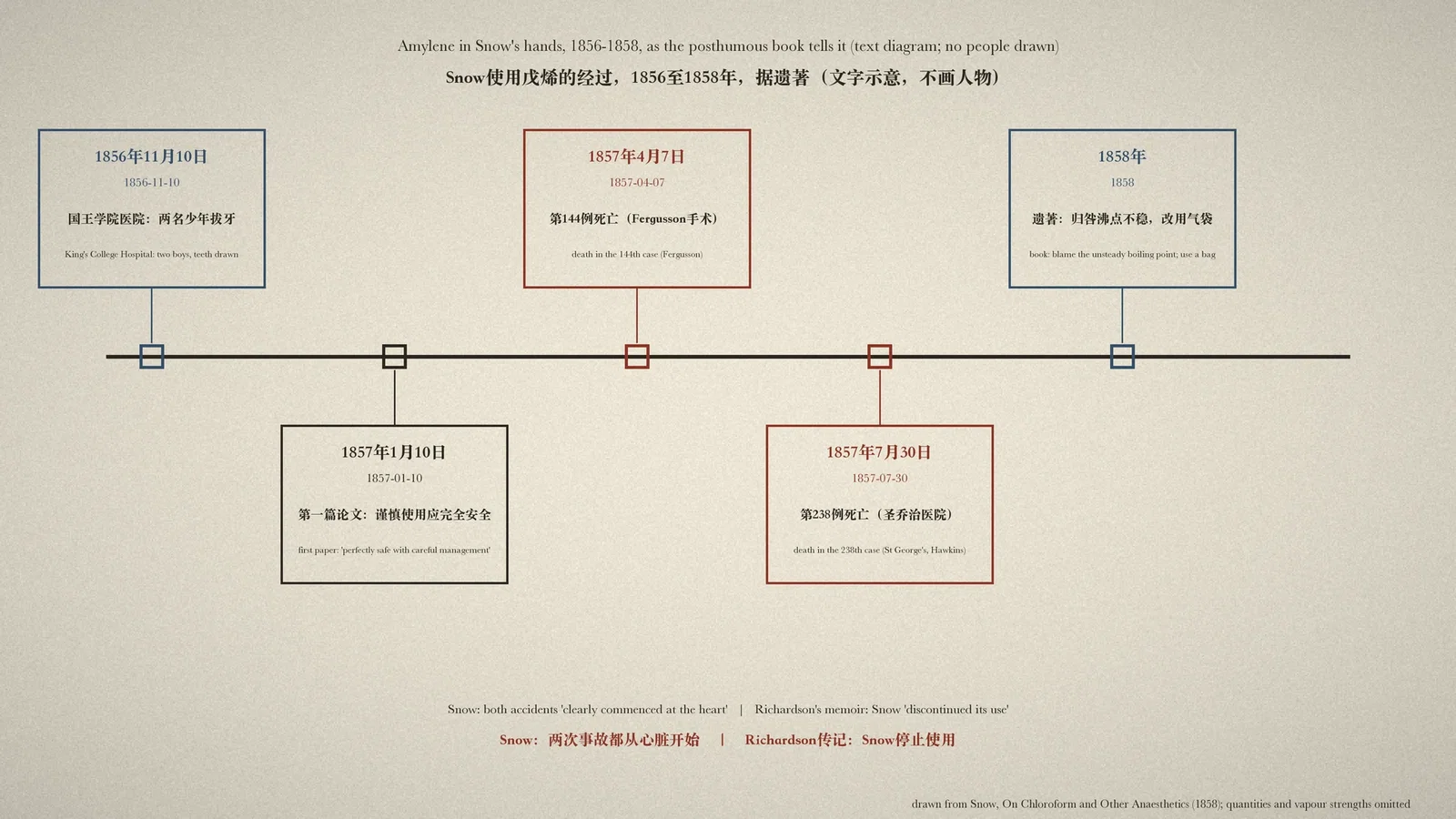
John Snow of London gave ether and chloroform thousands of times and kept searching for a safer anaesthetic. Late in 1856 Snow brought a new volatile liquid, amylene, into the operating theatre; within a year two patients had died in Snow's hands. Snow died in June 1858, and the story survives in the posthumous On Chloroform and Other Anaesthetics, edited that year by Benjamin Ward Richardson. This article reads that book: Snow's own account of the trial, the accidents and their cause, and one sentence from the editor's memoir that tells it differently. [1, title page][1, pp. 373-420]
Animal experiments and the first patients
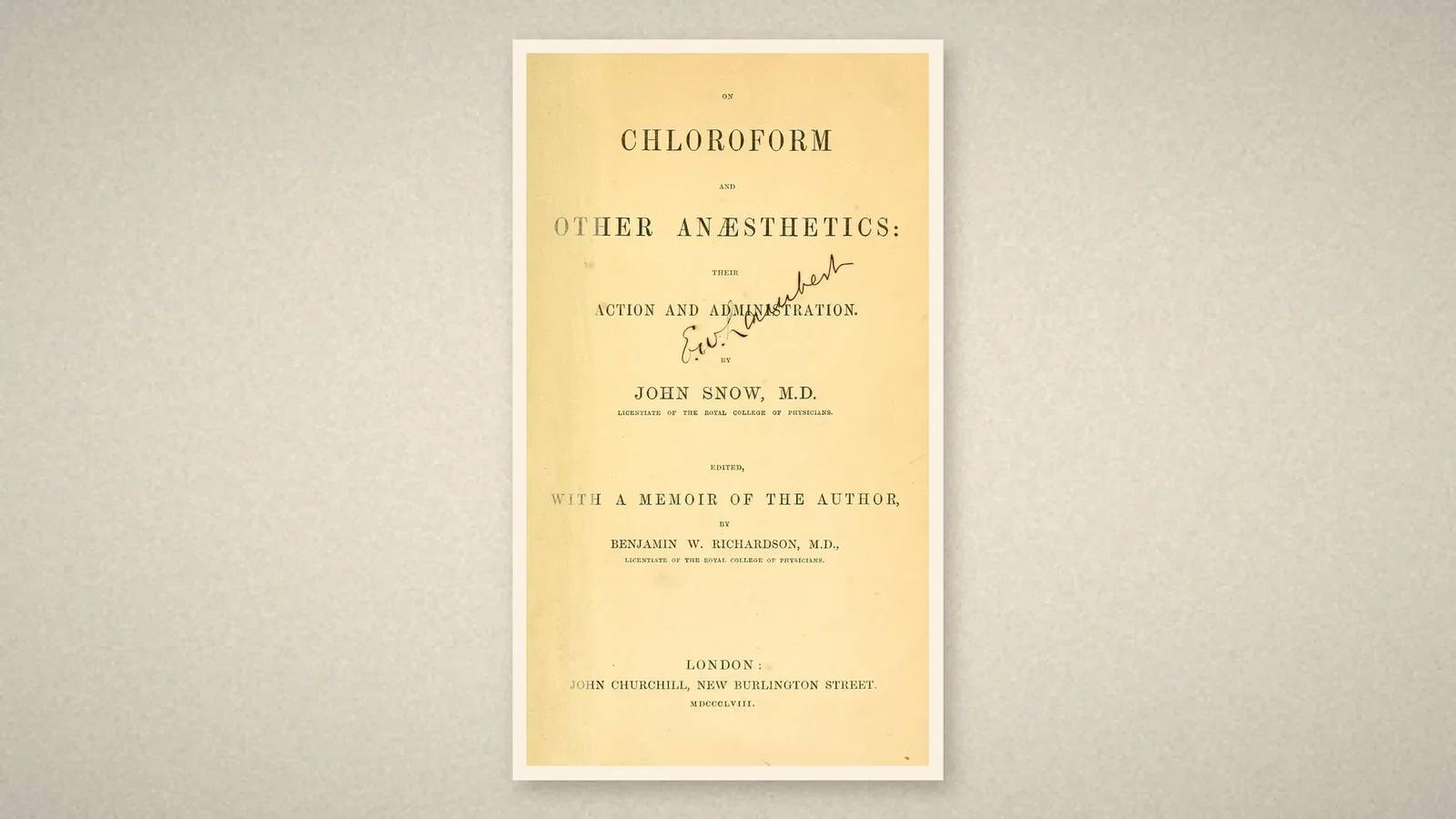
The amylene chapter begins with its chemistry and with animal experiments. Snow found that amylene, like chloroform, could cause sudden death by over-narcotism and paralysis of the heart, but that "it is more difficult to cause this kind of sudden death with amylene than with chloroform"; Snow had also inhaled small quantities personally. On that evidence the inhaler used for years with chloroform seemed suitable for amylene too, and would have been, Snow wrote, "if the amylene furnished for inhalation had been a constant and uniform product, boiling steadily at the same temperature, like chloroform". [1, pp. 384-387]
On 10 November 1856, at King's College Hospital, Snow gave amylene to two boys of about fourteen before Samuel Cartwright extracted teeth; there was too little to remove consciousness entirely, but the effect encouraged a further trial. On 4 December, in the same hospital, two men, a young woman and a girl of ten were made completely unconscious and free of pain. The book's historical introduction adds that amylene was the only new agent to come into use after chloroform, "first employed by me in King's College Hospital in November 1856", and that Snow had since used it in a great number of operations and found advantages over chloroform in most cases: that is Snow's own claim. [1, p. 387][1, p. 23]
In the first paper on amylene, read in January 1857, Snow wrote that while not venturing to predict for it the absolute safety of ether, "I trust that it will be perfectly safe with careful management." [1, p. 417]
Two deaths
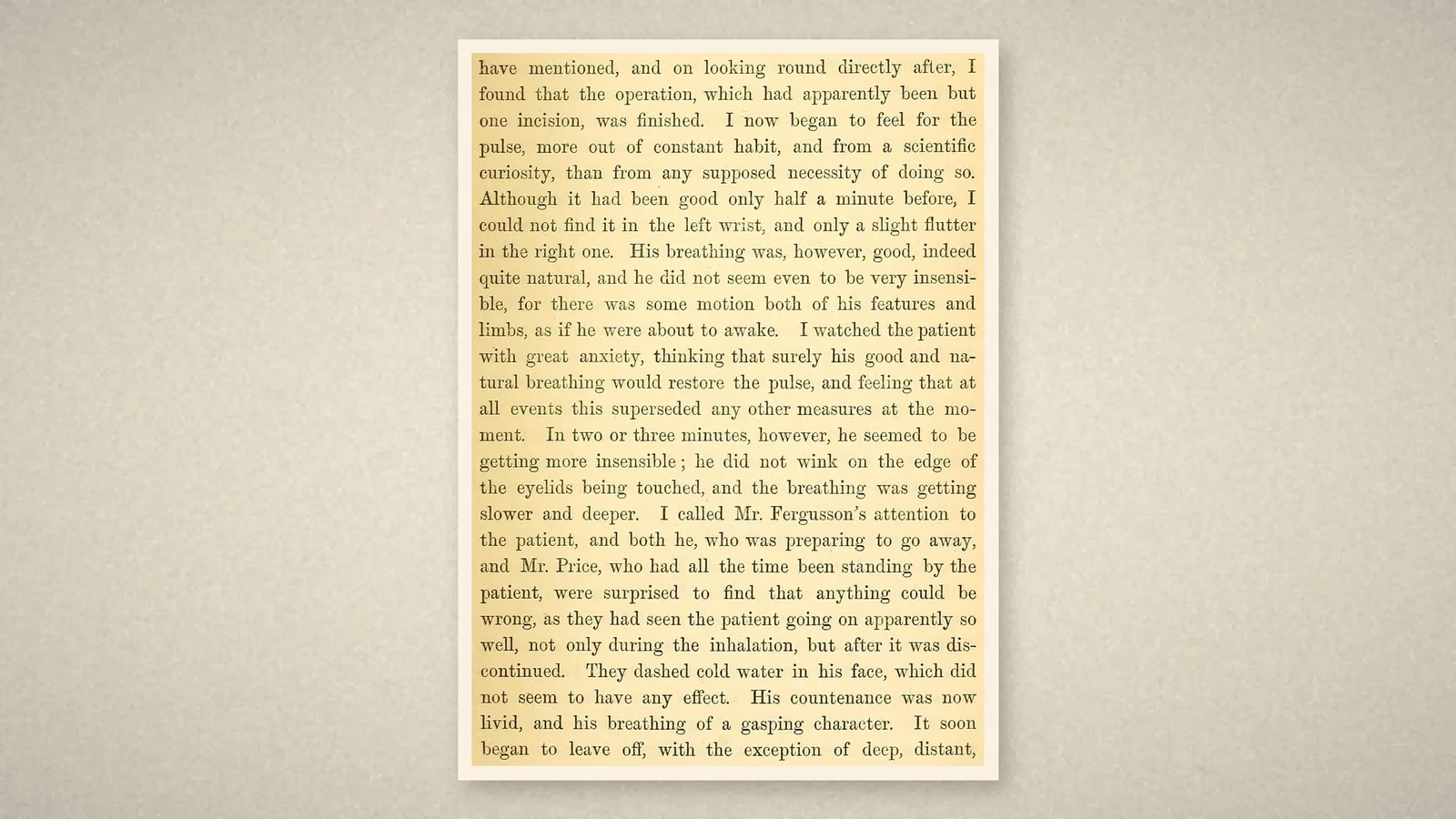
"I had the misfortune to lose two patients from the inhalation of amylene." The first was on 7 April 1857, when Fergusson operated for fistula on a man of 33, in good health apart from the local complaint, whose heart sounds had been normal the day before. About two minutes into the inhalation the patient became quietly unconscious, and Fergusson found the pulse very good. As the operation began, Snow noticed that the valve of the face-piece had moved from three-quarters to fully closed, though only for a few seconds. The operation, a single incision, was soon over; feeling for the pulse from habit, Snow could not find it at the left wrist and felt only a flutter at the right, while the breathing was "good, indeed quite natural". Within two or three minutes the patient grew more insensible and the breathing slower and deeper; cold water was dashed in the face, the countenance turned livid, and artificial respiration by Marshall Hall's method failed. [1, pp. 408-410]
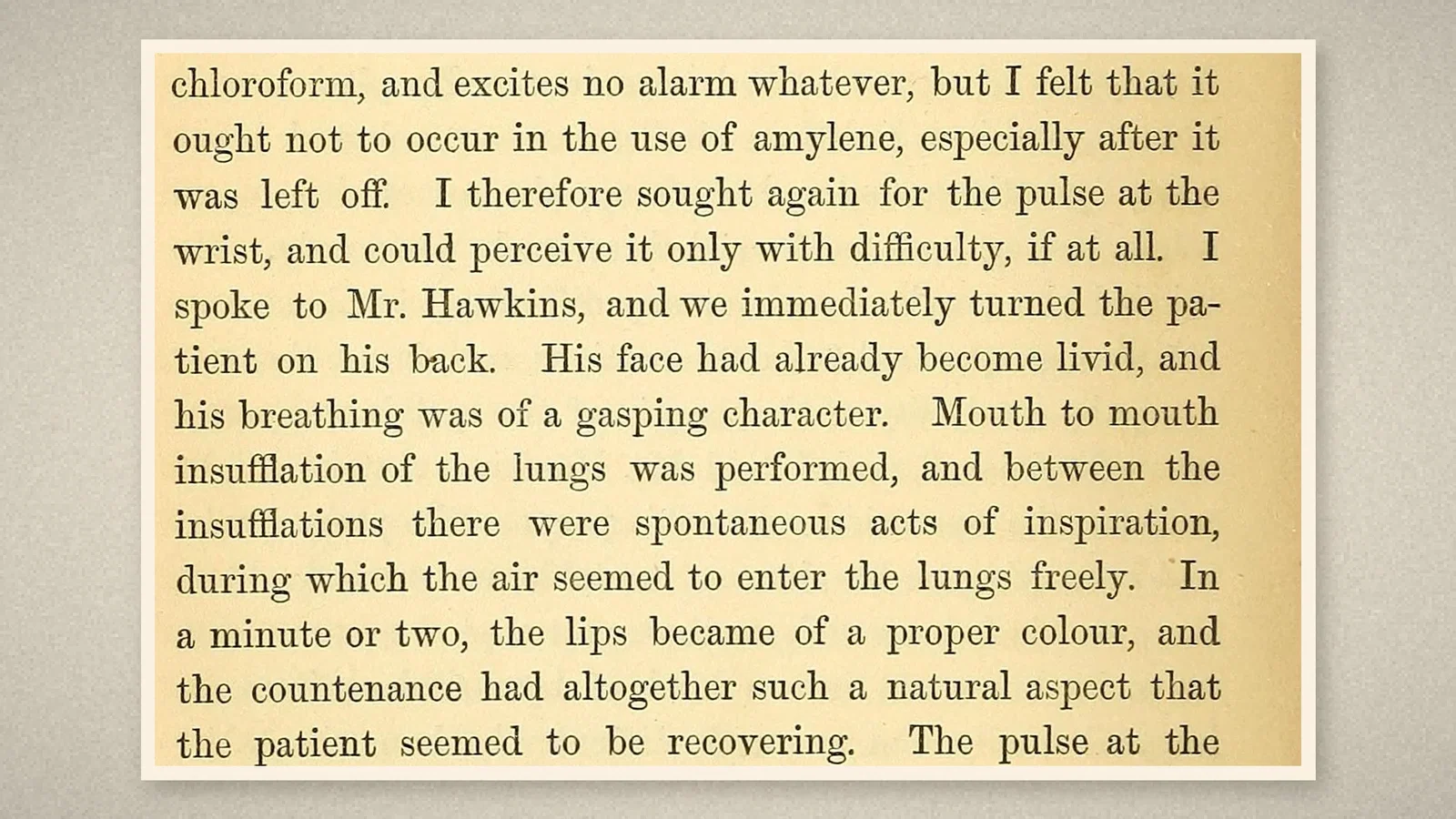
The second was on 30 July 1857 at St George's Hospital, where Caesar Hawkins removed a small tumour from the back of a tailor of 24 who had already had three similar operations under chloroform. During the inhalation the patient burst into hysterical laughter and had to be held on the table; the operation was quickly done, and then the limbs relaxed and the breathing, "though free enough", became noisy and snoring. In chloroform, Snow wrote, this would cause no alarm, but it ought not to occur with amylene after the inhalation had stopped; the pulse could hardly be felt, and when the patient was turned over the face was livid and the breathing gasping. After mouth-to-mouth insufflation the lips briefly regained their colour; Marshall Hall's method was continued for an hour and a half, and an attempt at galvanopuncture of the heart was made, without success. [1, pp. 411-414]
Snow's explanation
Both accidents, Snow argued, "clearly commenced at the heart", and the brain was never more than partly under the influence of amylene; Snow rejected the suggestion by Devergie in Paris that the first death was largely asphyxia, since the patient had breathed freely throughout. The cause, Snow concluded, was "the unsteady boiling point of the agent": a single specimen boiled over a wide range, and specimens differed in volatility, so the inhaler could suddenly give off far too strong a vapour early in evaporation. [1, pp. 414-416]
Snow also counted: the first accident came in the 144th case of amylene, the second in the 238th, and in the ninety and more cases between them Snow "never had occasion to feel a moment's uneasiness". In future, Snow intended to put a measured quantity of the liquid into a bag filled with air, so that the variable boiling point could have no influence on the vapour breathed, and judged that in this way amylene would be "absolutely safe". Snow added that amylene had been used in Paris, Strasbourg, Montpellier, Lyons and Berlin without any accident reported except the two in Snow's own hands, and that the Paris Academy of Medicine had nonetheless recommended its disuse because of them. [1, pp. 416-419]
The editor's sentence
In the memoir at the front of the book, Richardson wrote that Snow had been sanguine about amylene's safety for some time, but that the deaths Snow had so faithfully recorded ended those hopes, and that Snow discontinued its use as soon as the risks were known. That does not match Snow's own plan, at the end of the chapter, to continue with a bag. The History of Anaesthesia Society timeline likewise says that Snow abandoned amylene by July 1857. [1, memoir][2]
What the record shows
The value of this record lies in its candour: an anaesthetist known for safety described two deaths in great detail, down to the position of a valve, the moment the pulse was felt and each step of resuscitation, and looked for the cause in the physical properties of the drug. It also shows that the person involved and a biographer can give the same story different endings.
Sources and reading limits
Read: Snow, On Chloroform and Other Anaesthetics: Their Action and Administration (London: Churchill, 1858; edited with a memoir by B. W. Richardson; Internet Archive onchloroformothe00snow): the title page and the date of the preface; the memoir passage on amylene; the passage on amylene in the historical introduction (p. 23); and the amylene chapter (printed pp. 373-420), especially the animal experiments on cardiac arrest, the first clinical uses of November and December 1856, the two deaths of 7 April and 30 July 1857 (pp. 408-414), Snow's analysis and plan to use a bag (pp. 414-417) and the reception in Paris (pp. 417-419). Also read: the History of Anaesthesia Society online timeline entry for 10 November 1856.
Not covered: Snow's 1857 papers on amylene in the Medical Times and Gazette and the Lancet; hospital records and any inquest reports on the two deaths; the Paris Academy reports by Debout, Tourdes, Giraldis and Jobert de Lamballe.
Limits: this is Snow's own account, published after Snow's death; the judgement about the cause is Snow's explanation. Vapour strengths, quantities and temperatures in the chapter are omitted, and the illustrations avoid them. "First employed by me" is Snow's own phrase. The patients are not identified.
Three illustrations are taken from the 1858 book (title page, p. 409, p. 412). One is a timeline drawn from the text, with no people drawn.
- Snow J. On chloroform and other anaesthetics: their action and administration. Richardson BW, editor. London: John Churchill; 1858. Internet Archive
- History of Anaesthesia Society. Timeline. Web page
Continue exploring
Related reading connects shared questions and contexts; it does not by itself establish historical influence.
- 1847: Snow Makes Ether a Question of Observation and Control
- 1853: The Queen's Chloroform, Relief Without an End to Debate
Anesthesia Epochs · The Source Room · About & Editorial Method
Published November 4, 2026. Sources and reading limits are stated above. Illustrations are labelled as original source images or AI-made. Historical accounts are educational; they are not current treatment instructions.