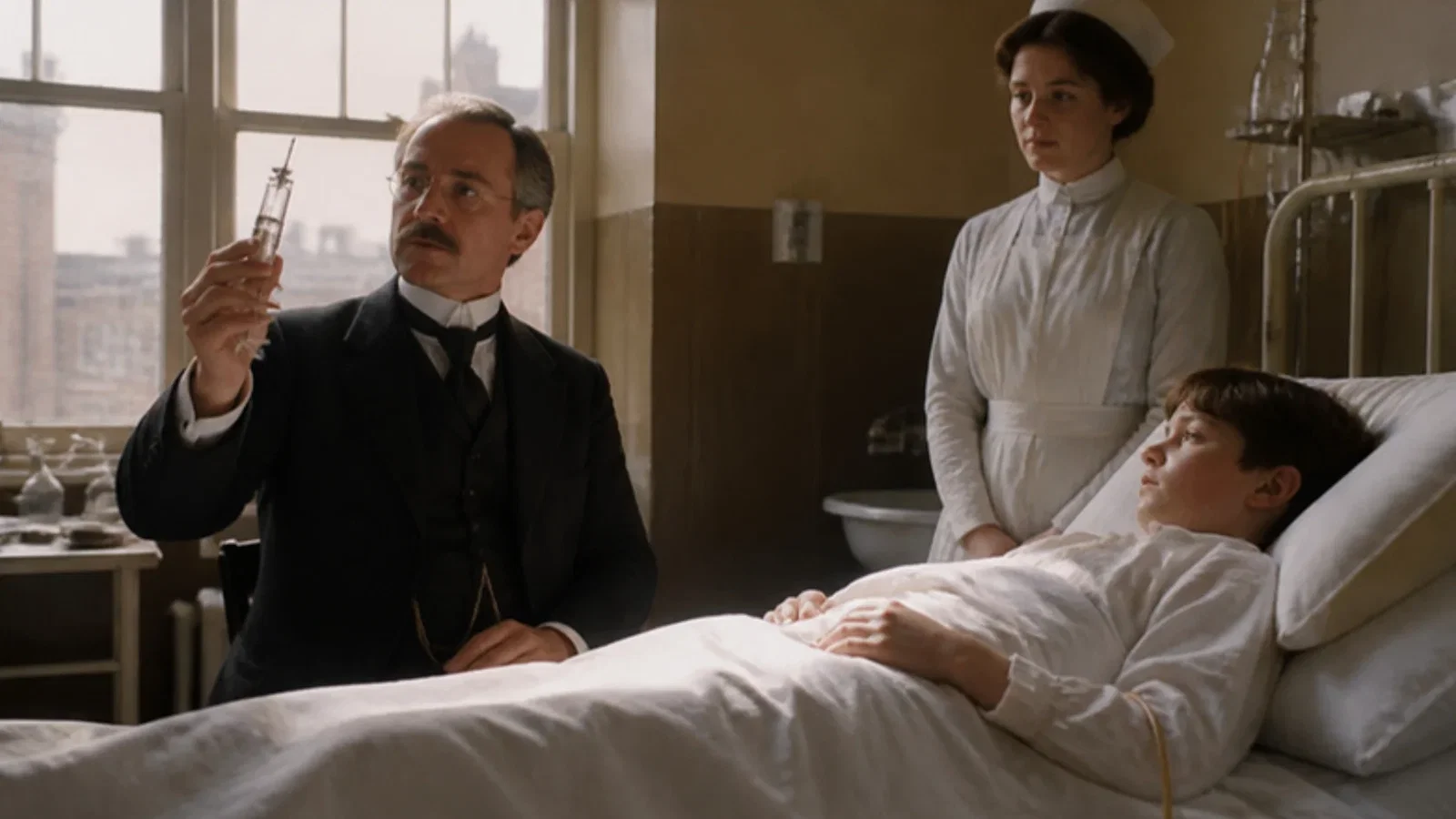
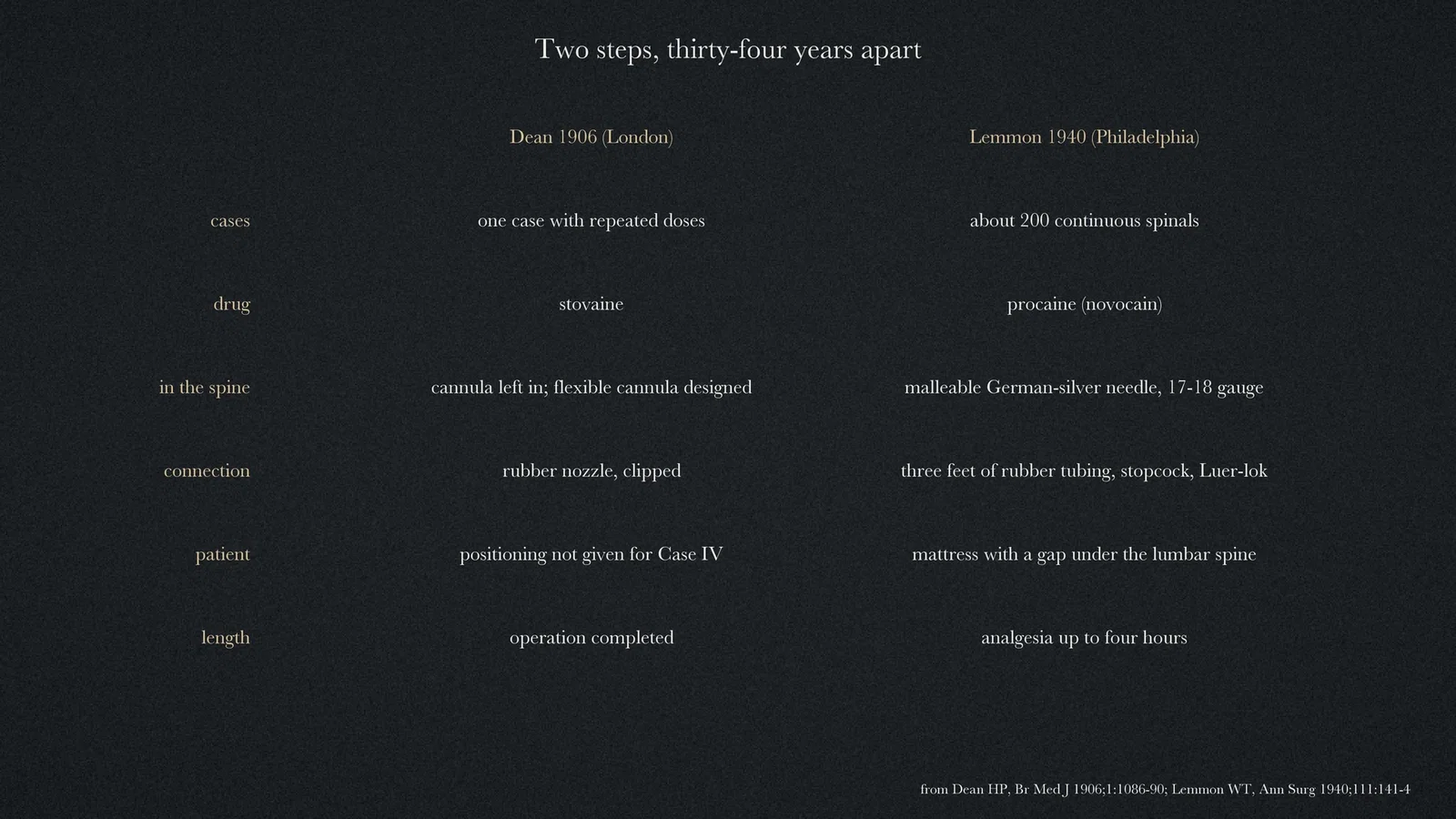
A London surgeon gave repeated doses of stovaine through a cannula left in the spine of a youth with peritonitis; thirty-four years later a Philadelphia surgeon reported about 200 continuous spinals with a malleable needle, tubing and a mattress with a gap.
Reading Library · Anesthesia Epochs · 中文版
Watch the education video (for clinicians)
1906: Dean's Indwelling Spinal Cannula — Lemmon's Continuous Spinal · Anesthesia Epochs Education Series
A single spinal injection lasts as long as the drug lasts. Giving more on the table means leaving something in the spine, and the question of what to leave there runs from a London case report to the catheters of today. This article reads two steps in that story in the original: Henry Percy Dean's article in the British Medical Journal of 12 May 1906, and William T. Lemmon's preliminary report in Annals of Surgery in January 1940. A 2023 essay by Jordan Francke puts the two side by side, and is read here as well. [1] [2] [3]
A surgeon's argument for stovaine
Dean, "Surgeon and Teacher of Operative Surgery to the London Hospital", began with the harm done by a general anaesthetic "such as chloroform or ether" to a patient with an acute abdominal disease. Local cocaine was, in Dean's experience, out of the range of practical surgery, and spinal cocaine in a dose large enough for the upper abdomen would further damage an already weakened patient. The new drug was stovaine, the chlorhydrate of an amino-alcohol. Below the groin, Dean wrote, the choice between stovaine and a general anaesthetic was a matter of taste. In general peritonitis it was "no longer a matter of sentiment, but a matter of life and death". [1]
The first three cases each had a single dose of 0.6 c. cm. of the solution. The third patient, a 43-year-old dock labourer, turned out to have a volvulus of the sigmoid colon; breathing and pulse failed during the operation, and the patient died some nine hours afterwards. Dean was not sure how far the stovaine was responsible, but warned that even 0.6 c. cm. could produce enough intercostal paralysis seriously to hinder respiration. [1]
Case IV: the cannula stays in
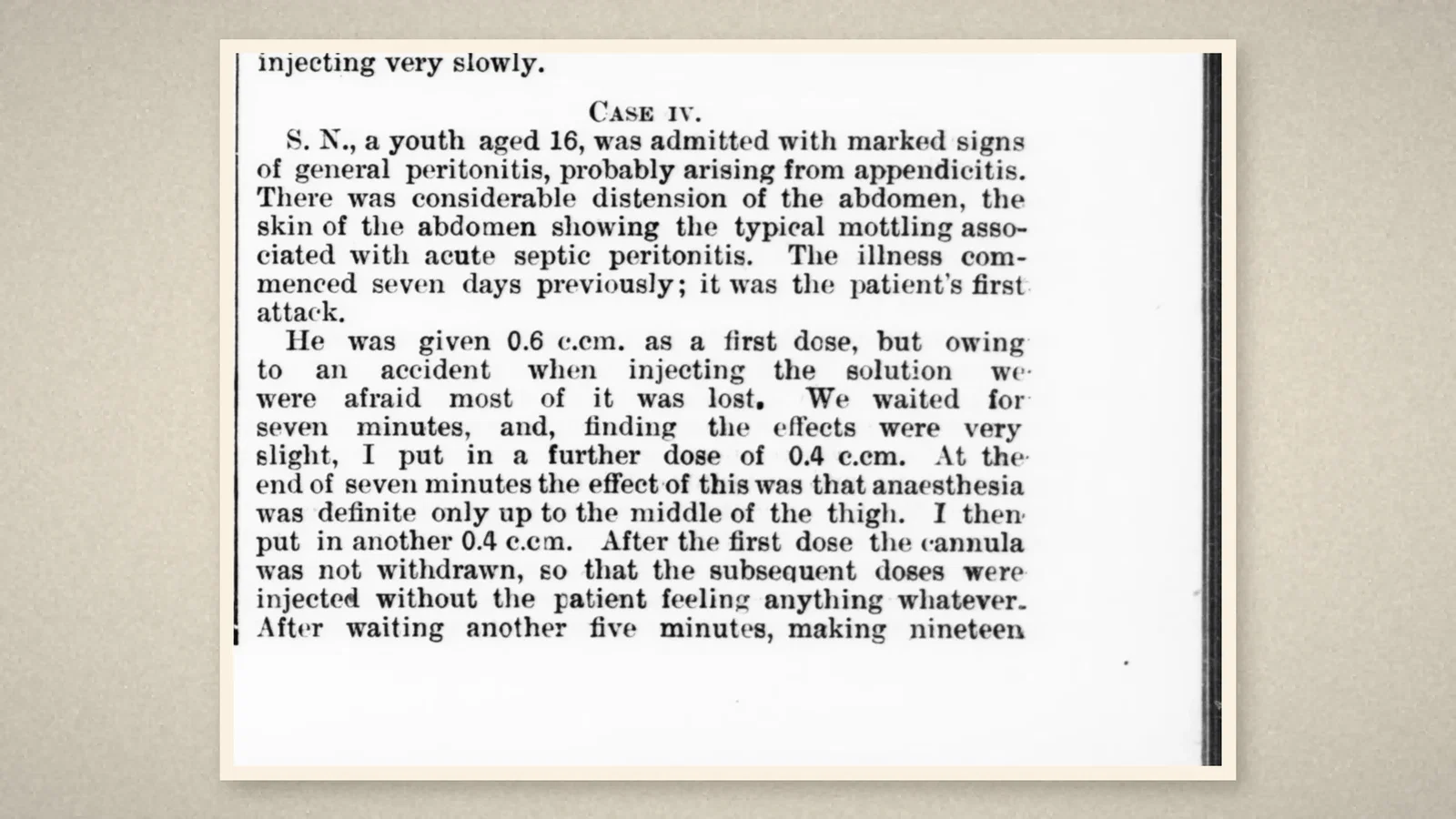
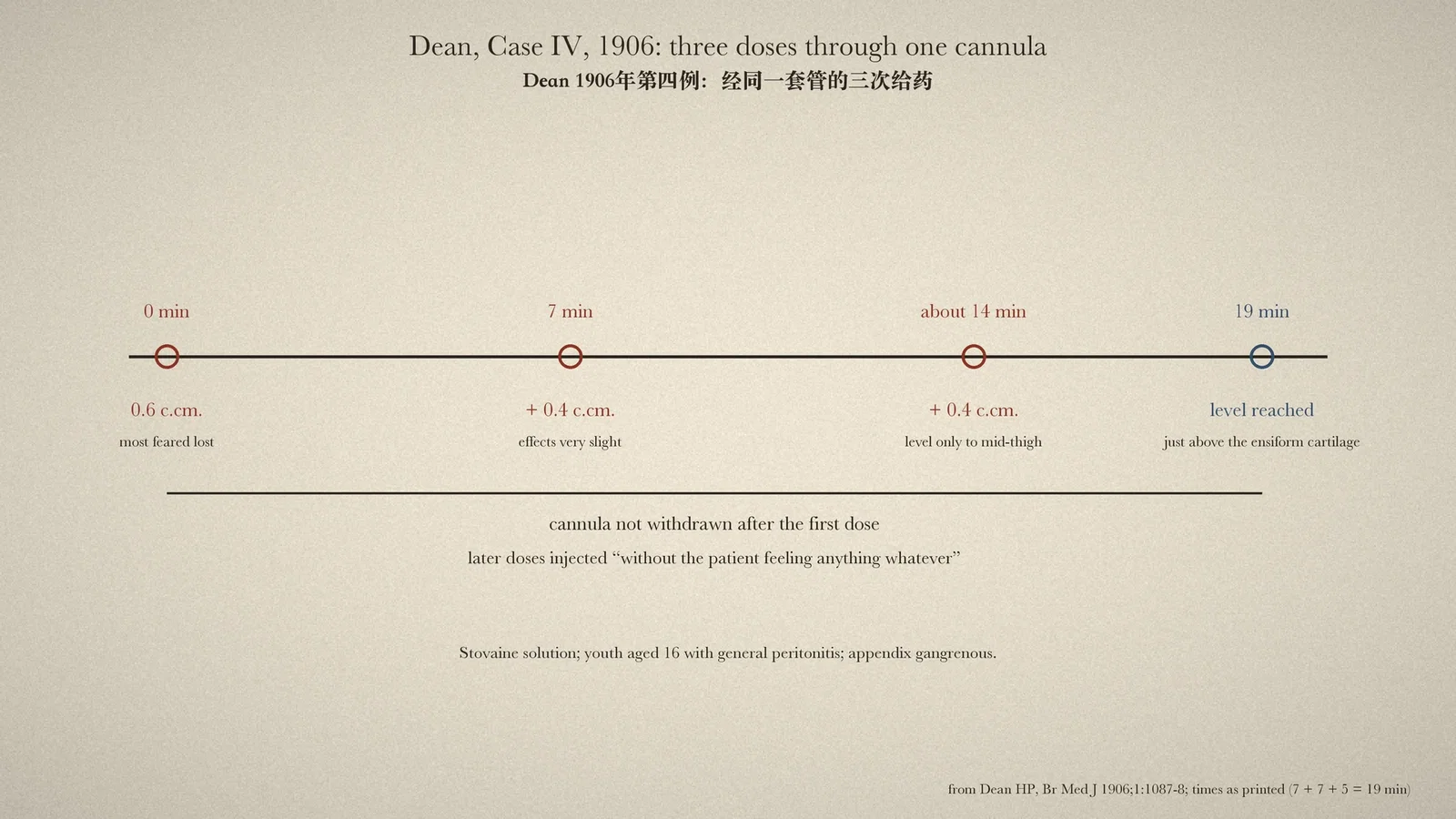
The fourth patient was "a youth aged 16" with general peritonitis, probably from appendicitis, seven days into the illness. A first dose of 0.6 c. cm. went wrong: "owing to an accident when injecting the solution we were afraid most of it was lost". After seven minutes the effect was very slight, so Dean put in a further 0.4 c. cm.; after seven more, the anaesthesia reached only the middle of the thigh, and Dean put in another 0.4. Then comes the sentence this article is about: "After the first dose the cannula was not withdrawn, so that the subsequent doses were injected without the patient feeling anything whatever." Nineteen minutes from the start, sensation was lost up to a line just above the ensiform cartilage. The appendix was gangrenous; the patient felt nothing through the operation and the pulse improved. Dean's verdict on the approach was mixed: "this gradual method was rather tedious", but the result rewarded it. [1]
Dean was not the only surgeon giving a second spinal dose. The article reports that Sonnenburg gave another dose after eight minutes "using the trocar again", and that Chaput gave 0.4 and then 0.3 at ten minutes, moving the patient onto the side again. What Case IV adds is that the needle never came out. [1]
A flexible cannula, not yet tried
The idea reappears in Dean's section on apparatus. For one dose a simple trocar and cannula would do; the danger lay in "the terminal portion inside the spinal canal", if the patient moved or artificial respiration became necessary. Dean had therefore designed a cannula that was flexible, with a rounded end, so that no sharp edge would come against a nerve or vessel: "I think it will be possible to leave the flexible cannula in position. This, however, is an aspect of the question that further experience alone can decide." A small rubber nozzle linked syringe and cannula, and could be clipped to stop cerebrospinal fluid escaping. [1]
Lemmon's method, thirty-four years later
Lemmon's paper, read before the Philadelphia Academy of Surgery on 4 December 1939, starts from two problems seen in sixteen years and more than 2,000 spinal anaesthetics: the spinal that fails "to take" and the spinal that wears off too soon. In about 200 continuous spinal anaesthesias, Lemmon reported, none had failed to take, and analgesia had been kept up for as long as four hours with repeated injections of procaine. [2]
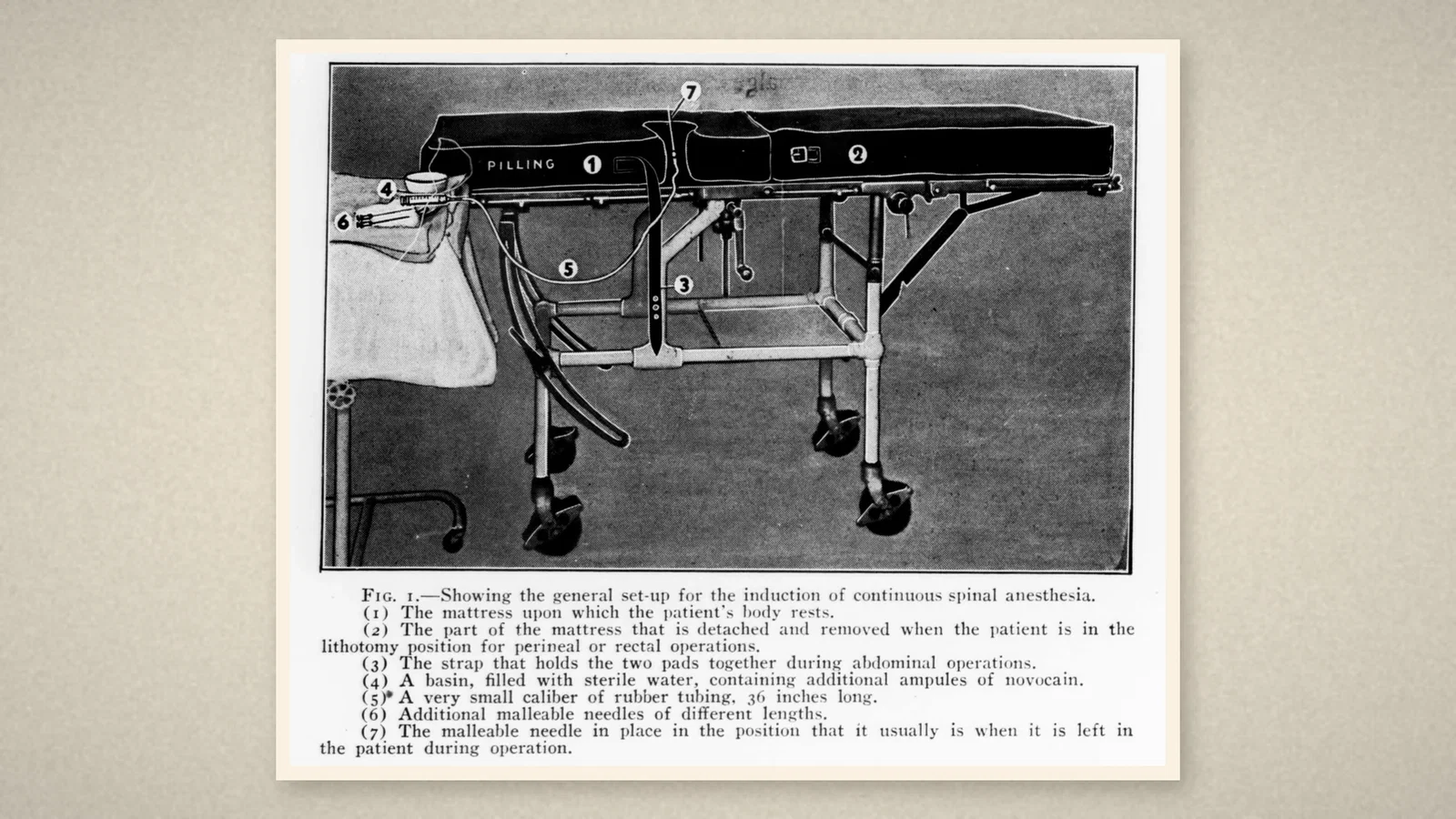
The equipment was listed as a rubber-covered mattress, spinal needles, rubber tubing, a stopcock, Luer-lok connections and a 10 cc syringe. The mattress had a seven-inch gap under the lumbar spine. After a lateral puncture, procaine was dissolved in withdrawn spinal fluid, three feet of fine tubing was filled, and a first 1 to 2 cc was given; the patient was then turned onto the back with the needle left in, sitting in the gap so that it never touched table or mattress, and further doses were given as needed. The needles were malleable German silver, 17 or 18 gauge, because within a month two ordinary needles had broken off in the spine when patients moved. [2]
How the story is told now
Francke's 2023 essay describes Dean as having "unintentionally stumbled upon" continuous spinal anaesthesia, says that "Dean's revelation failed to garner significant attention", and presents Lemmon's needle as another retained metal needle, the problem that Edward Tuohy at the Mayo Clinic later tried to solve by threading a ureteral catheter. [3] Dean's own text is more specific than the summary: the cannula stayed in because a dose had gone wrong, and Dean had already designed a flexible, round-ended cannula to be left in place, while admitting it had not been proven.
What the record shows
Dean reported one case in which repeated spinal doses were given through a cannula left in place, and an untested idea for doing it safely. Lemmon reported a method, with equipment and about 200 patients. Neither article claims to be the first, and this article does not award the title to either.
Sources and reading limits
Read: Dean's 1906 article in full; Lemmon's 1940 report in full; Francke's 2023 essay.
Not covered: the PubMed Central scan of Dean's article; the Sonnenburg and Chaput papers; later discussion of Lemmon's method; Tuohy's catheter papers, left to a separate article. Doses are as printed.
Two illustrations are page crops from the 1906 and 1940 articles; two are drawn from them.
- Dean HP. The importance of anaesthesia by lumbar injection in operations for acute abdominal diseases. Br Med J. 1906;1(2367):1086-90. Internet Archive
- Lemmon WT. A method for continuous spinal anesthesia: a preliminary report. Ann Surg. 1940;111(1):141-4. Internet Archive
- Francke J. The danger of using a medical eponym: missing the point of the Tuohy needle. CSA Bulletin. 2023 May 16. CSA
Continue exploring
Related reading connects shared questions and contexts; it does not by itself establish historical influence.
- 1899: Tuffier Brings Spinal Cocaine to the Société de Chirurgie
- 1898: Bier's Spinal Analgesia and Its Aftermath
Anesthesia Epochs · The Source Room · About & Editorial Method
Published November 2, 2026. Sources and reading limits are stated above. Illustrations are labelled as original source images or AI-made. Historical accounts are educational; they are not current treatment instructions.