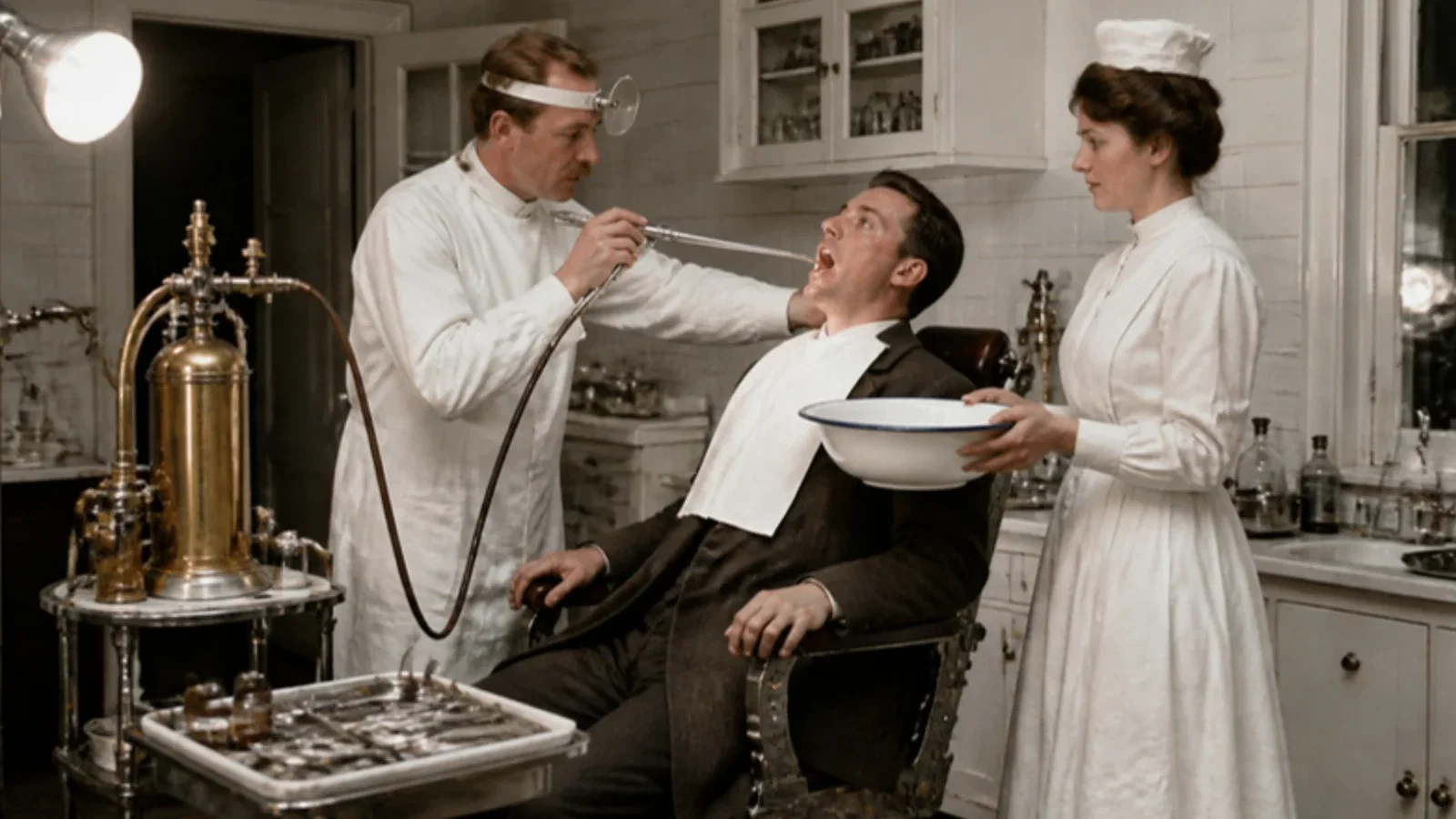
The Australian Society of Anaesthetists dates the Yankauer sucker to 1907, to Sidney Yankauer, ENT surgeon at Mount Sinai Hospital, New York. Yankauer's own description of the suction tip could not be found; what can be read is Edwin Pynchon's 'Some improved nose, throat and ear instruments' in The Laryngoscope of 1907, describing a compressed-air aspirator, built from a modified DeVilbiss spray, whose long bendable metal tip was 'of inestimable value for the removal of blood during an operation and is far superior to the cotton swab', and a 'Yankauer-Pynchon cut-off', developed from a new cut-off that Yankauer exhibited at the New York Academy of Medicine in November 1905.
Reading Library · Anesthesia Epochs · 中文版
Watch the education video (for clinicians)
1907: The Yankauer Sucker — Pynchon's Aspirator and the Cut-Off · Anesthesia Epochs Education Series
Few objects in an operating theatre are handled as often as the suction tip that carries Sidney Yankauer's name. The Australian Society of Anaesthetists (ASA) timeline dates it under 1907: "The Yankauer sucker developed", by Dr Sidney Yankauer, ear, nose and throat surgeon at Mount Sinai Hospital, New York. [2, p. 34]
Yankauer's own description of the suction tip was not found in The Laryngoscope for 1907 and could not be obtained from any other source for this article. What that volume does contain is a paper on suction in ENT surgery by another surgeon, with a component designed by Yankauer. It shows the problem the sucker would later answer, and how such instruments were made and improved at the time. [1]
An aspirator from a spray bottle
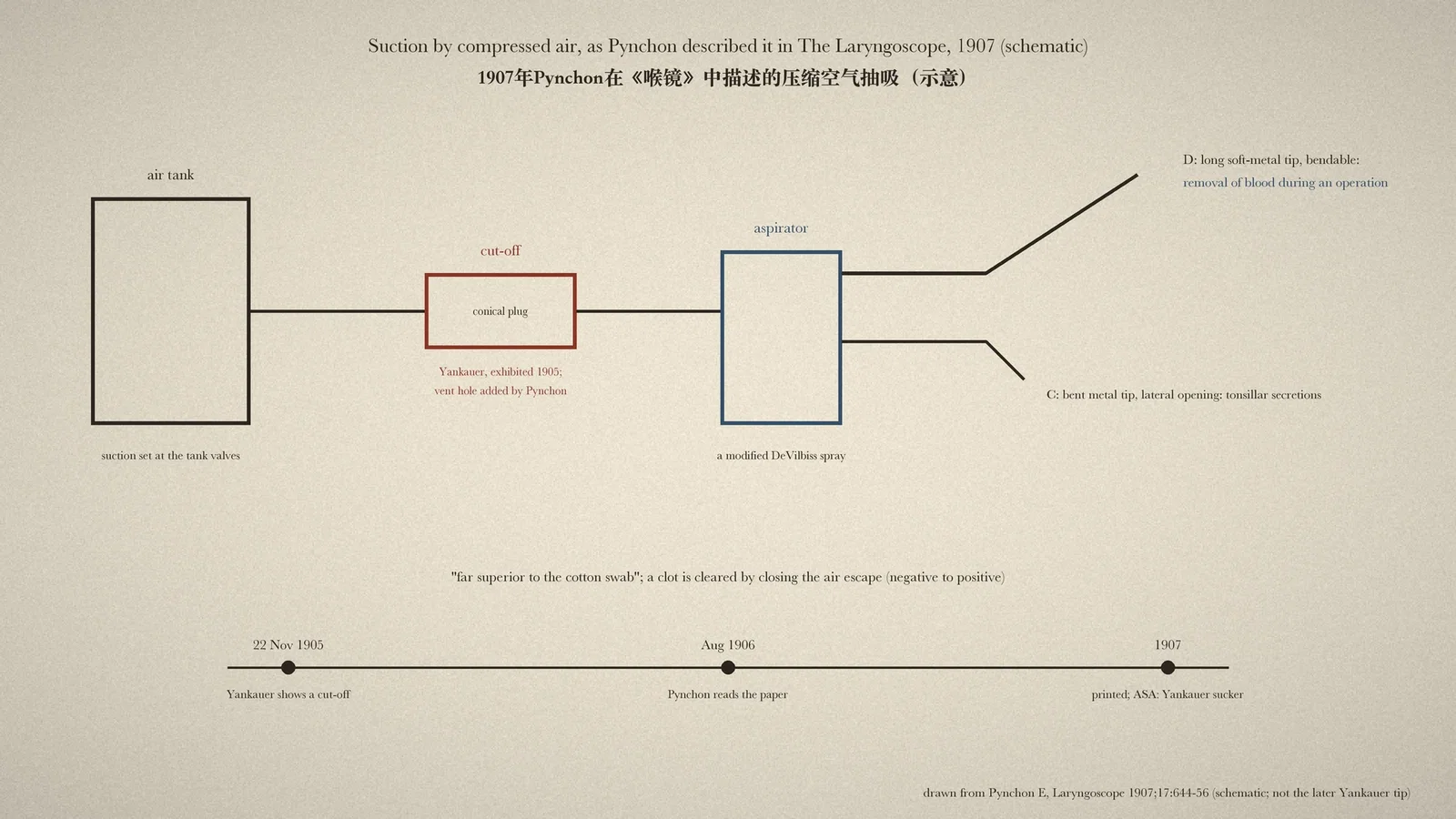
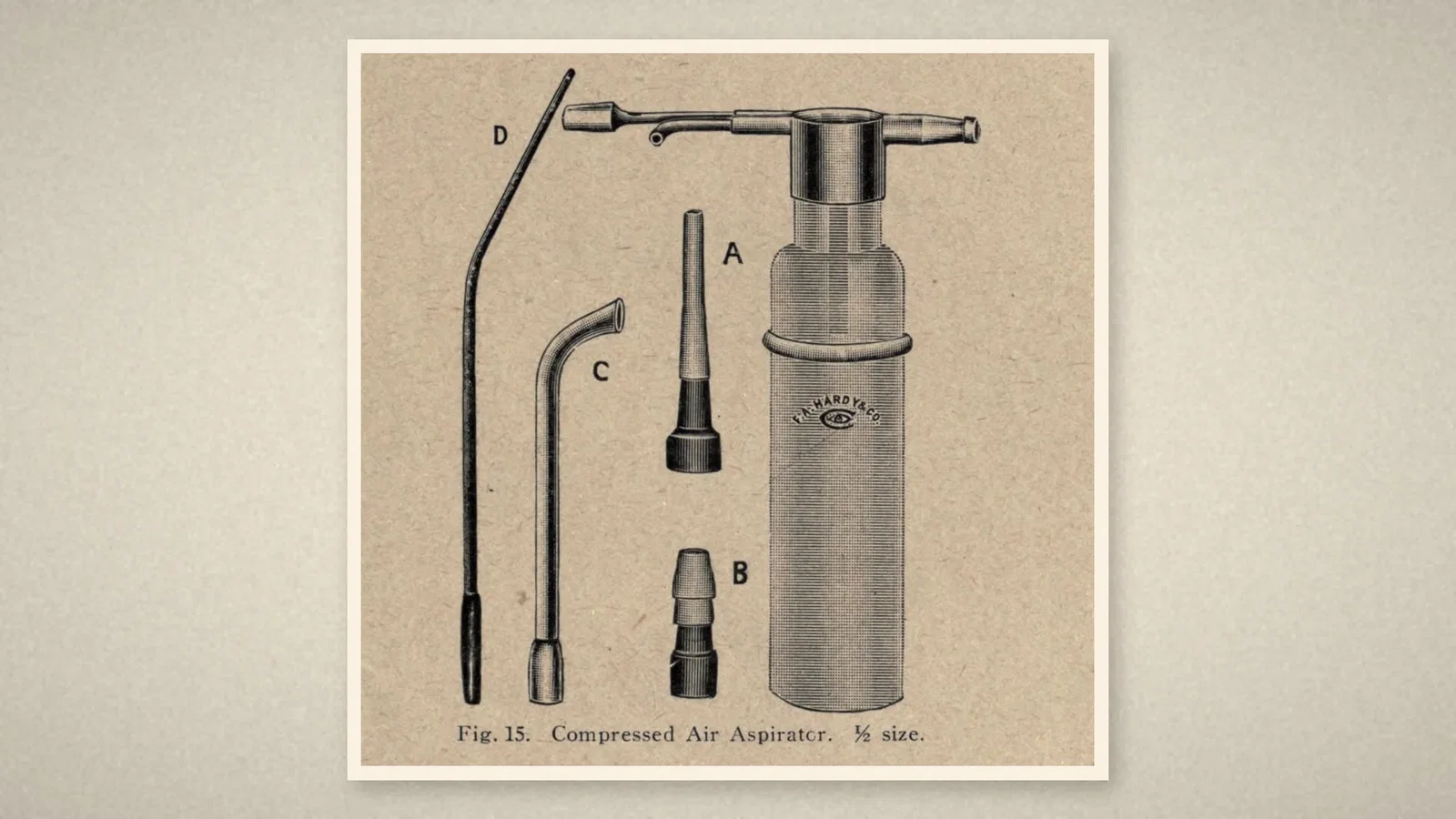
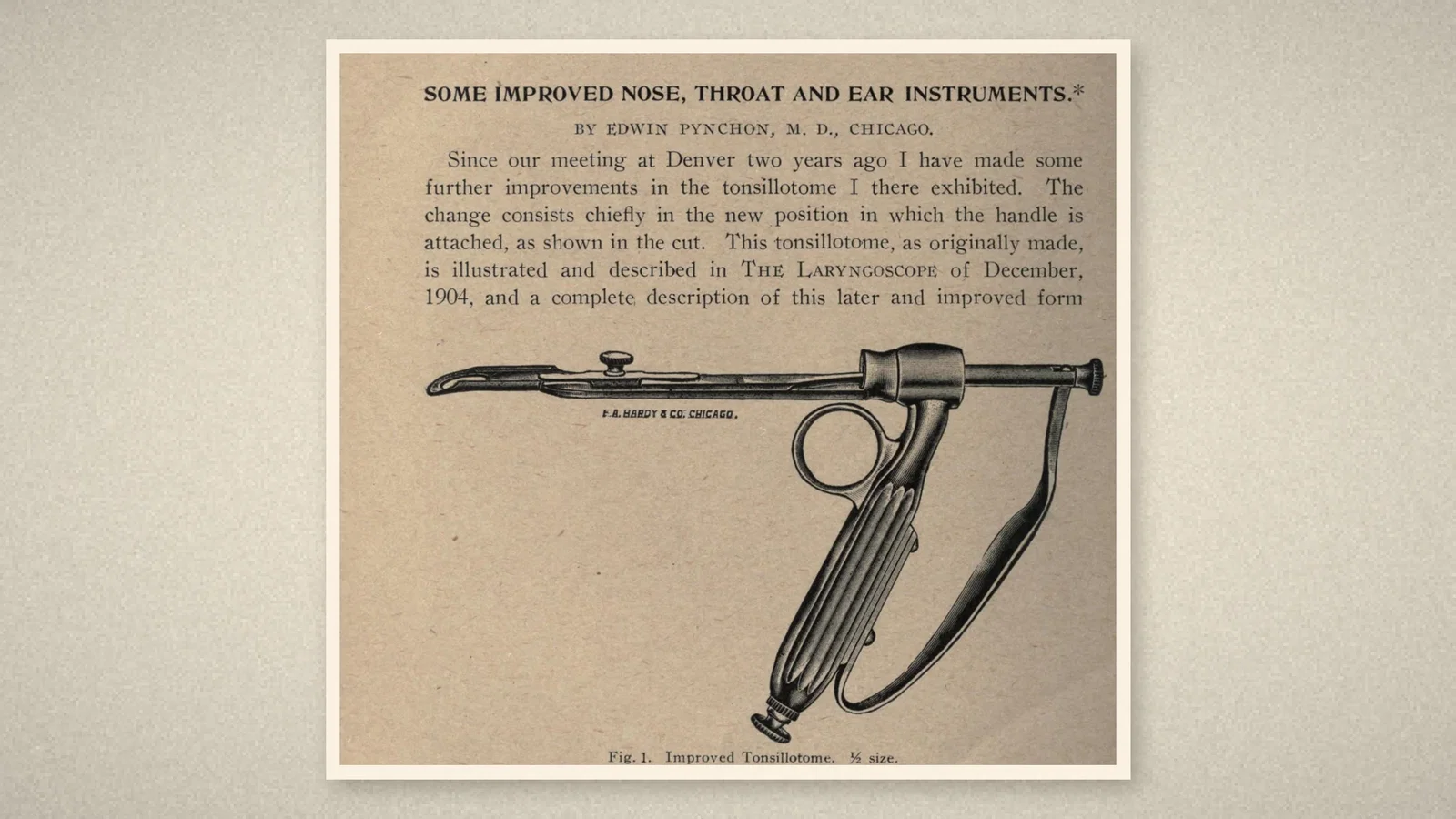
Edwin Pynchon of Chicago read "Some improved nose, throat and ear instruments" to the American Academy of Ophthalmology and Oto-Laryngology in August 1906, and The Laryngoscope printed it in 1907. Among saws, forceps and a tonsillotome, Pynchon described a "compressed air aspirator" (Fig. 15). It was made "by making certain required changes in a DeVilbiss spray apparatus, and hence is of convenient size to hold in the hand and is operated by the use of compressed air, therefore the strength of suction can be easily regulated by adjusting the controlling valves of the air tank". [1, pp. 644, 653-4]
The tips show where suction was wanted. A bent metal tip with a lateral opening "can be turned in either direction for the removal of tonsillar secretions", for which "a strong suction is required". And "a long soft-metal tip, which can be bent as desired, is of inestimable value for the removal of blood during an operation and is far superior to the cotton swab". If the tube became stopped by a blood clot, it could be "instantly freed by closing the air escape, when the negative is converted into positive air pressure". [1, p. 654]
Yankauer's cut-off
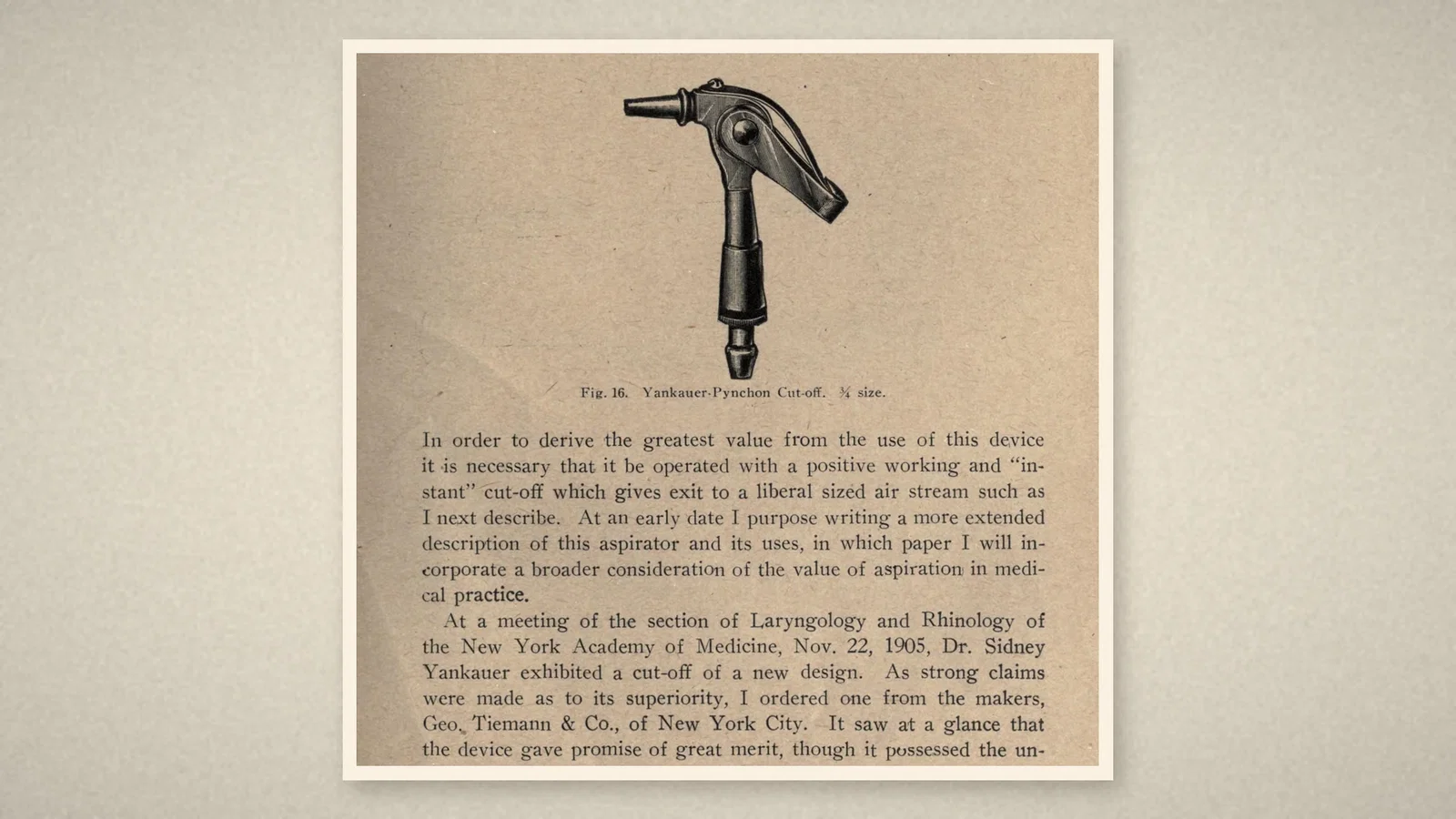
To get the most from the aspirator, Pynchon wrote, it had to be "operated with a positive working and 'instant' cut-off". The answer came from New York. "At a meeting of the section of Laryngology and Rhinology of the New York Academy of Medicine, Nov. 22, 1905, Dr. Sidney Yankauer exhibited a cut-off of a new design." Pynchon ordered one from the makers, Geo. Tiemann & Co., and saw "at a glance that the device gave promise of great merit, though it possessed the unpardonable defect of not being 'instant'". A small vent hole, Pynchon thought, would cure it; Tiemann made a second version with that change, and after months of use Pynchon was "convinced of its sterling merit", improving the spring later. The result, "all metal" and "practically of but two pieces", with the air controlled "solely by the revolving of a conical metal plug", appears in the paper as the "Yankauer-Pynchon Cut-off". [1, pp. 655-6]
What the record shows
The ASA's 1907 entry names a device whose original description this article could not find. The 1907 record that can be read shows the setting in which a dedicated surgical sucker made sense: throat surgeons removing blood and secretions from the operative field, preferring suction to the cotton swab, building their apparatus from spray bottles and air tanks, and refining small parts by trial. Yankauer appears in it as an inventor of one such part.
Sources and reading limits
Read: Pynchon's paper in The Laryngoscope 1907;17:644-56, the sections on the compressed air aspirator and the Yankauer-Pynchon cut-off in full, with the volume index, from the Internet Archive scan; the ASA timeline entry for 1907.
Not covered: any paper by Yankauer describing the suction tip that bears the Yankauer name, which could not be obtained; Yankauer's other papers in the same volume, which were searched and concern other instruments; the proceedings of the New York Academy of Medicine for November 1905; Pynchon's promised fuller paper on the aspirator. This article does not claim that Pynchon's aspirator is the Yankauer sucker, and it does not describe or draw the later rigid Yankauer tip. The ASA's date and attribution are the ASA's. Quotations are from the English original.
Three illustrations are crops of The Laryngoscope (pp. 653, 655 and 644), including Figs. 15 and 16; one is drawn from the paper.
- Pynchon E. Some improved nose, throat and ear instruments. Laryngoscope. 1907;17:644-56. Internet Archive
- Australian Society of Anaesthetists. Anaesthesia history timeline. 2024. ASA
Continue exploring
Related reading connects shared questions and contexts; it does not by itself establish historical influence.
Anesthesia Epochs · The Source Room · About & Editorial Method
Published November 2, 2026. Sources and reading limits are stated above. Illustrations are labelled as original source images or AI-made. Historical accounts are educational; they are not current treatment instructions.