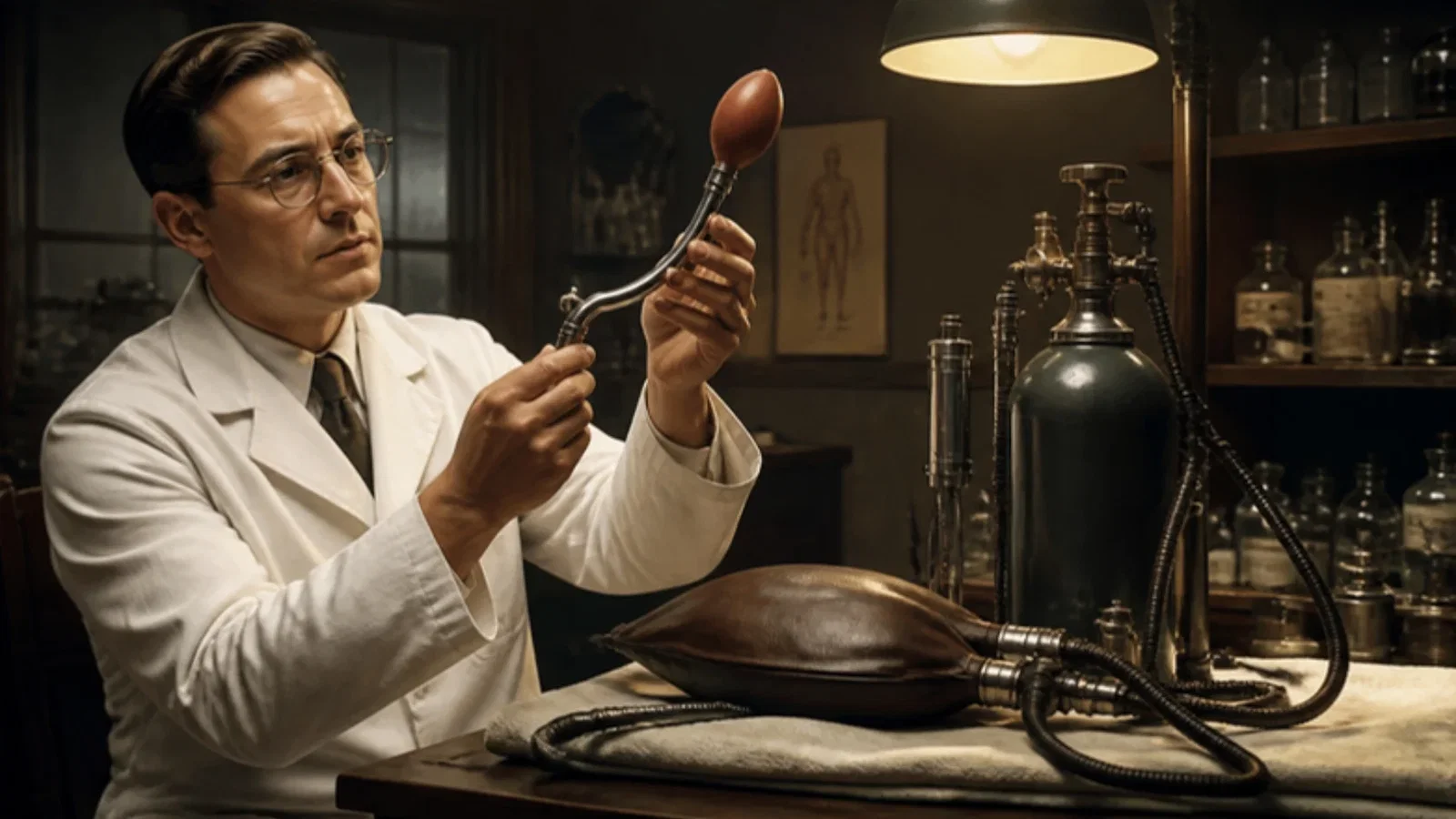
The Australian Society of Anaesthetists dates the marketing of Leech's pharyngeal bulb gasway to 1937. Leech's original paper in Anesthesia and Analgesia could not be obtained; this article reads two letters in the British Journal of Anaesthesia of 1990, in which R. Bodman, as the laryngeal mask drew attention, pointed out that Leech had described a device with the same purpose in 1937, quoting its construction and insertion and Griffith's practice, and A. I. J. Brain replied with the differences in position and seal. A nurse anaesthetists' meeting programme of 1941 also lists a talk on 'My Experience with the Leech Pharyngeal Bulb Gasway'.
Reading Library · Anesthesia Epochs · 中文版
Watch the education video (for clinicians)
1937: Leech's Pharyngeal Bulb Gasway · Anesthesia Epochs Education Series
Cyclopropane was given in closed circuits, and a closed circuit needs a seal. A face mask could leak, and an endotracheal tube meant intubating through the cords. The Australian Society of Anaesthetists (ASA) timeline records a third option under 1937: "Leech 'pharyngeal bulb gasway' marketed", by the Canadian anaesthetist Beverley Leech. According to the ASA, Leech began the design in 1935 by making wax casts of cadavers' pharynxes, to provide a safe closed circuit with cyclopropane in head and neck surgery, and the moulds were used to make soft rubber bulbs fitted to the ends of metal Connell oropharyngeal airways. [4, p. 48]
Leech's own paper, "Pharyngeal bulb gasway: a new aid in cyclopropane anesthesia", appeared in Anesthesia and Analgesia in 1937; the International Abstracts of Surgery listed it that June. It could not be obtained for this article. The fullest description that can be read today comes from a letter written more than half a century later. [3][1]
Déjà vu
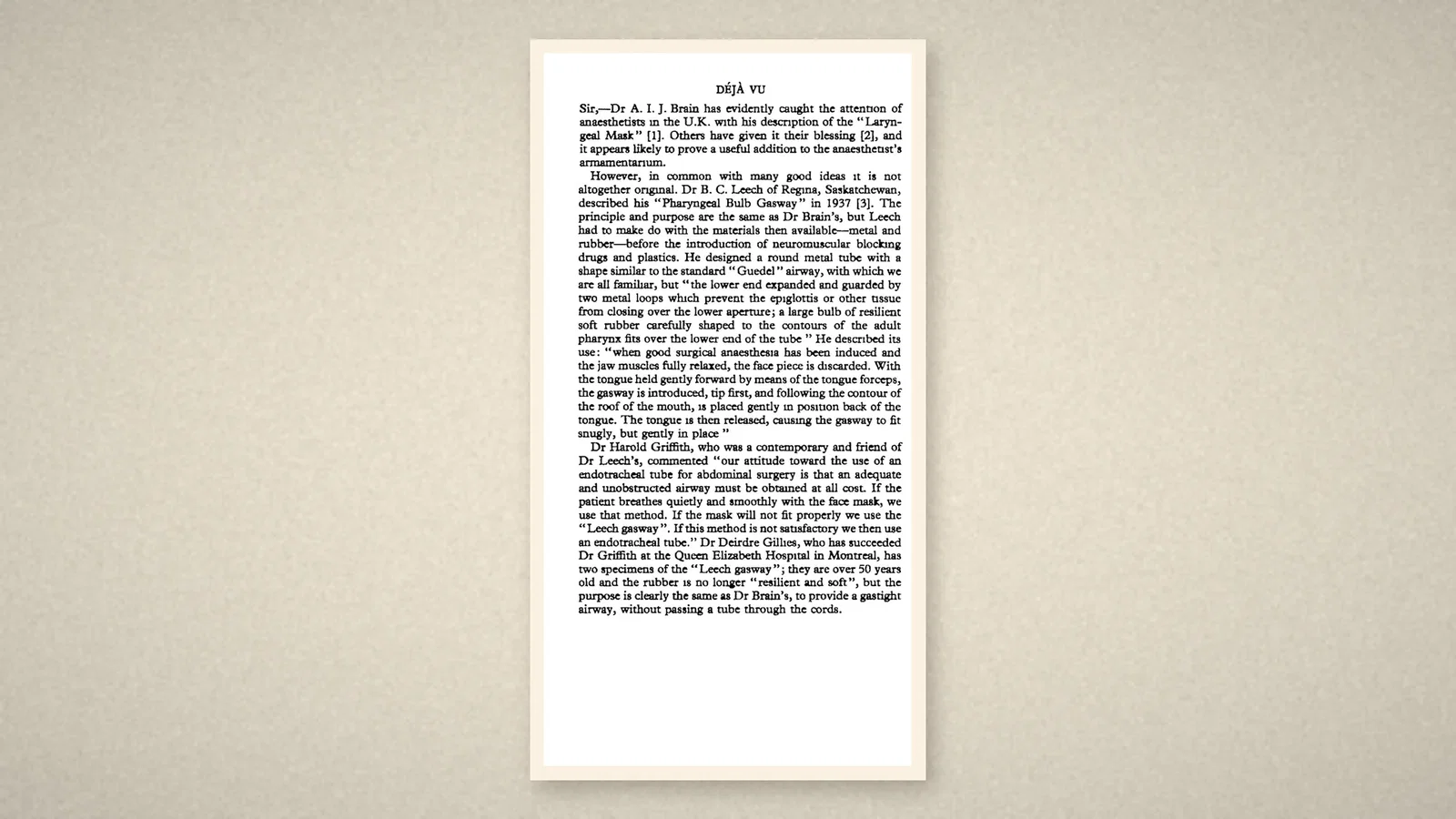
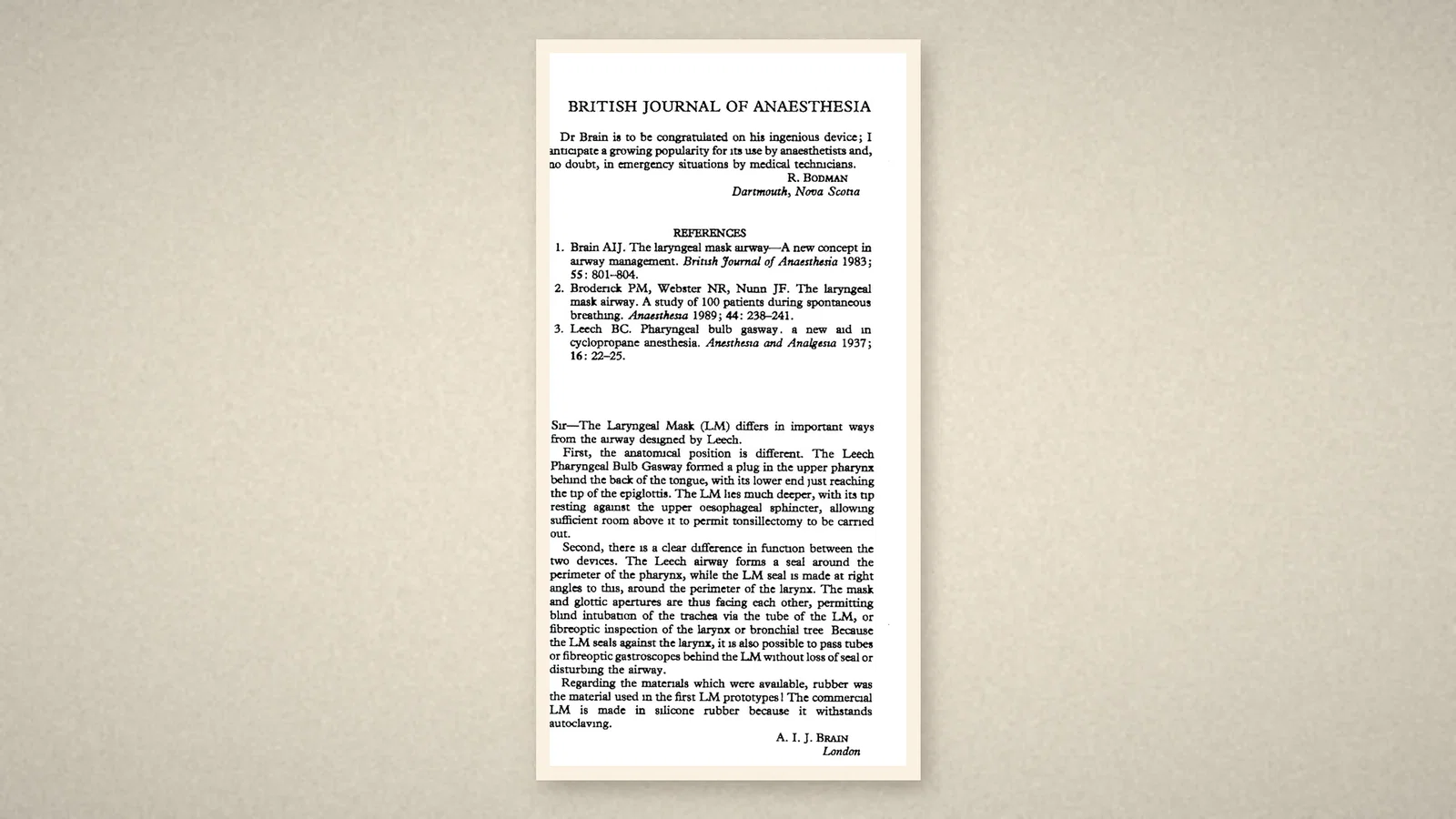
In 1990 the laryngeal mask was new to British practice. R. Bodman of Dartmouth, Nova Scotia, wrote to the British Journal of Anaesthesia under the heading "Déjà vu". Dr A. I. J. Brain's laryngeal mask, Bodman wrote, "appears likely to prove a useful addition", but "in common with many good ideas it is not altogether original": "Dr B. C. Leech of Regina, Saskatchewan," had described the pharyngeal bulb gasway in 1937, with the same principle and purpose, though Leech "had to make do with the materials then available—metal and rubber—before the introduction of neuromuscular blocking drugs and plastics". [1, p. 406]
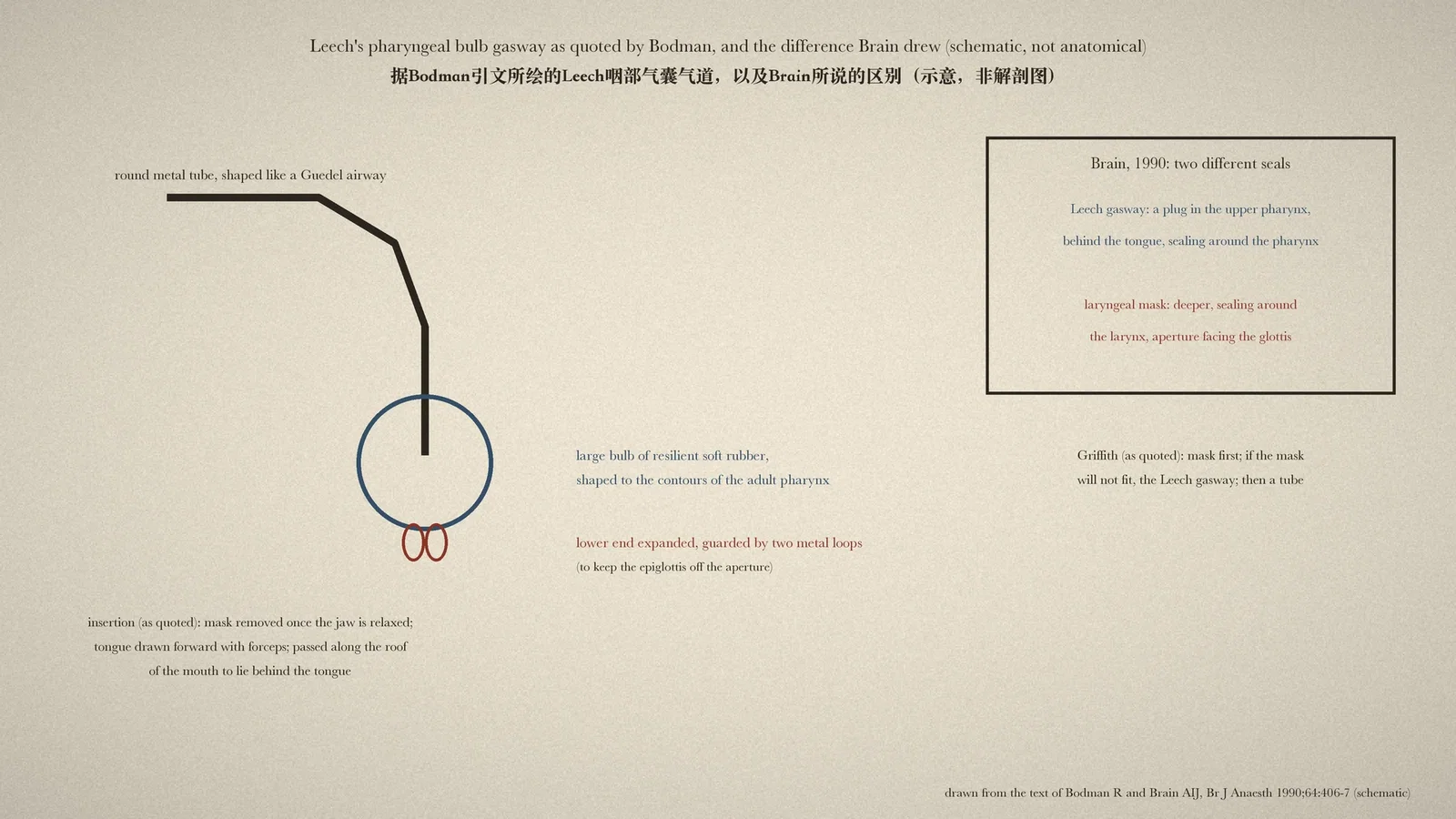
Bodman quoted Leech's description. The gasway was a round metal tube shaped like the familiar Guedel airway, but with "the lower end expanded and guarded by two metal loops which prevent the epiglottis or other tissue from closing over the lower aperture; a large bulb of resilient soft rubber carefully shaped to the contours of the adult pharynx fits over the lower end of the tube". It went in once anaesthesia was deep: "when good surgical anaesthesia has been induced and the jaw muscles fully relaxed, the face piece is discarded. With the tongue held gently forward by means of the tongue forceps, the gasway is introduced, tip first, and following the contour of the roof of the mouth, is placed gently in position back of the tongue." [1, p. 406]
Where it fitted in practice
Bodman also quoted Harold Griffith, "a contemporary and friend of Dr Leech's", on how the device was used in Montreal: an adequate airway "must be obtained at all cost". If the patient breathed smoothly with the face mask, they used the mask; "If the mask will not fit properly we use the 'Leech gasway'. If this method is not satisfactory we then use an endotracheal tube." Two specimens survived at the Queen Elizabeth Hospital in Montreal, "over 50 years old", their rubber no longer resilient, but their purpose "clearly the same as Dr Brain's, to provide a gastight airway, without passing a tube through the cords". [1, p. 406]
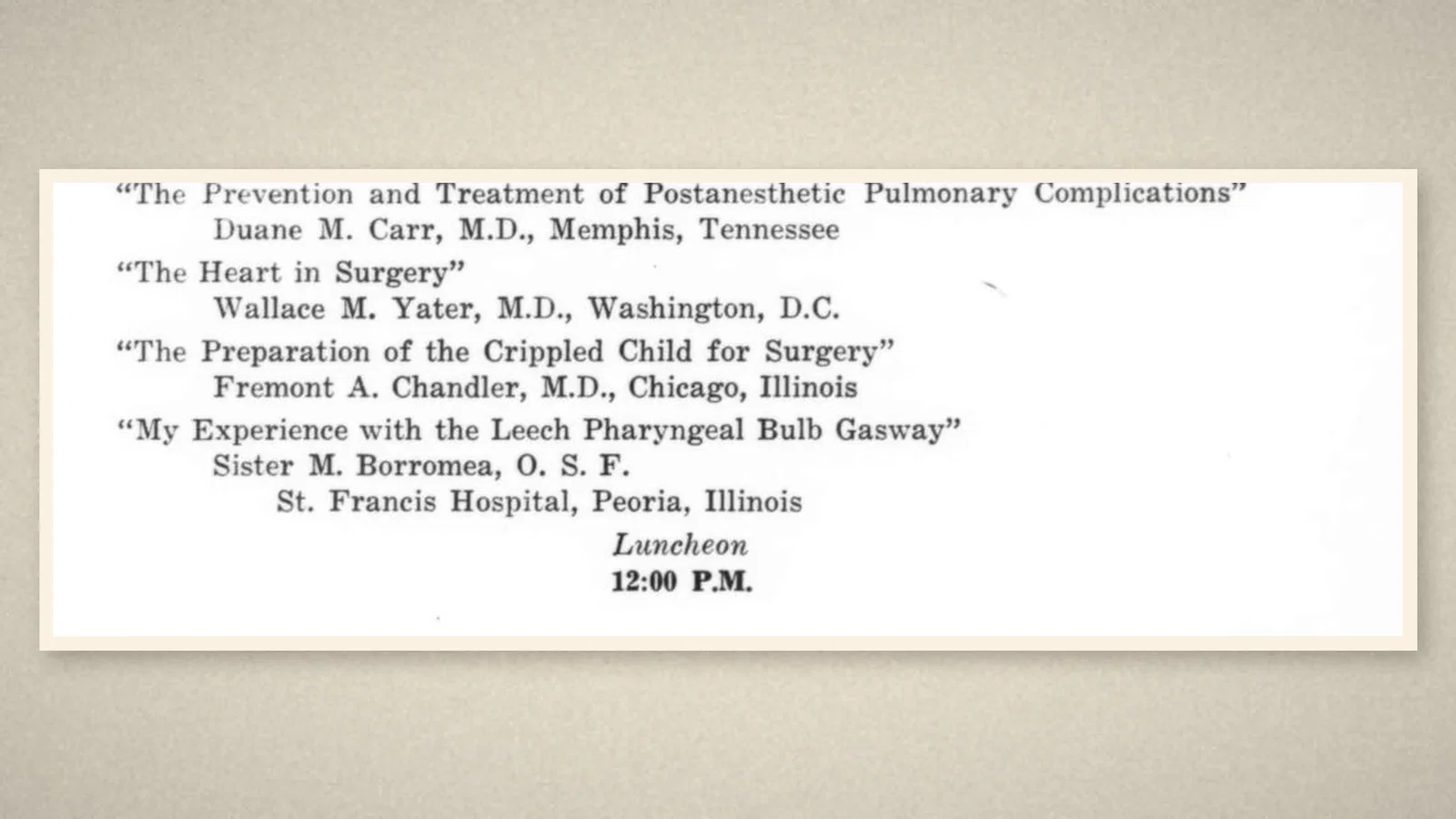
The device also reached nurse anaesthetists in the United States. The programme of the Mid-South Post Graduate Nurse Anesthetists Assembly in Memphis, in February 1941, lists a talk from St. Francis Hospital, Peoria, Illinois: "My Experience with the Leech Pharyngeal Bulb Gasway". Only the title survives in the programme. [2, p. 59]
Brain's reply
Brain answered in the same column that the laryngeal mask "differs in important ways from the airway designed by Leech". The gasway "formed a plug in the upper pharynx behind the back of the tongue, with its lower end just reaching the tip of the epiglottis"; the laryngeal mask lies much deeper. The gasway sealed "around the perimeter of the pharynx", while the laryngeal mask seals around the larynx, so that mask and glottis face each other and a tube or fibreoptic scope can pass through it. As for materials, Brain added, rubber had been used for the first laryngeal mask prototypes. [1, pp. 406-7]
What the record shows
The exchange shows two ways of reading an old device. To Bodman, the gasway proved that the idea of a gastight airway without intubation was old. To Brain, the difference lay in where the seal was made and what it allowed. Both agreed that Leech had faced the same problem, a closed circuit without a tube, with only metal and rubber to solve it.
Sources and reading limits
Read: the correspondence in the British Journal of Anaesthesia 1990;64:406-7 (Bodman's letter and Brain's reply), from the Digital Library of India scan on the Internet Archive; the programme in the Bulletin of the American Association of Nurse Anesthetists, February 1941 (p. 59); the listing in the International Abstracts of Surgery, June 1937; the ASA timeline entry for 1937.
Not covered: Leech's original paper in Anesthesia and Analgesia 1937, which could not be obtained; the text of the 1941 talk; Griffith's own writings, quoted here only through Bodman; any drawing or photograph of the gasway. The description of the device is Leech's as Bodman quotes it; the wax casts of 1935 and the Connell airways rest on the ASA alone. Bodman's view that the laryngeal mask was "not altogether original" and Brain's reply are both reported; this article makes no claim of priority. The 1941 speaker is identified only by hospital. The drawn figure is a labelled schematic from the quoted description, not a reconstruction of the object. Quotations are from the English originals.
Three illustrations are crops of the BJA 1990 (p. 406, both columns) and of the AANA Bulletin 1941 (p. 59); one is drawn from the letters.
- Bodman R. Deja vu [letter]; Brain AIJ [reply]. Br J Anaesth. 1990;64:406-7. Internet Archive
- Mid-South Annual Meeting programme, Mid-South Post Graduate Nurse Anesthetists Assembly, Memphis, 12-13 February 1941. Bulletin of the American Association of Nurse Anesthetists. 1941 Feb;9(1):58-9. Internet Archive
- International Abstracts of Surgery. Surg Gynecol Obstet. 1937 Jun;64 (supplement): bibliography of anesthesia. Internet Archive
- Australian Society of Anaesthetists. Anaesthesia history timeline. 2024. ASA
Continue exploring
Related reading connects shared questions and contexts; it does not by itself establish historical influence.
- 1931: Guedel and Waters' Cuffed Endotracheal Tube
- 1920: Guedel Divides Ether's Third Stage into Four Strata
Anesthesia Epochs · The Source Room · About & Editorial Method
Published November 2, 2026. Sources and reading limits are stated above. Illustrations are labelled as original source images or AI-made. Historical accounts are educational; they are not current treatment instructions.