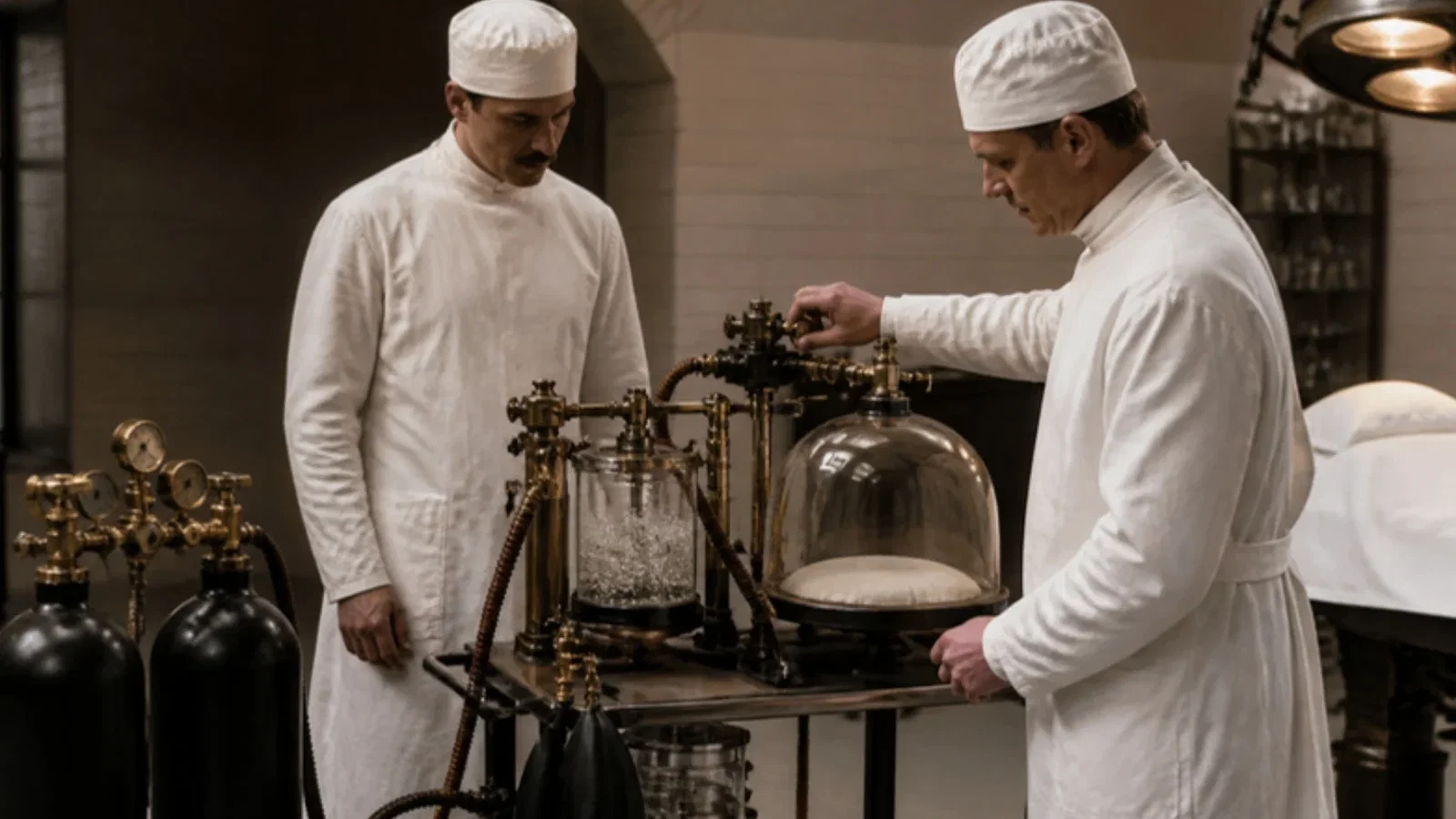
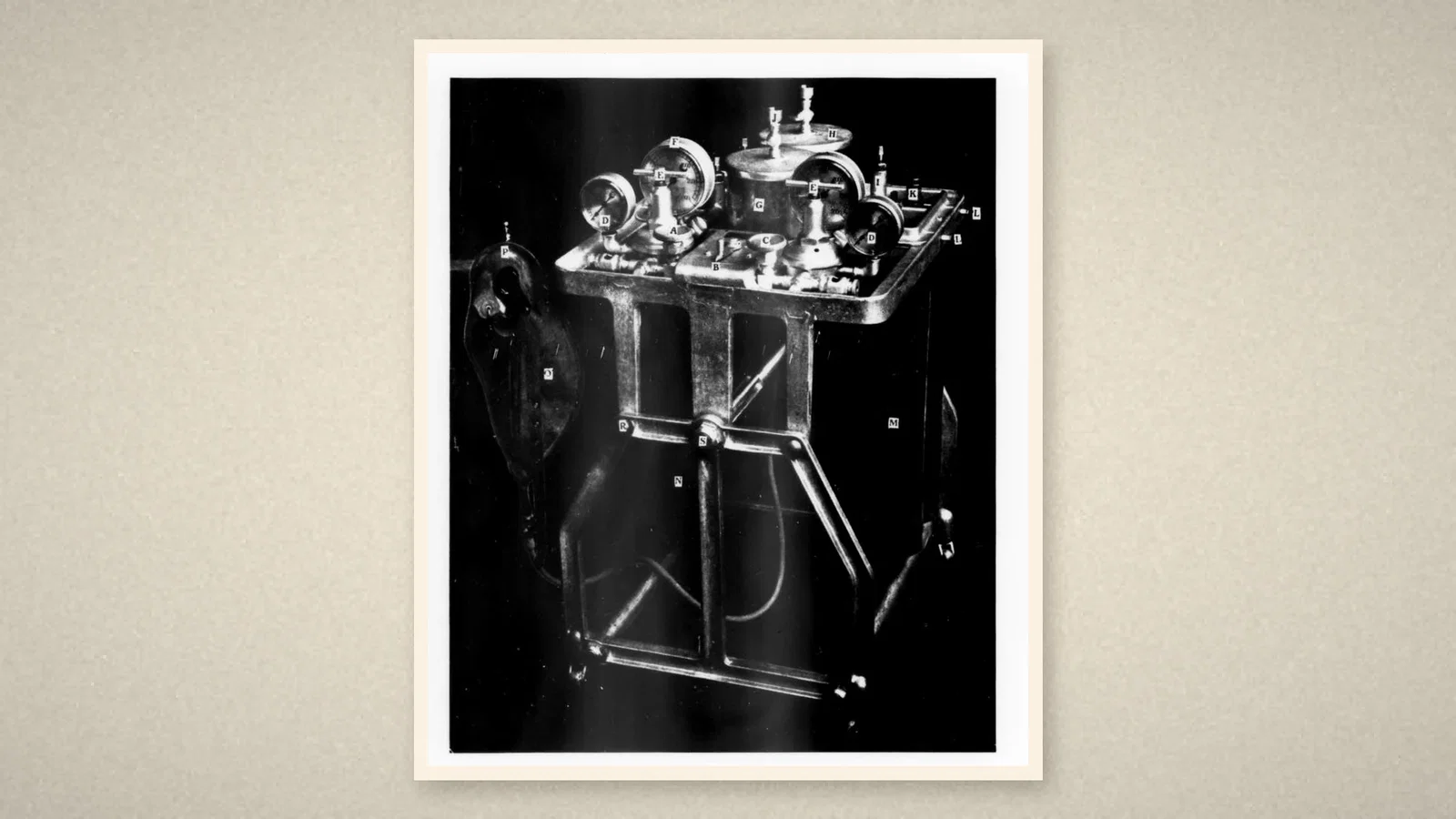
In September 1912 Surgery, Gynecology and Obstetrics published 'Nitrous oxide-oxygen-ether anaesthesia: notes on administration; a perfected apparatus' by Frederic J. Cotton and Walter M. Boothby of the Boston City Hospital: machines on Hewitt's bag principle could not keep the two bags equally full, so the mixture varied; the authors set four requirements, an absolutely regular flow of each gas, visible flow, ether addable gradually yet rapidly, and an air-tight face-piece, and met them with automatic reducing valves built into the machine, gases bubbling separately through water into a glass mixing chamber, and an ether chamber. Any anaesthesia with cyanosis, they insisted, was dangerous.
Reading Library · Anesthesia Epochs · 中文版
Watch the education video (for clinicians)
1912: The Cotton-Boothby Apparatus — Boston City Hospital · Anesthesia Epochs Education Series
A modern anaesthetic machine does two quiet things that are easy to forget: it delivers each gas at a steady rate, and it shows the anaesthetist how much is flowing. In 1912 a surgeon and an anaesthetist at the Boston City Hospital described a machine built around exactly those two demands, and explained why the machines then in use could not meet them. [1]
The problem with bags
"Nitrous oxide-oxygen-ether anaesthesia: notes on administration; a perfected apparatus", by Frederic J. Cotton, first assistant surgeon at the Boston City Hospital, and Walter M. Boothby, its anaesthetist, appeared in Surgery, Gynecology and Obstetrics in September 1912. Andrews of Chicago in 1868 and Bert of Paris in 1879 had shown that nitrous oxide and oxygen could give an ideal anaesthesia, and the authors added that "all experimental and clinical work has emphasized the fact that a constant mixture" gave a smoother anaesthesia than one of varying composition. [1, p. 281]
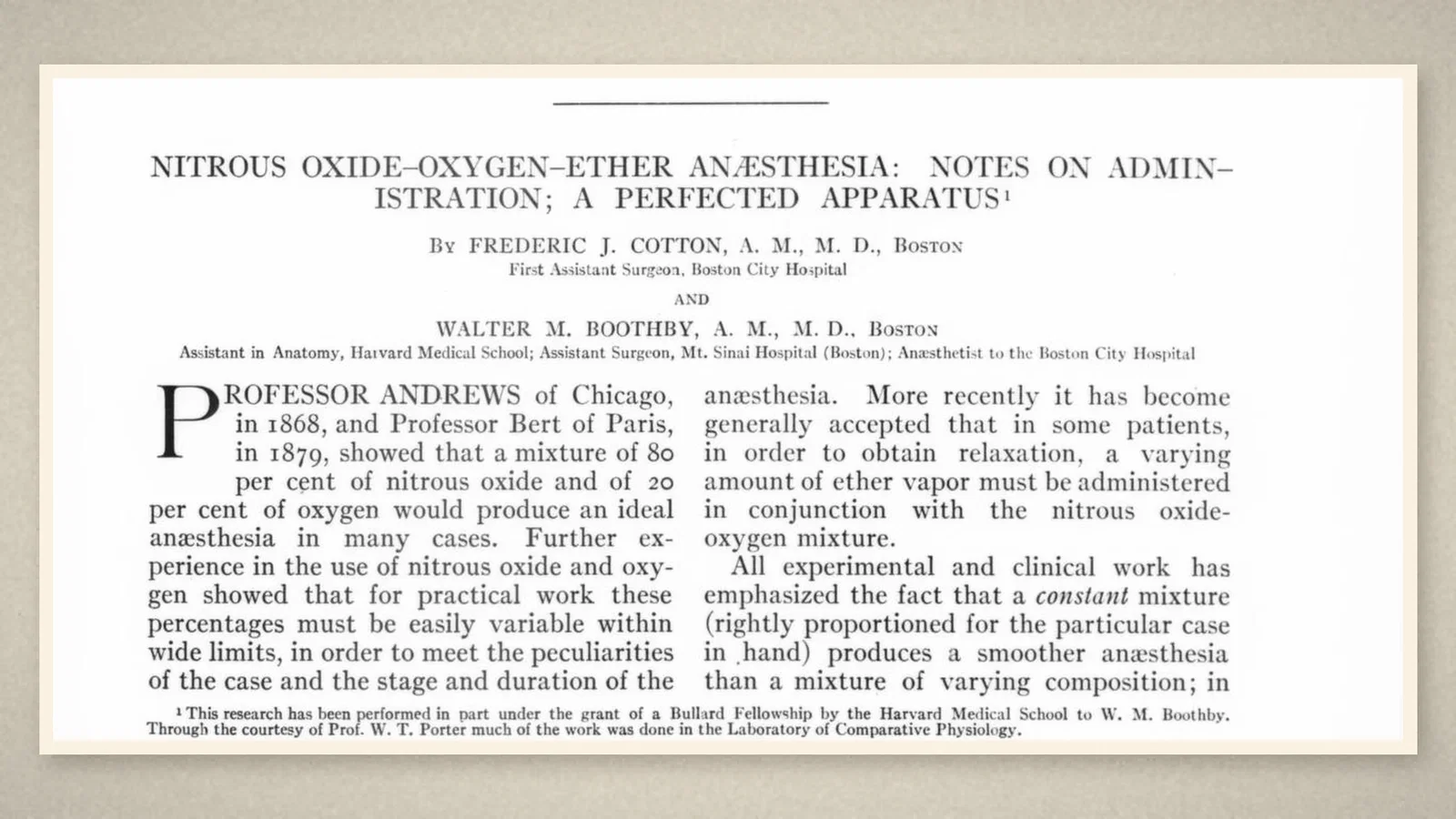
Hewitt of England, they wrote, had built the first apparatus suitable for general surgery: the gases went from the tanks into semi-elastic bags and from the bags through a graduated valve. But "it has been found very hard to maintain the two bags evenly and equally distended", so the mixture actually received "must of necessity vary greatly". McKesson's newer apparatus was built on the same principle. [1, p. 282]
Four requirements
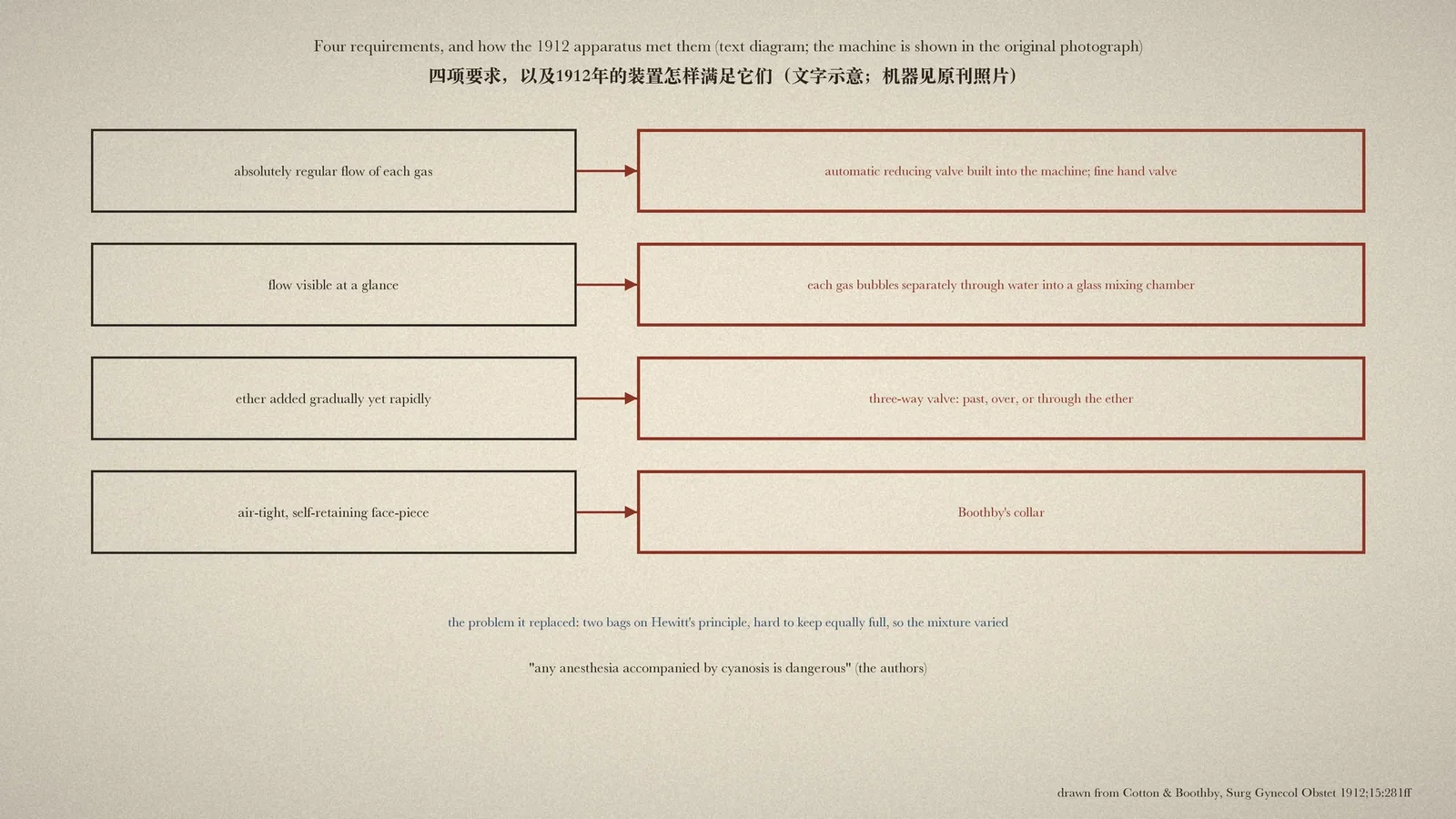
The authors "laid down four fundamental requirements". There must be "an absolutely regular flow of each gas at any rate desired, without the necessity of frequent valve manipulation"; the flow "must be rendered visible so that their proportions can be approximately estimated at a glance"; there must be an efficient way of adding ether vapour "gradually yet rapidly"; and the face-piece must be "absolutely air-tight and also practically self-retaining". [1, p. 282]
The answers were mechanical. Automatic reducing valves, built into the machine rather than attached to the tanks, brought the tank pressure down to a working level. Visibility "has been solved by having each gas bubble separately through water into a glass mixing chamber", with a fine hand valve for each gas that, once set, would hold "unaltered for hours". A three-way valve sent the mixture past the ether, over its surface or bubbling through it. Boothby had designed an air-tight, self-retaining collar for the mask. [1, pp. 282-4]
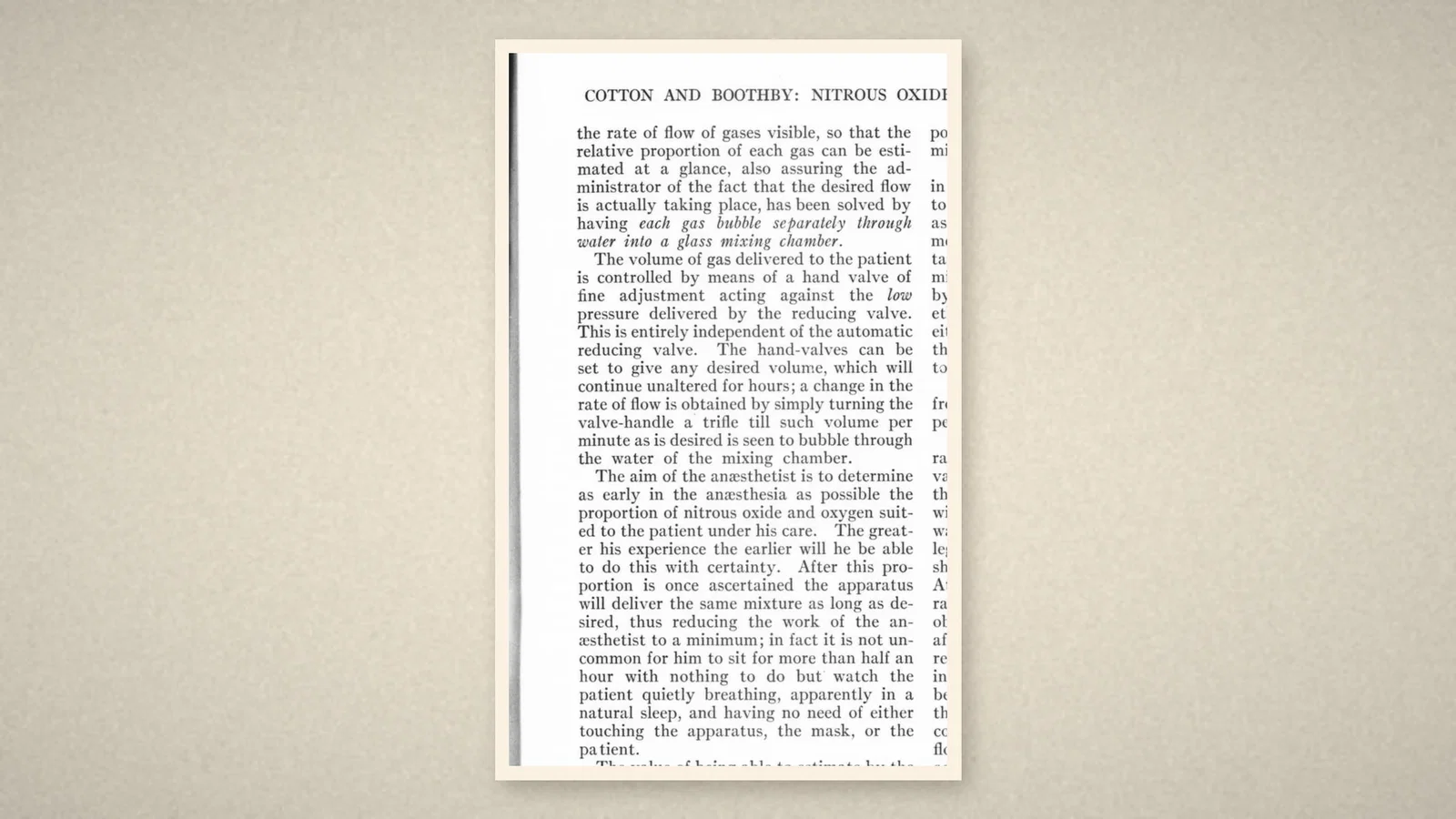
Once the right proportion for a patient was found, the authors wrote, the machine would keep delivering it, and the anaesthetist could often sit for more than half an hour with nothing to do but watch the patient breathing. When a patient showed signs of becoming "light", ether could be increased within seconds to "catch" the patient and then shut off; "in at least one quarter of the cases no ether at all will be required". [1, pp. 283-4]
A warning about colour
The paper ends with a warning. "We thoroughly believe that any anesthesia accompanied by cyanosis is dangerous"; deaths under gas and oxygen were being reported, and "no deaths have been reported in which the patients color was maintained pink". Even with enough oxygen, too much nitrous oxide produced stertor, mucus, "a death-like pallor" and loss of reflexes, and then the mask should come off at once. [1, pp. 285-6]
What the record shows
The step from a bag squeezed by guesswork to a flow that could be set and seen. The four requirements read like a specification for every machine since: steady flow, visible flow, a controllable vapour, and a seal. The warning beside them reads like a reminder that the machine was only as safe as the colour of the patient.
Sources and reading limits
Read: Cotton and Boothby, Surgery, Gynecology and Obstetrics, September 1912, volume 15, from p. 281 through the description of the apparatus, the discussion of ether, the face-piece, cyanosis and overdose, and the photograph and key on p. 286.
Not covered: Boothby's 1912 paper on the air-tight collar in the Boston Medical and Surgical Journal; the authors' earlier paper; Hewitt's and McKesson's descriptions; the maker's literature; the Wood Library-Museum item. The last page of the article was not located, so the reference gives the first page.
Limits: "a perfected apparatus" and the judgements of Hewitt's and McKesson's machines are the authors' own; Hewitt as "the first" is their statement. Pressures, flows, tank sizes and drug doses in the paper are not repeated. No claim of first is made by this article. Quotations are from the English original.
Three illustrations are crops of the 1912 paper; one is drawn from it.
- Cotton FJ, Boothby WM. Nitrous oxide-oxygen-ether anaesthesia: notes on administration; a perfected apparatus. Surg Gynecol Obstet. 1912;15(3):281. Internet Archive
Continue exploring
Related reading connects shared questions and contexts; it does not by itself establish historical influence.
Anesthesia Epochs · The Source Room · About & Editorial Method
Published November 3, 2026. Sources and reading limits are stated above. Illustrations are labelled as original source images or AI-made. Historical accounts are educational; they are not current treatment instructions.