
In the Nobel Lecture of 11 December 1913, 'Anaphylaxis', Charles Richet explained the word coined twelve years earlier as the opposite of protection, and recalled how, after studying the venom of Physalia on Prince Albert of Monaco's yacht, Richet and Paul Portier injected dogs with extract of sea-anemone tentacles; dogs that survived and were injected again weeks later with a tiny amount collapsed with vomiting, bloody diarrhoea, syncope, asphyxia and death; by 1902 the pair stated three rules: a previously injected subject is far more sensitive, the second reaction differs entirely from the first, and three or four weeks of incubation are needed; Arthus and Rosenau and Anderson extended it to serum and all proteins; and Richet noted that anaphylaxis occurs and can kill in people, citing a fatal second injection of anti-plague serum and Pirquet and Schick's serum sickness in children given diphtheria serum.
Reading Library · Anesthesia Epochs · 中文版
Watch the education video (for clinicians)
1913: Anaphylaxis — Two Different Clocks · Anesthesia Epochs Education Series
Today anaesthetists ask about allergies before giving drugs, and operating theatres keep drugs and protocols ready for severe allergic reactions. The word "anaphylaxis", and the idea that an earlier exposure sensitises the body so that harm comes with the next, go back to the French physiologist Charles Richet. In 1913 Richet received the Nobel Prize in Physiology or Medicine and lectured in Stockholm on 11 December. This article reads that lecture. [1, p. 1][2, p. 38]
A new word
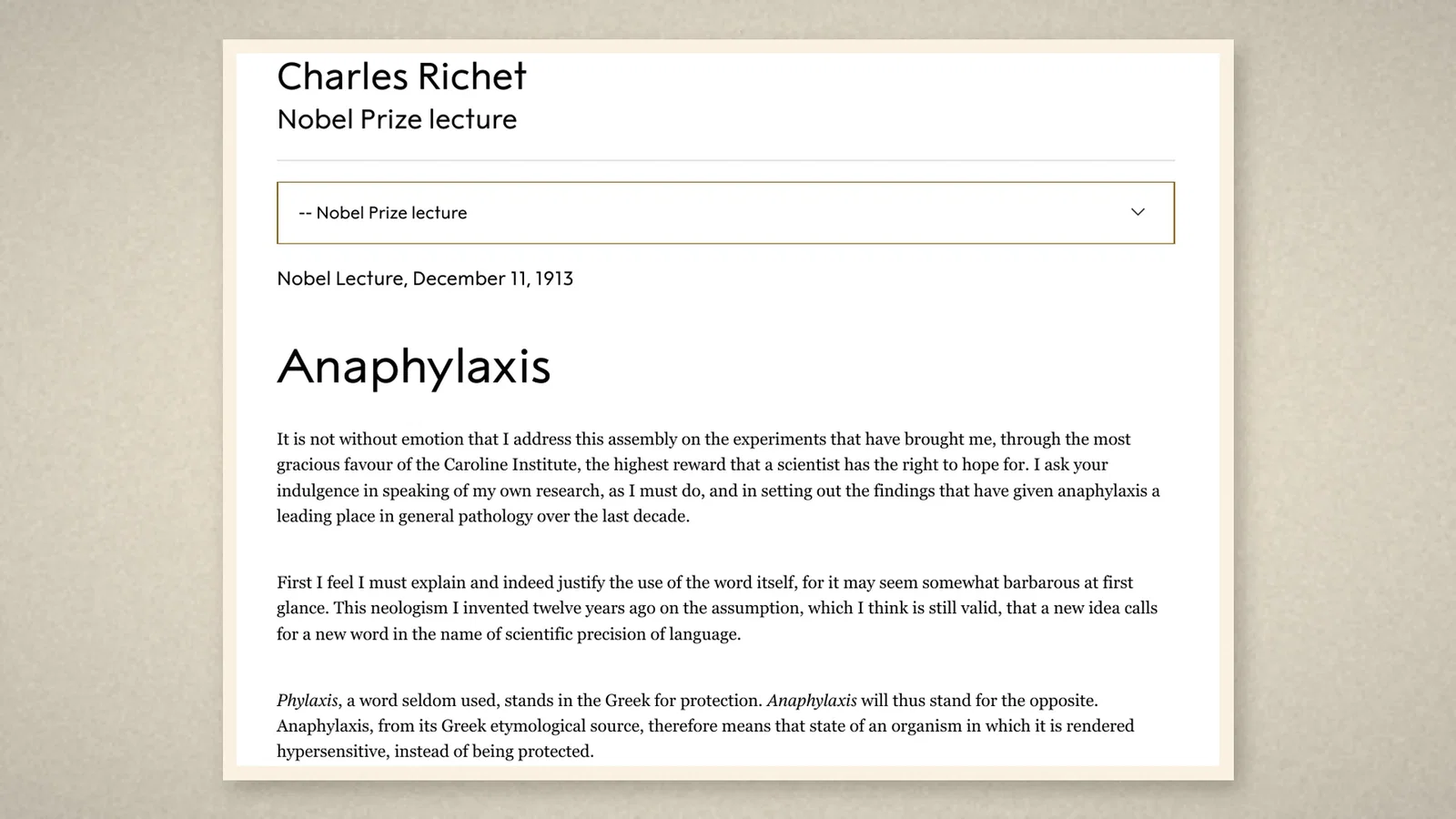
Richet began by defending the word, which might seem barbarous at first: "This neologism I invented twelve years ago", on the view that a new idea calls for a new word in the name of scientific precision. Phylaxis in Greek means protection; anaphylaxis means the opposite, the state of an organism "rendered hypersensitive, instead of being protected". [1, p. 1]
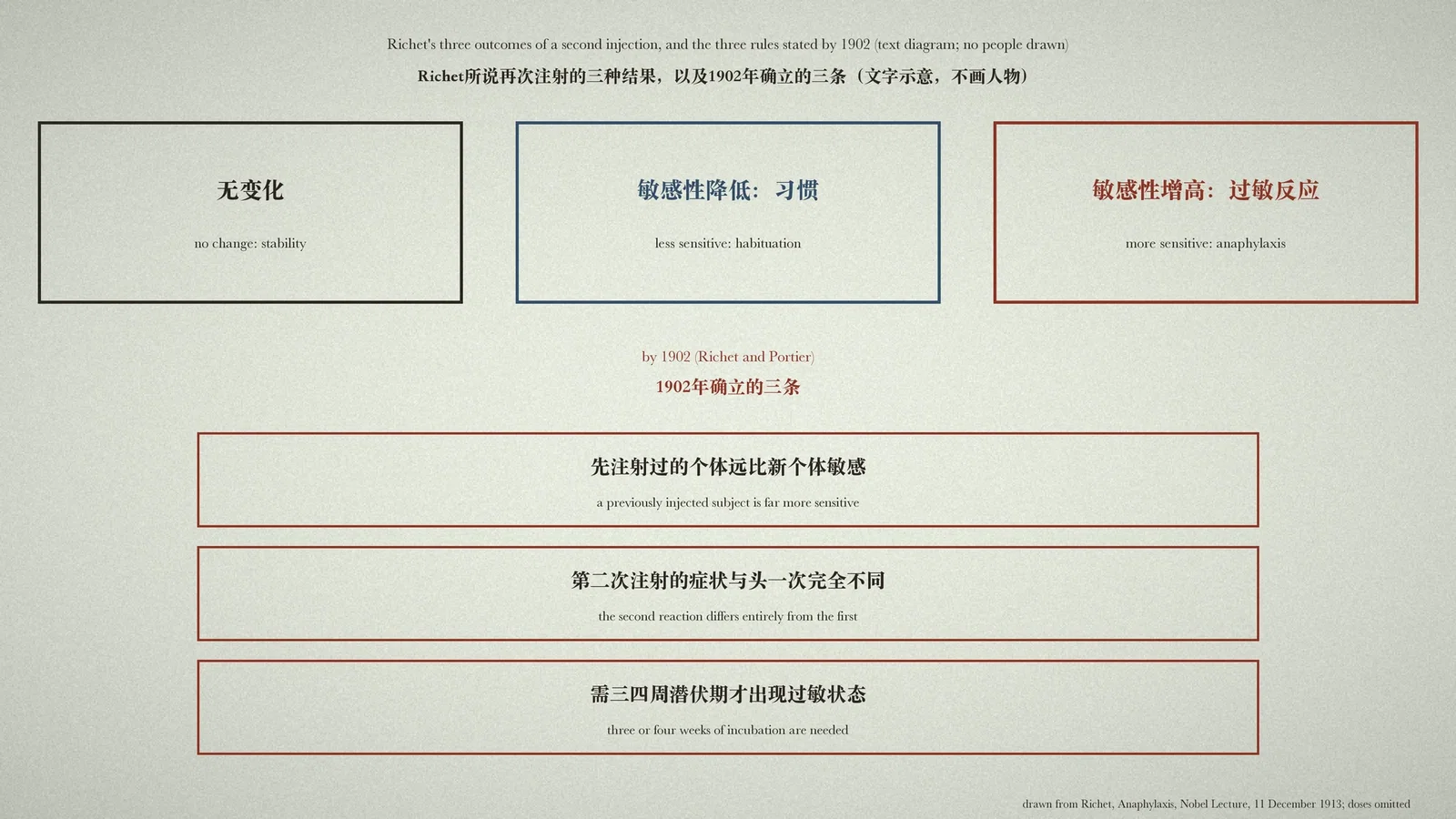
Richet then gave an example. A subject receives a moderate dose of a poison, seems normal a few days later, and is given the same dose again: what happens? There are three possibilities. The simplest and commonest is no change, the same effects as before; the second is diminished sensitivity, habituation or tolerance; and the third, which Richet claimed to have shown, is heightened sensitivity: "The first injection, instead of protecting the organism, renders it more fragile and more susceptible. This is anaphylaxis." [1, pp. 1-2]
A yacht, Portuguese men-of-war and sea anemones
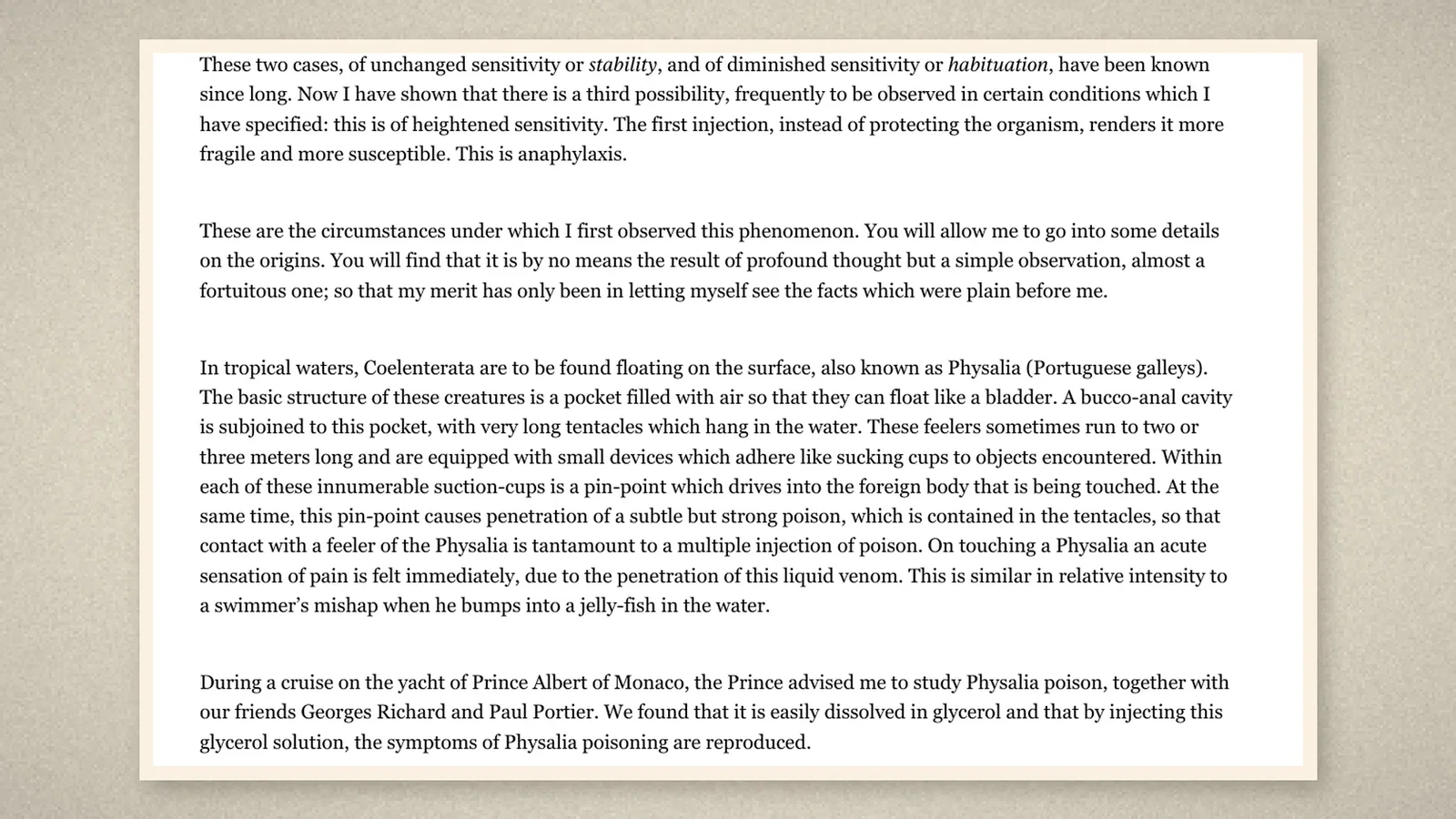
The discovery, Richet said, was "by no means the result of profound thought but a simple observation, almost a fortuitous one", and the only merit lay in seeing the facts that were plain. On a cruise on the yacht of Prince Albert of Monaco, the Prince advised Richet to study the venom of Physalia, the Portuguese man-of-war floating in tropical waters, together with Georges Richard and Paul Portier; the venom dissolved easily in glycerol, and injecting the solution reproduced the poisoning. Back in France, with no Physalia to hand, Richet turned to sea anemones, abundant on Europe's rocky shores, and with Portier set about measuring the toxicity of the glycerol extract of their tentacles. [1, p. 2]
The poison acted slowly, and three or four days had to pass before it was known whether a dose was fatal. Some dogs survived and, seeming normal two to four weeks later, were used for a new experiment. Then "an unexpected phenomenon arose, which we thought extraordinary": a dog previously injected, even with the smallest dose, at once showed serious symptoms, vomiting, bloody diarrhoea, syncope, unconsciousness, asphyxia and death. [1, pp. 2-3]
Three rules by 1902
The experiment was repeated many times, and by 1902 Richet and Portier could state three cornerstones of anaphylaxis: a subject previously injected is far more sensitive than a new one; the symptoms of the second injection, a swift and total depression of the nervous system, do not resemble those of the first; and three or four weeks must pass before the anaphylactic state appears, the period of incubation. [1, p. 3]
Research then spread quickly. In 1903 Arthus in Lausanne showed that a first intravenous injection of serum makes a rabbit anaphylactic, so that the phenomenon applied not only to toxins but to all proteins, toxic or not; two years later Rosenau and Anderson in America showed that it follows every injection of serum, with milk, egg and muscle extract also effective, and that the guinea-pig is the most sensitive animal. The lecture describes degrees of reaction, the most severe a violent assault on the nervous system that "has been called anaphylactic shock". [1, pp. 3-5]
Anaphylaxis in people
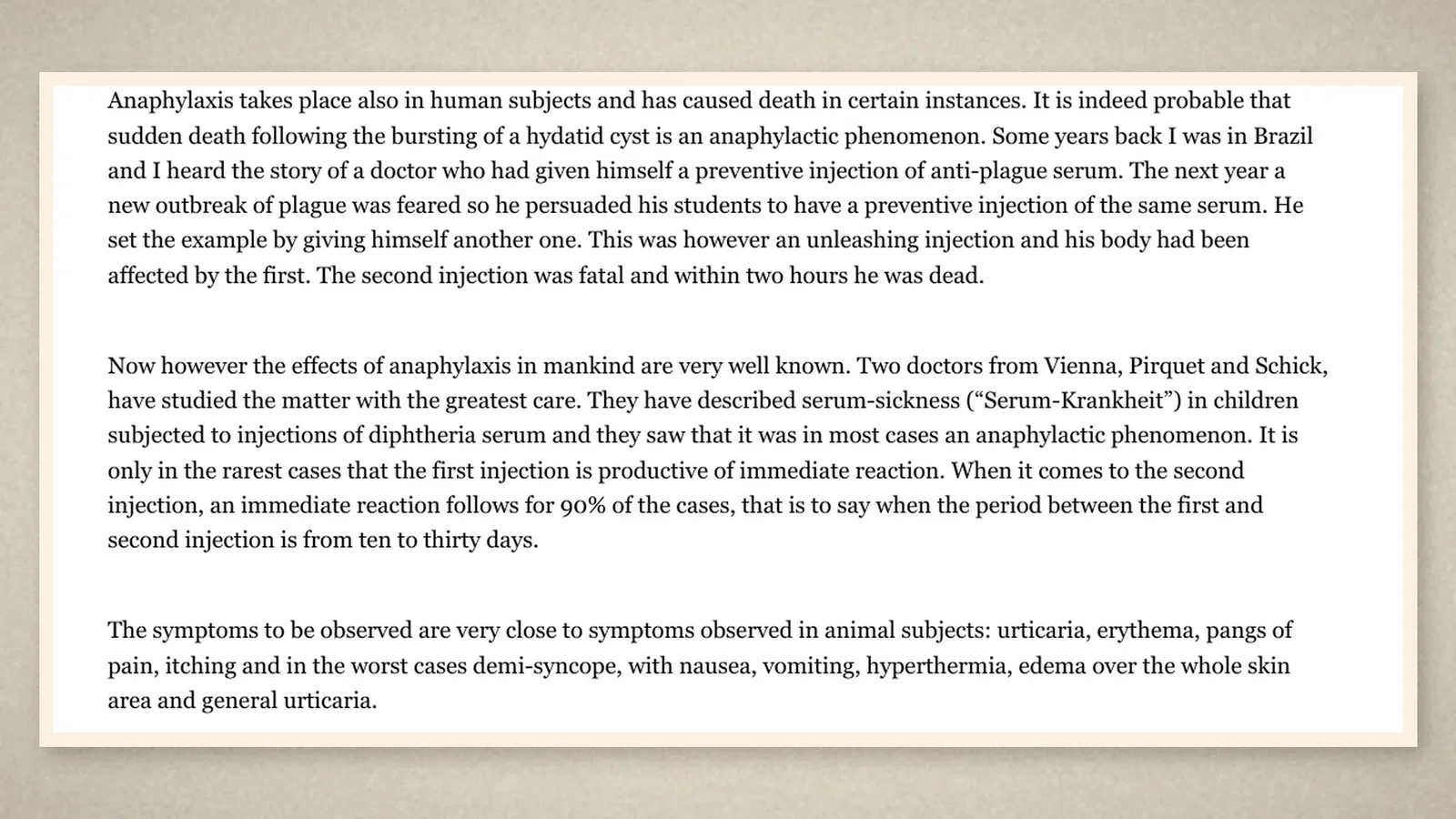
"Anaphylaxis takes place also in human subjects and has caused death in certain instances." Richet told a story heard in Brazil: a doctor had taken a preventive injection of anti-plague serum; a year later, with plague feared again, the doctor urged students to be injected and took a second injection as an example; it proved to be an unleashing injection, and the doctor was dead within two hours. [1, p. 5]
The effects in people, Richet said, were now well known. In Vienna, Pirquet and Schick had studied "serum sickness" in children given diphtheria serum and found it mostly anaphylactic: a first injection rarely produced an immediate reaction, but a second, ten to thirty days later, usually did. The symptoms resembled those in animals: urticaria, erythema, pain, itching and, in the worst cases, near-syncope with nausea, vomiting, fever and generalised oedema. "By comparison of anaphylactic effects in man and the animals, it will be seen that they are akin." [1, p. 5]
What the record shows
The lecture leaves drug safety a simple and essential idea: a drug or protein that caused no trouble the first time may not be harmless the next, and the weeks in between are when the danger forms. Asking about past reactions before an operation continues that idea in practice.
Sources and reading limits
Read: Richet, "Anaphylaxis", Nobel Lecture, 11 December 1913, the English text on the Nobel Prize website, in full. The ASA 2024 timeline entry for 1913 (p. 38) used as the lead.
Not covered: Portier and Richet's original 1902 note in the Comptes rendus de la Société de Biologie; Arthus's 1903 paper; the work of Rosenau and Anderson; Pirquet and Schick's monograph on serum sickness.
Limits: this is Richet's own retrospect more than ten years later, in English translation. The doses in the experiments and the percentage in the serum-sickness series are omitted. The timeline's remark that only Richet received the prize "for some seemingly unfair reason" is the timeline's comment and is not used. The opening sentences about present-day anaesthetic practice are context, not content of the lecture.
Three illustrations are taken from the printed pages of the lecture (pages 1, 2 and 5). One is a text diagram drawn from the lecture, with no people drawn.
- Richet C. Anaphylaxis. Nobel Lecture, December 11, 1913. NobelPrize.org
- Australian Society of Anaesthetists. Anaesthesia History Timeline. 2024. PDF
Continue exploring
Related reading connects shared questions and contexts; it does not by itself establish historical influence.
Anesthesia Epochs · The Source Room · About & Editorial Method
Published November 4, 2026. Sources and reading limits are stated above. Illustrations are labelled as original source images or AI-made. Historical accounts are educational; they are not current treatment instructions.