In the Nobel Lecture of 11 December 1930, 'On individual differences in human blood', Karl Landsteiner recalled testing whether individuals within a species differ serologically by mixing the serum and red cells of different people; agglutination was frequent and followed a regular pattern, giving four blood groups, the red cells carrying none, one or both of two agglutinogens and the serum containing agglutinins against those absent. Turning to transfusion, Landsteiner described its long history since Harvey, its abandonment because it sometimes caused serious symptoms and death, the mystery of why human blood could be dangerous, and how the blood groups solved it; Ottenberg first took agglutination into account, and in the emergencies of the Great War serological selection of donors became the normal practice; the lecture also mentions direct cross-comparison of recipient and donor blood, beginning with small quantities, and the use and risks of group O donors.
Reading Library · Anesthesia Epochs · 中文版
Watch the education video (for clinicians)
1930: Landsteiner's Nobel Lecture — Blood Groups and Transfusion · Anesthesia Epochs Education Series
The safety of surgery and anaesthesia depends heavily on replacing lost blood safely. For a long time, though, transfusion sometimes saved life and sometimes ended it, and no one could say why. According to the timeline, Karl Landsteiner received the 1930 Nobel Prize in Physiology or Medicine for discovering the blood groups. On 11 December 1930 Landsteiner lectured in Stockholm on that discovery and its meaning for transfusion. This article reads the lecture; the Australian Society of Anaesthetists' timeline lists the discovery under 1901. [1, p. 234][2, p. 31]
The simplest experiment
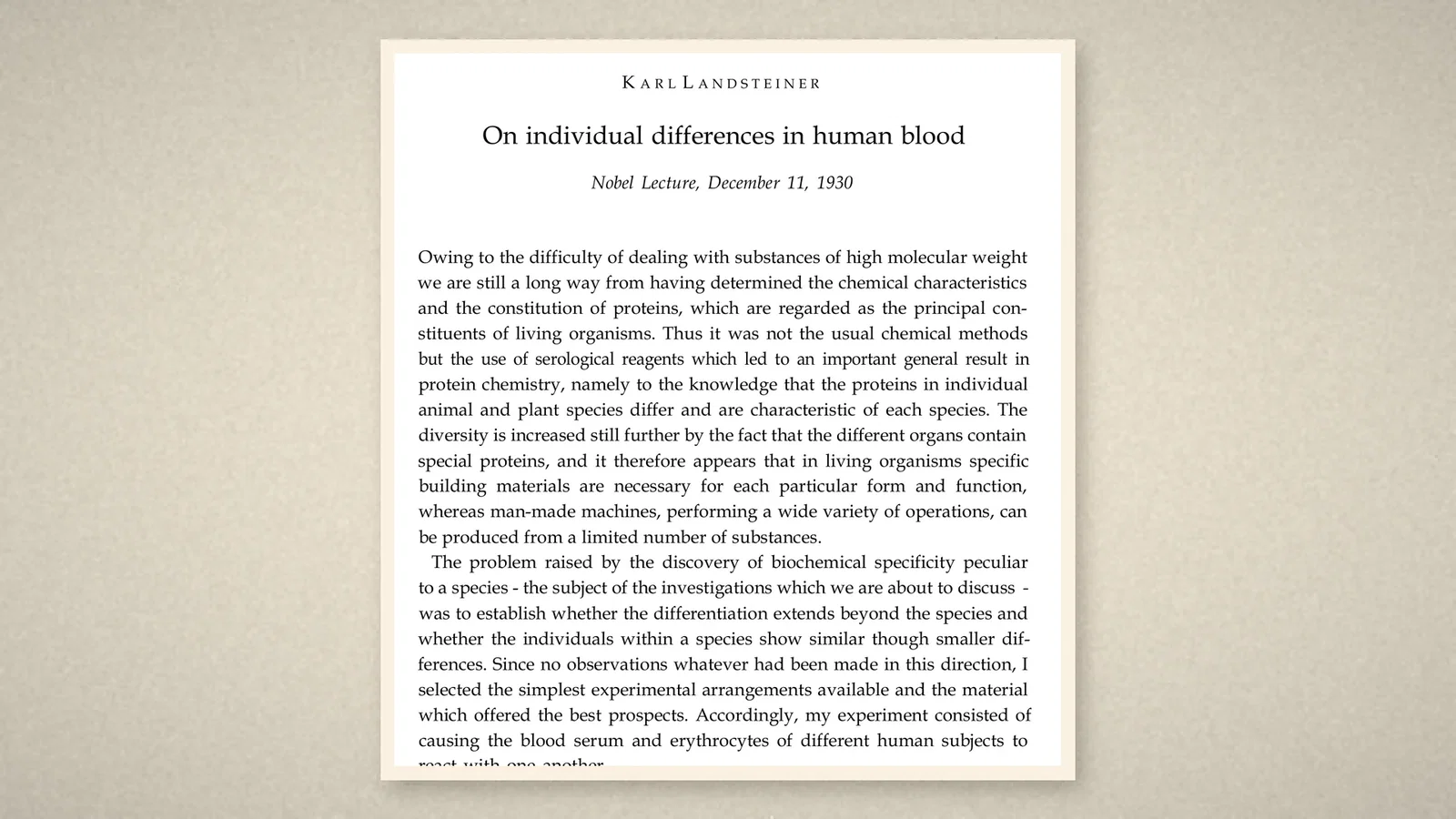
The lecture begins with proteins: serology had shown that the proteins of different animal and plant species differ and are characteristic of each species. The question Landsteiner set out to answer was whether the differentiation extends beyond the species, whether individuals within a species show similar though smaller differences. Since "no observations whatever had been made in this direction", the simplest experiment was chosen: "causing the blood serum and erythrocytes of different human subjects to react with one another". [1, p. 234]
The result was only partly as expected. Many samples showed no change at all, just as if the cells had been mixed with their own serum; but agglutination, in which the serum clumps another person's red cells, often occurred. Surprisingly, when it did occur, it was as marked as the reactions between species. The first task was to rule out that these differences were merely traces of past illness. [1, pp. 234-235]
Four blood groups
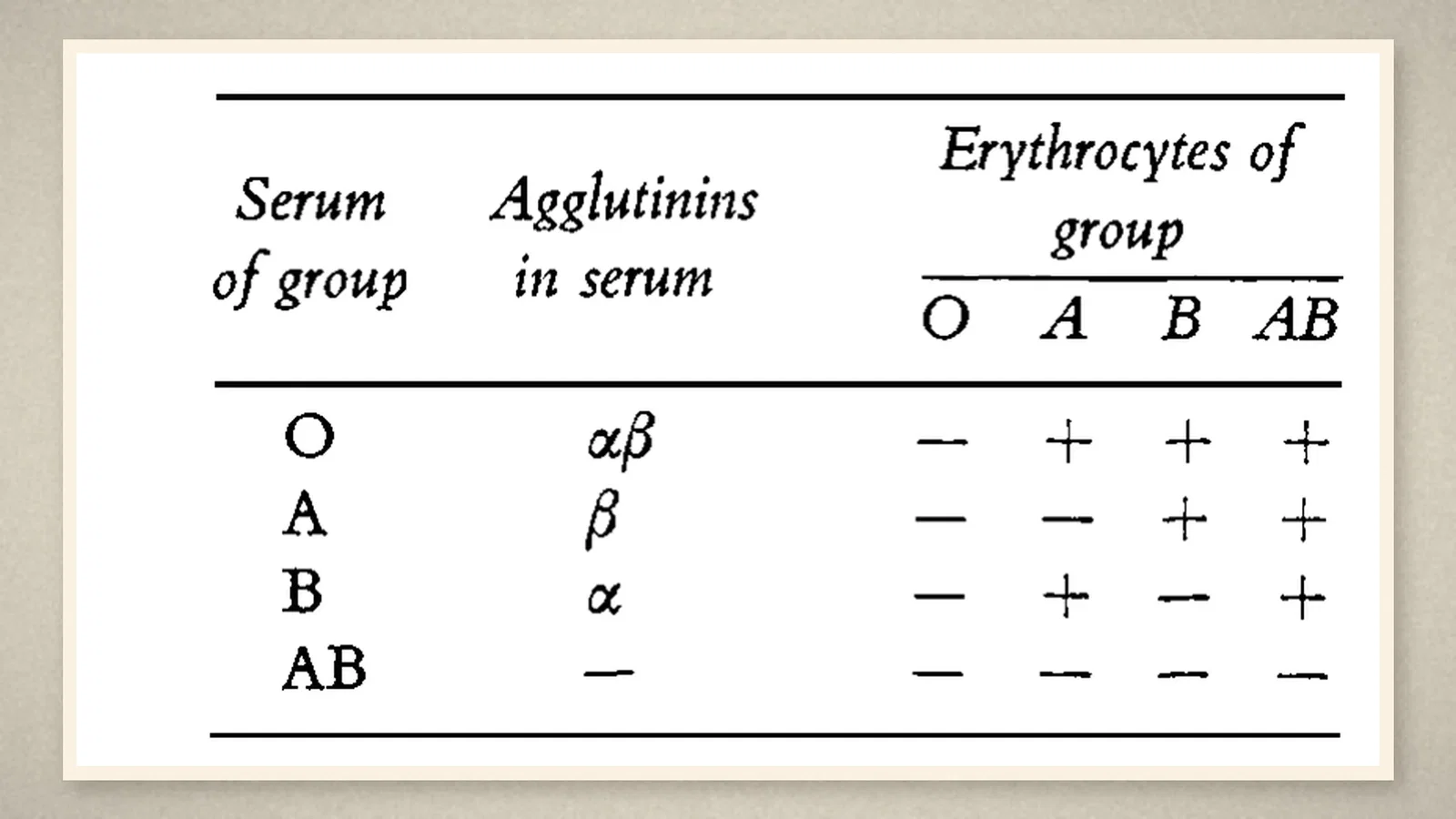
It soon became clear that the reactions follow a pattern valid for all human blood, and that the individual peculiarities are as characteristic as the serological features of a species. "Basically, in fact, there are four different types of human blood, the so-called blood groups." The red cells evidently contain substances, iso-agglutinogens, of two different structures, both of which may be absent or one or both present; and every serum contains exactly those agglutinins that react with the agglutinogens absent from its own cells, for reasons not then known. Hence fixed relationships between the groups that make them easy to determine; the groups are named after the agglutinogens in the cells. The lecture's table shows groups O, A, B and AB, with each serum's reaction against each group's red cells. [1, p. 235]
The lecture then turns to iso-agglutination in animals, new agglutinable factors and subgroups, the inheritance of the groups, and their forensic use, especially in excluding paternity. [1, pp. 235-242]
Transfusion: why people died
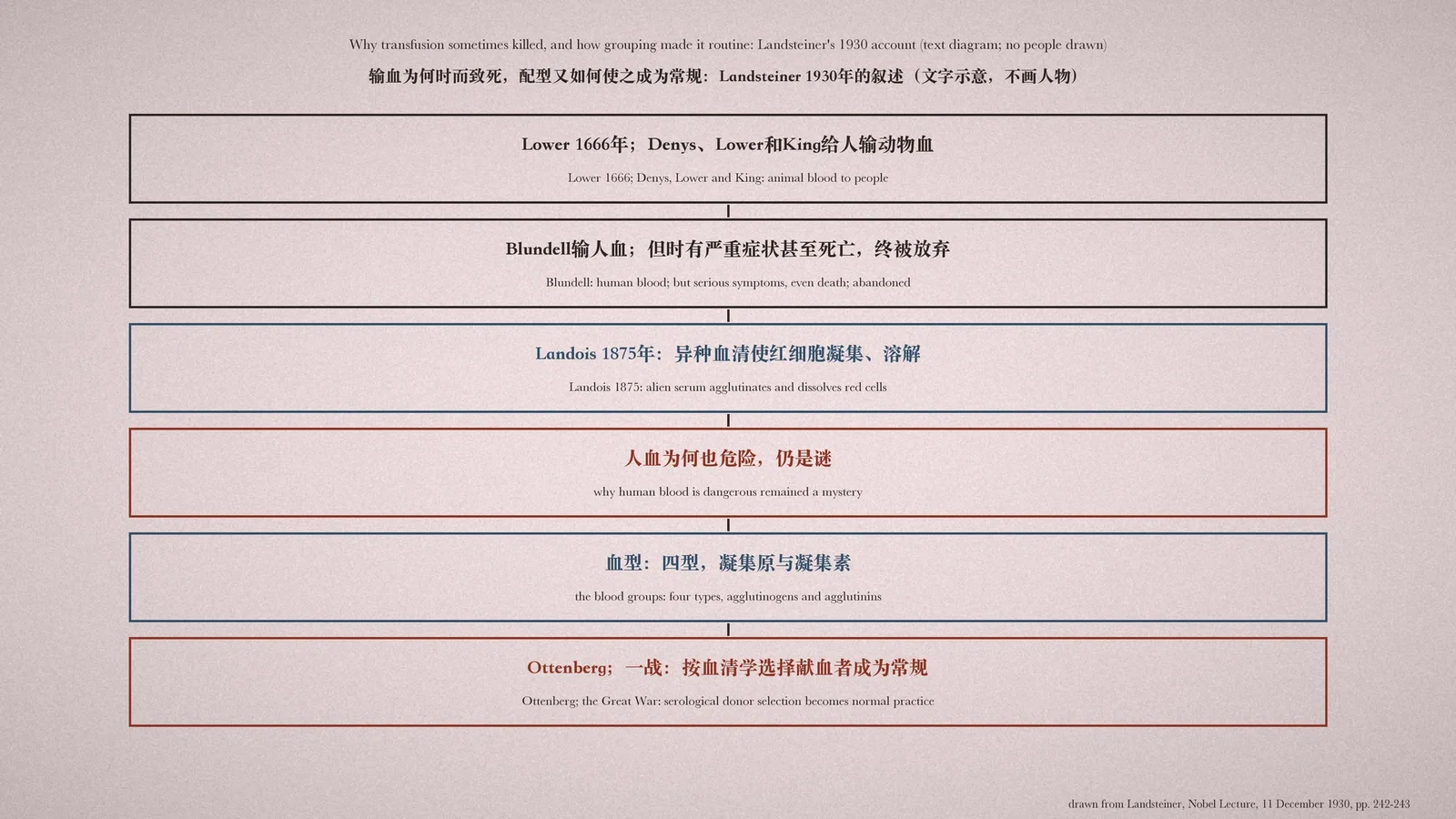
More important to practical medicine, Landsteiner said, was the use of the group reaction in transfusion. Its history went back to Harvey's discovery of the circulation: Lower transfused dogs in 1666, and the next year Denys in France and Lower and King in England gave animal blood to people; later appliances were improved and defibrinated blood was found usable; and the earliest transfusions of human blood were probably made by Blundell in the first half of the nineteenth century. Yet transfusion, "though often very useful, sometimes resulted in serious symptoms and even in the death of the patient", the effort to make it regular practice failed, and the idea was finally abandoned. [1, pp. 242-243]
Landois explained the disasters with animal blood: as early as 1875 Landois had found that serum of an alien species agglutinates and dissolves red cells. But "it remained a mystery why the introduction of human blood into the circulation may also be dangerous", since serum was thought inert towards cells of the same species. [1, p. 243]
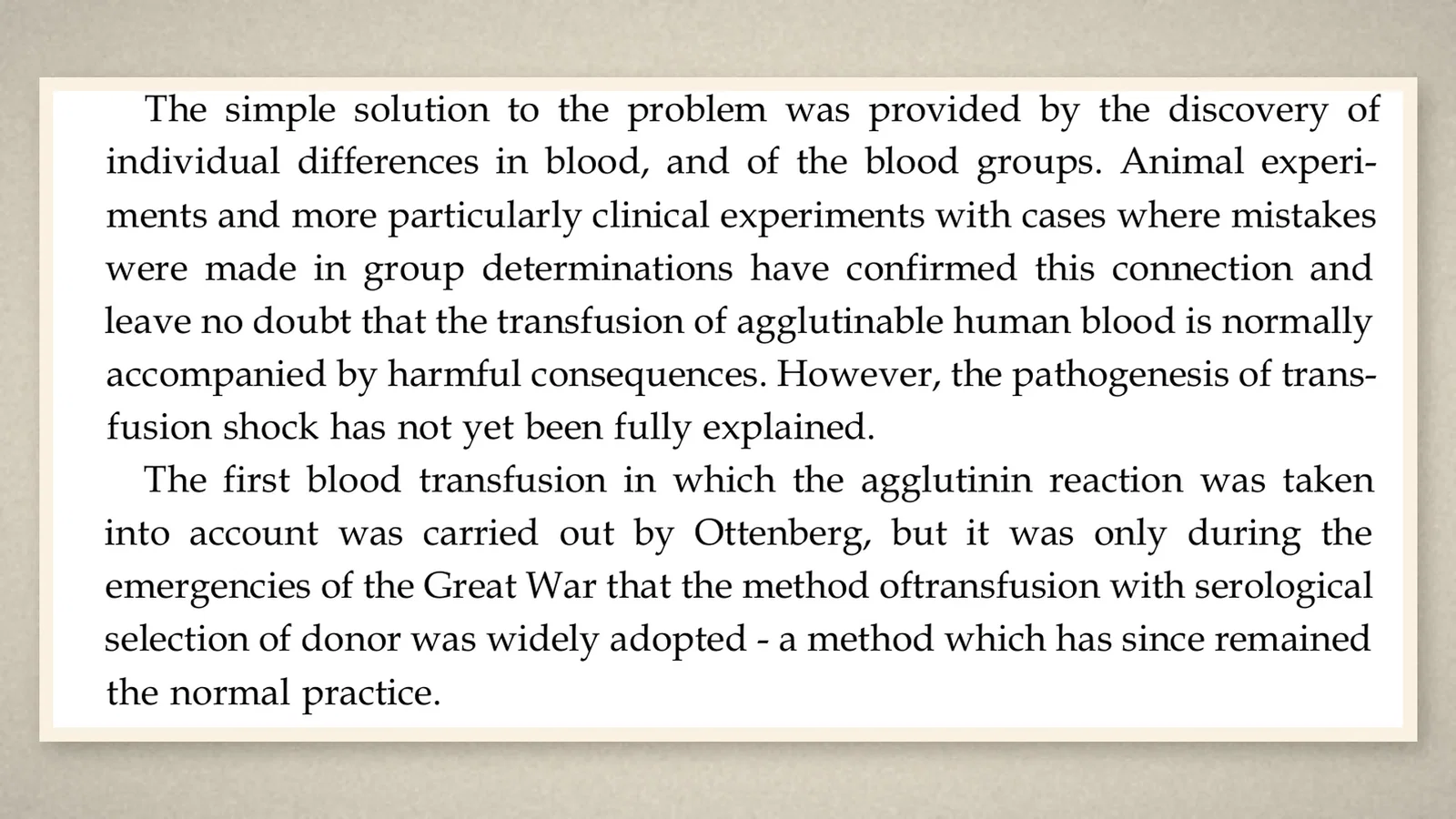
"The simple solution to the problem was provided by the discovery of individual differences in blood, and of the blood groups." Animal experiments, and above all clinical cases in which mistakes were made in grouping, confirmed the connection and left no doubt that transfusing agglutinable human blood is normally harmful; the pathogenesis of transfusion shock, however, was not yet fully explained. [1, p. 243]
From one attempt to routine
Ottenberg, Landsteiner said, carried out the first transfusion that took the agglutinin reaction into account, but only in the emergencies of the Great War was serological selection of donors widely adopted, and it had since remained the normal practice. The lecture mentions the sources of error in grouping and their control by direct comparison of the recipient's blood with the donor's, and the precaution of beginning a transfusion with small quantities. Same-group blood was not strictly necessary: group O blood, whose cells are not affected by the recipient's serum, could be used, but donors with a high agglutinin content had to be excluded, as they could be dangerous, especially to severely anaemic and weakened patients. "Universal donors" of group O were of great value in emergencies and for recipients of rare groups. [1, p. 243]
The most obvious indication for transfusion was acute or chronic anaemia, as from wounds, lung haemorrhage, obstetric bleeding and gastric or duodenal ulcer; another wide field was shock after severe injury and operations. [1, pp. 243-244]
What the record shows
The lecture reduces a problem that had puzzled people for centuries, why transfusion sometimes saved and sometimes killed, to a difference that can be tested on a glass slide. Grouping before operation, cross-matching, and starting a transfusion slowly all have a source in these few pages.
Sources and reading limits
Read: Landsteiner, "On individual differences in human blood", Nobel Lecture, 11 December 1930 (PDF from the Nobel Prize website, pp. 234-245 of Nobel Lectures, Physiology or Medicine 1922-1941), in full. The ASA 2024 history timeline entry for 1901 (p. 31) used as the lead.
Not covered: Landsteiner's original papers of 1900 and 1901 (not found in open scans); Ottenberg's papers; the primary sources behind the timeline's entries on citrate anticoagulation in 1914 and Australian transfusion services in 1929.
Limits: this is Landsteiner's retrospect, nearly thirty years after the discovery; the lecture itself does not give the year, and 1901 is the timeline's date. The lecture prints the date of Sprat's History of the Royal Society as "1607", evidently a misprint, which is not repeated in the body here; paternity statistics are omitted. Words such as "first" are quoted from the lecture.
Three illustrations are crops of the Nobel Lecture (first page, the table on p. 235, p. 243). One is a text diagram drawn from the lecture, with no people drawn.
- Landsteiner K. On individual differences in human blood. Nobel Lecture, December 11, 1930. In: Nobel Lectures, Physiology or Medicine 1922-1941. Amsterdam: Elsevier; 1965. p. 234-45. NobelPrize.org
- Australian Society of Anaesthetists. Anaesthesia History Timeline. 2024. PDF
Continue exploring
Related reading connects shared questions and contexts; it does not by itself establish historical influence.
Anesthesia Epochs · The Source Room · About & Editorial Method
Published November 4, 2026. Sources and reading limits are stated above. Illustrations are labelled as original source images or AI-made. Historical accounts are educational; they are not current treatment instructions.