
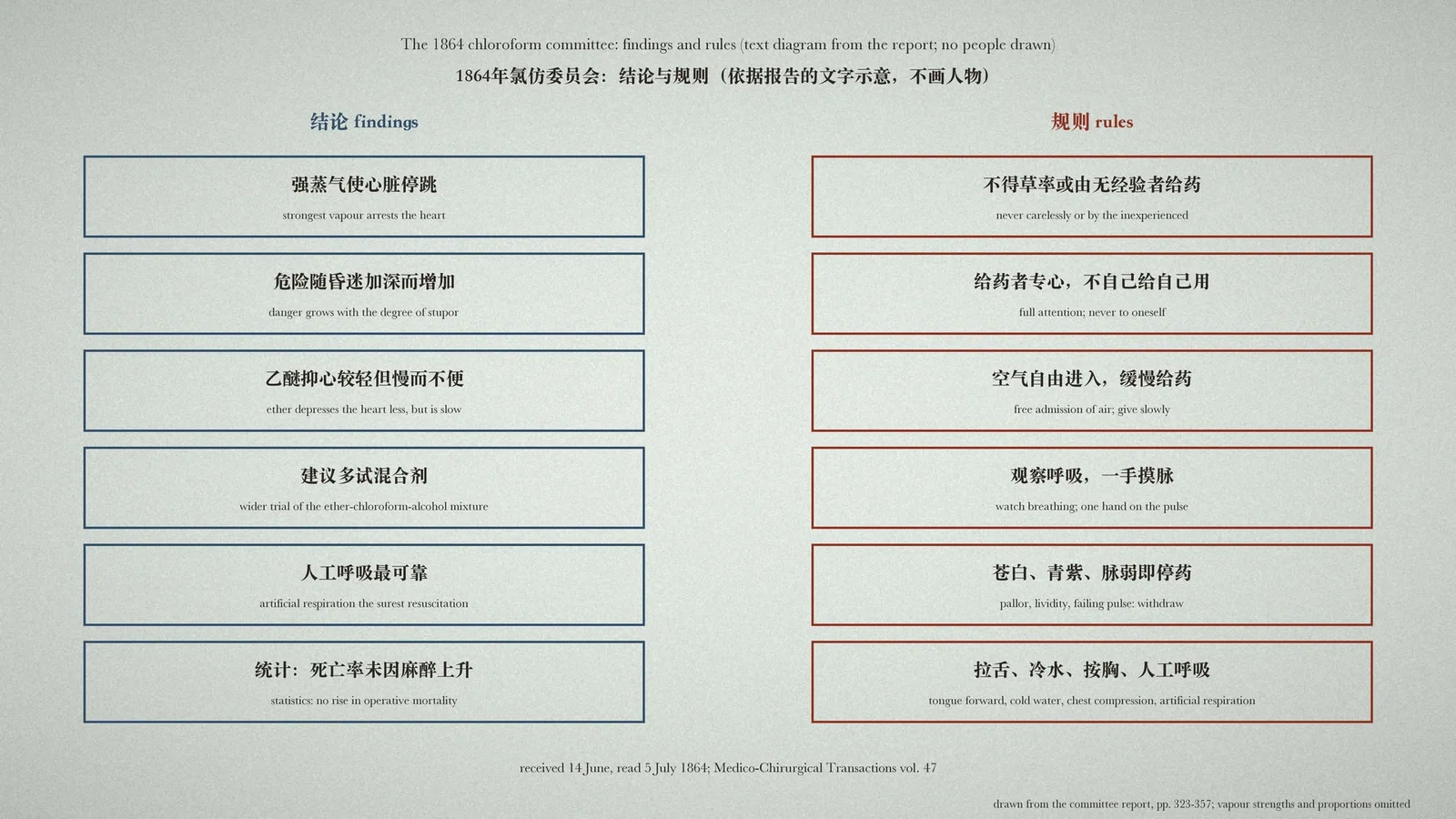
Read on 5 July 1864, the committee's report found that danger grows with depth and strong vapour arrests the heart, and set rules for resuscitation.
Reading Library · Anesthesia Epochs · 中文版
Watch the education video (for clinicians)
1864: The Chloroform Committee — The Rules It Wrote · Anesthesia Epochs Education Series
More than ten years after chloroform entered practice, deaths under it were still reported in Britain, and there was no agreement on why it killed or how it should be given. The Royal Medical and Chirurgical Society in London appointed a committee to find out. On 5 July 1864 the committee's report was read to the Society, and it was printed in Medico-Chirurgical Transactions vol. 47, filling more than a hundred pages. This article reads its method, its conclusions and its rules. [1, p. 323][2, p. 20]
A committee's task
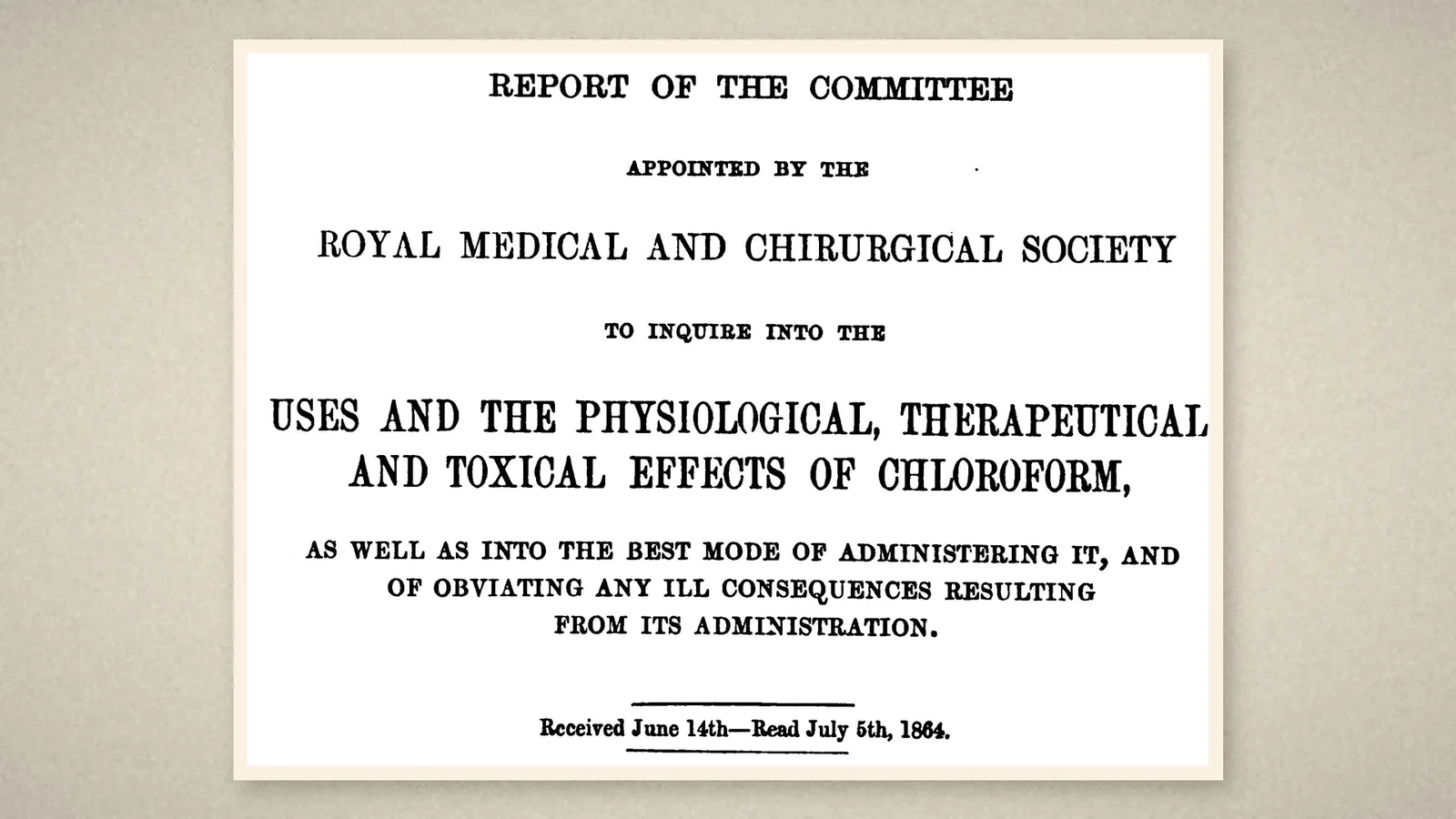
The full title was the report of the committee appointed by the Royal Medical and Chirurgical Society to inquire into the uses and the physiological, therapeutical and toxical effects of chloroform, as well as into the best mode of administering it and of obviating any ill consequences resulting from its administration; it was received on 14 June and read on 5 July 1864. [1, p. 323]
The committee began by saying that few replies had come in on the medical uses of chloroform, so the report said little about them; it concentrated on the points of chief practical importance, above all the action on the heart and on respiration. The report rested mainly on experiments the members had observed together, rather than on earlier literature, and compared the results with cases in which death or peril of life had followed chloroform in people. The experiments were chiefly on dogs: dilute vapour was measured with Mr Clover's apparatus and the strongest vapour came from a heated inhaler; because giving it by mouth often caused spasm of the throat, some was given through an opening in the trachea for comparison. [1, pp. 323-325]
The heart and the breathing
The physiological conclusions were plain. The sequence of effects in animals resembles that in man. In complete anaesthesia the heart always acts with less than its natural force. The strongest vapour, admitted freely to the lungs, kills by arresting the heart; with moderate doses the heart is long weakened before death, breathing generally but not always stops first, and death results from failure of both. "The danger attending the use of chloroform increases with the degree of stupor it induces." Apparent irregularities depend mainly on the strength of the vapour, the quality of the chloroform and the constitution of the patient. [1, p. 350]
On ether the committee was of two minds. Ether at first strengthens the heart, depresses it less than chloroform at the same depth of insensibility, and kills chiefly by arresting respiration; it was "less dangerous in its operation than chloroform". Yet its slow and uncertain action made it inconvenient, and the committee concurred in the general opinion that had led to its disuse in Britain. The energy of chloroform and its depression of the heart, the report added, demanded great caution and suggested a search for less objectionable anaesthetics; and it urged wider trial in Britain of a mixture of ether, chloroform and alcohol, which it judged safer when deep and prolonged anaesthesia was needed. [1, pp. 350-351]
On resuscitation, the report found artificial respiration the most certain means of restoring life: it usually succeeds after breathing has stopped if the heart still beats, and only exceptionally after the heart has stopped; galvanism works within the same limits but is far less to be relied on. [1, p. 352]
Rules for giving chloroform
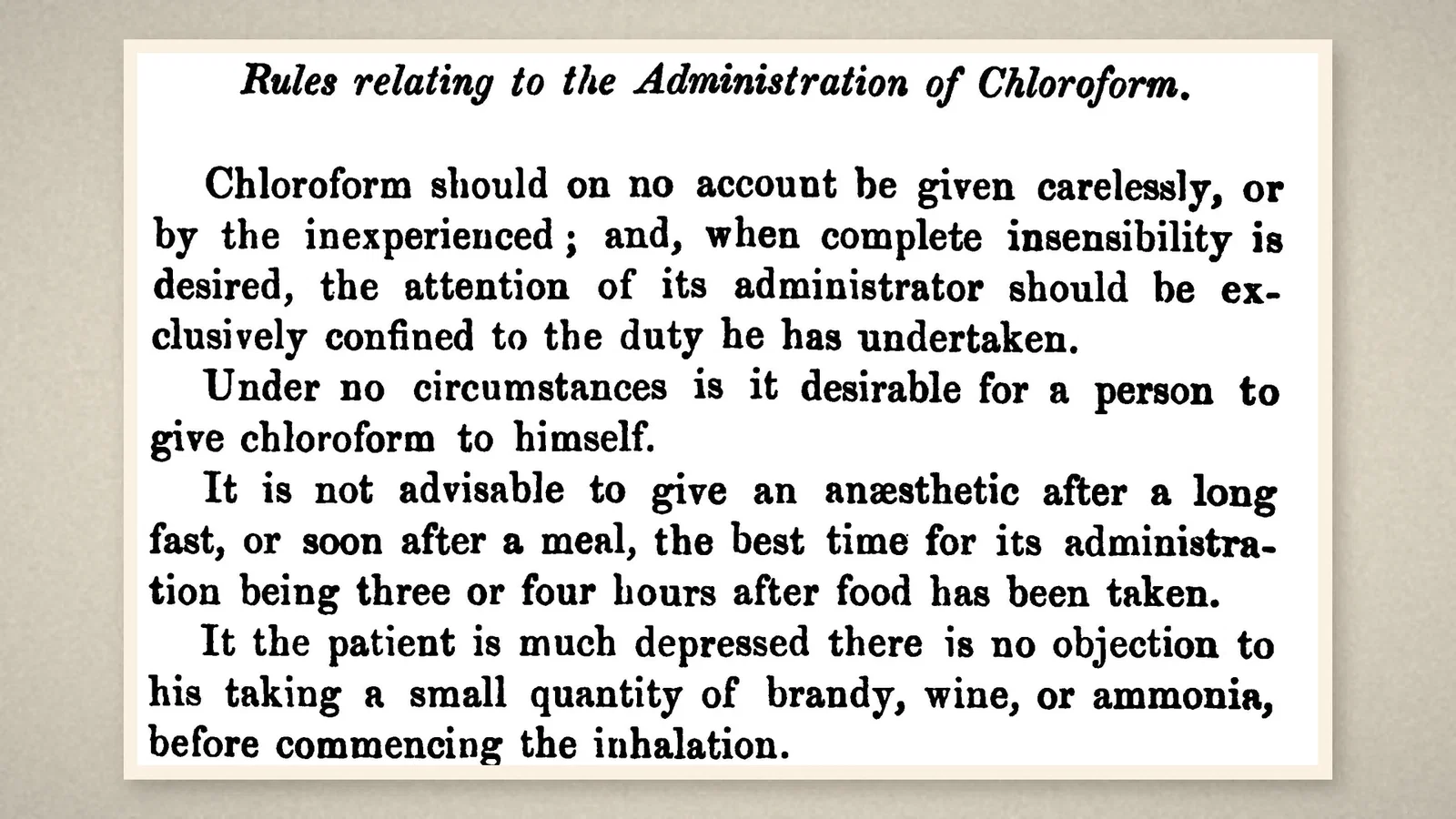
Then came the "Rules relating to the Administration of Chloroform". The first: chloroform "should on no account be given carelessly, or by the inexperienced", and when complete insensibility is wanted the administrator's attention should be confined exclusively to that duty. Under no circumstances should anyone give chloroform to oneself. It should not be given after a long fast or soon after a meal, the best time being three or four hours after food; a much depressed patient might first take a little brandy, wine or ammonia. [1, p. 352]
The next rules concerned air, position and apparatus. Free admission of air during narcotism is absolutely necessary. The recumbent position is preferable; the prone position is inconvenient for the administrator but no more dangerous, while the upright or sitting posture risks syncope, and sudden raising or turning of the body should be avoided. No apparatus is essential to safety if air is freely admixed; lint or a handkerchief should be folded as an open cone and held away from the face. Chloroform must be given slowly, sudden increases of strength being most dangerous, and the administrator should be guided by its effect on the patient rather than by the amount given. [1, p. 353]
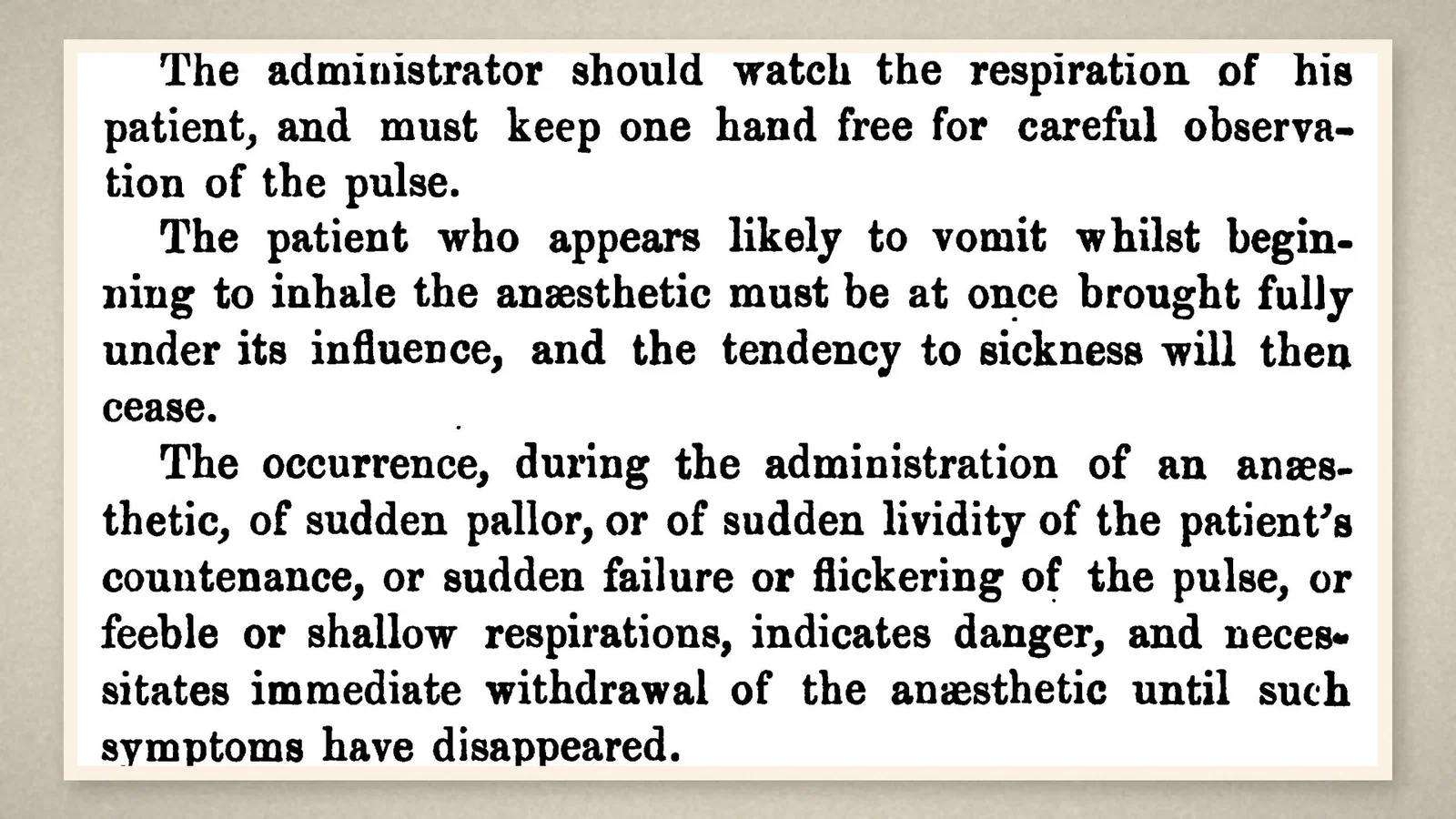
The administrator should watch the breathing and keep one hand free for careful observation of the pulse. Sudden pallor or lividity of the face, sudden failure or flickering of the pulse, or feeble or shallow breathing indicate danger and require immediate withdrawal of the anaesthetic until those signs disappear. If death from failure of breathing or of the heart threatens, fresh air should be admitted, the tongue pulled forward, the mouth and throat cleared, the patient kept lying, cold water dashed on face and chest, and the chest compressed rhythmically; in more threatening cases artificial respiration should begin at once, and galvanism may be added, but "the artificial respiration is on no account to be delayed or suspended in order that galvanism may be tried". [1, pp. 353-354]
Operations and statistics
The report also gave advice by type of operation: with heart disease an anaesthetic may be given when operation is needed, though a fatty, weak or dilated heart demands great caution; in consumption anaesthetics may be given when operation is unavoidable; operations on the jaws, lips and mouth are ordinarily safe, but deep insensibility is unwise where sudden bleeding in the palate or throat is likely; operations inside the eye raise concern about straining and vomiting. Finally, comparing 2586 capital operations before and 1847 after the introduction of anaesthetics, drawn from all authentic sources available, the report concluded that anaesthetics "have in no degree increased the rate of mortality". [1, pp. 354-357]
What the record shows
The report turned more than ten years of argument into rules that could be followed: who should give the anaesthetic, how, what to watch and what to do when things go wrong. Undivided attention, slow deepening, continuous watching of breathing and circulation, and immediate withdrawal with artificial ventilation in danger all appear, in an early form, on this page of rules.
Sources and reading limits
Read: the report of the Royal Medical and Chirurgical Society's chloroform committee, Medico-Chirurgical Transactions vol. 47 (1864): the title and dates (p. 323), introduction and method (pp. 323-325), the physiological conclusions on chloroform, ether, the mixture, the throat and resuscitation (pp. 350-352), the rules of administration and treatment of danger (pp. 352-354), and the advice on operations and the statistics (pp. 354-357); the ASA 2024 history timeline entry for 1864 (p. 20).
Not covered: the experimental records and appendices in the middle and end of the report (pp. 325-350 and 357-442, skimmed only); the list of committee members; the later BMA committees of 1875, 1891 and 1901.
Limits: the timeline says Clover developed the "Clover bag" while on the committee; the report mentions only "Mr. Clover's apparatus", and the bag claim is not checked here. The timeline says the committee found ether safer; the report does call ether less dangerous but also concurs in its disuse. Vapour percentages, temperatures and the proportions of the mixture are omitted, and the illustrations avoid those passages.
Three illustrations are crops of the 1864 report (pp. 323, 352 and 353). One is a text diagram drawn from the report, with no people drawn.
- Report of the committee appointed by the Royal Medical and Chirurgical Society to inquire into the uses and the physiological, therapeutical, and toxical effects of chloroform. Medico-Chirurgical Transactions. 1864;47:323-442. Internet Archive
- Australian Society of Anaesthetists. Anaesthesia History Timeline. 2024. PDF
Continue exploring
Related reading connects shared questions and contexts; it does not by itself establish historical influence.
- 1848: A Winlaton Girl Dies Under Chloroform, and Simpson Disputes Why
- 1856: Snow Tries Amylene at King's College Hospital
- 1847: Chloroform, from Self-Experiment to a Public Report
Anesthesia Epochs · The Source Room · About & Editorial Method
Published November 4, 2026. Sources and reading limits are stated above. Illustrations are labelled as original source images or AI-made. Historical accounts are educational; they are not current treatment instructions.