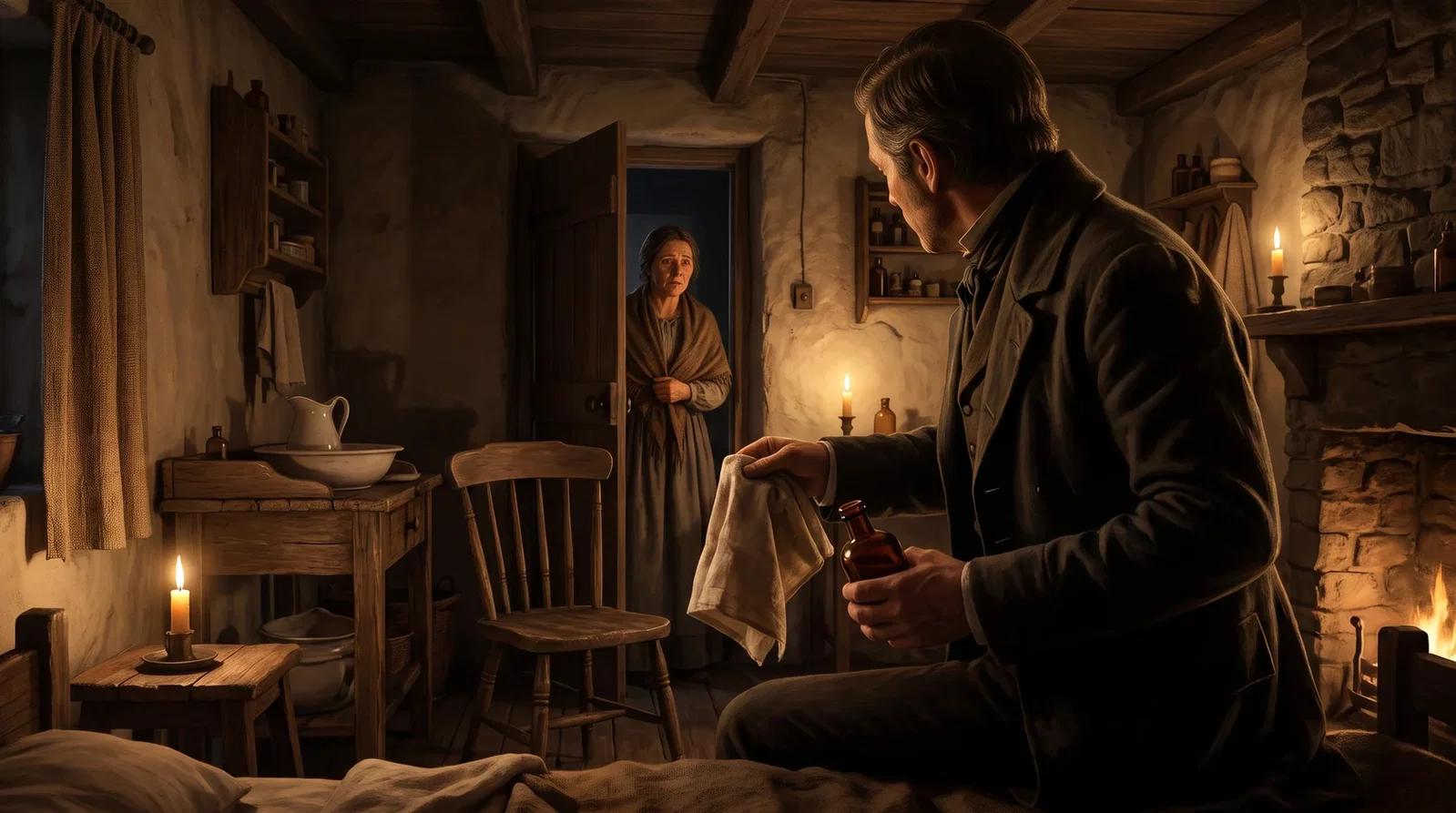
The Lancet printed the inquest on a 15-year-old who died during toenail removal; Simpson replied that water and brandy given in revival caused asphyxia.
Reading Library · Anesthesia Epochs · 中文版
Watch the education video (for clinicians)
1848: The Winlaton Inquest — One Death, Three Readings · Anesthesia Epochs Education Series
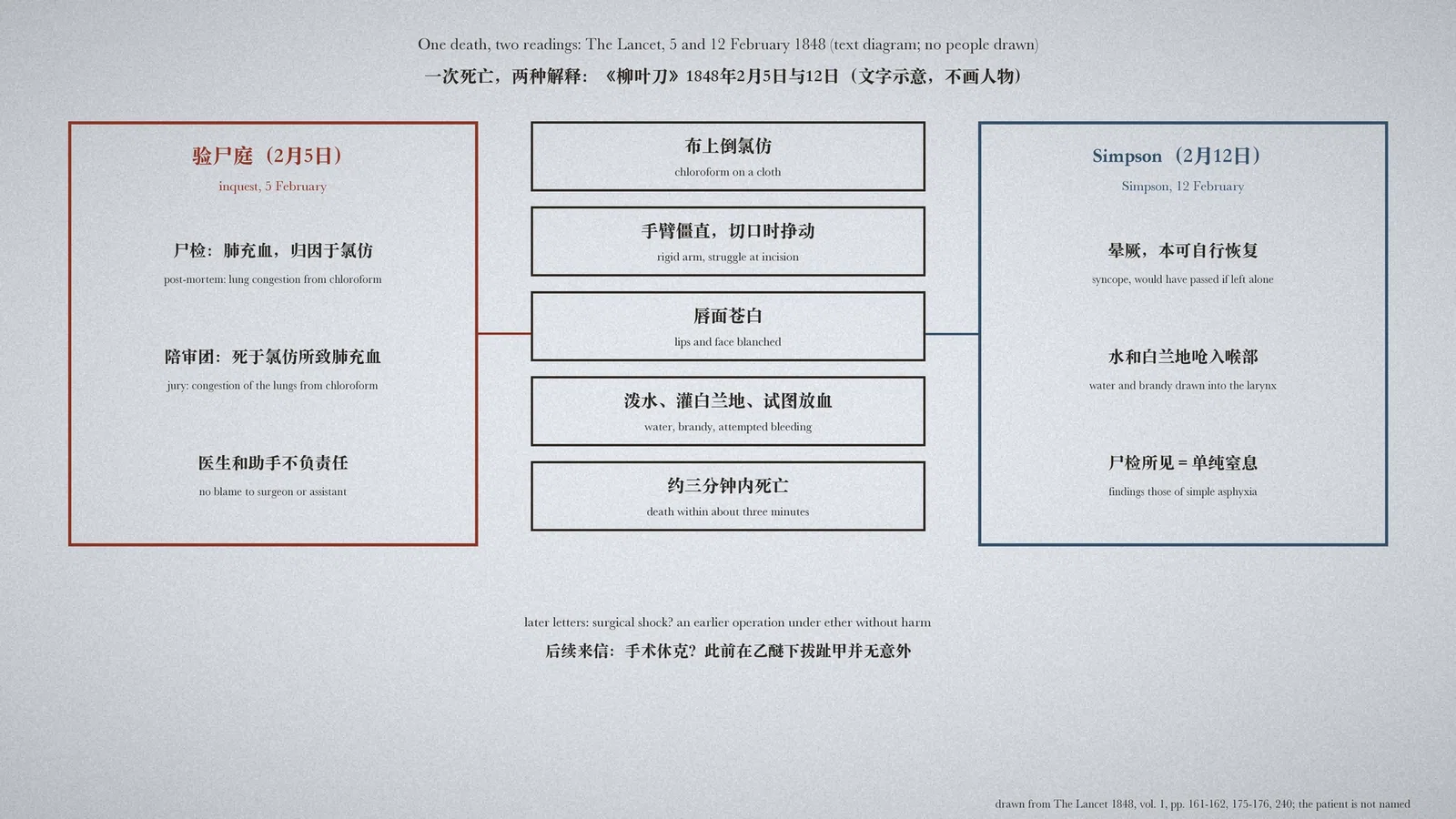
Simpson brought chloroform into practice in November 1847, and within months it was in use across Britain. Early in 1848, at Winlaton near Newcastle, a 15-year-old girl having a toenail removed at home died within minutes of inhaling chloroform. The Lancet printed the evidence and verdict of the inquest, and a week later Simpson replied in its pages. This article reads those two issues, reports both sides in the words of the sources and takes neither side; the girl's name is not given. [1, pp. 161-162][1, p. 175]
Evidence at the inquest
On 5 February 1848, under the heading "Fatal application of chloroform", The Lancet reported an inquest held "on Tuesday last" at Winlaton, about five miles from Newcastle-upon-Tyne, on a girl of 15 who had died under chloroform on the Friday before; the case "excited great interest". [1, p. 161]
The family said that the girl had long suffered with the toes and had had a toenail removed at the Newcastle infirmary about four months earlier; the toes remained bad, so the Whickham surgeon Meggison was called in, and it was decided to remove the nail of the right great toe. Meggison and an assistant came to the house at about one in the afternoon, with only a family member present. After the nail was off the girl moaned; Meggison dashed water in the face and put brandy into the mouth, and there was a rattling in the throat; bleeding from the arm and neck yielded very little blood. The girl never recovered. [1, p. 161]
Meggison's own evidence was that the girl had onychia and had never complained of pain in the chest. Seated in a chair, the girl was given chloroform on a cloth held to the nose; after two breaths the girl pulled the hand away, then breathed naturally when told; within about half a minute the arm muscles became rigid and the breathing a little quickened but not stertorous, the pulse natural at first and then somewhat weaker. The assistant began; at the semicircular incision the girl gave a struggle or jerk, which Meggison took to mean the chloroform had not taken full effect, but none was added. The eyes closed, the mouth opened, the lips and face blanched; water had no effect, a little brandy was swallowed with difficulty, and attempts to bleed on the floor obtained only a spoonful, by which time, Meggison believed, death had occurred. The time "would not be more than three minutes" from first inhalation to death. [1, pp. 161-162]
Post-mortem and verdict
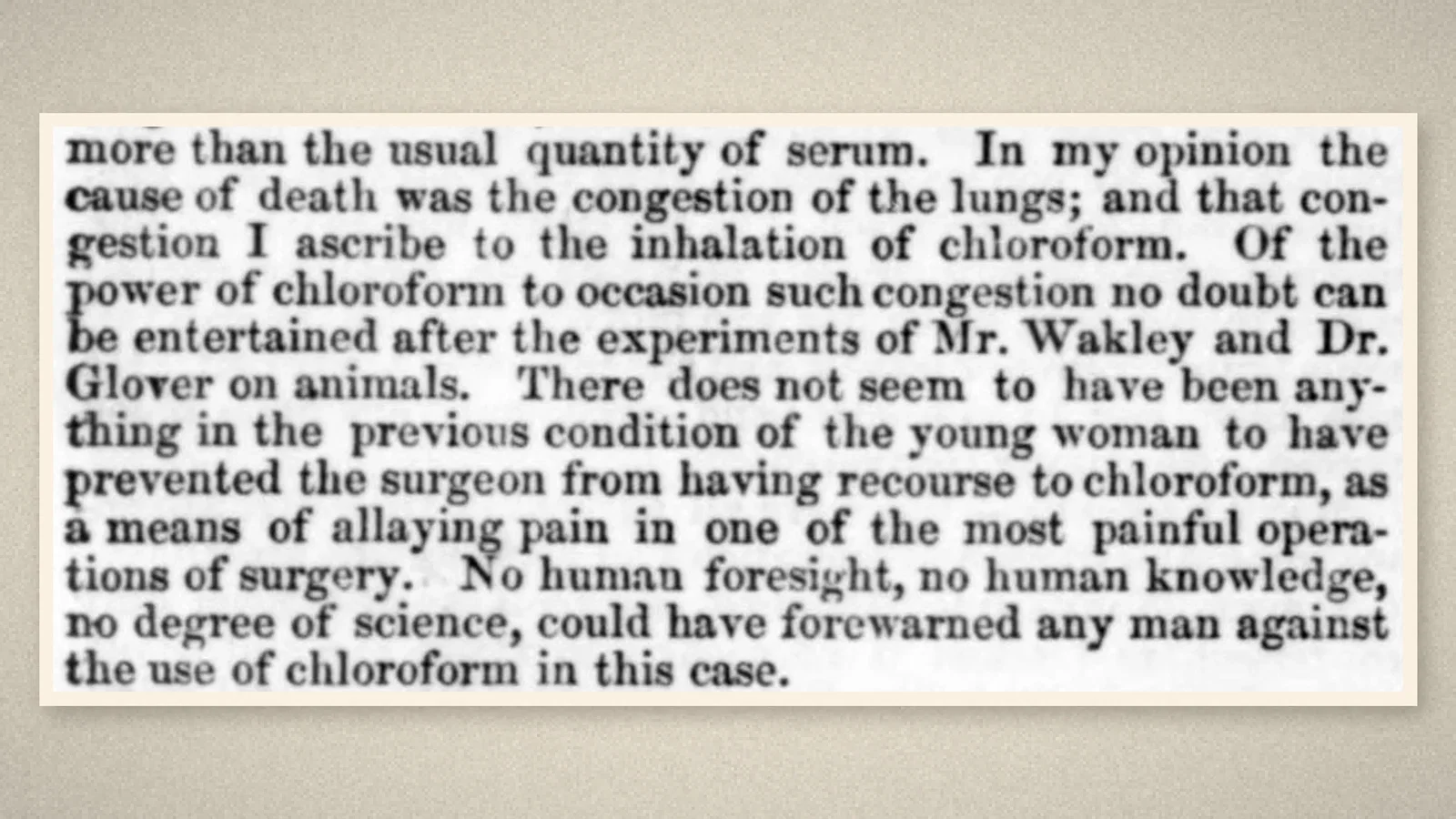
After an adjournment, the Newcastle surgeon Sir John Fife reported the post-mortem made with Dr Glover: highly congested lungs filled with bloody froth, an epiglottis reddened at the summit, a reddened larynx, a stomach full of food, congestion of the liver, kidneys, spleen and brain, and dark fluid blood in both sides of the heart. In Fife's opinion the cause of death was congestion of the lungs, ascribed to the inhalation of chloroform, as experiments by Wakley and Glover on animals had shown chloroform could produce it. Nothing in the previous condition, Fife added, should have kept the surgeon from using chloroform, and "no human foresight, no human knowledge, no degree of science" could have given warning. [1, p. 162]
After the coroner explained the law, the jury retired for a few minutes and found unanimously that death was from congestion of the lungs from the effect of chloroform, and that no blame attached to the surgeon Meggison or the assistant Lloyd. [1, p. 162]
Simpson's reply
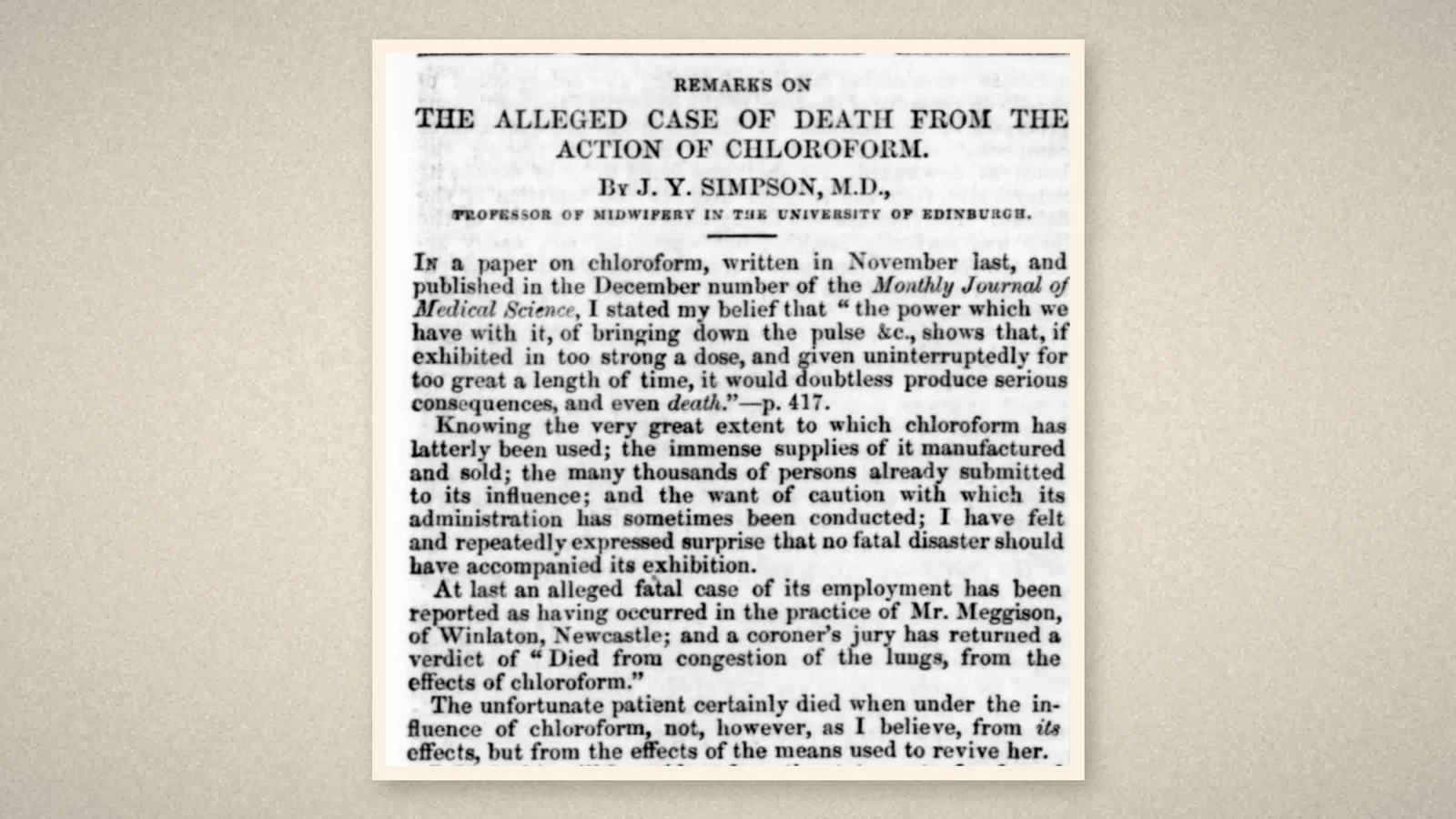
On 12 February the journal printed "Remarks on the alleged case of death from the action of chloroform" by J. Y. Simpson, professor of midwifery at Edinburgh. Simpson recalled writing in November 1847 that chloroform given too strongly and too long would doubtless produce serious consequences and even death, and confessed surprise, given how widely and sometimes how carelessly it was used, that no fatal disaster had yet occurred. Now an "alleged" fatal case had come. The patient, Simpson argued, certainly died under the influence of chloroform, but not from its effects: rather from the effects of the means used for revival. [1, p. 175]
The reasoning ran like this. The evidence showed that at the moment of operating the girl became suddenly blanched, falling into syncope, which might come from the operation, the chloroform or both. Simpson had seen such pallor with breathing briefly suspended, and in every case it passed quickly once the chloroformed napkin was taken away and the patient left alone. Here, with the best of motives, water and brandy were poured into the mouth; in syncope and anaesthesia the girl could not swallow, the liquid filled the pharynx and was drawn into the larynx; the evidence spoke of a rattling in the throat, and within a minute breathing stopped. [1, p. 175]
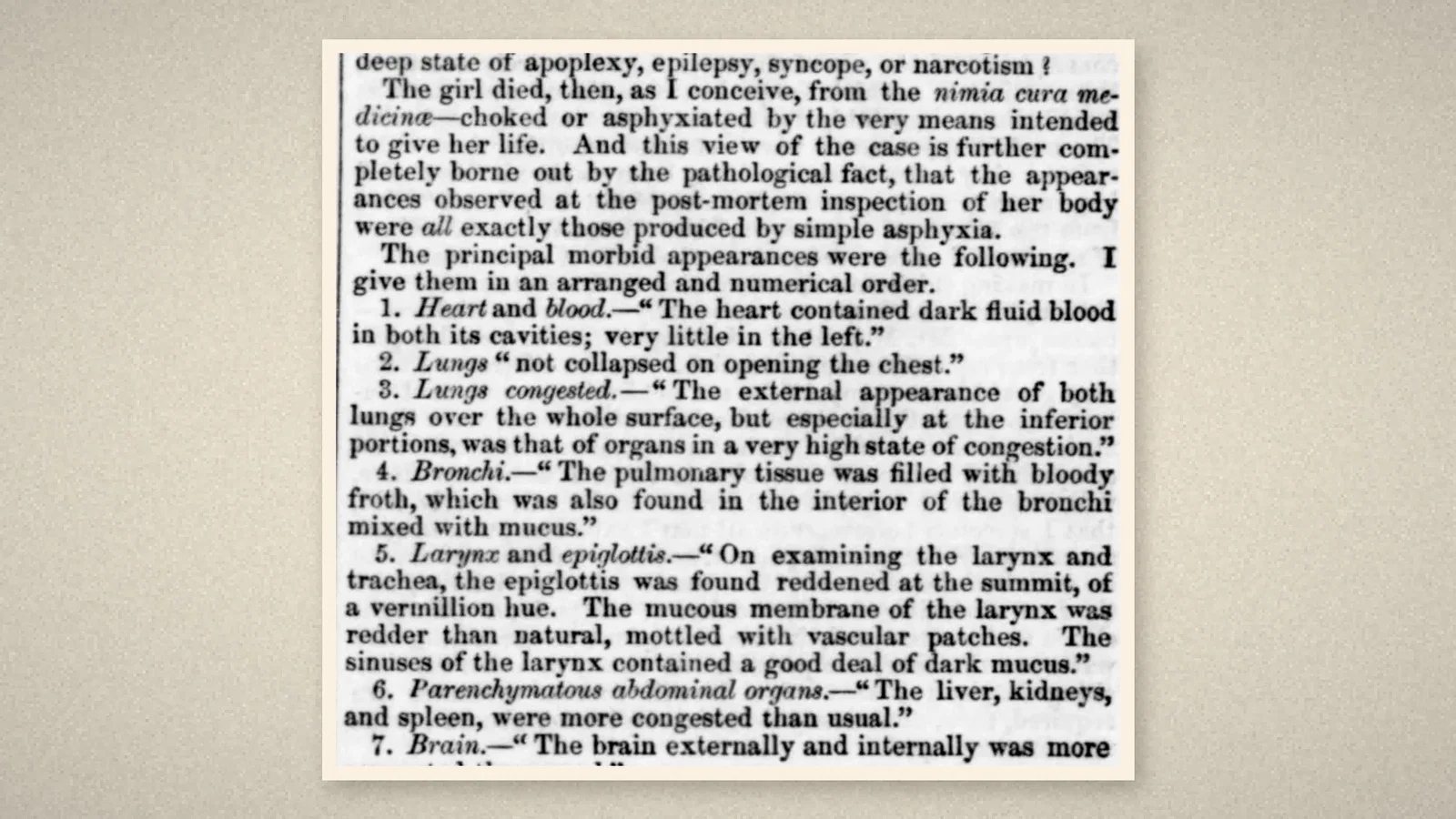
The girl died, Simpson concluded, "from the nimia cura medicinae", choked or asphyxiated by the very means intended to save life. Simpson listed the seven post-mortem findings from the inquest point by point beside the textbook appearances of simple asphyxia and found them identical, and added that in animals killed with chloroform in experiments by a committee of the Edinburgh Medico-Chirurgical Society, which Simpson had witnessed two months before, the heart held firm clots, unlike the dark fluid blood found here. [1, pp. 175-176]
The argument went on
More letters followed. Potter of the Newcastle Infirmary wrote that the same girl had had the nail of the left great toe removed there in October 1847 under ether, three different instruments being tried before full insensibility was reached, without any untoward result. Another correspondent welcomed Simpson's reply but asked why lung congestion had been singled out when brain and liver were congested too, and whether surgical shock rather than chloroform had caused the death. [1, p. 214][1, pp. 239-240]
What the record shows
This was a widely noticed death soon after chloroform came into use in Britain. The jury blamed chloroform, Simpson blamed asphyxia during revival, and a correspondent suggested shock: one post-mortem, three readings. It is a reminder that judging an anaesthetic death depended from the start on a careful record of what happened, and on alertness to the hazards of resuscitation itself.
Sources and reading limits
Read: The Lancet 1848, vol. 1: "Fatal application of chloroform" in the issue of 5 February (pp. 161-162, with the evidence of the family, Meggison, the assistant Lloyd, Fife and Glover, and the verdict); Simpson's "Remarks on the alleged case of death from the action of chloroform" in the issue of 12 February (pp. 175-176); Potter's letter from the Newcastle Infirmary (p. 214); and the letter "The alleged death from chloroform at Newcastle" (pp. 239-240).
Not covered: Meggison's own case report cited by Simpson; the inquisition itself and local newspaper reports; the Monthly Journal of Medical Science paper Simpson cites; the timelines of the History of Anaesthesia Society and the New Zealand society (the date of 28 January 1848 sometimes given was not checked against them; The Lancet says only that the death was on the Friday before the Tuesday inquest).
Limits: the report and letters are contemporary accounts and arguments, not a modern determination of cause. The amounts of chloroform and ether are omitted, and the illustrations avoid those passages. The girl's name appears in the sources but not in this article, and is cropped from the illustrations. This article does not call the case the earliest anaesthetic death.
Three illustrations are crops of The Lancet 1848 (p. 162 and two from p. 175). One is a text diagram drawn from the sources, with no people drawn.
- The Lancet. 1848;1:161-2 (Fatal application of chloroform); 175-6 (Simpson JY. Remarks on the alleged case of death from the action of chloroform); 214 (Potter. The late fatal case at Newcastle); 239-40 (The alleged death from chloroform at Newcastle). Internet Archive
Continue exploring
Related reading connects shared questions and contexts; it does not by itself establish historical influence.
- 1847: After Ether Deaths, the Pharmaceutical Journal Asks for Statistics
- 1847: Chloroform, from Self-Experiment to a Public Report
Anesthesia Epochs · The Source Room · About & Editorial Method
Published November 4, 2026. Sources and reading limits are stated above. Illustrations are labelled as original source images or AI-made. Historical accounts are educational; they are not current treatment instructions.