
After deaths at Colchester and Grantham and an inquest blaming the vapour, the journal called for statistical evidence on whether ether raised operative mortality.
Reading Library · Anesthesia Epochs · 中文版
Watch the education video (for clinicians)
1847: Ether Deaths and the Pharmaceutical Journal — Obtain Statistics · Anesthesia Epochs Education Series
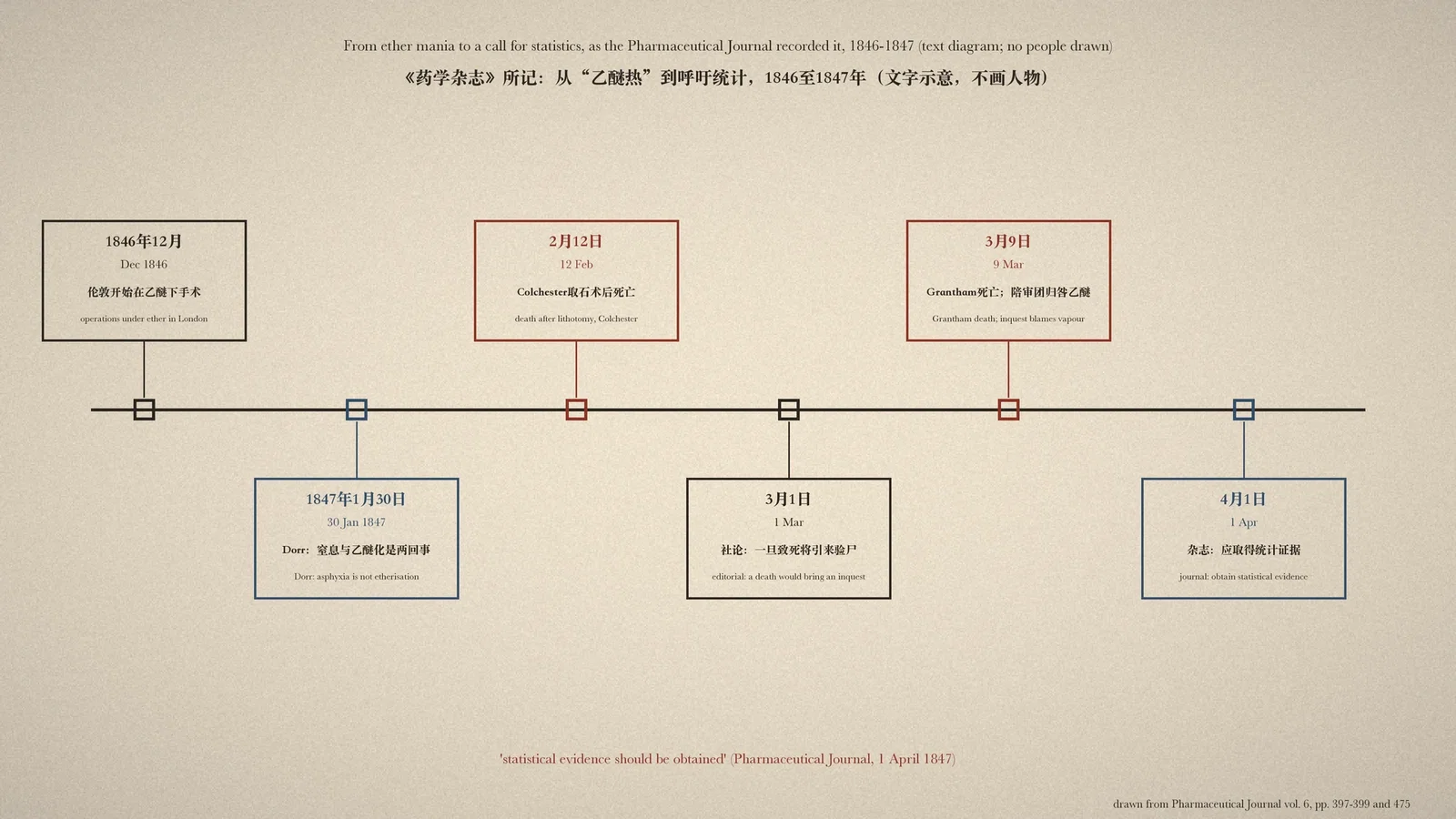
In December 1846 London surgeons began operating under ether. Within four months people in England had died on the operating table or soon after, and one death had gone to an inquest. In its issues of March and April 1847 the Pharmaceutical Journal and Transactions, the monthly of the Pharmaceutical Society in London, recorded how those first accidents were met: first worry about responsibility, then instructions for safe use, and then a demand that sounds familiar today, for statistics. [1, pp. 398-399][1, p. 475]
A death would mean an inquest and a verdict of manslaughter
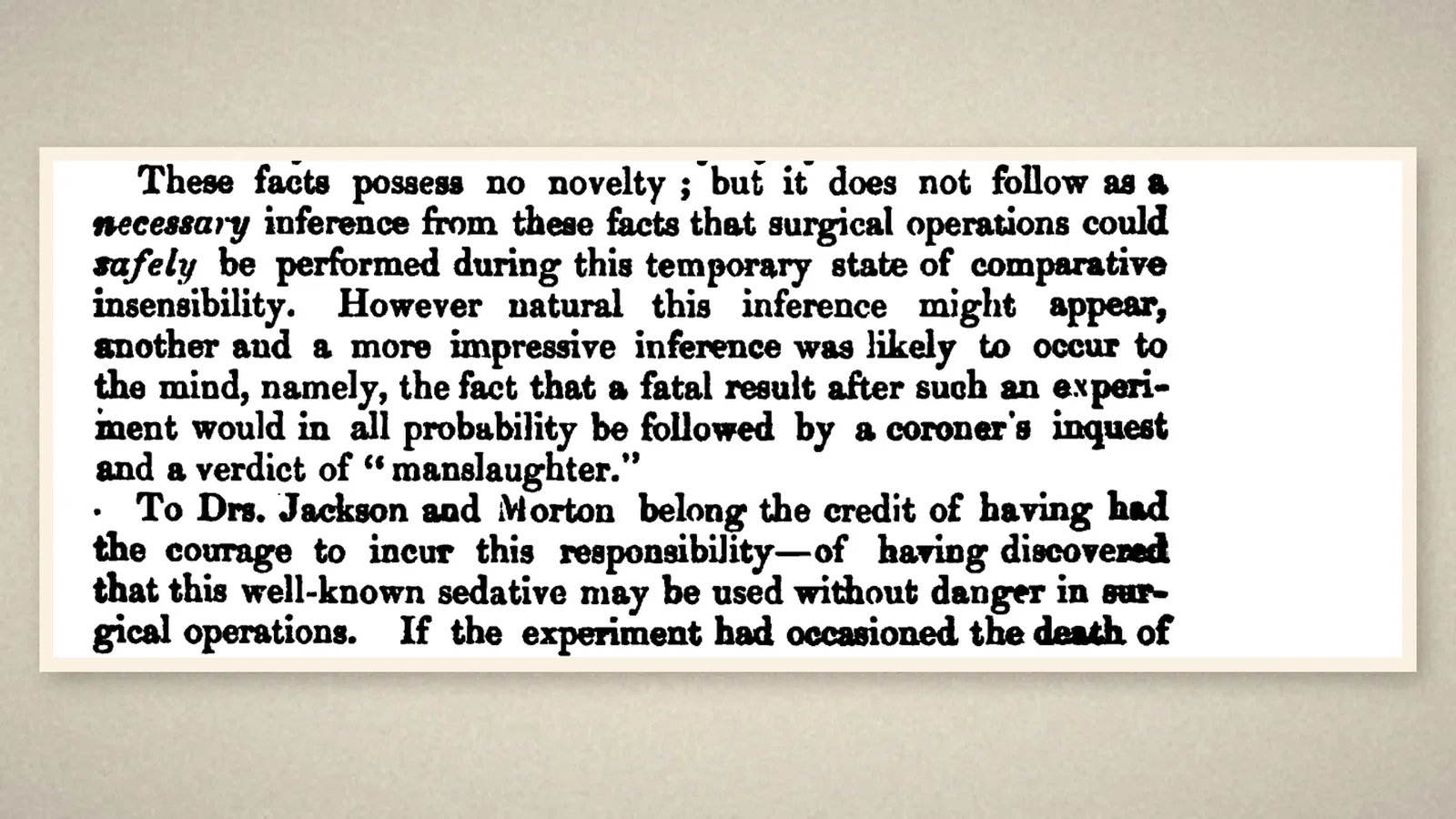
The issue of 1 March 1847 carried an editorial, "Patents for surgical operations", answering a pamphlet by James A. Dorr, agent in England for the Boston patentees. The sedative effect of ether had long been known, the editorial said: it had been inhaled to relieve pain more than twenty years earlier, and people under its influence had been seen to bruise themselves without feeling it. "These facts possess no novelty", but it did not follow as a necessary inference that operations could safely be performed in that temporary state of comparative insensibility. Another and more impressive inference was likely to occur to the mind: that a fatal result after such an experiment "would in all probability be followed by a coroner's inquest and a verdict of 'manslaughter'". To Jackson and Morton, therefore, belonged the credit of having had the courage to incur this responsibility. [1, p. 398]
The editorial went on to argue that monopolising ether inhalation by patent would degrade the character of the medical profession. [1, p. 399]
"Asphyxia and Etherisation are two very different things"
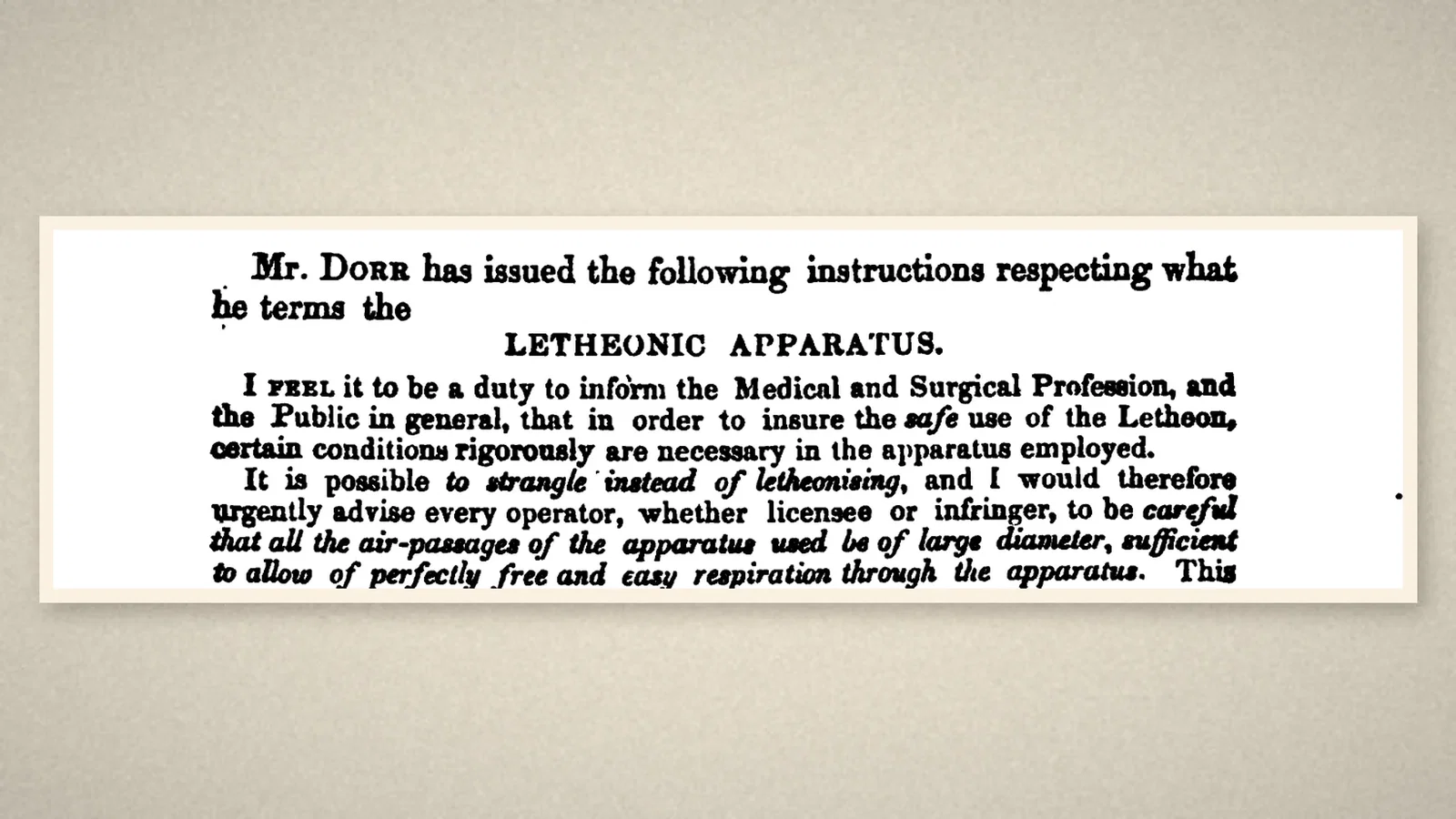
On the same page the journal reprinted Dorr's instructions on the "Letheonic apparatus", dated 30 January 1847. To insure the safe use of the Letheon, the patentees' name for ether inhalation, Dorr wrote, certain conditions were rigorously necessary in the apparatus, since "it is possible to strangle instead of letheonising": every air passage had to be wide enough for perfectly free and easy breathing, with no obstruction at the valves. Compressing a patient's nostrils with a spring or other instrument was "highly dangerous and improper"; the nostrils should be closed by the fingers of a prudent and experienced person. "Asphyxia and Etherisation are two very different things." The notice added that it was issued from motives of humanity and was no abandonment of any lawful claim. [1, p. 399]
The notice came from the patentees' agent and carried a commercial interest. Even so, it shows that by the end of January 1847 narrow passages, sticking valves and forced closure of the nose, and the asphyxia they could cause, were problems that needed public warning.
Two deaths and a verdict
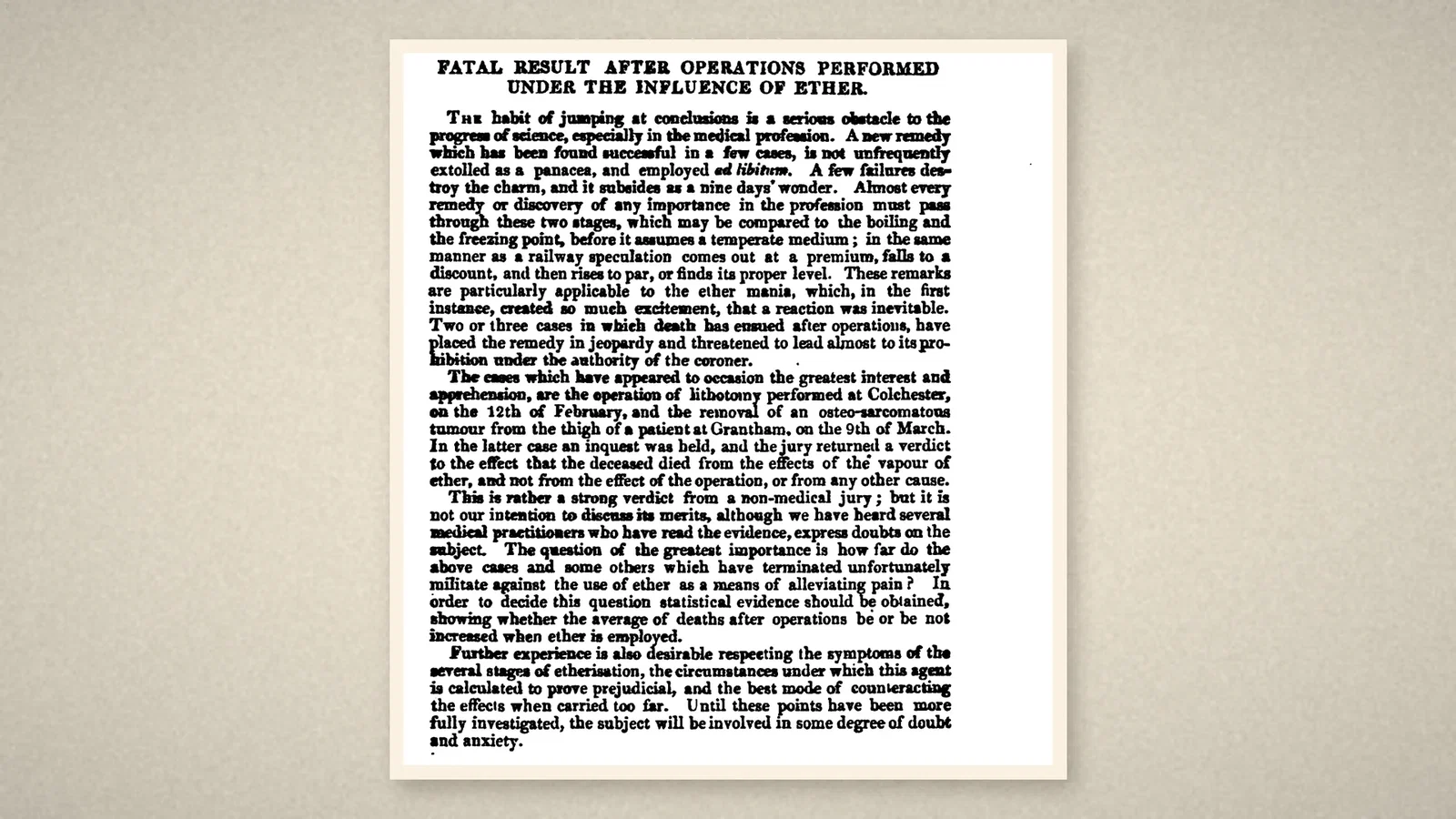
On 1 April the journal printed "Fatal result after operations performed under the influence of ether". The habit of jumping at conclusions, it began, was a serious obstacle to science, especially in medicine: a new remedy successful in a few cases was extolled as a panacea, and a few failures turned it into a nine days' wonder. The "ether mania" had created so much excitement that a reaction was inevitable, and two or three deaths after operations had placed the remedy in jeopardy and threatened to lead almost to its prohibition under the authority of the coroner. [1, p. 475]
The cases causing the greatest interest and apprehension, the journal said, were a lithotomy at Colchester on 12 February and the removal of an osteosarcomatous tumour from a patient's thigh at Grantham on 9 March. In the Grantham case an inquest was held, and the jury found that death came from the effects of the vapour of ether, and not from the operation or any other cause. The journal called this "rather a strong verdict from a non-medical jury", reported that several practitioners who had read the evidence doubted it, and declined to discuss its merits. [1, p. 475]
Obtain statistical evidence
The question of greatest importance, the journal went on, was how far these and some other unfortunate cases told against the use of ether to relieve pain. "In order to decide this question statistical evidence should be obtained, showing whether the average of deaths after operations be or be not increased when ether is employed." More experience was also needed of the symptoms of the several stages of etherisation, the circumstances in which ether was likely to prove harmful and the best means of counteracting it when carried too far; until then, the subject would remain one of some doubt and anxiety. [1, p. 475]
The article gave no figures and did not condemn ether. What it did was turn alarm over single cases into a question that could be tested: was a death caused by ether, or by the risk of the operation itself? Only a comparison of deaths after operations with and without ether could answer it.
The same year in a modern timeline
The 2024 history timeline of the Australian Society of Anaesthetists lists related events under 1847: it says that Jonathan Pereira, giving ether at the London Hospital, had the wooden-ball expiratory valve fail and afterwards wrote to Jacob Bell, president of the Pharmaceutical Society, a letter the timeline calls the earliest written anaesthetic incident report; it also lists a death under ether at Auxerre in France in July 1847, reported in the Gazette Médicale in March 1848. [2, pp. 15-16] These are the timeline's statements; Pereira's letter was not found in this volume of the journal.
What the record shows
Less than half a year after ether arrived, people were already arguing about three things: who was responsible when something went wrong, how to use it safely, and what evidence could show whether it was dangerous at all. The short article of April 1847, less than a page long, put the third question plainly.
Sources and reading limits
Read: Pharmaceutical Journal and Transactions, vol. 6 (1846-47): in the 1 March 1847 issue, the editorial "Patents for surgical operations" (pp. 397-399) and Dorr's "Letheonic apparatus" instructions (p. 399); in the 1 April issue, John Snow's letter on the inhaler table (pp. 474-475) and the article "Fatal result after operations performed under the influence of ether" (p. 475); and an earlier note in the volume on the North London Hospital ether operations of December 1846. The 2024 history timeline of the Australian Society of Anaesthetists, pp. 15-17, entries for 1847, used only as a lead.
Not covered: the Colchester and Grantham case reports and the Grantham inquest evidence (in the Lancet and the Medical Gazette of 1847); Pereira's 1847 letter to Jacob Bell described by the timeline (not found in this volume); the Gazette Médicale report of the Auxerre death; Sédillot's 1852 rules for chloroform; the aspiration death of 1853.
Limits: the April article is an editorial comment, not a case report; the dead are not identified. The bore size given in Dorr's notice is omitted, and the illustration stops before that line. "Earliest written incident report" is the timeline's phrase; this article makes no such claim of its own.
Three illustrations are crops of the Pharmaceutical Journal, vol. 6, 1847 (pp. 475, 398 and 399). One is a timeline drawn from the text, with no people or apparatus drawn.
- Pharmaceutical Journal and Transactions. 1847;6: 397-399 (Patents for surgical operations; Dorr JA, Letheonic apparatus), 475 (Fatal result after operations performed under the influence of ether). Internet Archive
- Australian Society of Anaesthetists. Anaesthesia History Timeline. 2024. PDF
Continue exploring
Related reading connects shared questions and contexts; it does not by itself establish historical influence.
- 1847: Semmelweis Orders Chlorine Handwashing in a Vienna Maternity Clinic
- 1846: Patent 4,848 and the Claim to Relieve Surgical Pain
Anesthesia Epochs · The Source Room · About & Editorial Method
Published November 4, 2026. Sources and reading limits are stated above. Illustrations are labelled as original source images or AI-made. Historical accounts are educational; they are not current treatment instructions.