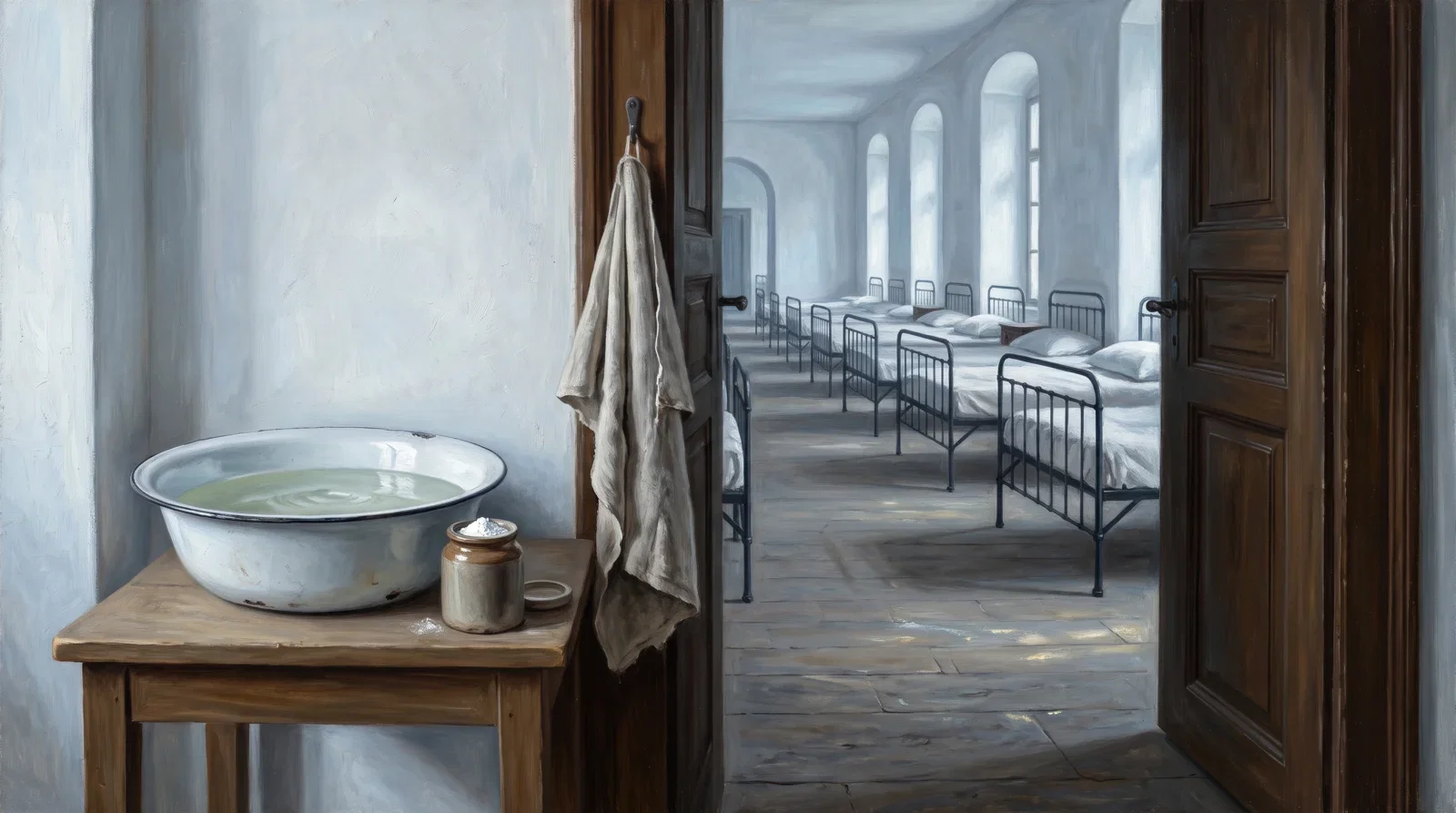
In an 1861 book Semmelweis recalled requiring students to wash in chlorine solution from mid-May 1847, after concluding that cadaveric matter on examiners' hands caused childbed fever.
Reading Library · Anesthesia Epochs · 中文版
Watch the education video (for clinicians)
1847: Semmelweis and Chlorine Handwashing — The Examining Finger · Anesthesia Epochs Education Series
In 1847 ether had only just taken the pain out of surgery; chloroform would follow that November. That spring, in a Vienna lying-in hospital, a young assistant began requiring everyone who examined a woman in labour to wash first in chlorine solution. Anaesthesia had answered pain, but not the infections and deaths that followed operations and childbirth; the Australian Society of Anaesthetists' history timeline lists the episode under 1847, beside the story of anaesthesia. [2, p. 16] This article reads the book that Ignaz Philipp Semmelweis published fourteen years later: a participant's retrospective account, not a record made at the time. [1, title page]
Two divisions
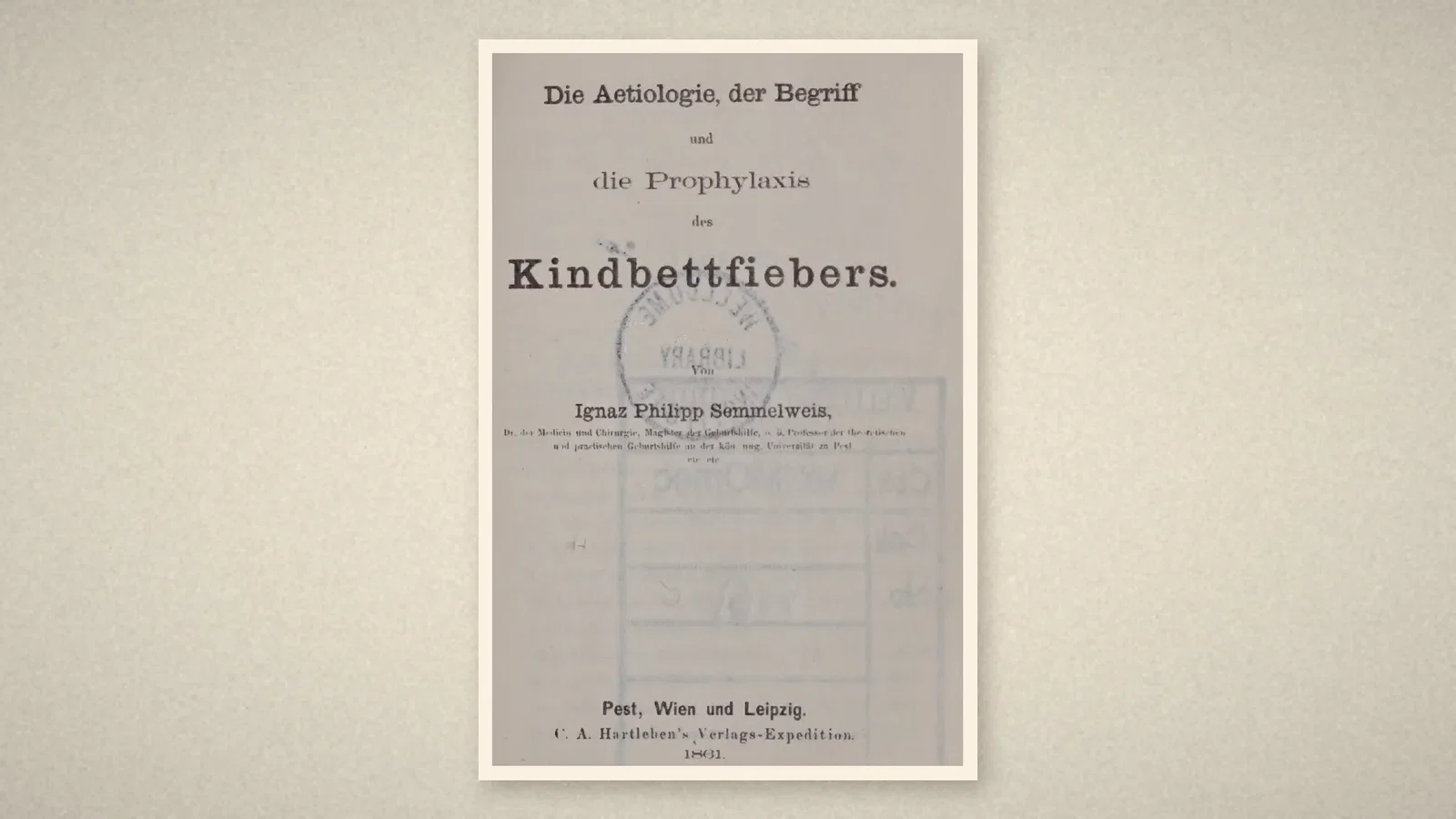
In 1861 Semmelweis published Die Aetiologie, der Begriff und die Prophylaxis des Kindbettfiebers (The Aetiology, Concept and Prophylaxis of Childbed Fever) with Hartleben in Pest, Vienna and Leipzig. It opens with Vienna's great free lying-in hospital, divided into two sections. Under orders of October 1840, all male medical students were assigned to the first division for obstetric teaching and all pupil midwives to the second; admissions alternated every 24 hours, and the first division had one more admitting day each week. [1, pp. 2-3]
Since the first division had been reserved for training doctors, Semmelweis wrote, its mortality had been higher until June 1847, in 1846 about five times higher; the real gap was greater still, because very sick women were sometimes transferred to the general hospital and not counted among the clinic's deaths. [1, pp. 3-4]
Kolletschka's death
On 2 March 1847 Semmelweis set off with two friends for Venice, hoping to restore a mind disturbed by events in the clinic; on 20 March, a few hours after returning to Vienna, the author took up the post of assistant in the first obstetric clinic and soon learned that Kolletschka, the much-respected professor of forensic medicine, had died. Kolletschka often held forensic dissections with students; during one, a student's dissecting knife pricked a finger, and lymphangitis and phlebitis followed, with death from inflammation of the pleura, pericardium, peritoneum and meninges. [1, pp. 52-53]
In that agitated state, Semmelweis wrote, the identity of Kolletschka's illness with the one that had killed hundreds of women in childbed forced itself on the mind "with irresistible clarity". The post-mortem findings were the same, so the conclusion should be too: not the wound but its contamination with cadaveric matter had caused the death. Where, then, did cadaveric matter enter the women? [1, pp. 53-54]
In the anatomical tradition of the Vienna school, professors, assistants and students often handled bodies. Ordinary washing with soap, Semmelweis wrote, did not remove all the cadaveric particles clinging to the hand, as its lingering smell showed; when pregnant women, women in labour and new mothers were examined, that hand carried the matter in. [1, pp. 54-55]
Chlorine
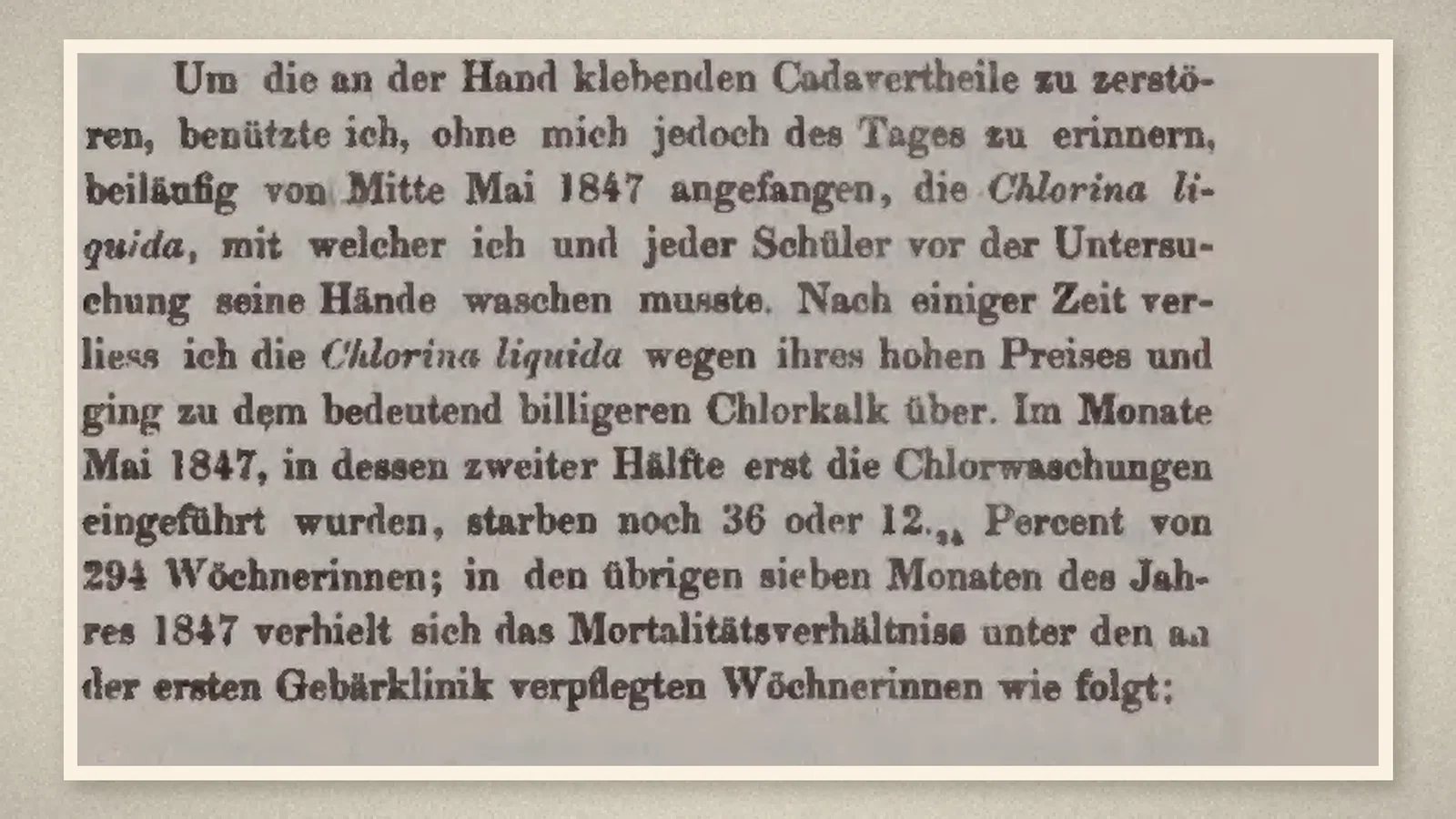
If cadaveric matter on the hand was the cause, destroying it chemically should prevent the disease. "To destroy the cadaveric particles clinging to the hand," Semmelweis wrote, "I used, without being able to recall the day, from about the middle of May 1847, Chlorina liquida, with which I and every student had to wash our hands before examining." After a while the expensive chlorine solution gave way to the much cheaper chloride of lime (Chlorkalk). [1, p. 55]
The figures in the book
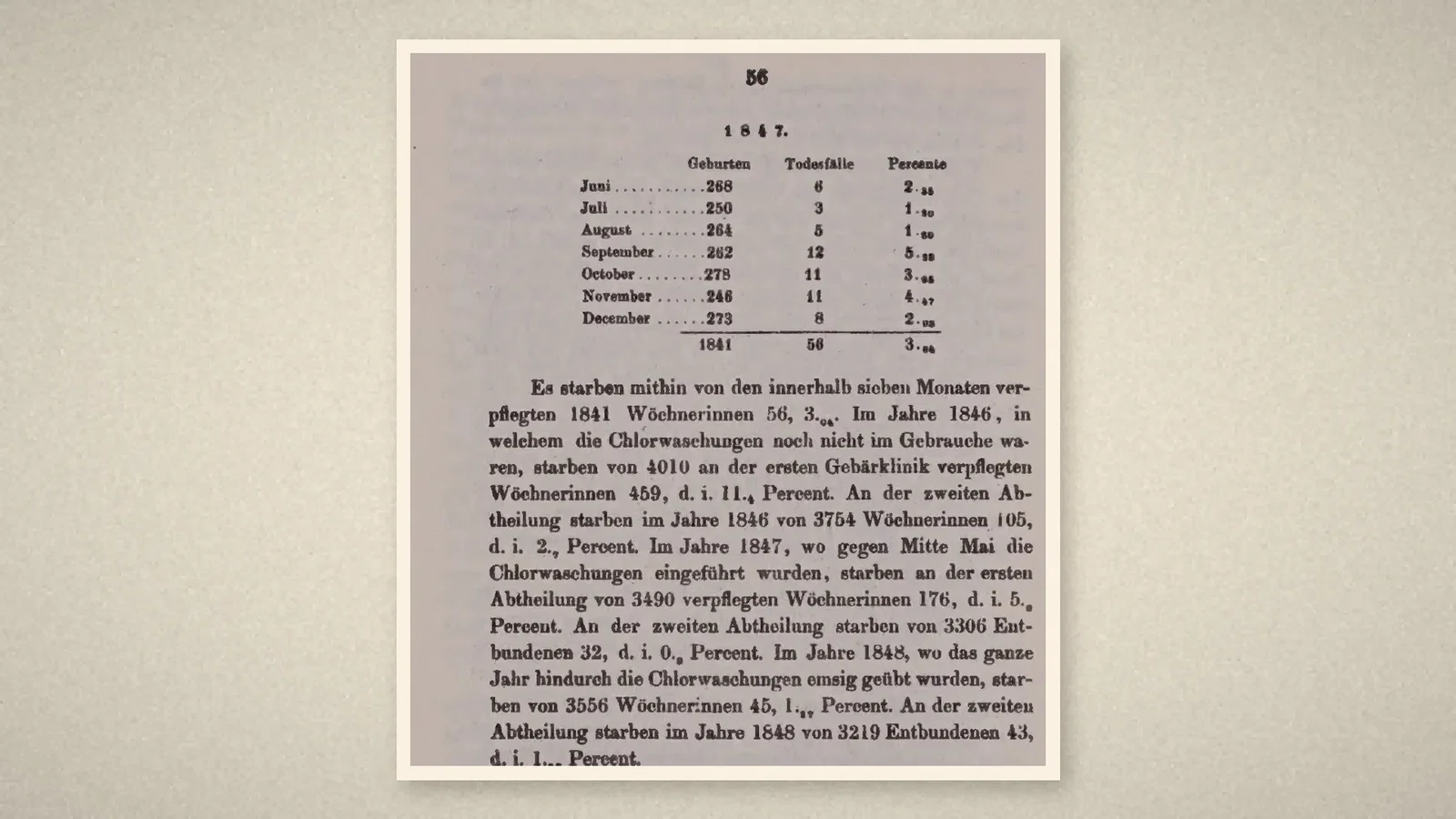
Chlorine washing began only in the second half of May 1847, the book says, and in that month 36 of 294 women in the first division still died. A table then gives births and deaths for each month from June to December: 1841 women in seven months, 56 deaths. The annual comparison follows. In 1846, before chlorine washing, 459 of 4010 women died in the first division, about 11.4%, against about 2.7% in the second; in 1847 the figures were about 5.0% and 0.9%; in 1848, with chlorine washing kept up all year, 45 of 3556 women died in the first division, about 1.27%, against about 1.33% in the second. [1, pp. 55-56]
These are figures that Semmelweis assembled and published more than ten years later; there was no controlled trial, and other changes in the same years cannot be excluded. But the book shows clearly how its author turned an observation into a rule and then tested the rule with numbers.
Soap was not enough
The rule was not settled at once. At first Semmelweis thought that students in the labour ward had no chance to soil their hands with cadaveric matter again, so a single chlorine wash on entering, with soap and water between examinations, seemed enough. In October 1847 a woman in labour with an ulcerating cancer of the uterus was admitted and placed in bed number one, where rounds always began; after examining this woman the examiners washed only with soap, and of twelve women delivered at the same time eleven died. [1, p. 59]
Semmelweis concluded that not only cadaveric matter but putrid discharge from living people caused childbed fever, and that hands must be washed in chlorine after examining anyone who might soil them in this way, before the next examination. "This rule, taken from that sad experience, we observed from then on." In November of the same year a woman with an ulcerating knee joint convinced Semmelweis that the air could carry the agent too. [1, pp. 59-60]
In the first obstetric clinic, Semmelweis wrote, the carrier of childbed fever was the examining finger. [1, p. 60]
What the record shows
In the very year anaesthesia appeared, an obstetrician in Vienna was already recording, in numbers, another invisible hazard of the hospital. Hand hygiene later became a basic rule for every operation and every anaesthetic procedure; this 1861 retrospective shows that the first rule grew out of a death, a chain of reasoning, a chemical wash and a correction after a mistake.
Sources and reading limits
Read: Semmelweis, Die Aetiologie, der Begriff und die Prophylaxis des Kindbettfiebers (Pest, Wien und Leipzig: Hartleben, 1861; Internet Archive b33953740, Wellcome Collection copy, public domain mark): the title page; the opening account of the two divisions and their mortality (printed pp. 2-4); and pp. 52-60 on Kolletschka's death, the reasoning about cadaveric matter, chlorine washing from about mid-May 1847, the 1847 monthly table, the annual figures for 1846-1848 and the cases of October and November 1847. The 2024 history timeline of the Australian Society of Anaesthetists, pp. 16-17, entries for 1847 and 1852, was used only as a lead.
Not covered: the rest of the book (later chapters, correspondence and polemics); Hebra's reports of 1847 and 1848 in the journal of the Vienna medical society; Semmelweis's 1850 lecture; the clinic's own registers; the Sédillot papers of 1851 and 1853 mentioned by the timeline.
Limits: this is Semmelweis's own account written more than ten years afterwards; "about mid-May 1847" is the author's estimate, given with the remark that the exact day was not remembered. The timeline says one clinic was "run by nurses"; the book says the second division trained midwives. The timeline also says Sédillot had linked postoperative infection to dissecting rooms in 1851 and 1853; that is the timeline's statement, and the papers were not read. The women in the clinic are not identified.
Three illustrations are crops of the 1861 book (title page, p. 55, p. 56).
- Semmelweis IP. Die Aetiologie, der Begriff und die Prophylaxis des Kindbettfiebers. Pest, Wien und Leipzig: C. A. Hartleben; 1861. Internet Archive
- Australian Society of Anaesthetists. Anaesthesia History Timeline. 2024. PDF
Continue exploring
Related reading connects shared questions and contexts; it does not by itself establish historical influence.
Anesthesia Epochs · The Source Room · About & Editorial Method
Published November 4, 2026. Sources and reading limits are stated above. Illustrations are labelled as original source images or AI-made. Historical accounts are educational; they are not current treatment instructions.