In 1867 Lister argued that dressings which destroyed the minute organisms carried in the air could prevent decomposition in wounds without shutting the air out.
Reading Library · Anesthesia Epochs · 中文版
Watch the education video (for clinicians)
1867: Lister's Antiseptic Principle — A Sign Is Not a Verdict · Anesthesia Epochs Education Series

An open window and moving linen introduce a historical question about excluding air. This is not a reconstruction of Lister’s ward, dressing technique or microbial distribution.
A wound could not be kept apart from the atmosphere indefinitely. Lister’s 1867 argument offered a way to let the air remain.
Opening the account of the antiseptic principle, Lister explained how suppuration had come to be connected with decomposition. If oxygen caused putrefaction, excluding it had seemed almost hopeless. Lister credited Pasteur’s research with a different account: the dangerous property belonged to minute living organisms carried in the atmosphere, rather than oxygen itself. A dressing capable of destroying their activity might therefore prevent decomposition without excluding the air. [1, p. 246]
This is Lister’s own account of the intellectual connection. Pasteur’s underlying papers were not independently examined for this essay, and the passage is not treated as a complete body of microbiological proof. It does show a change in the question: address what the air carried, rather than its presence alone.
A paper with two dates
The article appeared in the British Medical Journal on 21 September 1867. Its footnote records an earlier reading in the Surgical Section of the British Medical Association’s annual meeting in Dublin on 9 August. The article uses the publication date; neither date is presented as an exact invention day. [1, p. 246, header and note]
References to earlier installments in The Lancet also show that these three pages were not the beginning of all the work. Those earlier articles were not individually examined here. The account remains bounded by what this original publication supports.
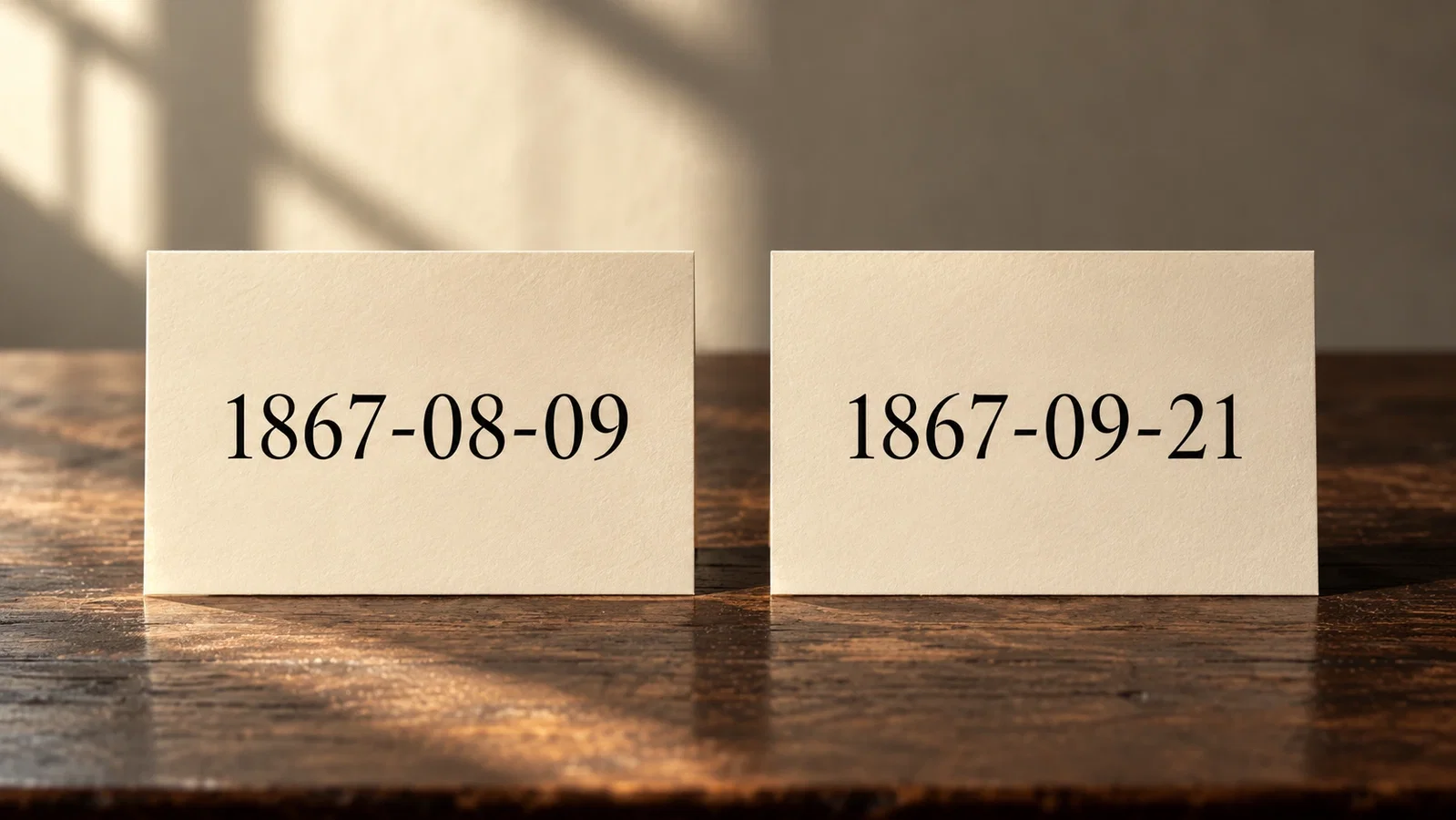
Modern editorial cards mark 1867-08-09 and 1867-09-21, the reading and publication dates. They are not historical invitations, manuscripts or exact discovery dates.
A principle still needed practical changes
Lister chose carbolic acid and began with compound fractures, seeking to prevent decomposition while blood and damaged tissue underwent healing under different local conditions. Lister also described damage to the skin from an earlier method, which required changes to the materials used to cover and protect the wound. [1, p. 246]
The article was not a settled modern checklist for aseptic surgery. The action of the agent, tissue tolerance and maintaining the intended conditions remained parts of the same practical problem. The historical preparations are not converted into instructions here.
Pus did not explain its own cause
Lister's discussion of discharge complicates an easy success story. Pus could appear after the first week, Lister warned, without necessarily showing that antiseptic treatment had failed. Lister used an observation involving clean metal over a granulating sore to argue that granulations did not inevitably form pus and that chemical stimulation could help explain suppuration. [1, p. 246, right column]
Carbolic acid and decomposing material could both provide a stimulus, Lister continued. In Lister's explanation, however, decomposition propagated and intensified itself, whereas the acid’s stimulation weakened with dilution. This distinction helped Lister interpret a local appearance rather than accept it as a self-explanatory sign. [1, p. 247, left column]
These historical propositions are not a rule for diagnosing a wound today. They show that introducing a treatment also required deciding what an observation meant. Between visible discharge and a verdict of failure lay the mechanism Lister was trying to distinguish.
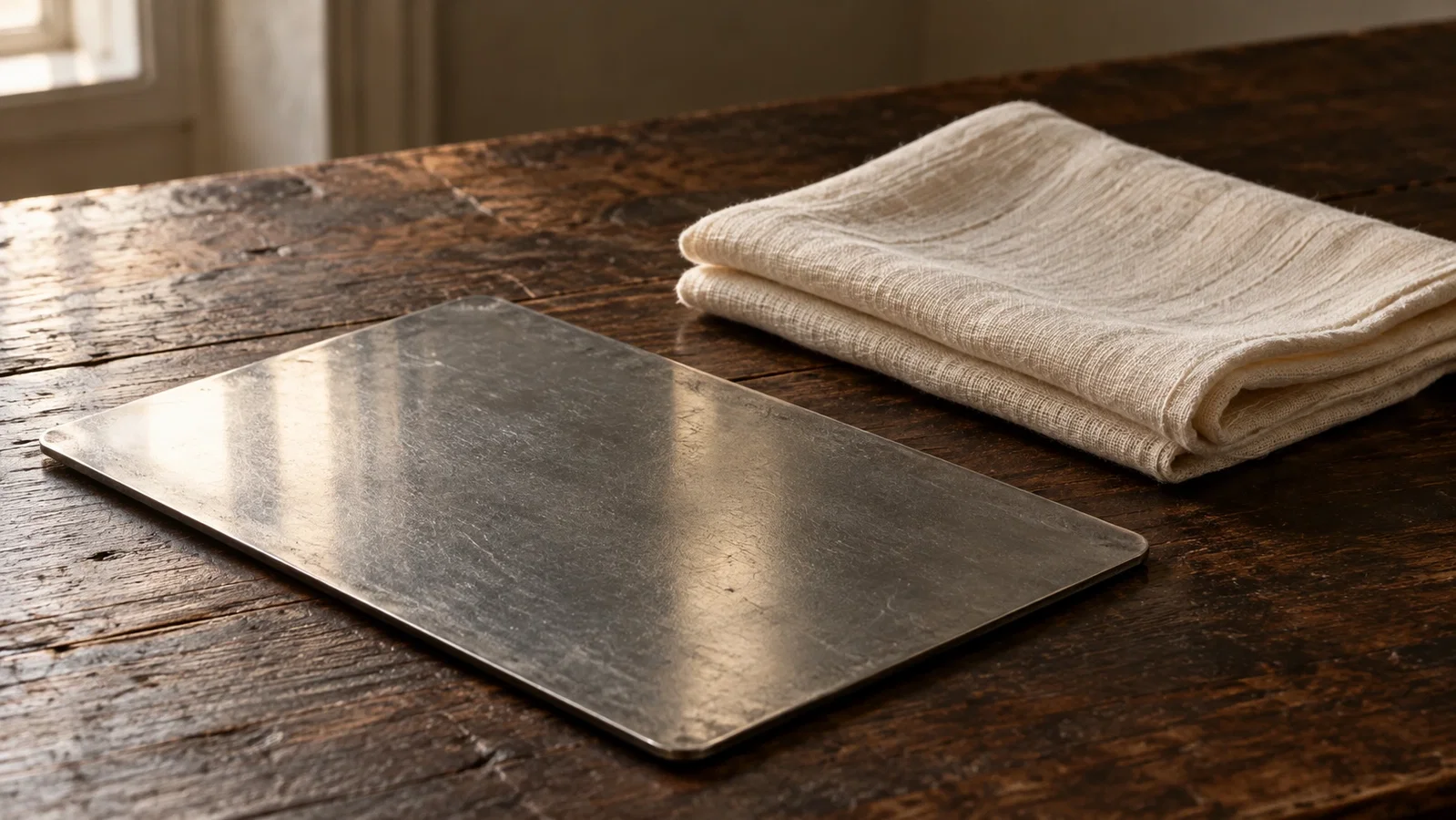
A flat metal sheet and folded cloth refer to the discussion of coverings and irritation. They show no wound or procedure and are not presented as surviving experimental or museum objects.
Nine months in the wards
Near the end, Lister turned to the Glasgow wards and reported that, after antiseptic treatment had been brought into full operation, nine months had passed without pyaemia, hospital gangrene or erysipelas, despite what Lister described as otherwise continuing unfavorable conditions, and called the change important. [1, p. 248, closing paragraphs]
The passage establishes what Lister reported. It does not provide a complete patient denominator, contemporaneous comparison wards or individual outcome records within these three pages. It cannot supply a calculated fall in infection or mortality, and the three named conditions cannot become an assertion that every infection had disappeared.
Other questions remained open on the same page. For ordinary incised wounds, Lister had not completely settled on the best method. Some benefits proposed for arterial ligatures were expectations for further testing. Confidence and unfinished work occupied the same account. [1, p. 248]

An imagined empty nineteenth-century ward. Its beds, arrangement and light do not reconstruct the Glasgow wards or represent the number of patients or comparison groups.
Placed alongside anesthesia history, the paper helps distinguish pain during an operation from what happens to a wound afterward. That is an editorial comparison of two historical problems, not a claim that anesthesia inevitably caused antiseptic surgery to emerge.
Lister’s article set out a principle while retaining the work of revising materials, interpreting discharge and testing further applications. Those unresolved details belong to its history as much as the conclusion that later became familiar.
Sources and reading limits
[1] Lister J. On the Antiseptic Principle in the Practice of Surgery. Br Med J. 1867 Sep 21;2(351):246–248. DOI:10.1136/bmj.2.351.246. Original three-page scan and record. Read: the complete article; on page 248 it occupies the left column up to its end, not the separate article on the right. The reading date is in the page 246 footnote and publication date in the original headers. These are images of the 1867 edition, not the 2010 reprint.
Not covered: Pasteur’s papers and the earlier Lancet series. Case accounts and the nine-month ward observation were not audited against original patient records. Global priority and modern clinical efficacy are not adjudicated. All four images are original interpretive works, without projecting modern aseptic equipment or a carbolic spray back into this account.
Continue exploring
Related reading connects shared questions and contexts; it does not by itself establish historical influence.
Anesthesia Epochs · The Source Room · About & Editorial Method
Updated October 30, 2026. Sources and reading limits are stated above. Illustrations are labelled as original source images or AI-made. Historical accounts are educational; they are not current treatment instructions.