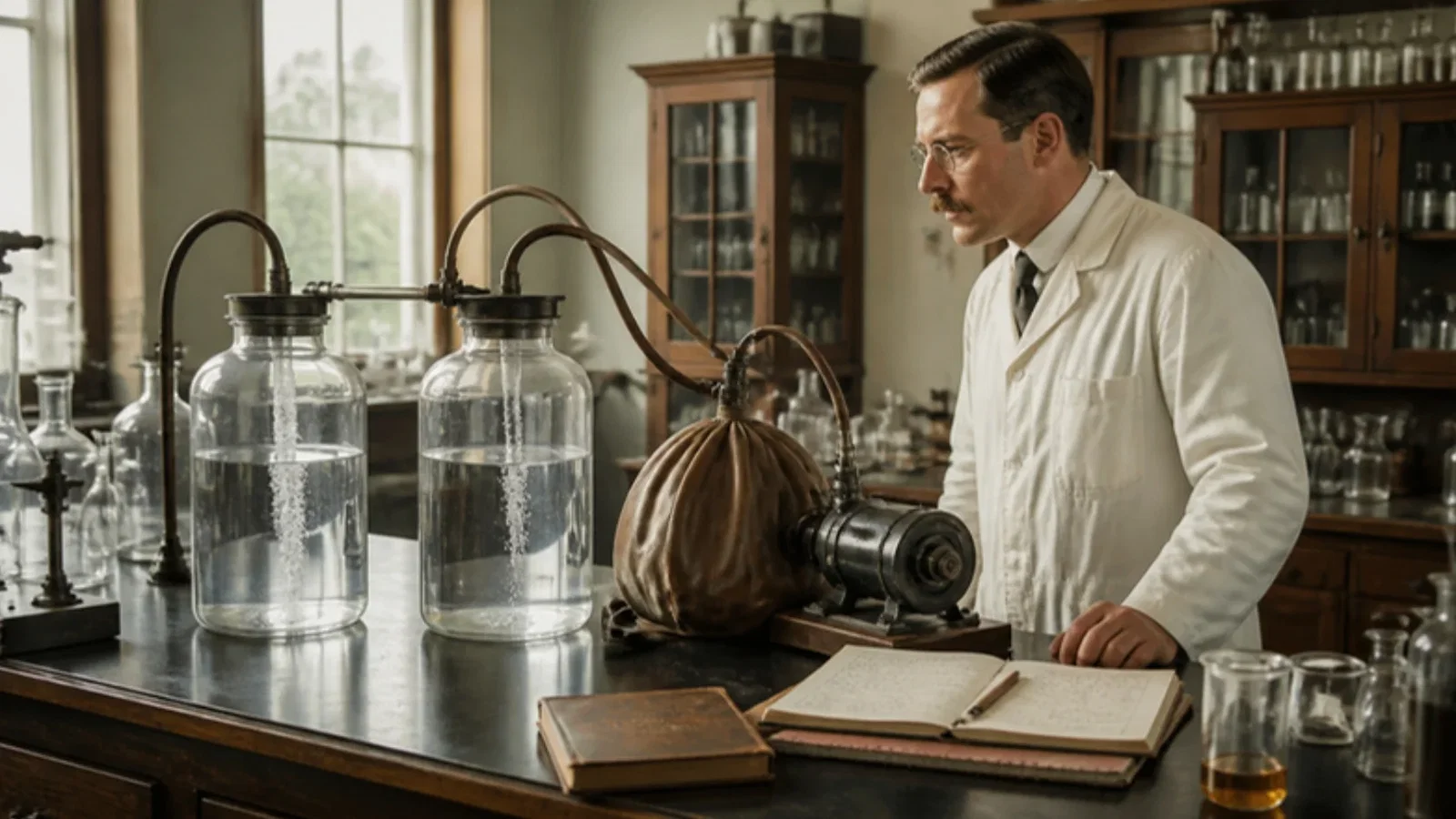
In October 1915, in the first issue of the Journal of Laboratory and Clinical Medicine, D. E. Jackson of Washington University in St. Louis described a closed circuit driven by an electric pump: exhaled air passed through a wash jar of strong alkali to absorb carbon dioxide and through sulphuric acid to dry it, received oxygen and returned to the breathing bag, so that nitrous oxide, ether or chloroform could be rebreathed; all results were in dogs.
Reading Library · Anesthesia Epochs · 中文版
Watch the education video (for clinicians)
1915: Jackson's Closed Circuit — Carbon Dioxide Absorption · Anesthesia Epochs Education Series
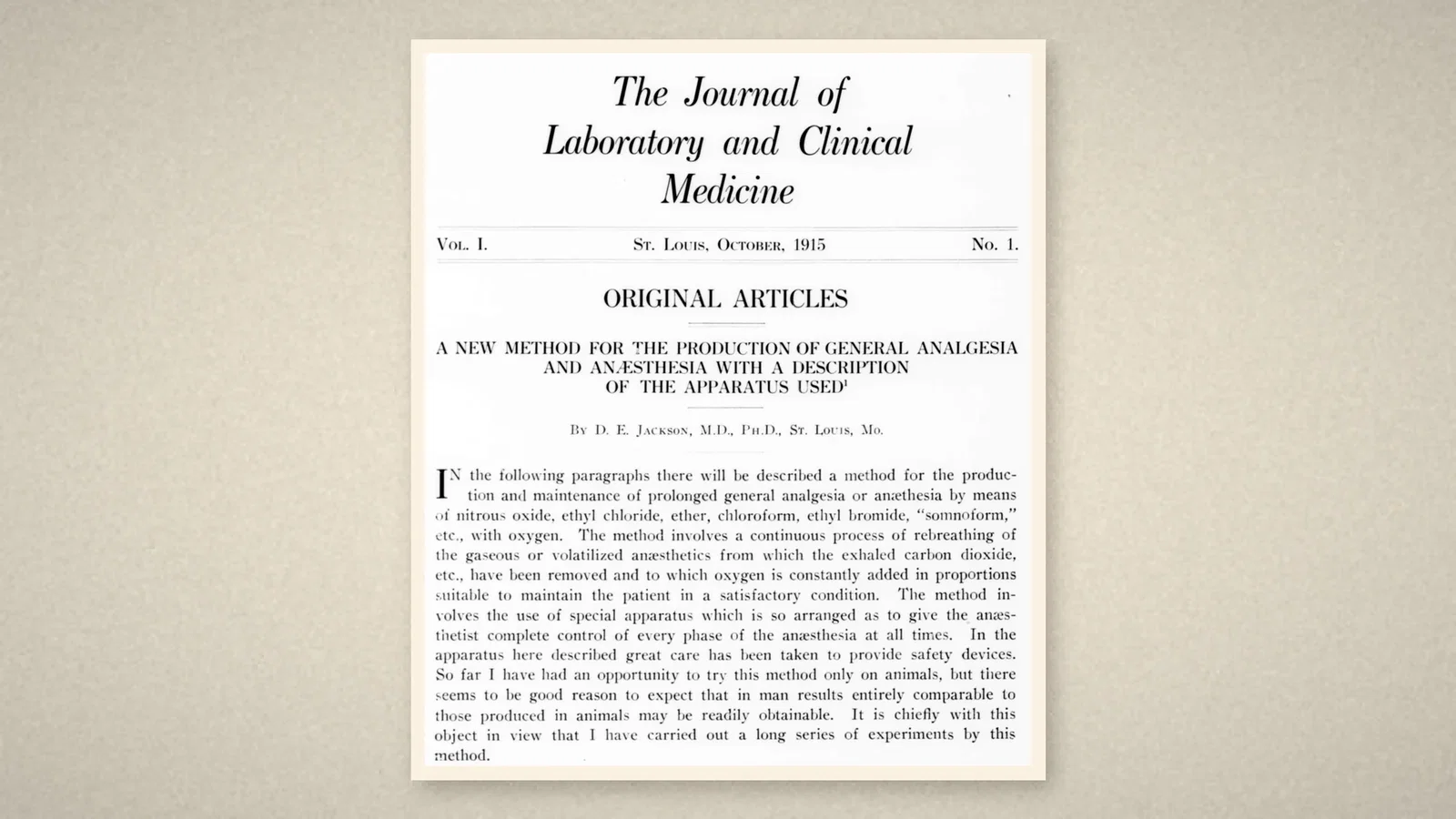
A circle system lets a patient breathe the same anaesthetic gas again and again, because a canister removes the carbon dioxide and fresh oxygen replaces what the body uses. In 1868 Coleman had already proposed passing expired nitrous oxide over lime (see that article). The Australian Society of Anaesthetists (ASA) timeline lists for 1915 a "CO2 absorber developed for use with closed circuit" by Dennis E Jackson, pharmacologist, of St Louis. This article reads the paper in which Jackson described it, the first article in the first issue of The Journal of Laboratory and Clinical Medicine, St. Louis, October 1915. [1][2]
The method
Jackson, of the Department of Pharmacology at Washington University Medical School, set out "a method for the production and maintenance of prolonged general analgesia or anaesthesia" with nitrous oxide, ethyl chloride, ether, chloroform, ethyl bromide or "somnoform", with oxygen. "The method involves a continuous process of rebreathing of the gaseous or volatilized anaesthetics from which the exhaled carbon dioxide, etc., have been removed and to which oxygen is constantly added." The paper is frank about its limits: "So far I have had an opportunity to try this method only on animals." Jackson did not claim the principles as new. Regnault and Rieset in 1849 had used a strong alkaline hydroxide to absorb an animal's carbon dioxide and had replaced its oxygen from a reservoir, and workers on metabolism had used the method ever since. What was new was the purpose: not to measure metabolism, but to keep an animal breathing normally while an anaesthetic was added to the air it breathed. [1]
The circuit
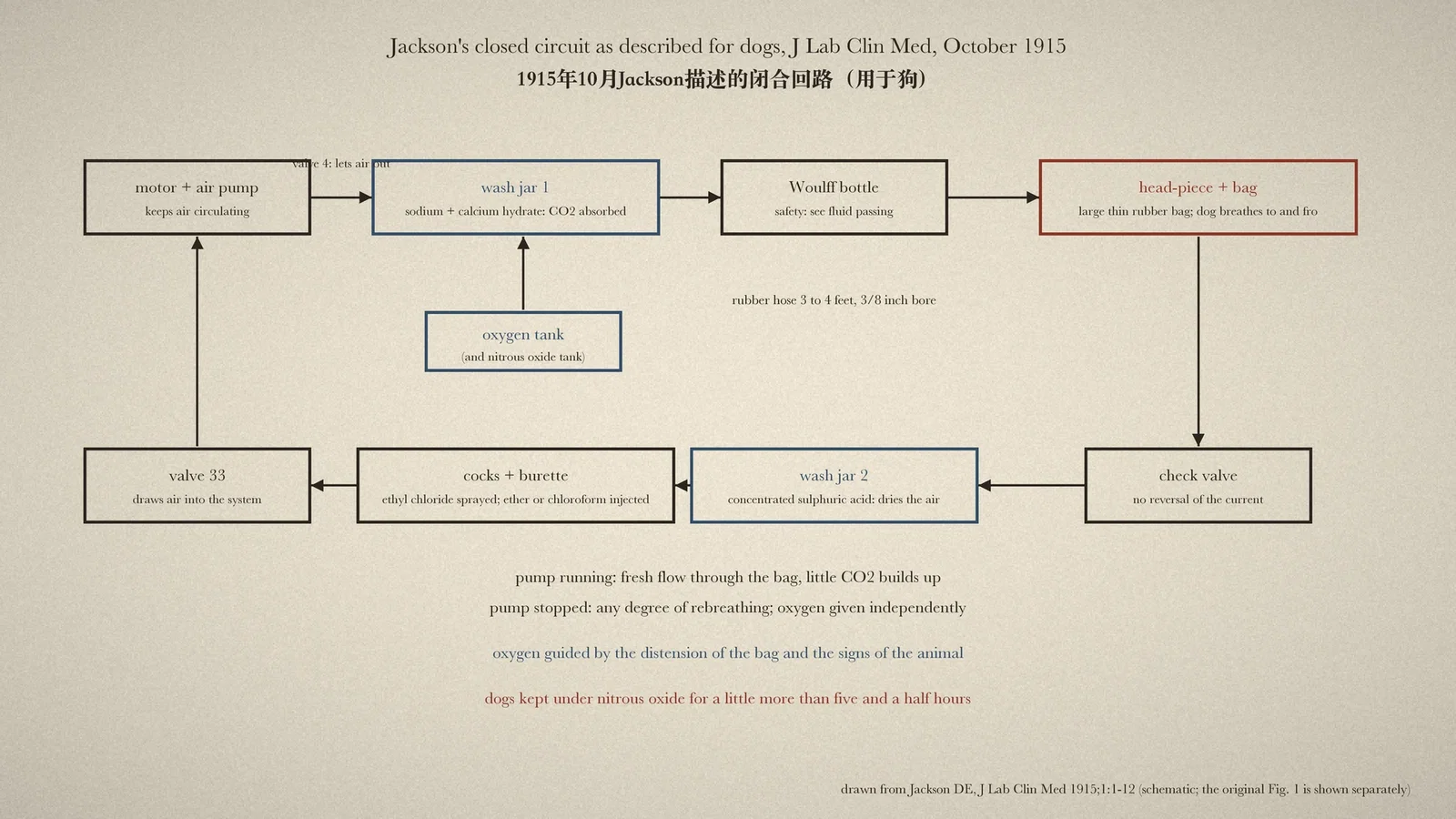
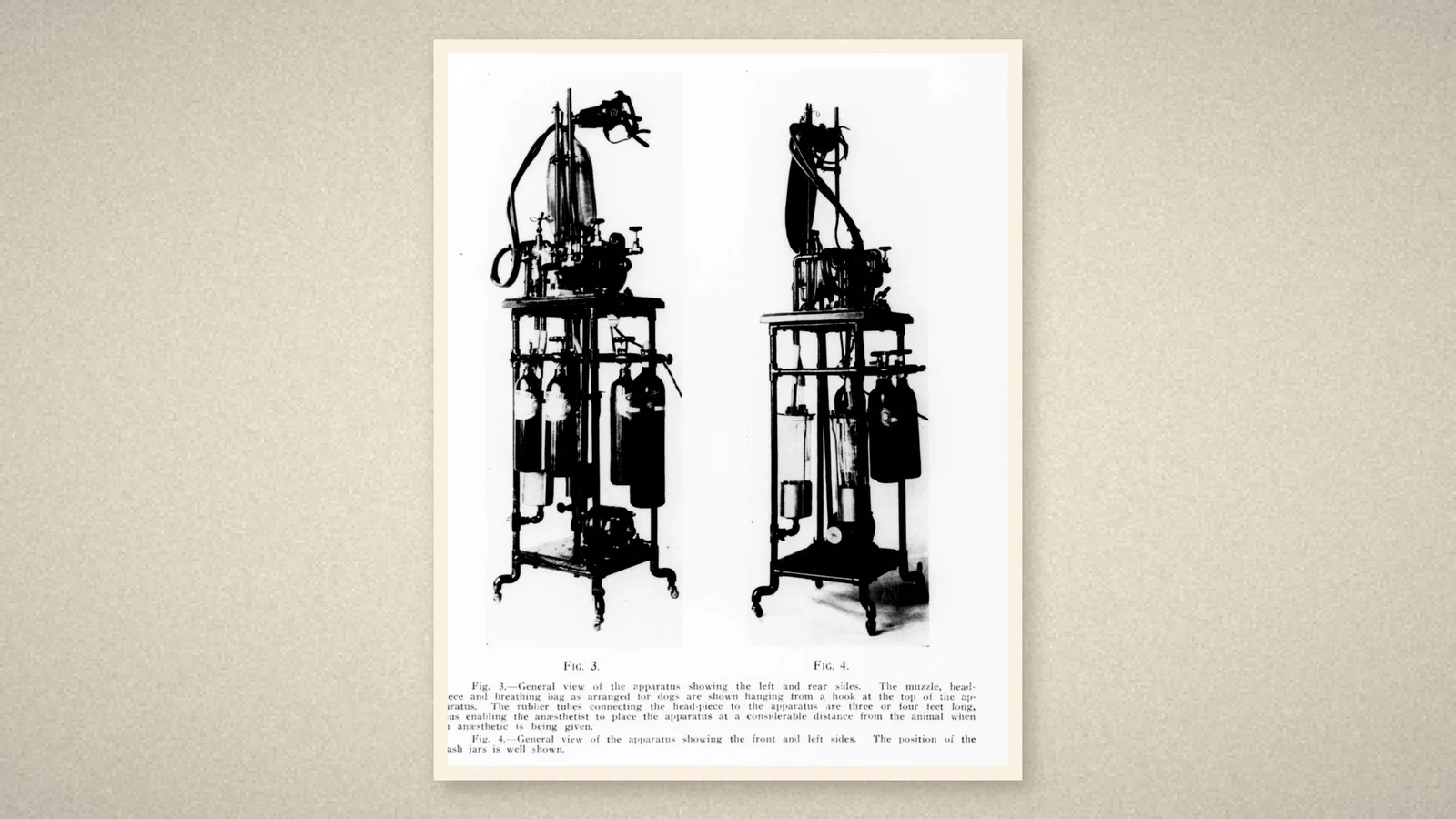
"A small electric motor (1) operates an air pump (2)", and "by means of a closed system of pipes and vessels air may be kept continually circulating through the apparatus without either loss or gain of air except at the instance of the operator." From the pump the air passed into a special wash jar, three and a half inches across and twelve inches high, filled to three or four inches with "a strong aqueous solution of sodium hydrate and calcium hydrate", whose purpose was to absorb the carbon dioxide. A glass bell inside caught the splashing. Next came a three-necked Woulff bottle, a safety device that let the operator see whether any fluid was passing toward the animal, and then a rubber hose three or four feet long to the head-piece and its large rubber breathing bag. [1]
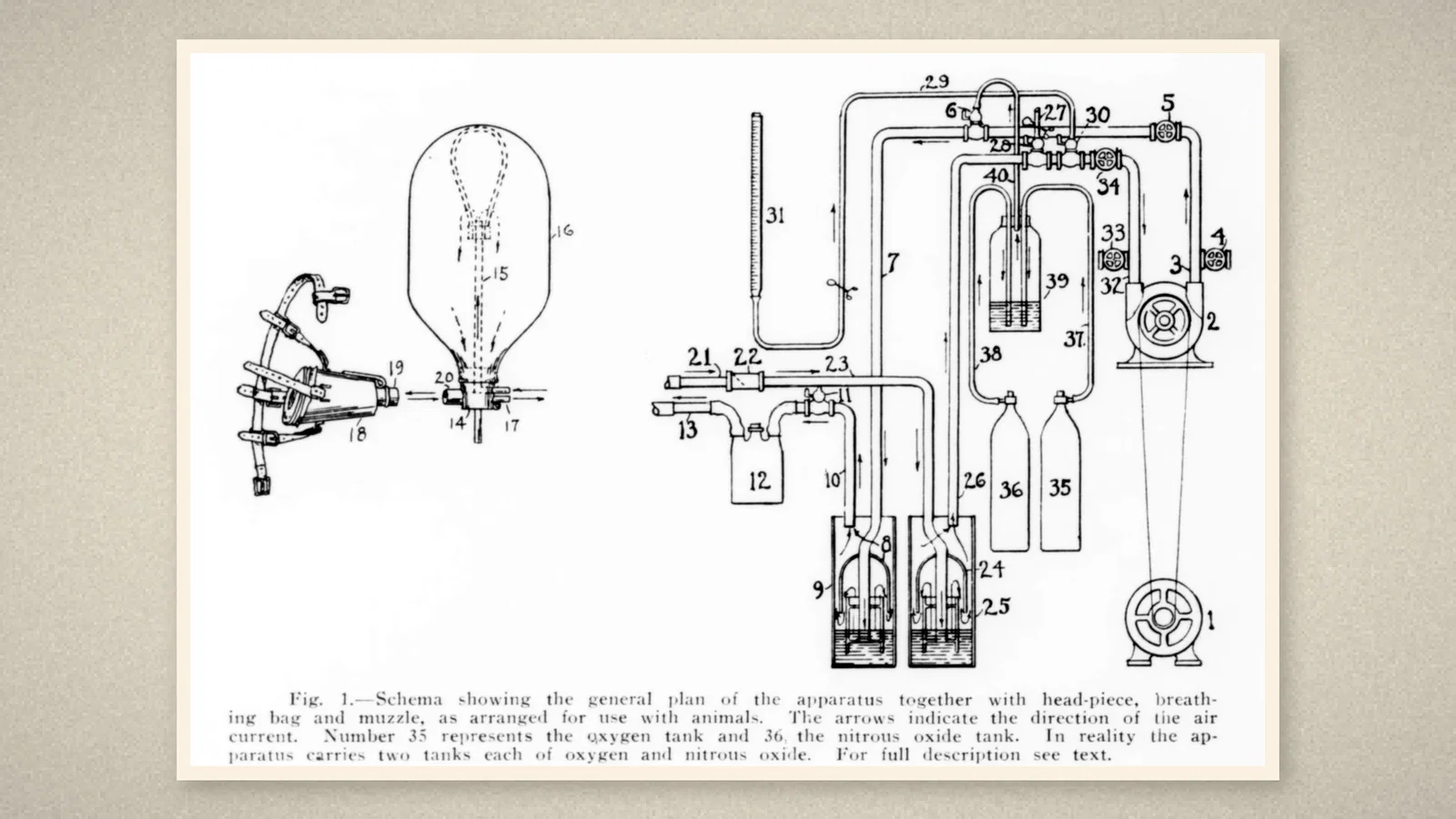
The return hose led to a check valve against any reversal of the current, and then to a second wash jar of concentrated sulphuric acid, which removed moisture, was thought to sterilize the exhaled air, and kept the pump from rusting. Before the pump, two cocks admitted the anaesthetic: volatile agents such as ethyl chloride could be sprayed in from ampoules, and ether or chloroform injected from a burette graduated in tenths of a cubic centimetre, which "permits of very accurate dosage". Two valves let the operator push air out of the system or draw it in, so that the fullness of the bag could be adjusted "in a few seconds". Oxygen from a commercial tank, bubbled through a wash bottle, entered the circuit before the alkali jar; "the extent of distension of the bag and the symptoms of the animal serve as guides for the administration of oxygen". Nitrous oxide entered the same way. [1]
Rebreathing at will
With the pump running, incoming air entered near the top of the bag and left at the bottom, so the bag was thoroughly ventilated. "If the pump be stopped any desired amount of rebreathing may be secured", and the oxygen supply remained "entirely independent of the rebreathing or of the carbon dioxide content of the bag." Jackson cited Yandell Henderson's work that a moderate accumulation of carbon dioxide may benefit an anaesthetized animal. Because almost all of an inhaled anaesthetic is exhaled again, the vapour simply went round the circuit, and as long as nothing entered or left, "the concentration of any given anaesthetic vapor within the machine and in the tissues of the animal must remain practically constant." The head-piece could also be used for intratracheal insufflation. [1]
Results and costs
Jackson's original aim was to make nitrous oxide "cheaper and safer", extending its use "particularly to that large and unfortunate proportion of our population which must depend on charity for its surgery". Oxygen would be the chief expense; a rough calculation gave about four cents an hour for nitrous oxide anaesthesia in a 15-pound dog. Dogs had been kept under nitrous oxide for a little more than five and a half hours, in excellent condition, and Fig. 6 reproduced a blood pressure and respiration tracing eighteen feet long. The summary insists that the descriptions were confined "strictly to results which have already been obtained by experiments on dogs", while drawing the conclusion that similar results might be obtained in man; a face-piece for the human subject had been made but was not described. [1]
What the record shows
Jackson's machine is the circle system in laboratory form: unidirectional flow through a carbon dioxide absorber, a reservoir bag as the visible monitor of volume, oxygen added to match consumption, the anaesthetic recirculated so that little is needed, and the choice between full scrubbing and deliberate rebreathing. The liquid absorbers, sulphuric acid and electric pump did not survive; the logic did.
Sources and reading limits
Read: Jackson DE, J Lab Clin Med 1915;1:1-12, in full; the ASA timeline entry for 1915.
Not covered: Jackson's later papers and the version of the apparatus for man; Wood Library-Museum material; any patent; later soda-lime canisters. The date of 1914 sometimes given is not supported by these pages; the article uses the issue date, October 1915. The 1915 absorber was a liquid wash jar of sodium and calcium hydrate; the text once calls the alkali "soda-lime". All results are from dogs; the expectation of similar results in man and the cost estimate are Jackson's. The ASA's description is quoted as the ASA's; the article makes no "first" claim. Coleman's 1868 proposal is a cross-reference to another article.
Three illustrations are crops of the October 1915 issue, including Jackson's Fig. 1 and the photographs of Figs. 3 and 4; one is drawn from Jackson's description.
- Jackson DE. A new method for the production of general analgesia and anaesthesia with a description of the apparatus used. J Lab Clin Med. 1915;1:1-12. Internet Archive
- Australian Society of Anaesthetists. Anaesthesia history timeline. 2024. ASA
Continue exploring
Related reading connects shared questions and contexts; it does not by itself establish historical influence.
Anesthesia Epochs · The Source Room · About & Editorial Method
Published November 2, 2026. Sources and reading limits are stated above. Illustrations are labelled as original source images or AI-made. Historical accounts are educational; they are not current treatment instructions.