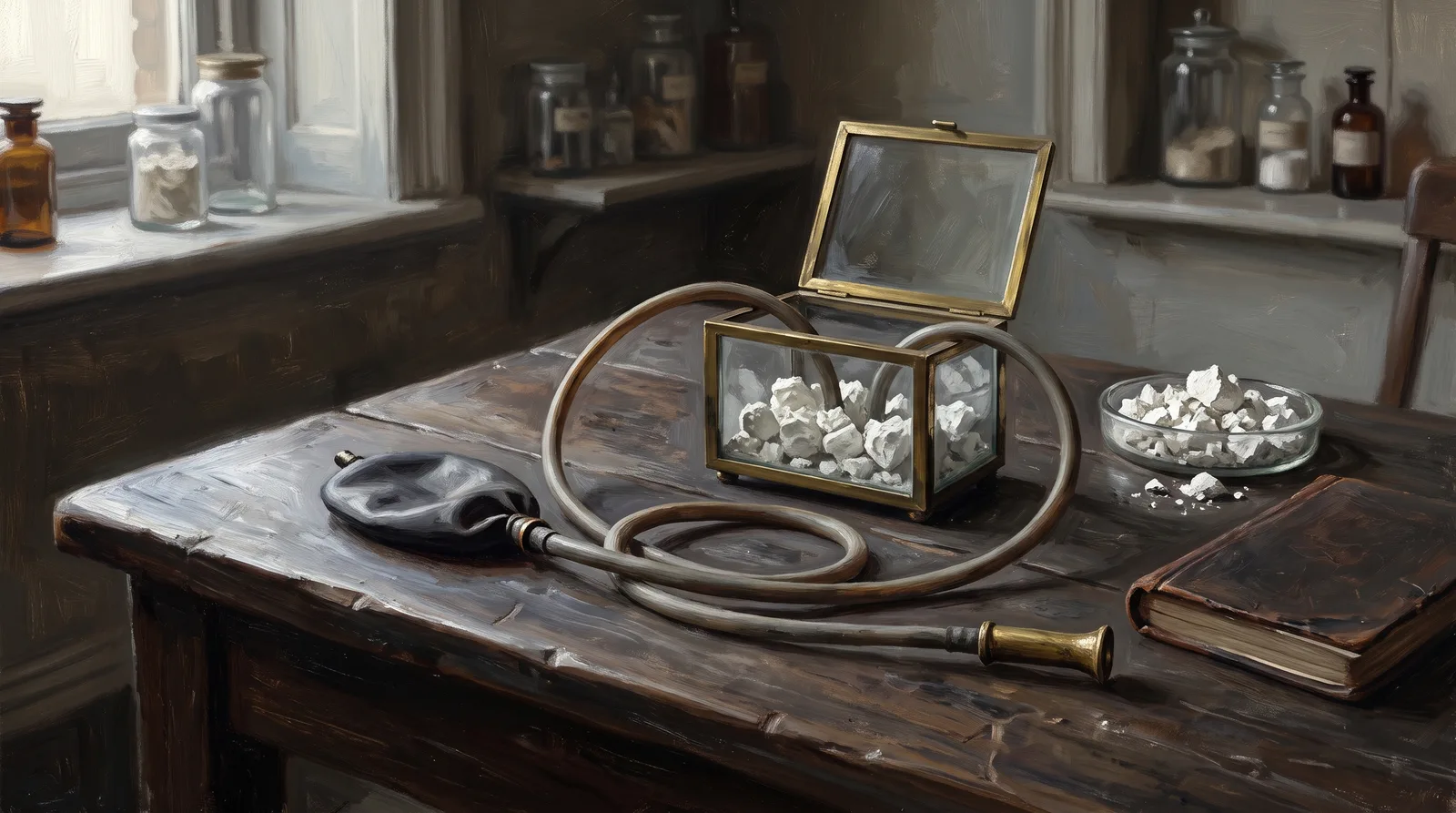
The dentist Alfred Coleman proposed cleaning expired nitrous oxide and breathing it again; in Coleman's early cases at the Dental Hospital the gas passed over slaked lime.
Reading Library · Anesthesia Epochs · 中文版
Watch the education video (for clinicians)
1868: Coleman's Lime Absorber — Breathing Nitrous Oxide Again · Anesthesia Epochs Education Series
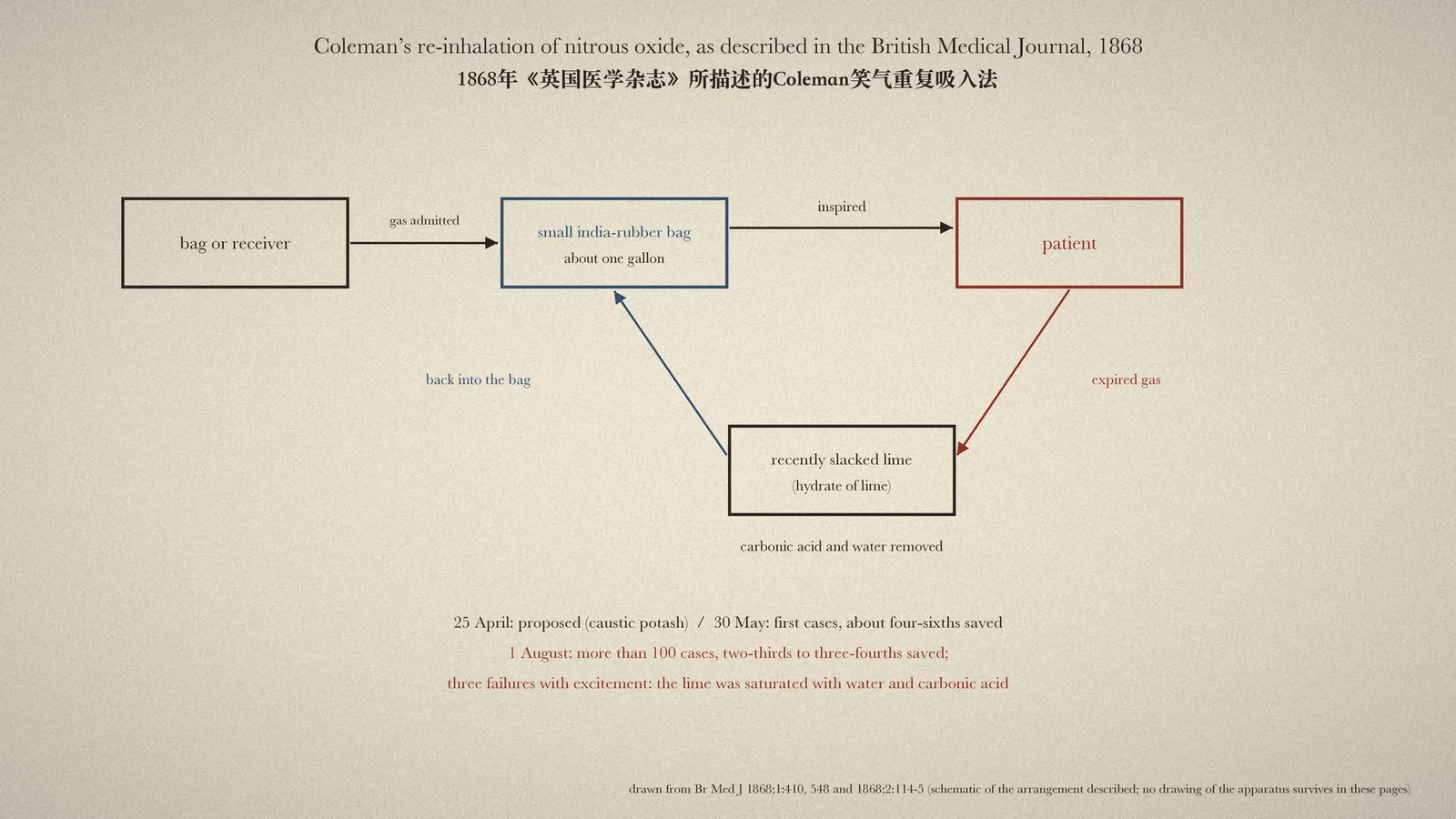
Every circle system in a modern anaesthetic machine sends the patient's exhaled gas through a canister of absorbent, which takes out the carbon dioxide, and returns the rest to be breathed again. The Australian Society of Anaesthetists' timeline calls the apparatus of the London dental surgeon Alfred Coleman, in 1868, "probably the first clinically-used carbon dioxide absorber". This article follows the idea through three letters printed in the British Medical Journal between April and August 1868: a proposal, a first trial reported by a colleague, and a report of more than a hundred cases, including three failures that taught Coleman something about the absorbent. [1][2][3][4]
Why save the gas
Nitrous oxide had returned to London dentistry in the spring of 1868, but the gas was troublesome to make and bulky to carry. On 25 April the BMJ printed Mr Paget's opinion, after watching Coleman give it at St Bartholomew's Hospital, that it worked for short operations, but that "with an apparatus so cumbrous as that which Mr. Coleman has to use, it would be impossible to employ the nitrous oxide largely in general practice". [1]
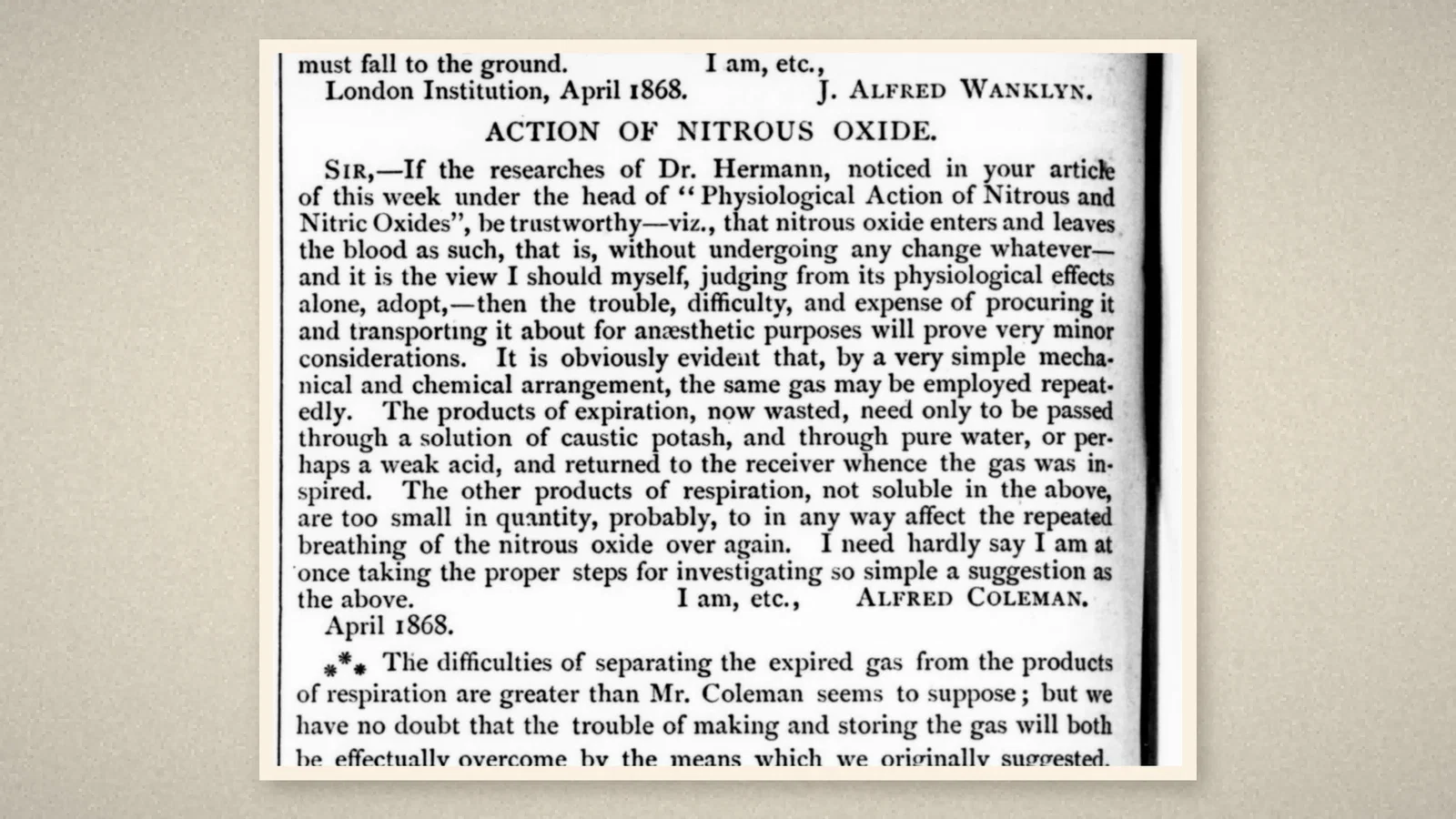
The week before, the journal had noticed two papers in which Dr Hermann concluded, in the journal's summary, that the gas is merely absorbed by the blood and leaves the body unchanged, "pure and simple laughing-gas". On the same page as Paget's remark, Coleman drew the practical conclusion. If Hermann was right, "the same gas may be employed repeatedly. The products of expiration, now wasted, need only to be passed through a solution of caustic potash, and through pure water, or perhaps a weak acid, and returned to the receiver whence the gas was inspired." Coleman added that steps to investigate the suggestion were already under way. The editor was not convinced: "The difficulties of separating the expired gas from the products of respiration are greater than Mr. Coleman seems to suppose." [1]
The first cases
Five weeks later the answer came from someone else. On 30 May the journal printed a letter from G. A. Ibbetson reporting the morning's cases at the Dental Hospital. In the first three, the gas "was administered by Mr. Coleman in rather a novel manner". About a third of the gas usually needed was breathed from a small india-rubber bag, "and an apparatus was so arranged in connection with it that the products of exhalation from the lungs were passed over recently slacked lime, and then reconveyed into the same bag. By this arrangement the gas was inhaled over and over again, the hydrate of lime removing the carbonic acid given off by the lungs." The patients went to sleep as quickly as with gas breathed only once, and one bagful served two patients, "effecting a saving, therefore, of about four-sixths". [2]
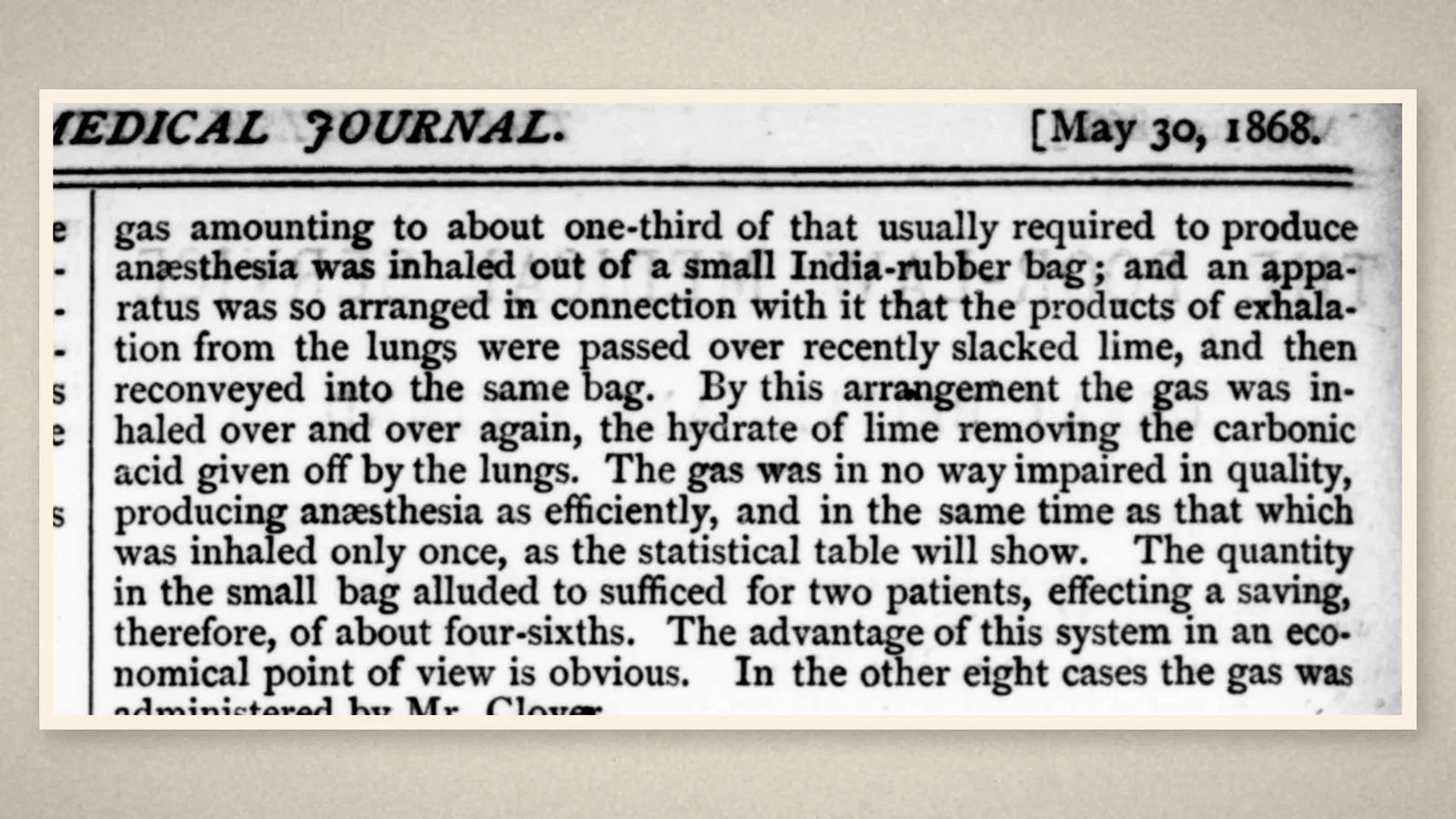
Caustic potash in solution had become solid lime. Lime, partly slaked, takes up both water and carbonic acid, and it could sit in the path of the gas without bubbling it through a liquid.
More than a hundred cases
On 1 August Coleman reported in a letter headed "Re-inhalation of Nitrous Oxide". The gas had now been given this way in more than 100 cases, and "with three exceptions" the result had been as good as breathing the gas once. The saving was "from two-thirds to three-fourths of the quantity of protoxide as ordinarily consumed". The absorbent was "quick lime recently and only partially slacked". The gas passed from a bag or receiver into a small india-rubber bag holding about a gallon; the patient breathed from it, "but the expired gases pass over the lime and enter the bag again by another route". Coleman did not claim that the gas was as pure after its passage over the lime as before, only that it was pure enough to put a second patient to sleep in nearly the same time. [3]
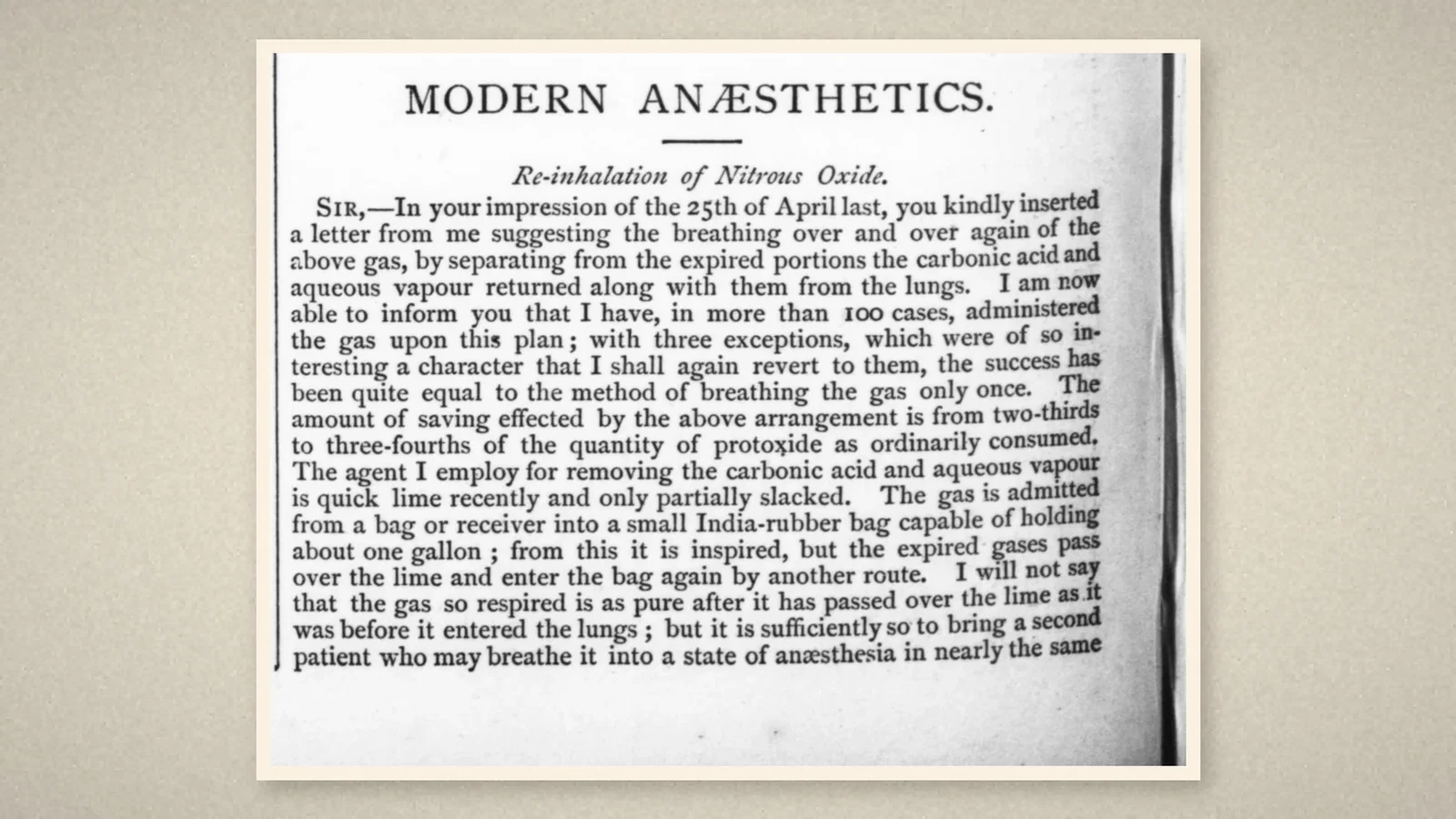
The letter also gave the evidence for the principle. Dr Frankland had analysed expired nitrous oxide for Coleman and found that it was "exhaled undecomposed", and gas already breathed by one person, once freed of carbonic acid and water, would anaesthetise another. Coleman had also tried compressed gas supplied by Mr Barth in iron bottles, each holding fifteen gallons, and found it as effective as gas that had not been compressed. [3]
Three failures and the exhausted lime
The three failures came one after another at the Dental Hospital, after four successes. The first patient, a man of twenty-two, sprang forward after about thirty seconds in a state of wild excitement; a policeman behaved in almost the same way; a third patient was equally unmanageable, but when given the gas in the ordinary way, breathed only once, became unconscious without any excitement. Coleman reasoned that the cause lay in the method, from air, water vapour or carbonic acid mixed with the gas, and was inclined to blame carbonic acid. Then came the finding: "upon examination, that the lime employed had become exhausted, or rather, I should say, completely saturated with water and carbonic acid." [3]
Here, within a few months of the first cases, an exhausted absorbent was identified as the cause of a clinical problem. The sign was excitement in patients breathing nitrous oxide without oxygen, not a reading on a monitor; but the reasoning, that the patient's distress came from carbonic acid getting through a spent absorbent, is the one behind every change of soda lime today.
What the record shows
The idea, the material and the failure all appear within four months. Coleman reasoned from physiology that the anaesthetic was not used up by the body, moved from the liquid absorbent first proposed to partly slaked lime, and found that the absorbent could run out. At the Oxford meeting in August, Coleman's "apparatus for economising nitrous oxide gas by re-inhalation" was exhibited in the Annual Museum, and in November Clover called it "an ingenious apparatus for absorbing the carbonic acid of the expired gas by means of hydrate of lime". [5][6]
Sources and reading limits
Read: in the British Medical Journal of 1868, Coleman's letter of April (25 April, p. 410), with the editor's note and Paget's remark on the same page; Ibbetson's letter (30 May, p. 548); Coleman's letter on re-inhalation (1 August, pp. 114-115); the Oxford Annual Museum report (22 August, p. 196); and Clover's paper (7 November, p. 492). The ASA timeline entry for 1868.
Not covered: Hermann's own papers of 1864 and 1865; any drawing or maker's description of the apparatus; Coxeter's catalogue; any statement by Coleman on giving the method up. The ASA timeline says the apparatus was supplied by Coxeter and Sons and abandoned at some time before 1881; these pages do not show either. The later absorbers in this topic, from the Dräger cartridge onwards, are not covered here. Ibbetson's saving (about four-sixths) and Coleman's (two-thirds to three-fourths) are given as printed. The gas was given without oxygen, and the excitement and other effects are reported, not endorsed.
Three illustrations are crops of the BMJ of 1868; one is drawn from the letters and is not a picture of the apparatus, of which no drawing appears in these pages.
- Coleman A. Action of nitrous oxide [letter]; with editorial note and report on the protoxide of nitrogen as an anaesthetic. Br Med J. 1868;1:410. Internet Archive
- Ibbetson GA. Anaesthetic action of nitrous oxide [letter]. Br Med J. 1868;1:548. Internet Archive
- Coleman A. Modern anaesthetics: re-inhalation of nitrous oxide [letter]. Br Med J. 1868;2:114-5. Internet Archive
- Australian Society of Anaesthetists. Anaesthesia history timeline. 2024. ASA
- British Medical Association, annual meeting at Oxford: the Annual Museum. Br Med J. 1868;2:196. Internet Archive
- Clover JT. On the administration of nitrous oxide. Br Med J. 1868;2:491-2. Internet Archive
Continue exploring
Related reading connects shared questions and contexts; it does not by itself establish historical influence.
- 1868: Clover Gives Nitrous Oxide Through a Sheet-Lead Face-Piece
- 1868: Andrews Adds Oxygen to Nitrous Oxide
Anesthesia Epochs · The Source Room · About & Editorial Method
Published November 2, 2026. Sources and reading limits are stated above. Illustrations are labelled as original source images or AI-made. Historical accounts are educational; they are not current treatment instructions.