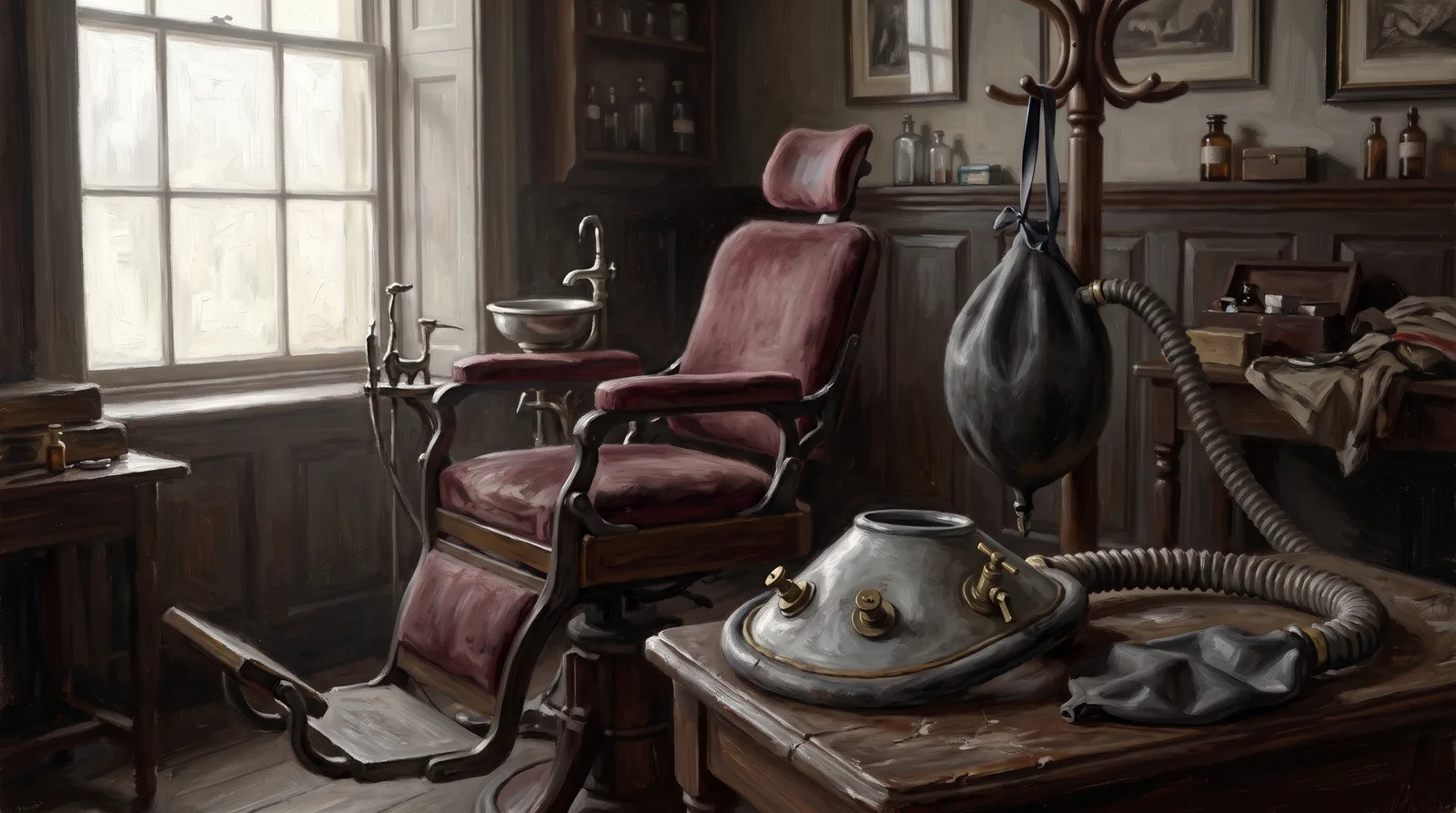
Clover's nitrous oxide apparatus had a sheet-lead face-piece moulded air-tight over nose and mouth, two valves against rebreathing and a bag hung at the side.
Reading Library · Anesthesia Epochs · 中文版
Watch the education video (for clinicians)
1868: Clover's Nitrous Oxide Face-Piece — The Seal and the Leak · Anesthesia Epochs Education Series
Nitrous oxide came back into British practice in 1868, and one of the people who made it work reliably was Joseph Thomas Clover. The History of Anaesthesia Society timeline records that Clover presented a paper "On the Administration of Nitrous Oxide" at the British Medical Association meeting in Oxford in August 1868, and that Coxeter and Son soon began to sell an apparatus with a cylinder of gas, a reservoir bag and a Clover face mask. This article reads the meeting reports in the British Medical Journal and Clover's full paper, printed in November with a woodcut. Its main interest for anaesthetists is a problem that has never gone away: how to make a face mask seal. [1][2][3]
The Oxford meeting
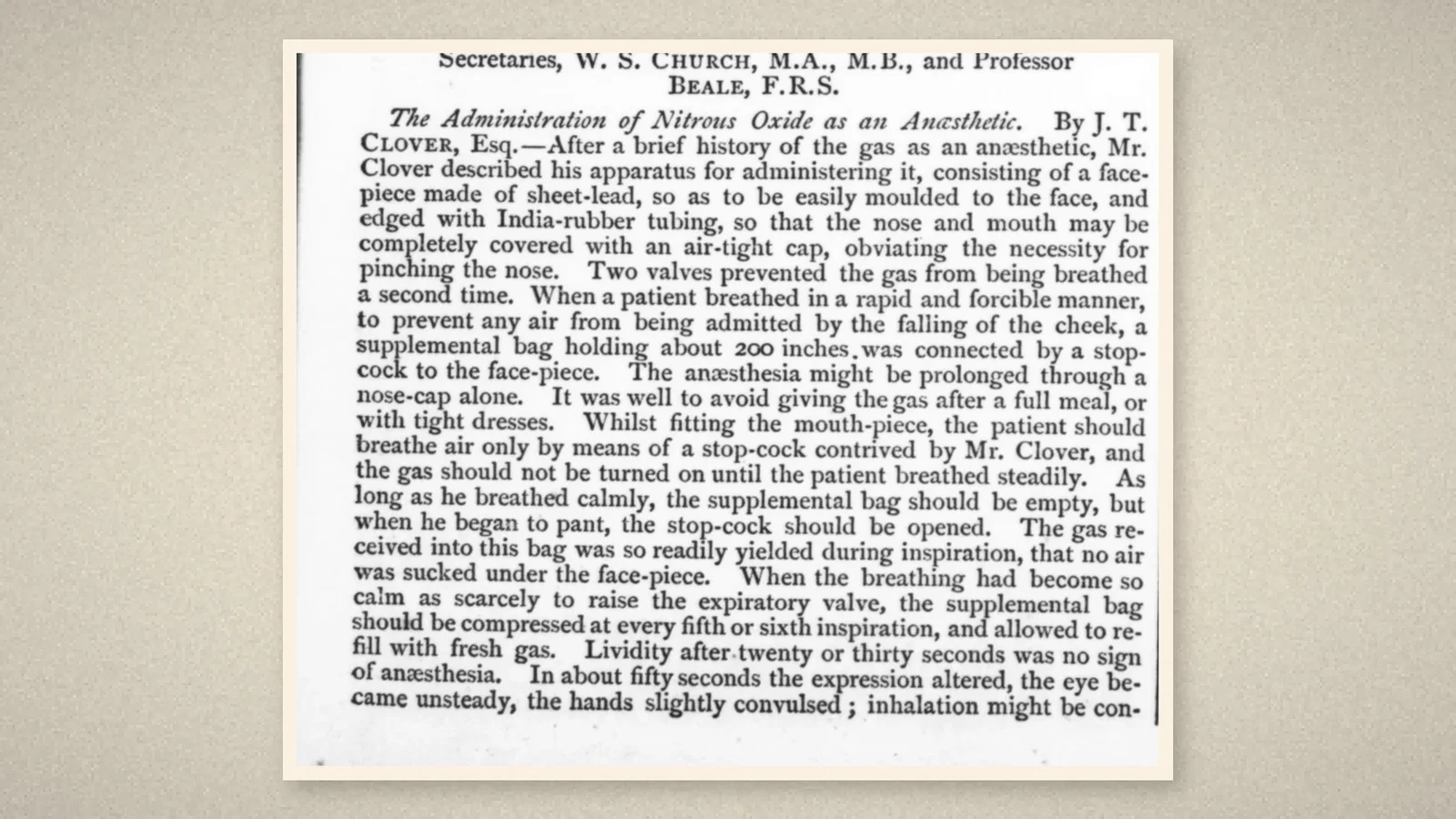
The Association met at Oxford on 4-7 August 1868. The BMJ of 22 August reported Clover's paper among those of the Section of Physiology: after "a brief history of the gas as an anaesthetic", Clover went on to describe the apparatus for giving it. The same report records that at the end of the session the dentist Mr Fox offered to take the gas so that members who had never seen it could watch, and Clover gave it then and there; and that on Wednesday 5 and Thursday 6 August, nitrogen was given by Dr Murray and nitrous oxide by Mr Clover at the Radcliffe Infirmary "in the presence of many members of the Association". [1]
In the same issue, the report of the meeting's Annual Museum notes that Mr Coxeter exhibited "a Clover's apparatus for inhaling chloroform and nitrous oxide gas", and that Mr Coleman showed "an apparatus for economising nitrous oxide gas by re-inhalation". [1]
Why the earlier method failed
The full paper, "On the administration of nitrous oxide" by J. T. Clover, FRCS, appeared in the BMJ of 7 November 1868. It begins with the history: the suggestion of Sir Humphry Davy; Colton's administration of the gas to the dentist Horace Wells in 1844; the revival of the practice by Colton some five years before; and the demonstrations given in March of that year at the Dental Hospital in London by Dr Evans of Paris. Evans used a large india-rubber bag and tube, joined to a wooden pipe with valves; the patient pressed the lips against the pipe while an assistant closed the nostrils. Most cases succeeded, but some patients struggled or seemed to feel the operation, and Clover put these partial failures down to two causes: the supply tube had collapsed, or air had been sucked in by accident. [2]
The apparatus
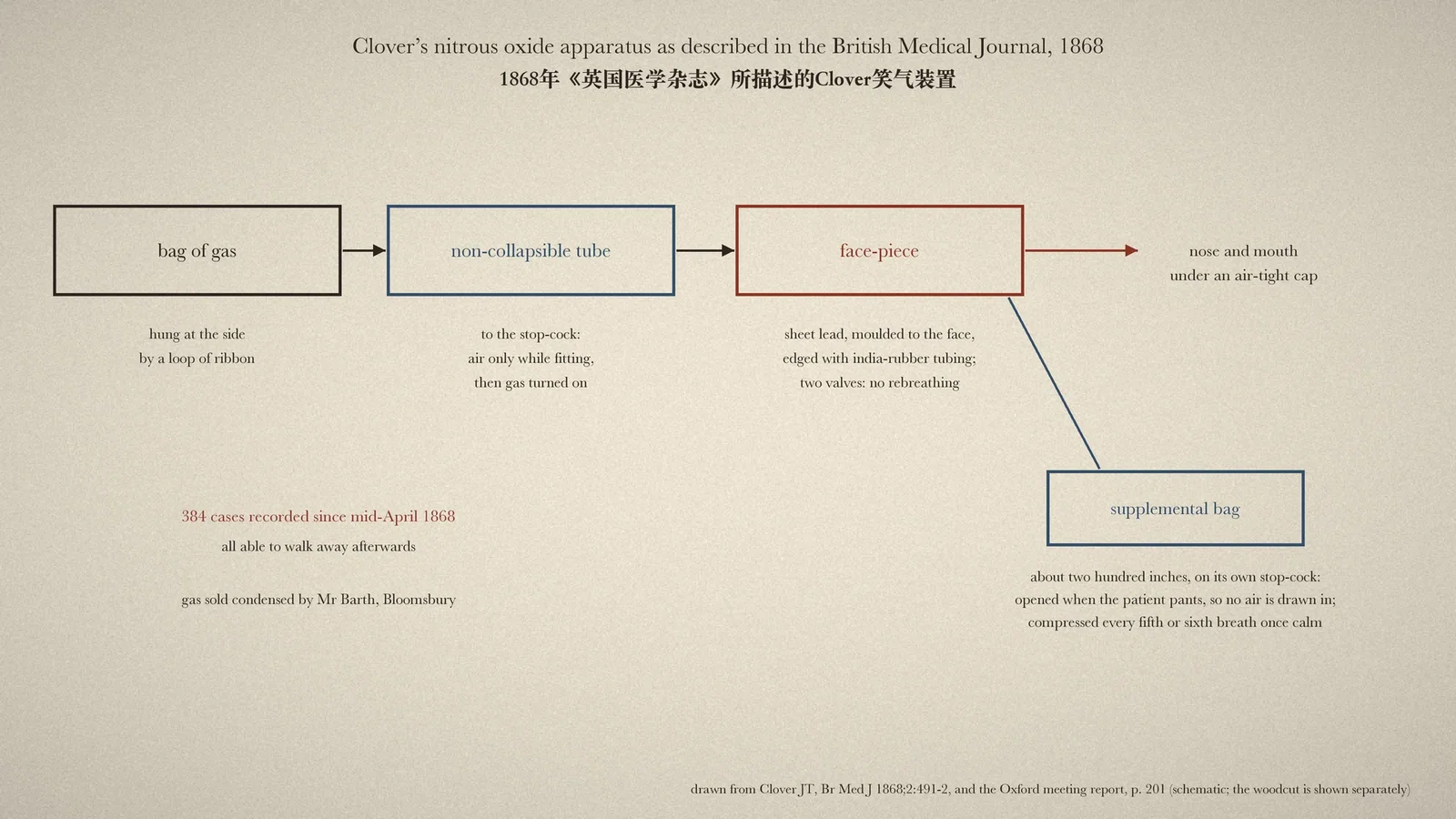
Clover's answer was "the following modification of an instrument which I have used for the last seven years, for giving four per cent. of the vapour of chloroform", that is, the chloroform bag described in 1862 (see that article). The bag was filled with nitrous oxide and hung at the administrator's side "by means of a loop of ribbon". A non-collapsible tube led to a face-piece "made of sheet lead, so as to be easily moulded to the face, and edged with India-rubber tubing, so that nose and mouth may be covered with an air-tight cap"; two valves prevented the gas from being breathed a second time. This did away with pinching the nose. [2]
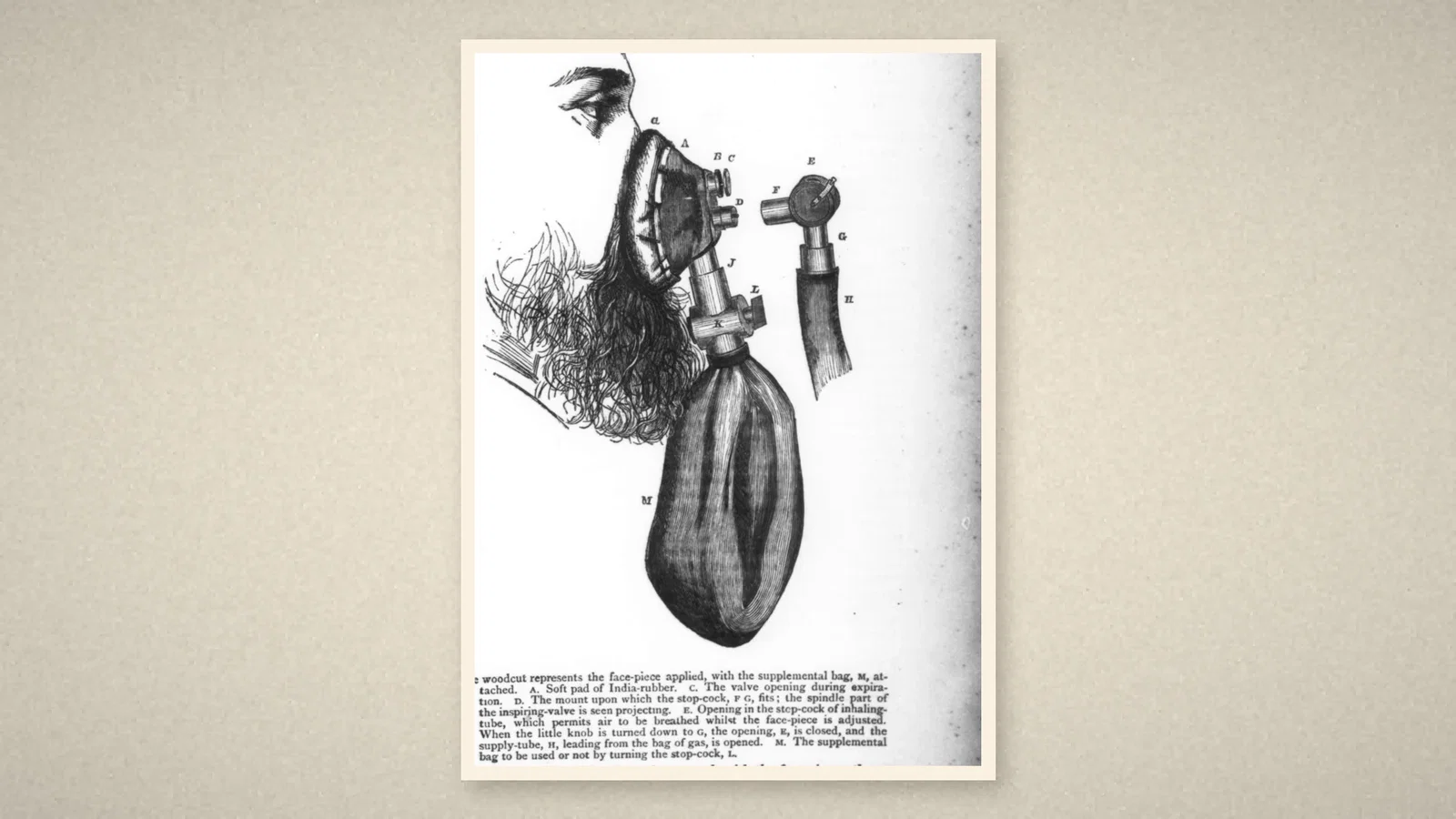
The woodcut shows the face-piece applied to a bearded face, the valves, a stop-cock on the face-piece and, hanging below, a second bag. Clover explains why that bag was needed. Even with a moulded mask, a patient breathing rapidly and forcibly could still draw in a little air "through the beard, or by the cheek falling in". To prevent this Clover added "a supplemental bag, holding about two hundred inches", joined to the face-piece by a three-quarter-inch tube and its own stop-cock. The stop-cock on the inhaling tube had an opening that let the patient breathe air while the face-piece was being fitted; turning the knob closed it and opened the supply from the bag of gas. [2]
How it was used
The patient breathed air first, and the gas was not turned on until breathing was steady. While breathing was calm the supplemental bag was kept empty; when the patient began to pant, its stop-cock was opened, and the gas in it was "so readily yielded during inspiration" that no air was drawn in under the face-piece. Once breathing was quiet, the supplemental bag was squeezed every fifth or sixth breath and allowed to refill with fresh gas, which kept the gas "sufficiently free from carbonic acid". Clover mentioned that Mr Coleman had "invented an ingenious apparatus for absorbing the carbonic acid of the expired gas by means of hydrate of lime", and conceded that it removed a great objection to breathing in and out of a simple bag. [2]
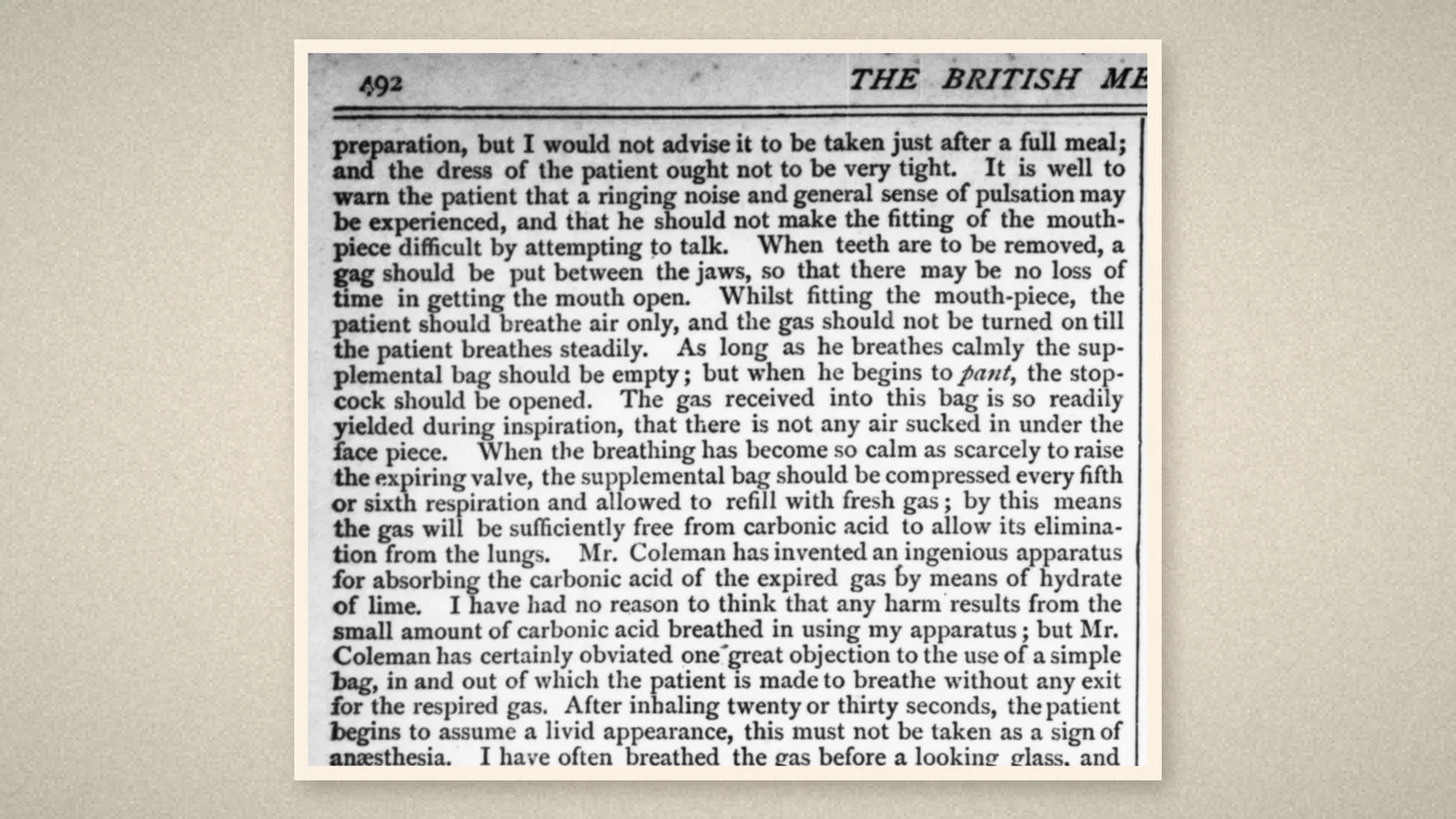
The signs were those of a gas given without oxygen. Lividity after twenty or thirty seconds was "no sign of anaesthesia"; at about fifty seconds the expression changed, the eye became unsteady and the hands twitched slightly, and Clover usually went on for ten or fifteen seconds more unless breathing slowed or stopped or the pulse became quick or unsteady; sudden dilatation of the pupil meant removing the gas at once. Since the middle of April Clover had recorded 384 cases, mostly dental extractions; in all of them there had been lividity, and in all the patient had walked away without help. For operations of ten or fifteen minutes Clover still preferred chloroform. The gas could be bought "in a condensed form" from Mr Barth of Duke Street, Bloomsbury. [2]
What the record shows
The 1868 paper is about the seal. Clover identified the two leaks that defeated nitrous oxide, a collapsing supply tube and air drawn in around the mask, and dealt with each: a tube that could not collapse, a mask that could be moulded to the individual face and cushioned with rubber, and a reserve bag to meet the peak of a panting breath. Anyone who has held a face mask on a bearded patient will recognise the problem in the woodcut.
The account also shows what the method cost. The gas was given without added oxygen, and the signs Clover relied on, lividity, twitching and brief apnoea, would not be accepted today.
Sources and reading limits
Read: Clover's paper in the British Medical Journal of 7 November 1868, pp. 491-492, with its woodcut; the reports of the Oxford meeting in the issue of 22 August 1868, the Section of Physiology (p. 201) and the Annual Museum (p. 196); the History of Anaesthesia Society timeline entry for August 1868.
Not covered: Coxeter and Son's catalogues or advertisements as evidence for the "marketing" in the timeline; Clover's later apparatus; Coleman's own paper; the accounts of Colton and Evans. The 1868 paper says only that the gas was sold condensed, and the article does not describe a cylinder. The meeting report gives 387 cases and places the paper in the Section of Physiology, while the printed paper gives 384 cases and a footnote says it was read in the Medical Section; both are given as printed. The day on which the paper was read is not stated. The clinical signs are reported as Clover reported them, not as acceptable practice.
Three illustrations are crops of the BMJ of 1868, including its woodcut; one is drawn from Clover's description.
- British Medical Association, annual meeting at Oxford: Section of Physiology; the Annual Museum. Br Med J. 1868;2:196, 201. Internet Archive
- Clover JT. On the administration of nitrous oxide. Br Med J. 1868;2:491-2. Internet Archive
- History of Anaesthesia Society. Timeline. HAS
Continue exploring
Related reading connects shared questions and contexts; it does not by itself establish historical influence.
- 1862: Clover Bags Chloroform at Four and a Half Per Cent
- 1863: Colton Takes Nitrous Oxide from Exhibition to Dentistry
- 1868: Andrews Adds Oxygen to Nitrous Oxide
Anesthesia Epochs · The Source Room · About & Editorial Method
Published November 2, 2026. Sources and reading limits are stated above. Illustrations are labelled as original source images or AI-made. Historical accounts are educational; they are not current treatment instructions.