In 1863 Colton revived nitrous oxide for tooth extraction in New Haven and opened a dental service in New York; Colton's own accounts of its scale disagree.
Reading Library · Anesthesia Epochs · 中文版
Watch the education video (for clinicians)
1863: Colton's Dental Revival of Nitrous Oxide · Anesthesia Epochs Education Series
An original historical imagining of a nineteenth-century dental room. The empty chair and doorway suggest a move into regular practice; they do not reconstruct Colton’s rooms, patients or equipment.
The article ended with an address.
In a piece reprinted in the January 1864 Dental Register, G. Q. Colton invited surgeons, physicians and dentists to visit the Colton Dental Association at 22 Bond Street, New York, and watch its operations. Readers were offered somewhere to go and see the claims demonstrated. [1, p. 39]
Colton also described referrals and skeptical dentists becoming favorable after observing the work. This was a promoter’s account of how a service attracted professional attention, not an independently verified survey of adoption throughout New York. Even with that limit, the invitation captures a change in setting: from a gas exhibition to a place that received patients and visiting practitioners. [1, pp. 38–39]
New Haven, remembered twice
The near-contemporary account placed Colton’s revival of the gas in New Haven in “May last.” Colton arranged for Dr. Smith to extract teeth, then went to New York and established the Colton Dental Association. Gas administration, extraction and a continuing service were becoming parts of the same undertaking. [1, p. 38]
Colton's 1886 pamphlet supplied a fuller scene and a different month. Colton recalled a private gathering before an exhibition in June 1863. Dr. J. H. Smith agreed to try dental extraction if Colton would administer the gas. In this version, an elderly woman had seven teeth removed, expressed satisfaction on recovering, and allowed Colton to tell the audience the patient's name and experience. [2, p. 9]
That detail shows how a reported patient response could become publicity. It reaches us through the participant’s much later recollection. No contemporary case book or independent statement from the woman was examined for this article. The patient's identity, conversation and surroundings must remain outside what the narrative or illustrations can supply.
Modern cards naming New Haven and New York mark the movement described in the accounts. They are not an original advertisement, a map or a dated travel record.
The teeth do not add up
Both texts describe three weeks and two days. The 1864 reprint claims more than eight thousand teeth were extracted in that period. The 1886 pamphlet instead says a little over three thousand. [1, p. 38; 2, p. 9]
There is no basis here for silently choosing one total or correcting the other. Neither total can be turned into a patient count: one patient could have several teeth removed. Without the underlying case records, the figures show how Colton represented the scale of the undertaking. They do not yield an audited denominator, a success rate or a comparative safety result.
The calendar requires similar restraint. “May last” in the January 1864 reprint and “June, 1863” in the later pamphlet remain different statements. This article uses 1863 at year precision. Publication dates are given separately, and no precise opening day or month is invented.
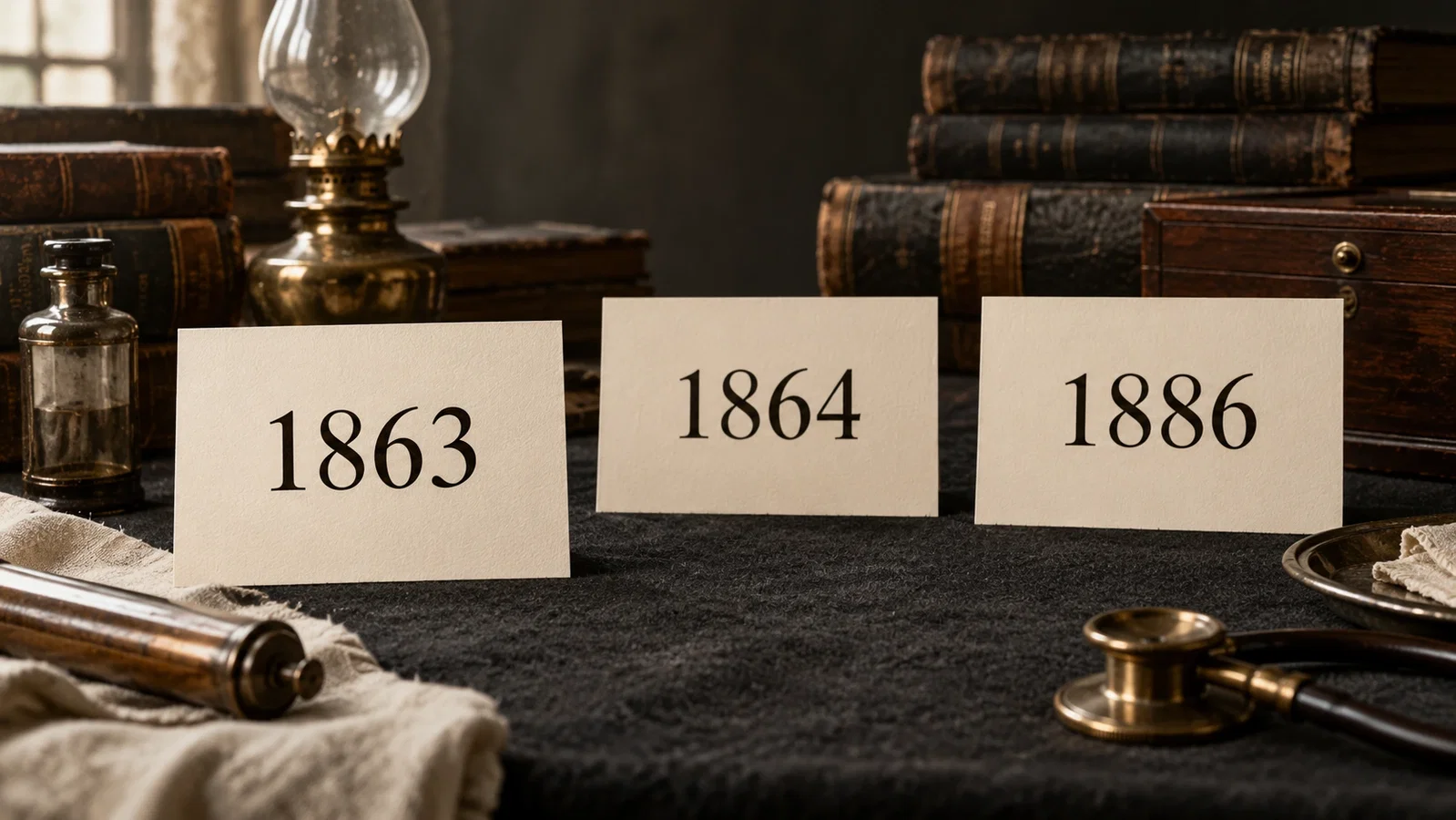
The event year, 1863, beside the publication years 1864 and 1886. These modern editorial cards do not represent three independent clinical investigations.
What a signature could show
In 1886 Colton claimed to have administered the gas to over 150,000 patients without a death. Colton said that the office held each patient’s autograph signature, numbered in sequence. The following page reproduced a professional testimonial dated November 1876, whose signatories described having experienced or witnessed the effects. [2, pp. 10–11]
Numbers, signatures and professional endorsement were resources for persuasion. What was examined here was the printed claim and testimonial, not the original register or signed sheet. The later total cannot be assigned to 1863, and the claimed absence of deaths cannot become an independently audited risk estimate.
The earlier article also complicates an entirely comfortable picture. Alongside sweeping assurances, Colton acknowledged nausea in a few cases involving several teeth and repeated administrations, attributing it to swallowed blood. That qualification belongs in the account even though the author minimized its significance. [1, p. 38]

An open blank ledger and a dip pen, created for this essay. There are no invented names, numbers or signatures; it is not Colton’s actual patient register.
Persuasion and explanation were different achievements
Colton’s physiological explanation was part of Colton's confidence. The 1864 article described a more highly oxygenated state of the blood; the 1886 pamphlet again treated the gas as supplying additional oxygen. These are historical arguments attributed to their author, not explanations adopted by this article. [1, p. 39; 2, p. 14]
A specific comparison is available in Andrews’s 1868 opening page. Andrews distinguished oxygen chemically combined in nitrous oxide from free oxygen available for blood oxygenation. Andrews discussed adding free oxygen while acknowledging that the investigation remained unfinished. [3, p. 656]
The comparison identifies different explanations in two sources. It does not establish that Andrews wrote the paper as a direct response to Colton, and the oxygen mixture is covered in a separate article. Organizing a service and persuading colleagues could matter historically even when the associated physiological and safety arguments were unsound or unverified.
The lasting scene here is a dental service with an address, visitors and claimed referrals. It does not require a verdict that nitrous oxide had disappeared everywhere for fifteen years, or that one individual alone restored it. Reading the participant’s accounts together preserves both the practical undertaking and the limits of the story Colton told about it.
Sources and reading limits
[1] G. Q. Colton. The New (or Old) Anæsthetic. The Dental Register. 1864 Jan;18(1):36–39. Four original scanned pages and bibliographic record. Page 39 credits the Medical and Surgical Reporter; that earlier printing is not covered.
[2] G. Q. Colton. Anaesthesia: Who Made and Developed This Great Discovery? A Statement. New York: A. G. Sherwood & Co.; 1886. Yale original-edition scan. Title page and pp. 9–11, 14–15. Two accounts by Colton are not independent corroboration.
[3] E. Andrews. The Oxygen Mixture, a New Anæsthetic Combination. Chicago Medical Examiner. 1868 Nov;9(11):656–661. Original scans. Page 656.
Not covered: the original case books, patient register and signatures. Month and tooth-total discrepancies remain unresolved. No global-priority, complete-adoption or modern safety verdict is offered. Four original interpretive illustrations accompany this article.
Continue exploring
Related reading connects shared questions and contexts; it does not by itself establish historical influence.
Anesthesia Epochs · The Source Room · About & Editorial Method
Updated October 30, 2026. Sources and reading limits are stated above. Illustrations are labelled as original source images or AI-made. Historical accounts are educational; they are not current treatment instructions.