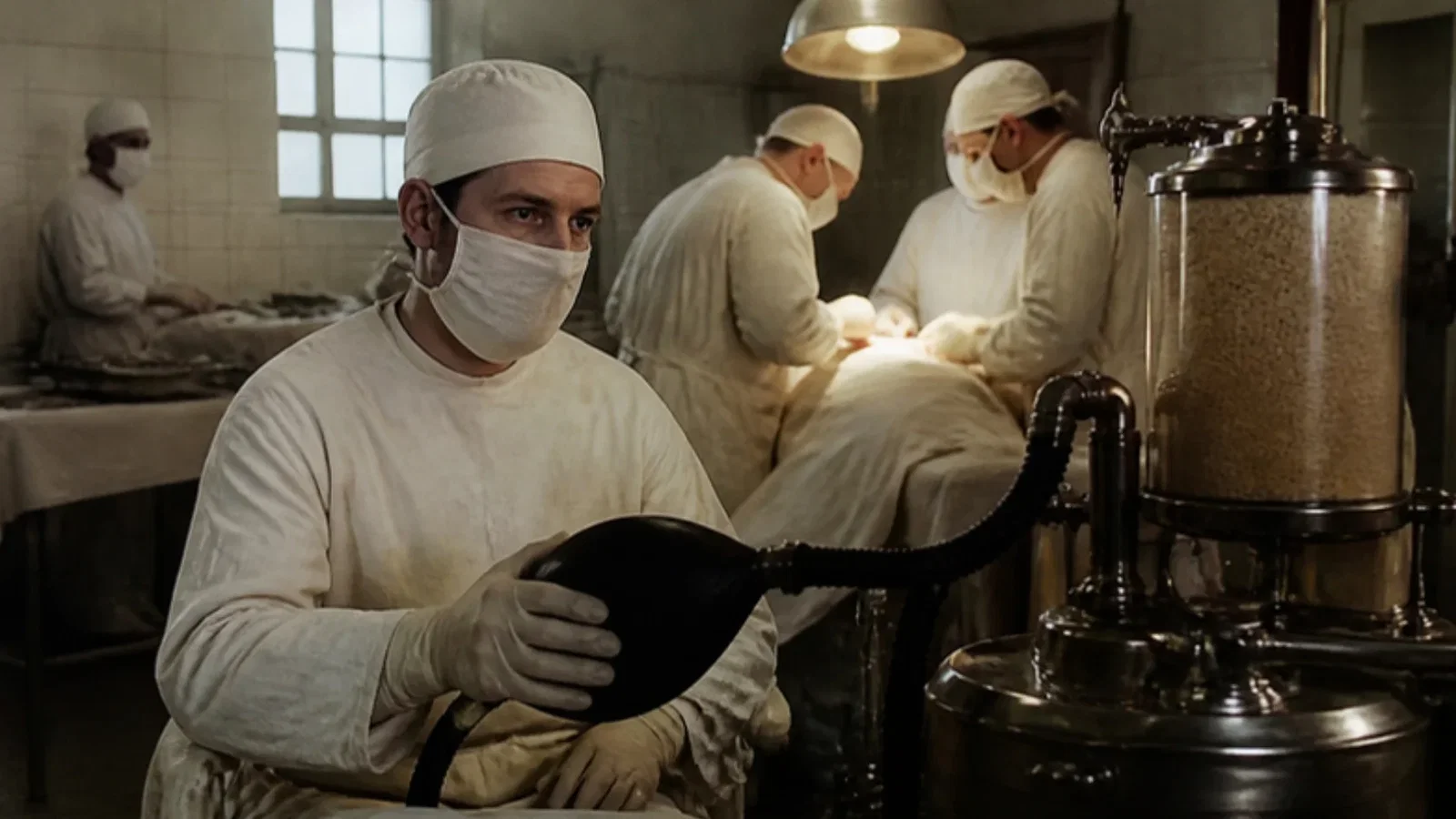
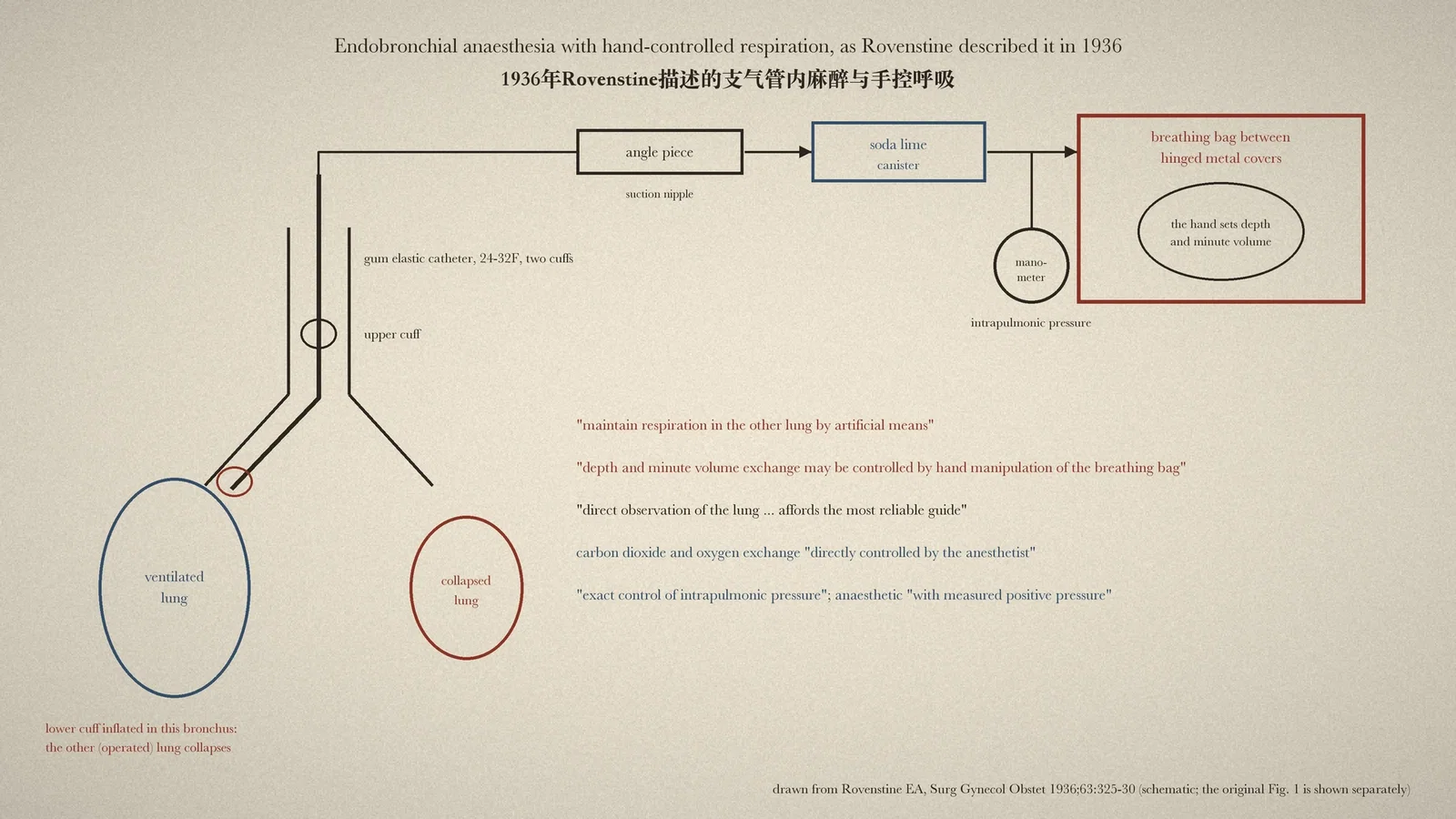
In September 1936 E. A. Rovenstine of New York University and Bellevue described endotracheal and endobronchial anaesthesia for intrathoracic surgery: a tube with a Waters-Guedel cuff connected to a soda lime canister and bag; with one lung collapsed, respiration in the other was maintained 'by artificial means', 'the depth and minute volume exchange may be controlled by hand manipulation of the breathing bag', with a bag between hinged metal covers and a manometer for intrapulmonic pressure.
Reading Library · Anesthesia Epochs · 中文版
Watch the education video (for clinicians)
1936: Rovenstine — One-Lung Anaesthesia by Hand · Anesthesia Epochs Education Series
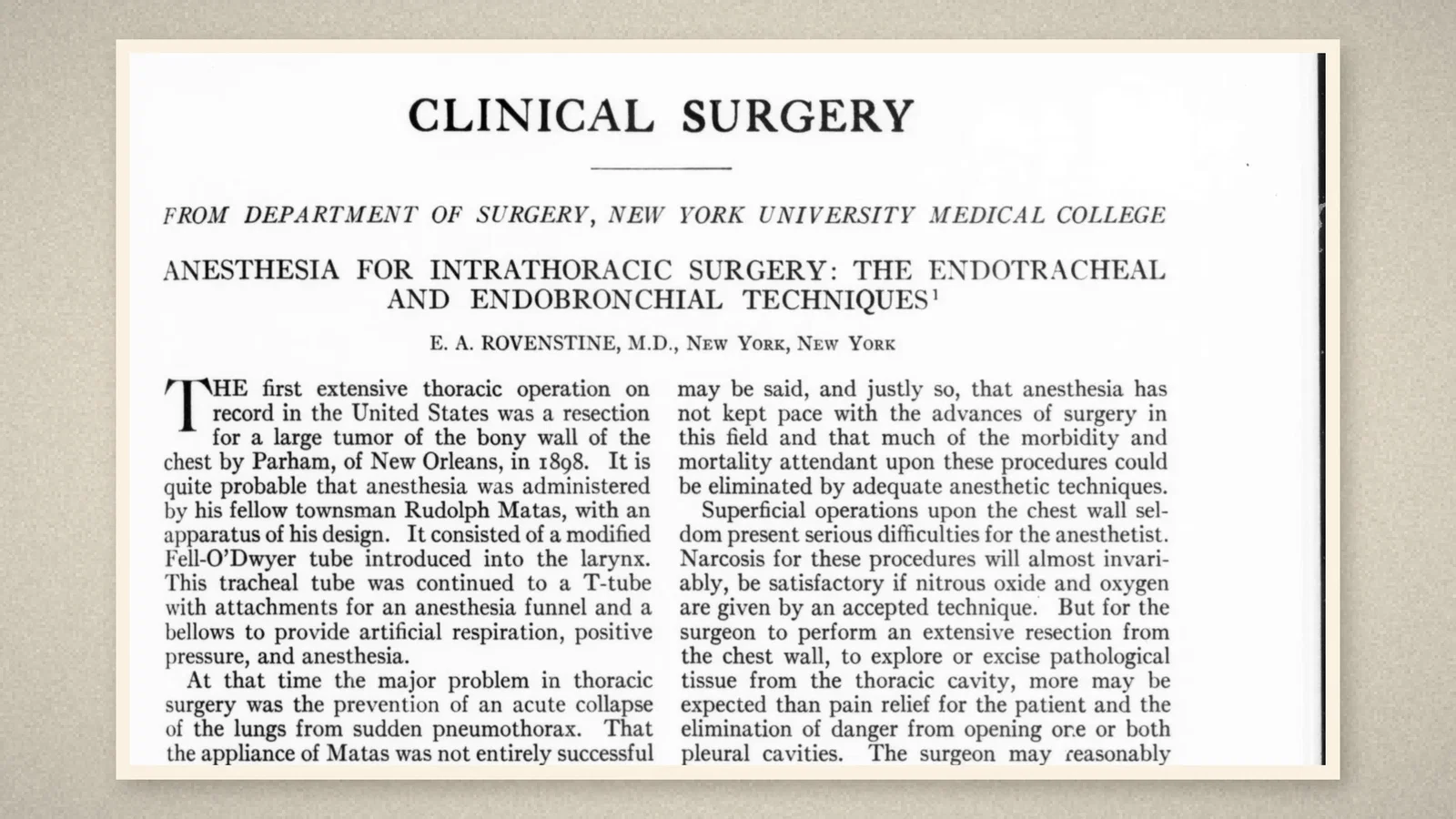
Before muscle relaxants and ventilators, opening the chest was dangerous because the lung collapsed and breathing became chaotic. The answer that thoracic anaesthesia adopted was to take over the patient's breathing: a sealed airway, a closed circuit and the anaesthetist's hand on the bag. The Australian Society of Anaesthetists (ASA) timeline records that in 1935 "controlled respiration" was introduced into Australia by Gilbert Troup of Perth after visiting Ralph Waters in Madison, and that Waters coined the term in 1936. This article reads a paper from the same year in which E. A. Rovenstine of New York University and Bellevue Hospital set out the method for chest surgery, published in Surgery, Gynecology and Obstetrics in September 1936. [1][2]
The problem of the open chest
Rovenstine began with history. The first extensive thoracic operation on record in the United States, a resection of a tumour of the chest wall by Parham of New Orleans in 1898, was probably anaesthetized by Rudolph Matas with an apparatus of Matas's own design, a modified Fell-O'Dwyer tube in the larynx continued to a T-tube with attachments for an anaesthesia funnel and "a bellows to provide artificial respiration, positive pressure, and anesthesia". The great problem then was "the prevention of an acute collapse of the lungs from sudden pneumothorax". Negative pressure chambers "large enough to contain the operating team and the patient's body" were built, then small positive pressure cabinets for the head, and finally positive pressure through airways or a tight mask. Even so, Rovenstine judged that anaesthesia "has not kept pace with the advances of surgery in this field". [1]
The surgeon, Rovenstine wrote, may reasonably demand "minimum respiratory movements, even prolonged apnea if desired", sufficient oxygenation with reduced minute volume, removal of blood and secretions from either bronchus while positive pressure is maintained, the ability "to deflate and reinflate either lung at the surgeon's direction and to maintain artificial respiration as required", and minimal physiological disturbance. [1]
The equipment
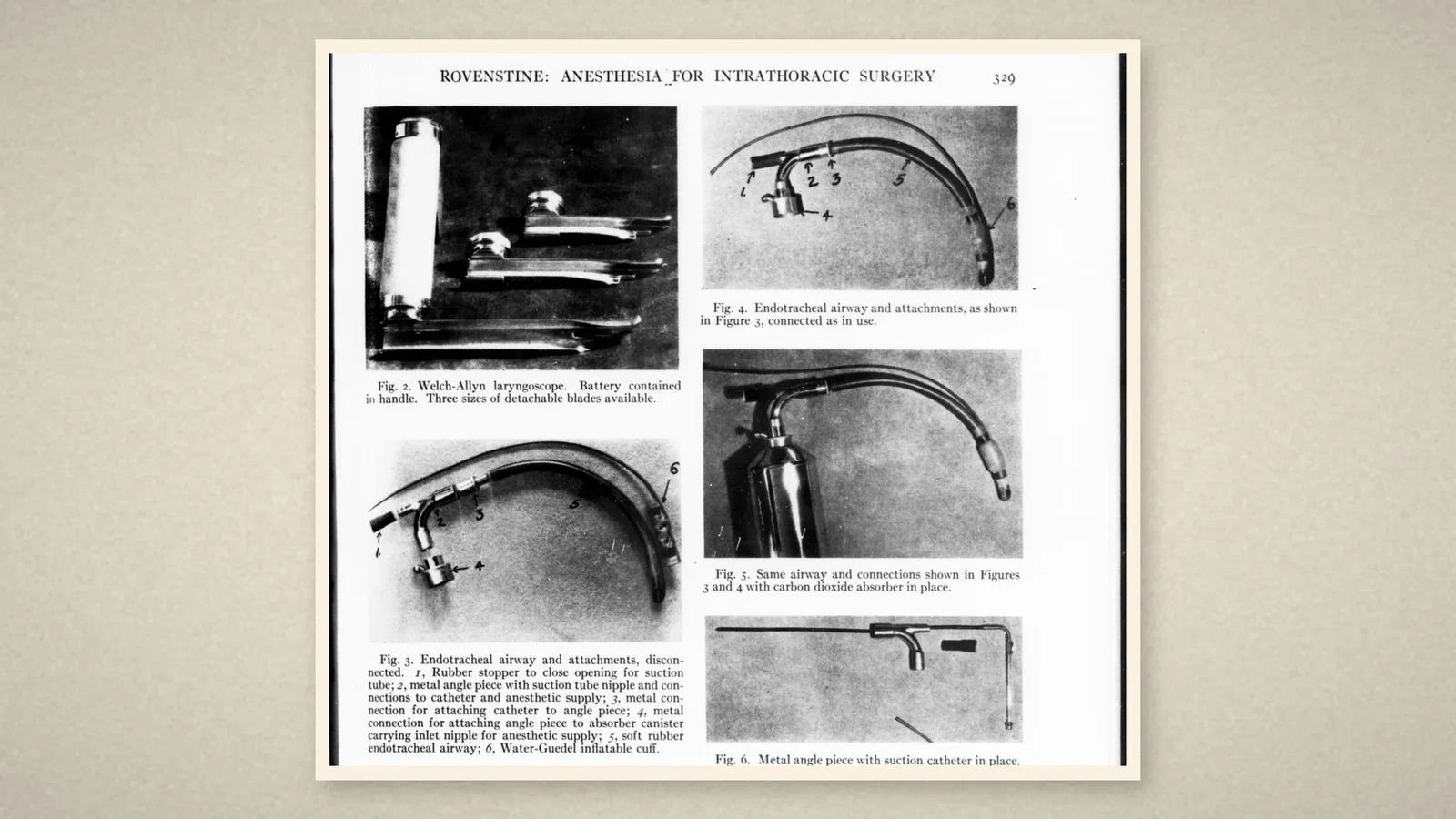
Endotracheal airways of No. 24 to 34F were cut from soft rubber tubing, the kind "revived by Magill after the war", with "a Waters-Guedel inflatable cuff" near the tracheal end. A metal angle piece connected the tube to the breathing bag or carbon dioxide absorber and carried a nipple for a suction catheter, so that "suction of foreign matter from the trachea or bronchi may be accomplished while differential pressure is still maintained". With a battery laryngoscope, the soda lime canister and breathing bag of the closed absorption technique, and a gas machine with fine flow control, that was the whole kit. For the endobronchial technique the airway was a gum elastic catheter of 24 to 32F, about 14 inches long, with two cuffs about two inches apart. [1]
Breathing by hand
After intubation through the mouth under direct vision, the catheter was advanced 12 to 15 centimetres beyond the cords until it entered the chosen bronchus. "Whenever the lung on the side of the operation is to be collapsed, the lower cuff on the airway is inflated and the upper deflated." Then came the key instruction: "With one lung atelectatic, it is well to maintain respiration in the other lung by artificial means. The depth and minute volume exchange may be controlled by hand manipulation of the breathing bag." Rovenstine recommended a breathing bag "cemented between metal covers", hinged so that one could be raised and lowered by hand, and a manometer on the closed system to measure intrapulmonic pressure; but once the chest was open, "direct observation of the lung ... affords the most reliable guide". [1]
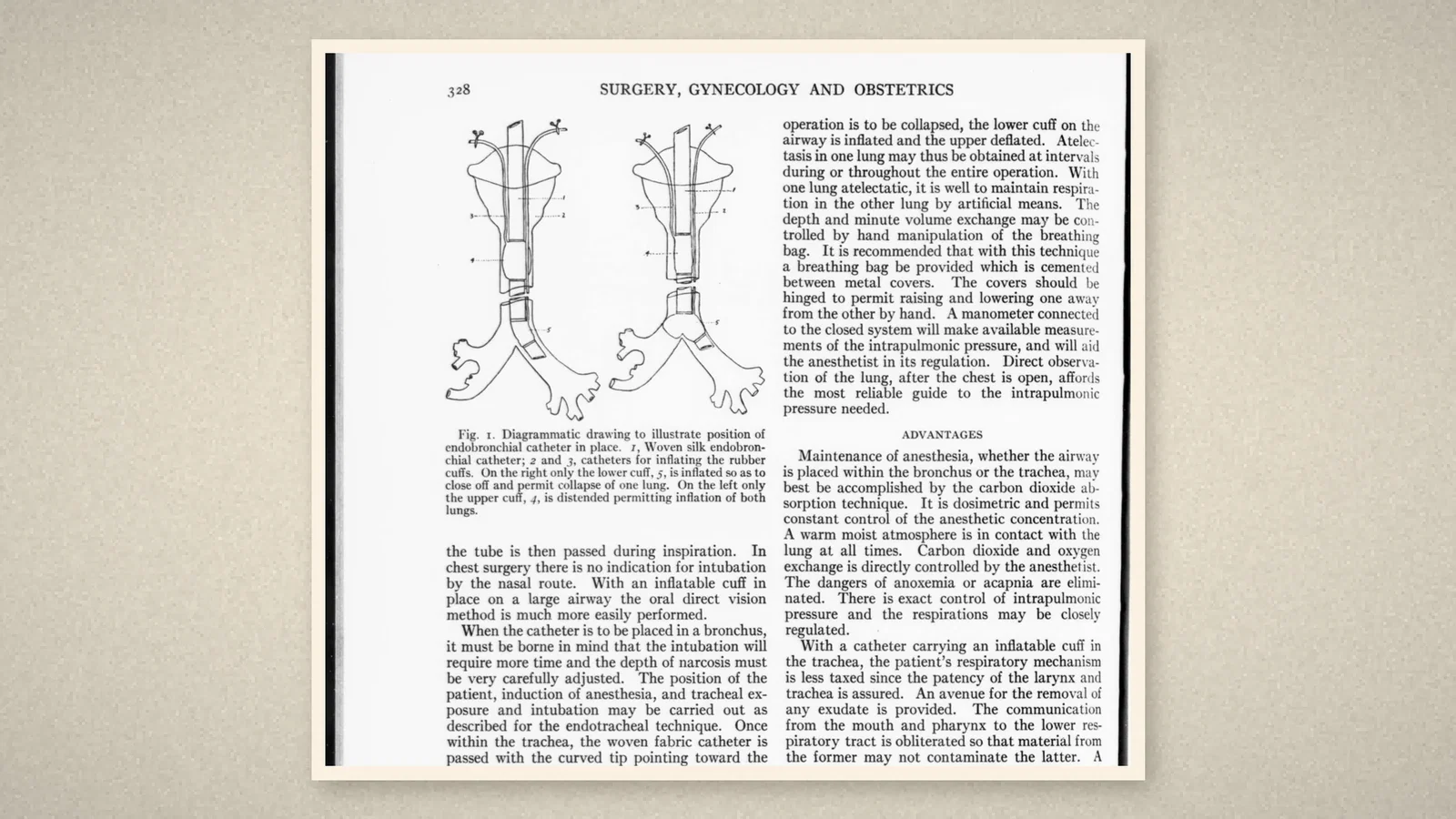
The advantages were listed plainly. The carbon dioxide absorption technique was "dosimetric"; "carbon dioxide and oxygen exchange is directly controlled by the anesthetist"; "there is exact control of intrapulmonic pressure and the respirations may be closely regulated"; and the anaesthetic "may be delivered with measured positive pressure". With one lung isolated, "paroxysmal, paradoxical, or violent respirations are eliminated", the mediastinum stays in place, and the surgeon can work undisturbed by the other lung. Rovenstine was cautious about the endobronchial method itself, saying the results so far were "insufficient to allow definite conclusions", and preferred the endotracheal technique for most cases. [1]
What the record shows
These six pages show controlled respiration arriving in the operating theatre as a manual skill: a cuffed tube to seal the airway, a closed circuit with absorber, a bag whose stroke the anaesthetist sets, a pressure gauge, and the lung itself as the monitor. One-lung ventilation, suction through a sealed connector and pressure monitoring of the circuit all appear here. Mechanical ventilators would later take over the hand's work, but the principles of tidal volume, rate and airway pressure set by the anaesthetist were already on the page.
Sources and reading limits
Read: Rovenstine EA, Surg Gynecol Obstet 1936;63:325-30, in full; the ASA timeline entries for 1935 and 1936.
Not covered: Waters's writings in which "controlled respiration" is said to have been named; Guedel and Treweek on ether apnoea (1934); Gale and Waters on closed endobronchial anaesthesia; Troup's Australian reports; later work by Crafoord and Nosworthy. Rovenstine does not use the phrase "controlled respiration"; the term and the dates for Waters and Troup are the ASA's. Premedication doses are not repeated.
Three illustrations are crops of the September 1936 issue, including Figs. 1-6; one is drawn from the text.
- Rovenstine EA. Anesthesia for intrathoracic surgery: the endotracheal and endobronchial techniques. Surg Gynecol Obstet. 1936;63:325-30. Internet Archive
- Australian Society of Anaesthetists. Anaesthesia history timeline. 2024. ASA
Continue exploring
Related reading connects shared questions and contexts; it does not by itself establish historical influence.
Anesthesia Epochs · The Source Room · About & Editorial Method
Published November 2, 2026. Sources and reading limits are stated above. Illustrations are labelled as original source images or AI-made. Historical accounts are educational; they are not current treatment instructions.