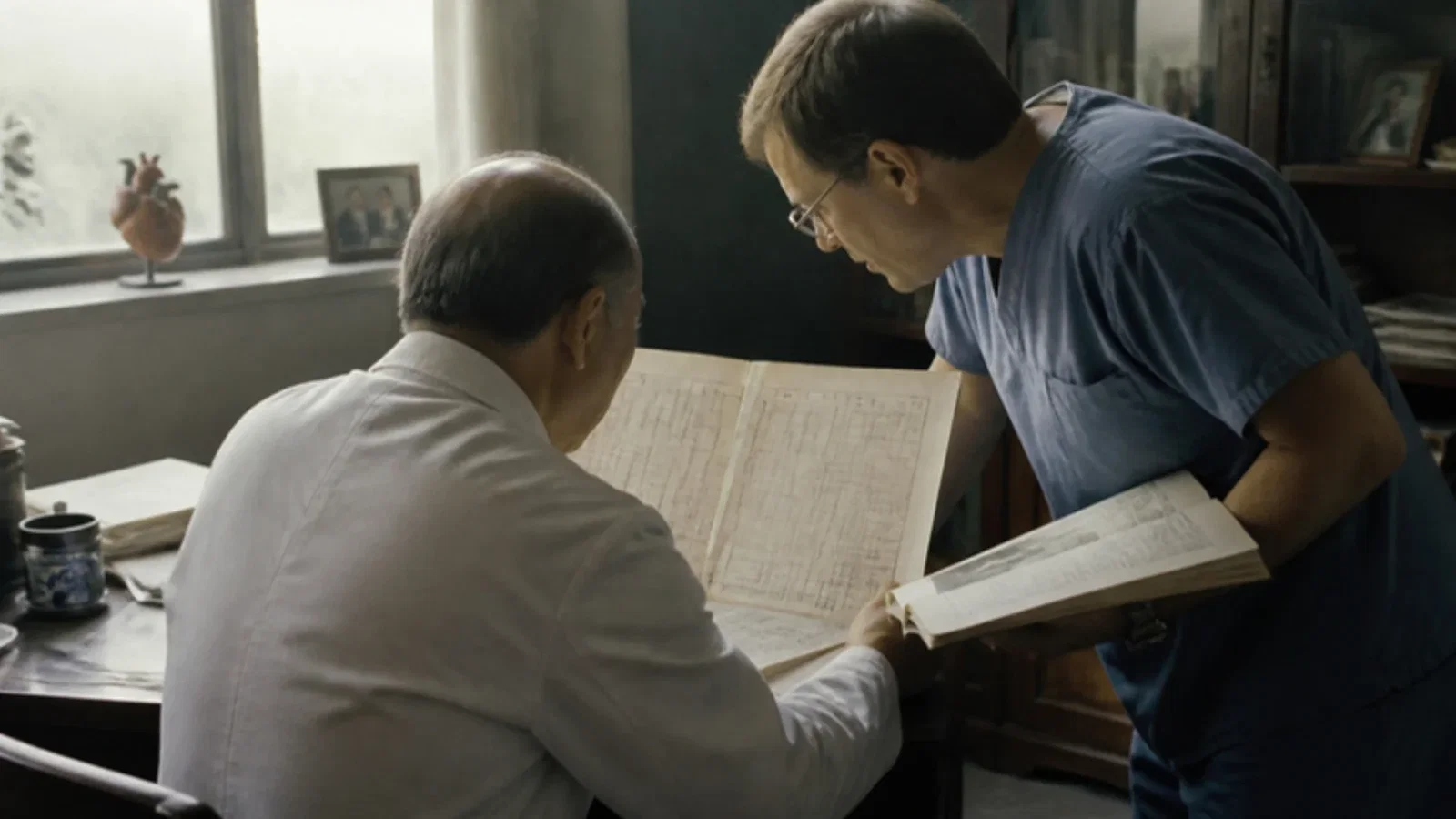
In the Fall 2008 CSA Bulletin, Merlin D. Larson described visiting Jone J. Wu (Wu Jue) at Zhongshan Hospital, Shanghai, in 2001. Wu, trained under Ralph Waters in Madison, showed the depth-of-anaesthesia chart in the 1959 edition of Wu's Chinese textbook Clinical Anesthesia. Larson found that it was not Guedel's chart but Noel A. Gillespie's modification published in Anesthesia and Analgesia in 1943, which deleted two pupil columns and added nine reflexes; Patrick Sim of the Wood Library confirmed that the Chinese chart was redrawn with only minor differences. Wu said that Western sources could not be credited at the time. In letters to Guedel, Gillespie argued that the reflexes, not the respiratory signs, were what mattered, and proposed calling the chart 'Guedel-Gillespie'; on 21 August 1941 Guedel replied that Gillespie's chart was better than Guedel's own and should bear Gillespie's name. Later textbooks reproduced Gillespie's chart but credited Guedel.
Reading Library · Anesthesia Epochs · 中文版
Watch the education video (for clinicians)
1943: Gillespie's Revision of Guedel's Chart · Anesthesia Epochs Education Series
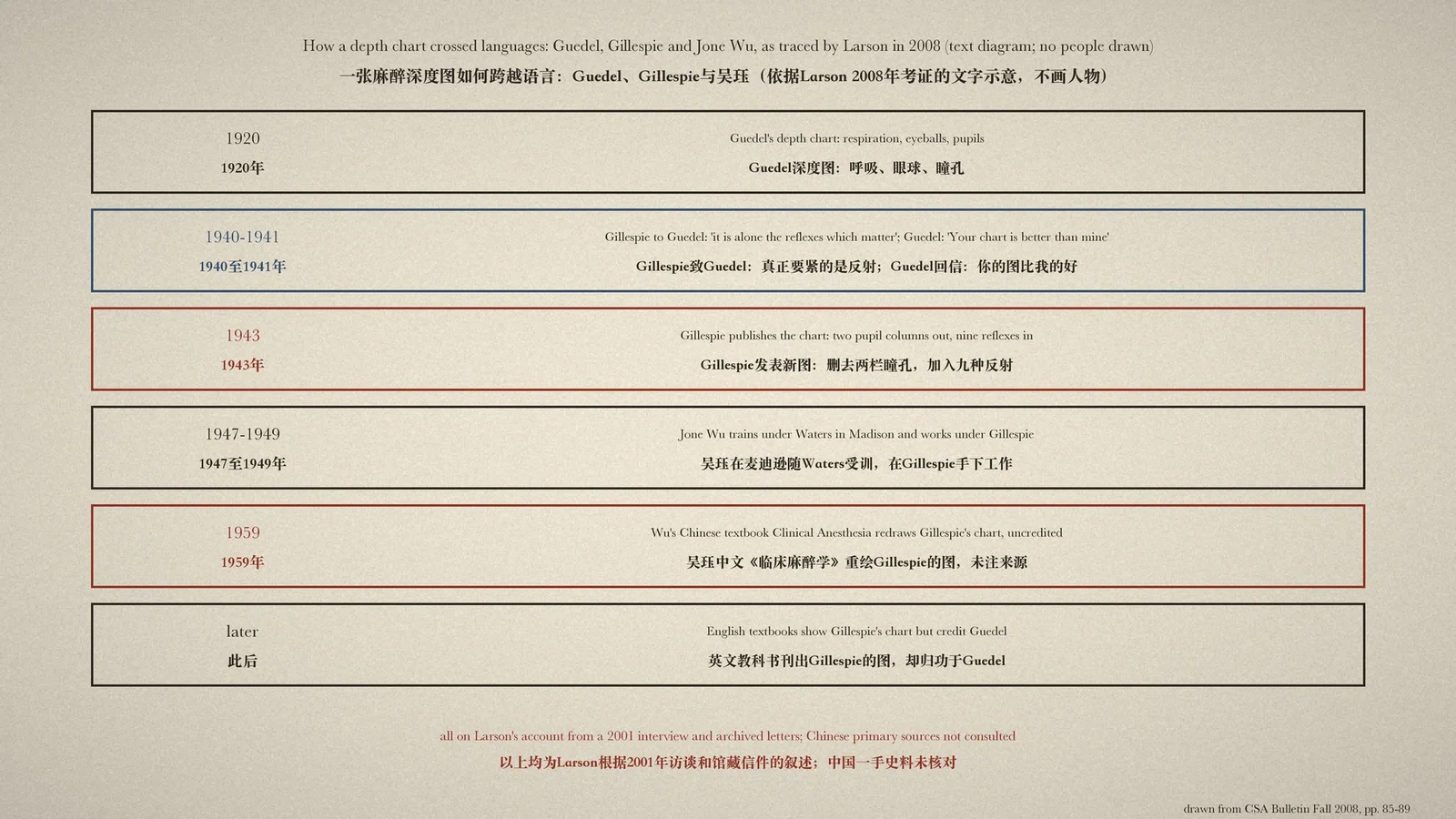
Most anaesthetists have seen the chart of the stages of ether anaesthesia: columns of breathing, eye movements and pupils, marked stage one to stage four, usually signed Guedel. In 2008 the historian of anaesthesia Merlin D. Larson wrote a column for the California Society of Anesthesiologists telling another story about it: in 1943 the chart was heavily revised by someone else, sixteen years later it was translated into a Chinese textbook, and on both journeys the reviser's name disappeared. [1, p. 85][1, p. 86]
An interview in Shanghai
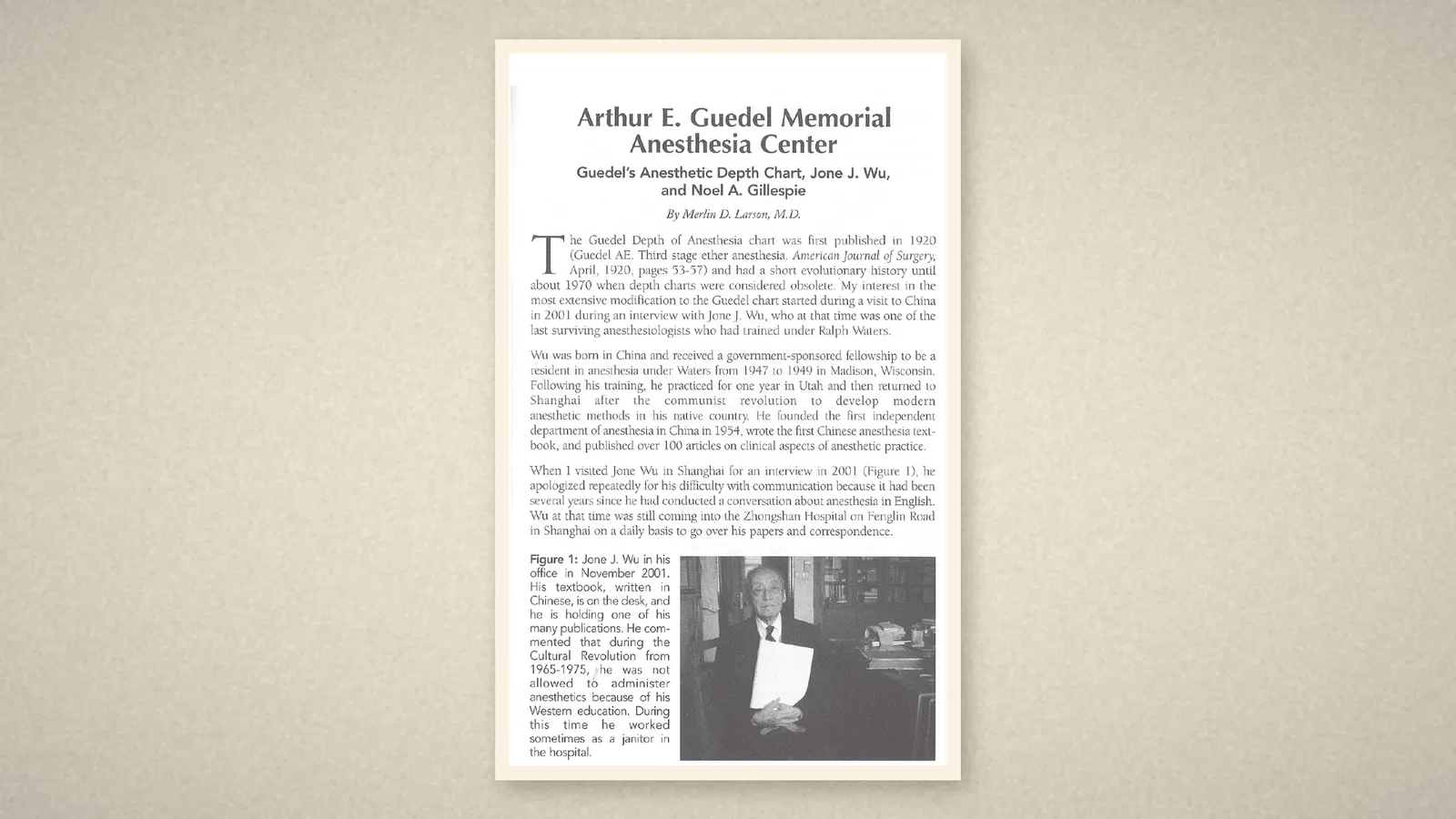
Guedel's chart, Larson wrote, was first published in 1920. Larson's interest in its "most extensive modification" began with an interview in China in 2001 with Jone J. Wu (Wu Jue). On Larson's account, Wu was born in China, held a government-sponsored fellowship as a resident under Ralph Waters in Madison, Wisconsin, from 1947 to 1949, practised for a year in Utah and returned to Shanghai to develop anaesthesia; according to Larson, Wu founded the first independent department of anaesthesia in China in 1954 and wrote the first Chinese anaesthesia textbook. At the time of the interview in November 2001, Wu still came daily to the Zhongshan Hospital on Fenglin Road to go over papers and correspondence, and recalled having been barred from giving anaesthetics during the Cultural Revolution because of a Western education, sometimes working as a janitor in the hospital. [1, p. 85]
During the interview Wu's Chinese textbook Clinical Anesthesia, 1959 edition, lay on the desk. Wu opened it at the depth chart, asked whether Larson knew Guedel's chart, and noted that the book had no references to Western authors because the government of the time would not permit credit to Western sources. [1, p. 86]
Not Guedel's chart
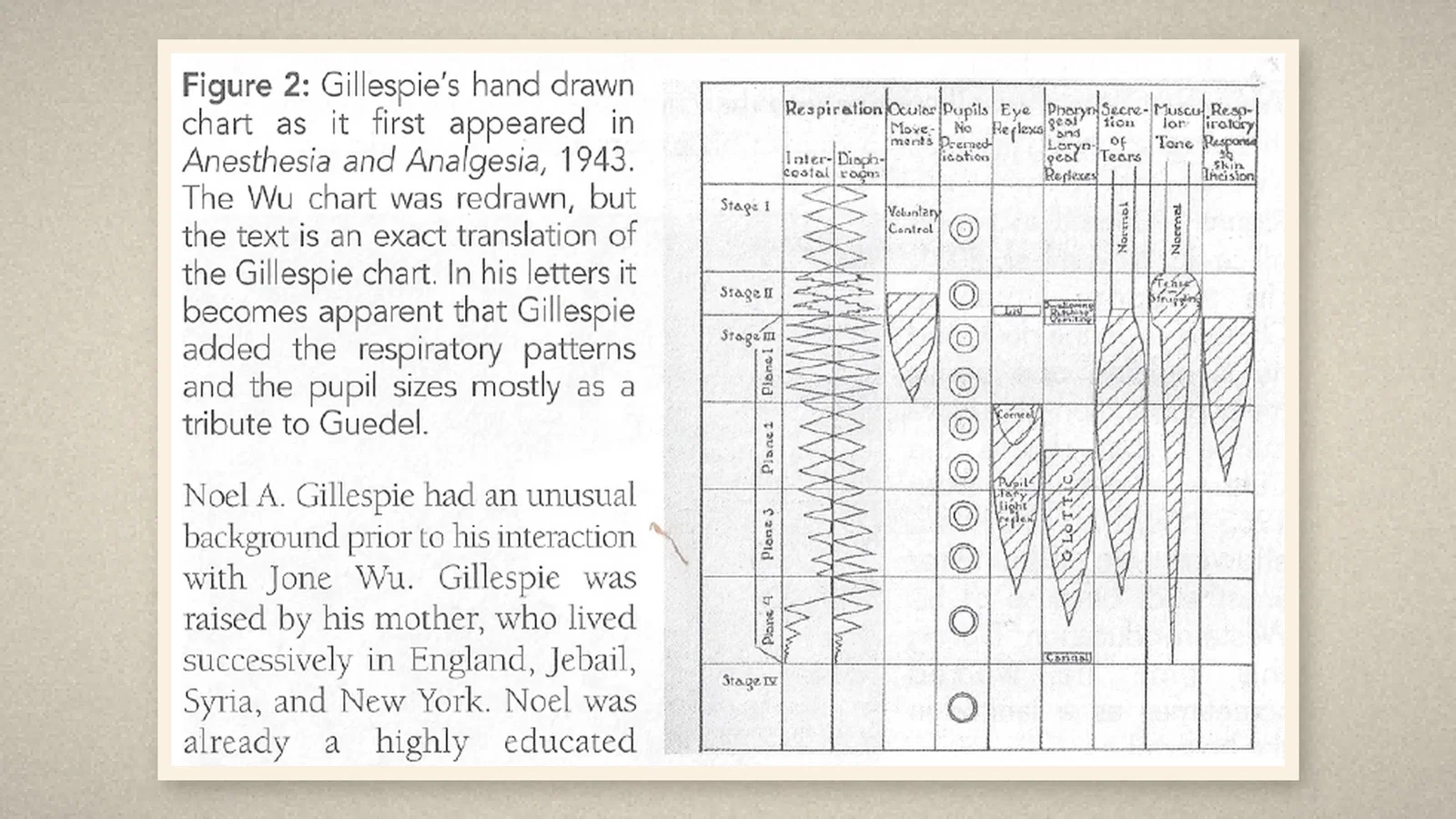
On close inspection, Larson found, the clinical signs chart in the book was not the one Guedel had drawn in two books or in the 1920 monograph. Further research led to its exact source: Noel A. Gillespie's depth chart in the September-October 1943 issue of Anesthesia and Analgesia, which deleted two pupil columns from Guedel's chart and added nine reflexes, Gillespie arguing that testing reflexes mattered more than respiratory or pupil signs. Patrick Sim of the Wood Library translated a photograph of Wu's chart and confirmed that it was redrawn "with only minor differences from the Gillespie original". [1, p. 86]
The two had met in Wisconsin. According to Larson, Gillespie began anaesthesia training at The London Hospital in 1933, came to Waters in Madison in 1939 and later joined the faculty part-time; Wu, a pharmacologist by training, worked under Gillespie from 1947 to 1949. [1, p. 87]
"Your chart is better than mine"
Gillespie drew the reflex chart as an assignment from Waters, who had been asked to contribute to an American Medical Association manual on safe anaesthesia, and corresponded extensively with Guedel about it; the letters are preserved in the Guedel Library. In a letter of 1940 Gillespie wrote that teaching treated the respiratory signs as if they were the only thing of importance, whereas "it is alone the reflexes which matter in practice". In 1941 Gillespie reported that the office called the new guide "Guedel-Gillespie", likening it to Busoni's piano arrangements of Bach's organ works, billed as "Bach-Busoni". [1, p. 87]
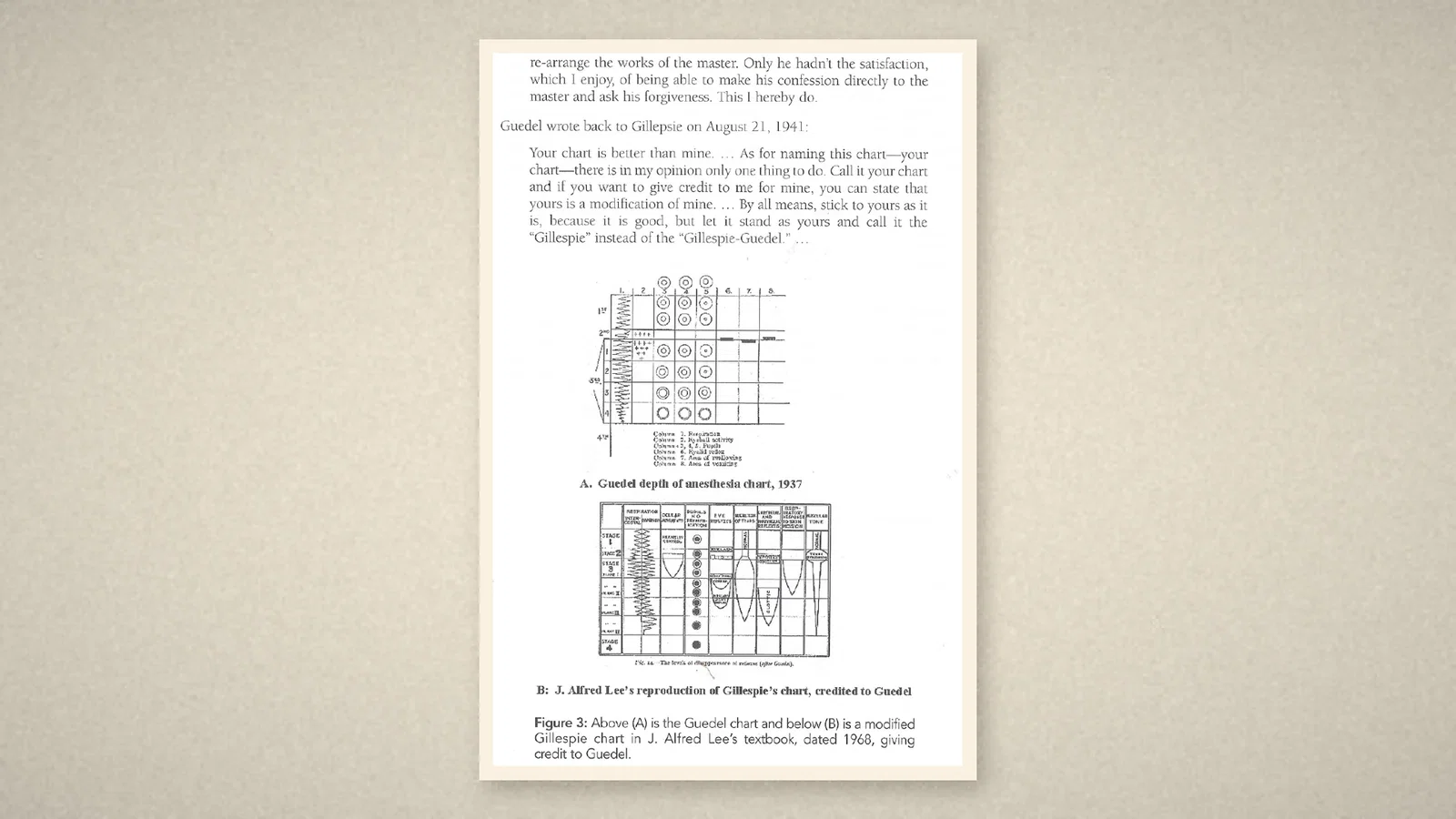
Guedel replied on 21 August 1941: "Your chart is better than mine." As for the name, there was only one thing to do: call it Gillespie's chart, and if credit was wanted for Guedel's, state that it was a modification; call it "the Gillespie" instead of "the Gillespie-Guedel". [1, p. 88]
The name was lost anyway
Ironically, Larson wrote, later textbooks showed the Gillespie chart again and again but credited Guedel, among them Lee's and Atkinson's British textbooks, and Guedel's own second book of 1951 showed only the original chart without citing Gillespie. Wu, Larson suggested, might have credited the former colleague but was not allowed to include references. The column ends by recording that Wu had died earlier in 2008, aged 100, and that Gillespie died in Madison in 1955, aged 51. [1, p. 88][1, p. 89]
What the record shows
On its way from English into Chinese, one chart lost its author's name twice: once because textbooks gave credit to the more famous man, and once because politics forbade naming Western sources. Larson's detective work joined the two threads back together.
Sources and reading limits
Read: Larson, "Guedel's Anesthetic Depth Chart, Jone J. Wu, and Noel A. Gillespie", CSA Bulletin Fall 2008, pp. 85-89, the whole Guedel Center column with figure captions.
Not covered: Gillespie's 1943 paper and chart in Anesthesia and Analgesia; Wu's Clinical Anesthesia in the 1959 or other editions; the Gillespie-Guedel letters in the Guedel Library; Guedel's books of 1937 and 1951 and Lee's textbook; Chinese primary sources on Wu's department and textbook; the 2001 interview record.
Limits: every fact here is on Larson's account, based on one interview and archived letters, not cross-checked against Chinese primary sources; claims of the "first independent department", the "first Chinese textbook" and the political background need such checking, so these are given as Larson's statements. The letters are quoted as Larson quotes them. Figure 1 is a photograph of Wu, not a patient. No doses are involved.
Three illustrations are crops of the CSA Bulletin, Fall 2008, pp. 85, 86 and 88 (the opening of the column with Wu's photograph, Gillespie's hand-drawn chart of 1943, and Guedel's reply with the textbook charts). One is a text diagram drawn from the column, with no people drawn.
- Larson MD. Guedel's anesthetic depth chart, Jone J. Wu, and Noel A. Gillespie. CSA Bulletin. Fall 2008:85-9. PDF
Continue exploring
Related reading connects shared questions and contexts; it does not by itself establish historical influence.
Anesthesia Epochs · The Source Room · About & Editorial Method
Published November 3, 2026. Sources and reading limits are stated above. Illustrations are labelled as original source images or AI-made. Historical accounts are educational; they are not current treatment instructions.