In the WFSA's Update in Anaesthesia vol. 40 (October 2025), Seokyung Shin's review 'The development of anaesthesia in Korea' recounts that before the war Korean surgery relied on spinal or open-drop ether, often without monitoring or oxygen; that during the Korean War (1950-1953) UN medical teams and hospital ships arrived, and Korean doctors met trained anaesthesiologists aboard the Danish hospital ship and at the Norwegian mobile hospital in Pocheon; and that in 1951 Captain H. S. Parmar, an Indian anaesthesiologist with the British Army, ran two short anaesthesia courses for Korean army doctors, the military physician Yoo Seung-heon later recalling seeing him intubate at the 1st Army Hospital in Daegu; Figure 4 reproduces the cover and typed programme of Parmar's 1951 course manual; these efforts laid the groundwork for Korean anaesthesiology, with Yoo trained at the WHO centre in Copenhagen in 1955, the Korean Society of Anaesthesiology founded in 1956 and the specialty recognised in 1962.
Reading Library · Anesthesia Epochs · 中文版
Watch the education video (for clinicians)
1951: Captain Parmar's Anaesthesia Courses in Wartime Korea · Anesthesia Epochs Education Series
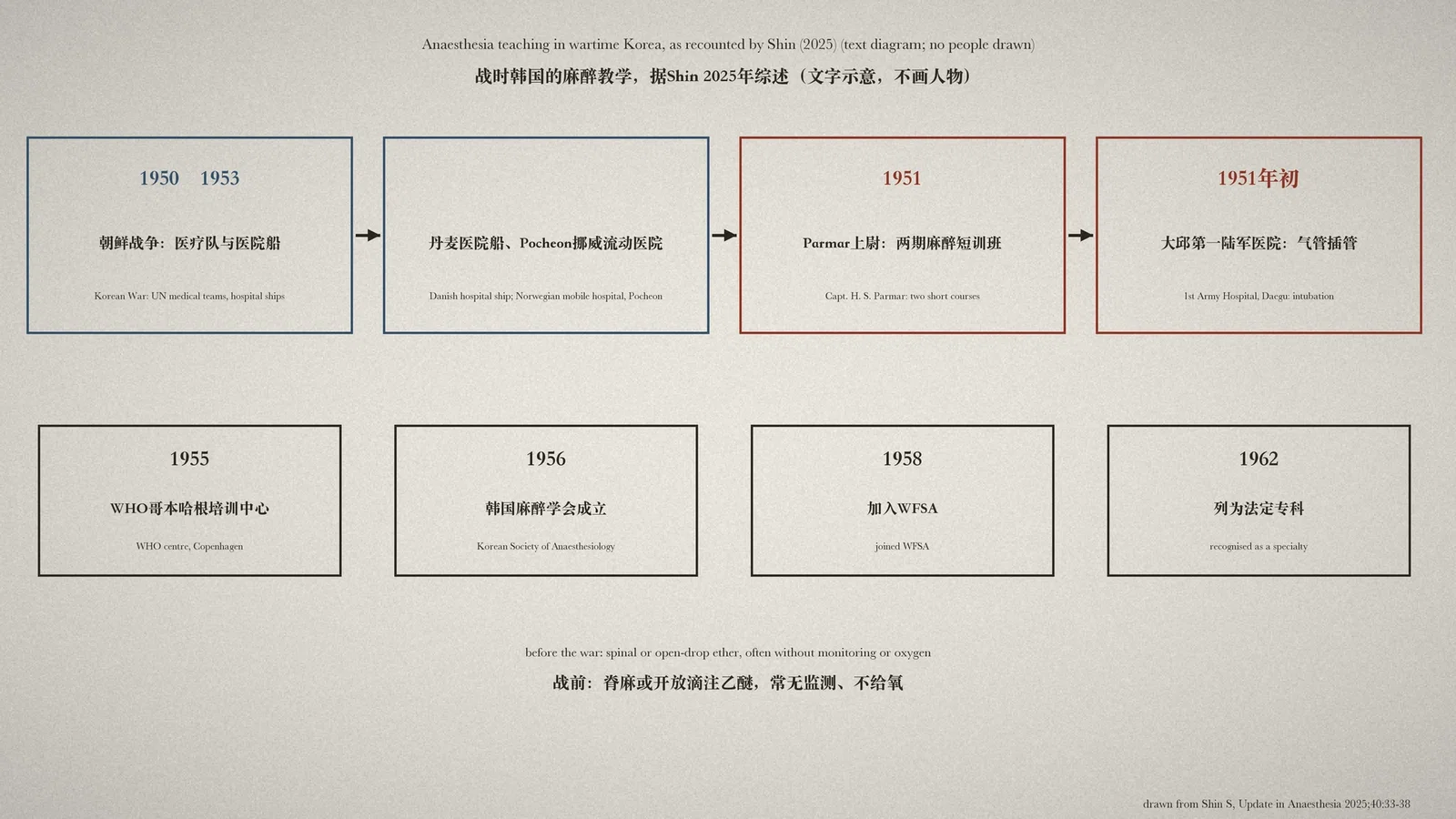
A country's anaesthesia specialty can begin, in part, with a typed course programme in wartime. In 1951, with the Korean War at its height, an Indian anaesthesiologist serving with the British Army taught anaesthesia to Korean army doctors in Daegu. The account comes from a review in the 2025 history issue of Update in Anaesthesia, published by the World Federation of Societies of Anaesthesiologists (WFSA), which also reproduces the cover and programme of the course. This article reads that review. [1, p. 33][1, pp. 36-37]
A review and one document from 1951
Update in Anaesthesia is the WFSA's educational journal for anaesthesia providers worldwide; volume 40, published in October 2025, was a history issue for the federation's 70th anniversary. In it Seokyung Shin of Yonsei University College of Medicine reviewed the development of anaesthesia in Korea, from the missionary and colonial periods to the post-liberation and Korean War years. [1, p. 33]
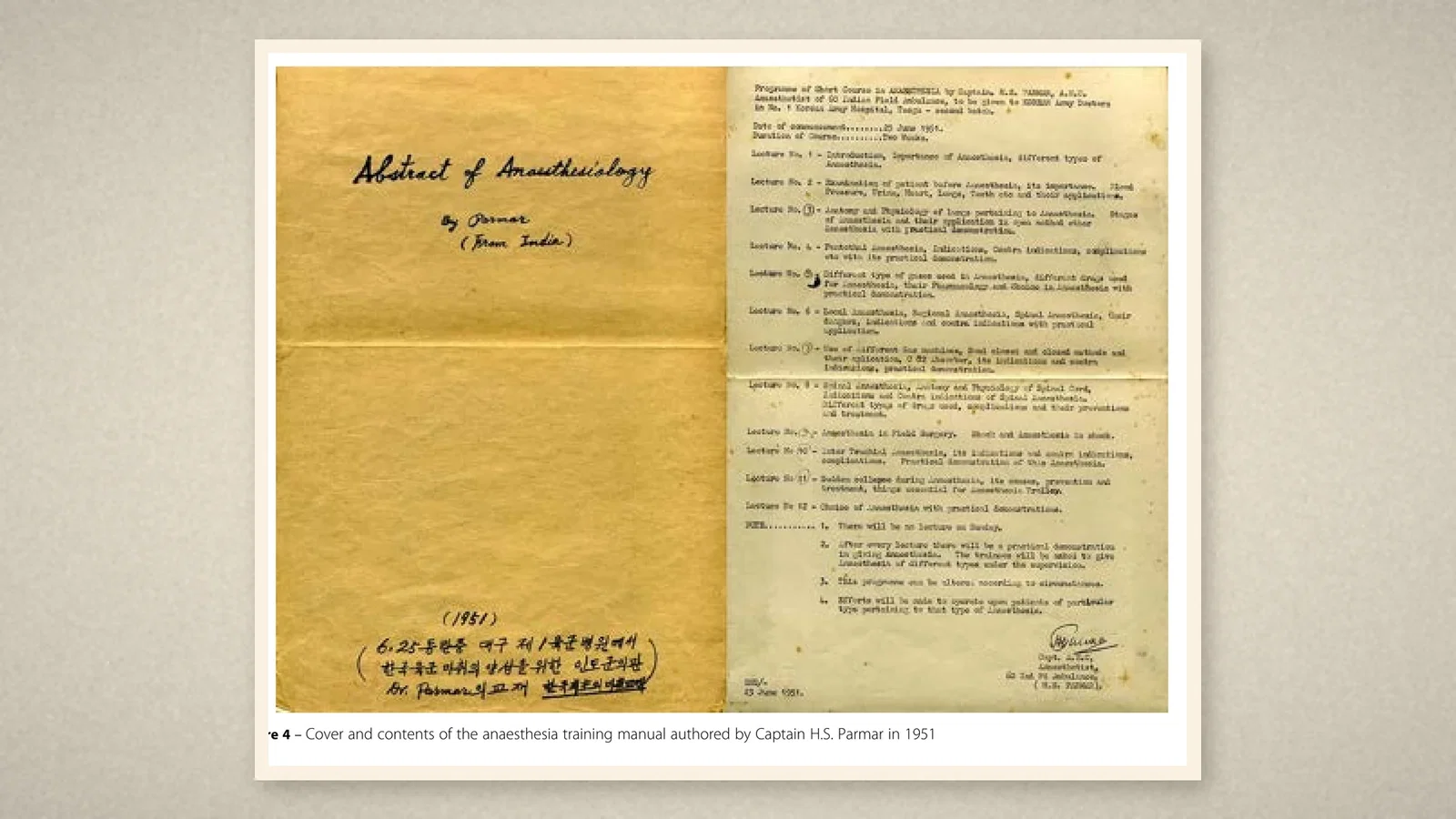
Figure 4 of the review is captioned "Cover and contents of the anaesthesia training manual authored by Captain H.S. Parmar in 1951". The cover is handwritten, "Abstract of Anaesthesiology by Parmar (from India)", and beside it is a typed programme of a short course in anaesthesia to be given to Korean army doctors, listing a dozen lectures from an introduction and preanaesthetic assessment through the methods of anaesthesia to anaesthesia in field surgery. It is the only document from 1951 available for this article, and only as a reproduction in the review. [1, p. 37]
Before and during the war
Before the war, the review says, anaesthesia in Korea was basic: operations were usually done under spinal or open-drop ether anaesthesia, often without proper monitoring or supplemental oxygen, although Korean physicians made progress, Kim Yeon-bok, for example, demonstrating intravenous pentothal anaesthesia at Severance Hospital in 1948. [1, p. 35]
The Korean War (1950-1953) was a national tragedy, but the author sees it also as a catalyst for the rapid introduction of modern medicine: United Nations medical teams were deployed and hospital ships from several countries docked in Busan. Korean military and general physicians, the review says, met trained anaesthesiologists aboard the Danish hospital ship and at the Norwegian mobile hospital in Pocheon, and some began formal training in anaesthesia. [1, p. 35]
Captain Parmar
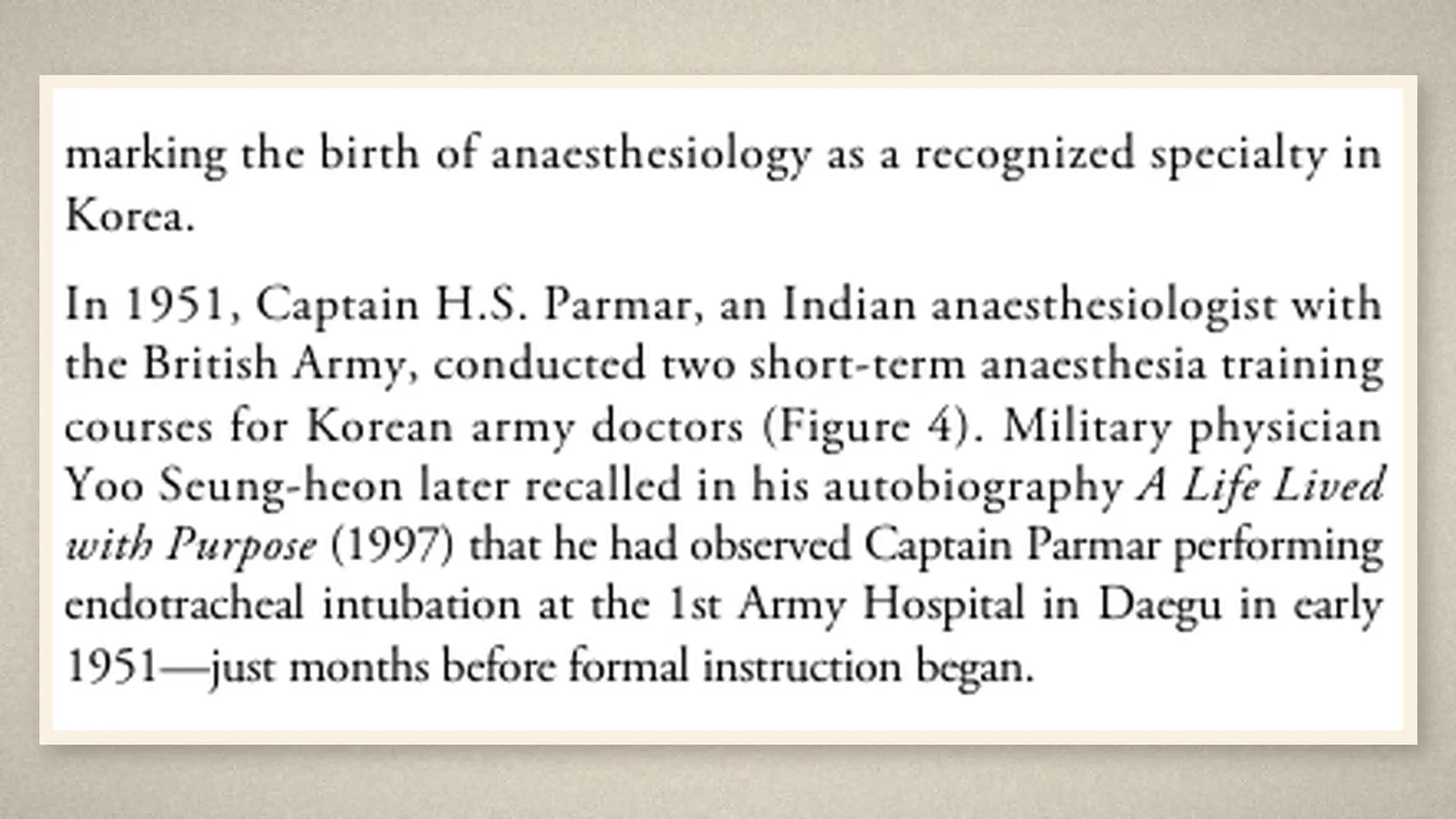
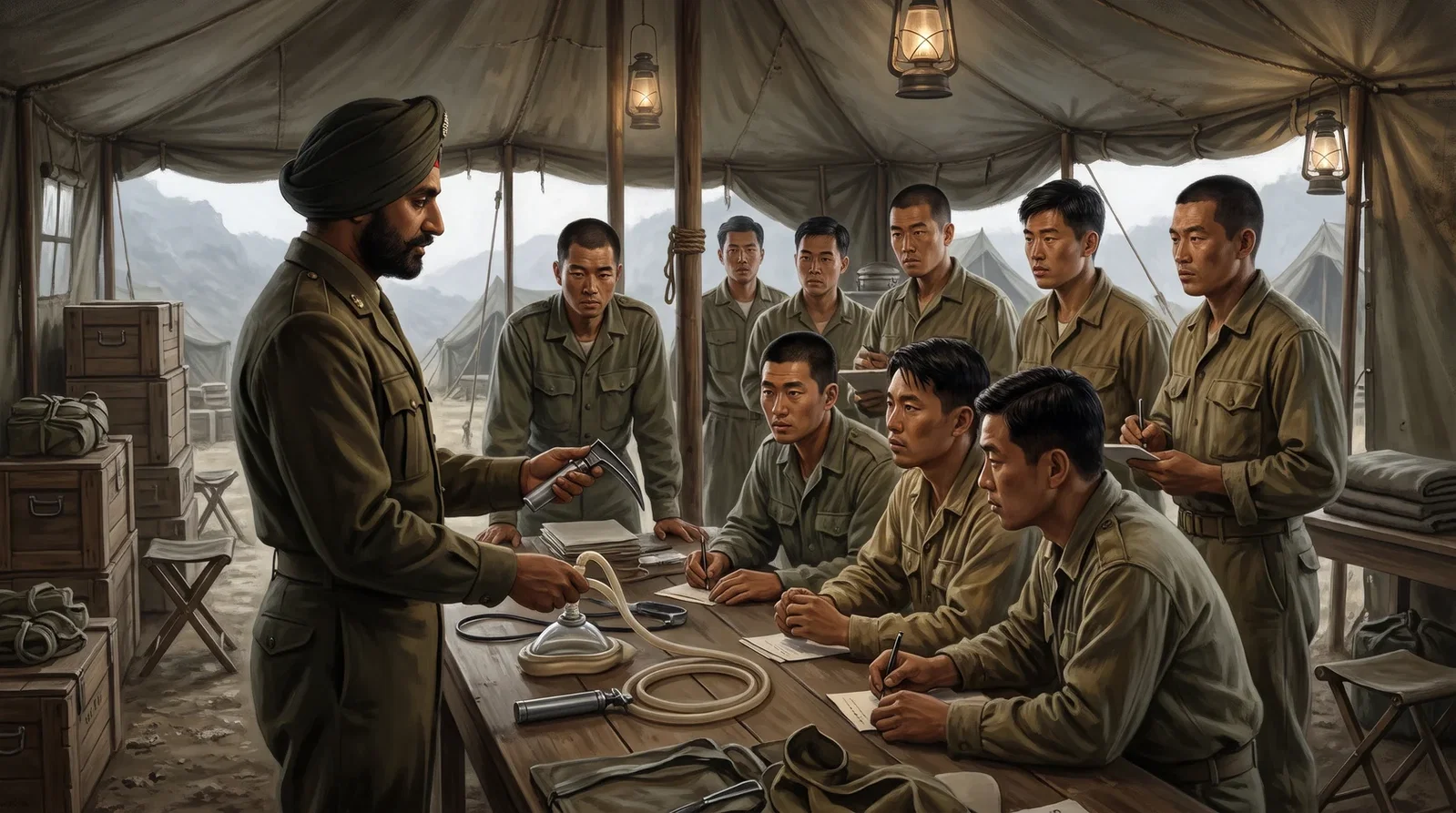
In 1951 Captain H. S. Parmar, an Indian anaesthesiologist with the British Army, conducted two short-term anaesthesia training courses for Korean army doctors. The military physician Yoo Seung-heon later recalled, in the 1997 autobiography A Life Lived with Purpose, having watched Parmar perform endotracheal intubation at the 1st Army Hospital in Daegu in early 1951, months before formal instruction began. These wartime efforts, the author writes, laid the groundwork for formal anaesthesia education: Korean doctors trained by foreign specialists during the war went on to establish the country's anaesthesia departments and training programmes. [1, p. 36]
Afterwards
The review continues: in 1955 Yoo Seung-heon attended the WHO anaesthesia training centre in Copenhagen and later trained in the UK; when specialist certification was introduced in 1953, anaesthesiology was excluded, and doctors who had focused on anaesthesia had to return to their original specialties; on 10 November 1956, with the help of the US Army anaesthesiologist Captain V. A. Traina, about 30 physicians founded the Korean Society of Anaesthesiology at Severance Hospital; the society joined the WFSA in 1958; and anaesthesiology was formally recognised as a specialty in 1962, with board examinations from 1963. [1, pp. 36-37]
What the record shows
War brought casualties and also exchange. Two short courses by a foreign military doctor and a typed programme became one of the starting points of a national specialty, a reminder that anaesthetic knowledge often travels by unexpected routes.
Sources and reading limits
Read: Seokyung Shin, "The development of anaesthesia in Korea: a historical review", Update in Anaesthesia vol. 40, October 2025, pp. 33-38, in full, with the issue's front matter.
Not covered: Parmar's original 1951 manual and programme (seen only as reproduced in Figure 4); Yoo Seung-heon's autobiography; British Army or Indian Field Ambulance records.
Limits: this article rests on a 2025 review, not on 1951 archives; the typed text in Figure 4 is blurred, and only its clearly legible parts are reported. Any wording about priority is the review's own. Photographs in the review that show people (Figures 2 and 3) are not used. Korean names are given in the review's romanisation.
Three illustrations are taken from the issue of Update in Anaesthesia (Figure 4, p. 33, p. 36). One is a text diagram drawn from the review, with no people drawn.
- Shin S. The development of anaesthesia in Korea: a historical review. Update in Anaesthesia. 2025;40:33-38. PDF
Continue exploring
Related reading connects shared questions and contexts; it does not by itself establish historical influence.
Anesthesia Epochs · The Source Room · About & Editorial Method
Published November 4, 2026. Sources and reading limits are stated above. Illustrations are labelled as original source images or AI-made. Historical accounts are educational; they are not current treatment instructions.