
In Anaesthesia, October 1951 (vol. 6, no. 4), H. J. V. Morton and W. D. Wylie, members of the committee the Association of Anaesthetists had set up eighteen months earlier to investigate deaths associated with anaesthesia, analysed 43 deaths from regurgitation or vomiting, many showing inexperience; written as a frankly didactic paper for beginners, it set out three conditions (material in the stomach, something to bring it out, access to the air passages), urged postponement of non-urgent cases after food, emptying the stomach with Ryle's or oesophageal tubes, a nitrous oxide-oxygen-ether induction before a cuffed tube for the learner, no anaesthesia within five hours of a meal, no oral glucose for diabetic patients and suction tested beforehand; 32 of the 43 regurgitated liquids, and 25 deaths followed events at or just after induction.
Reading Library · Anesthesia Epochs · 中文版
Watch the education video (for clinicians)
1951: Aspiration at Induction — Morton and Wylie · Anesthesia Epochs Education Series
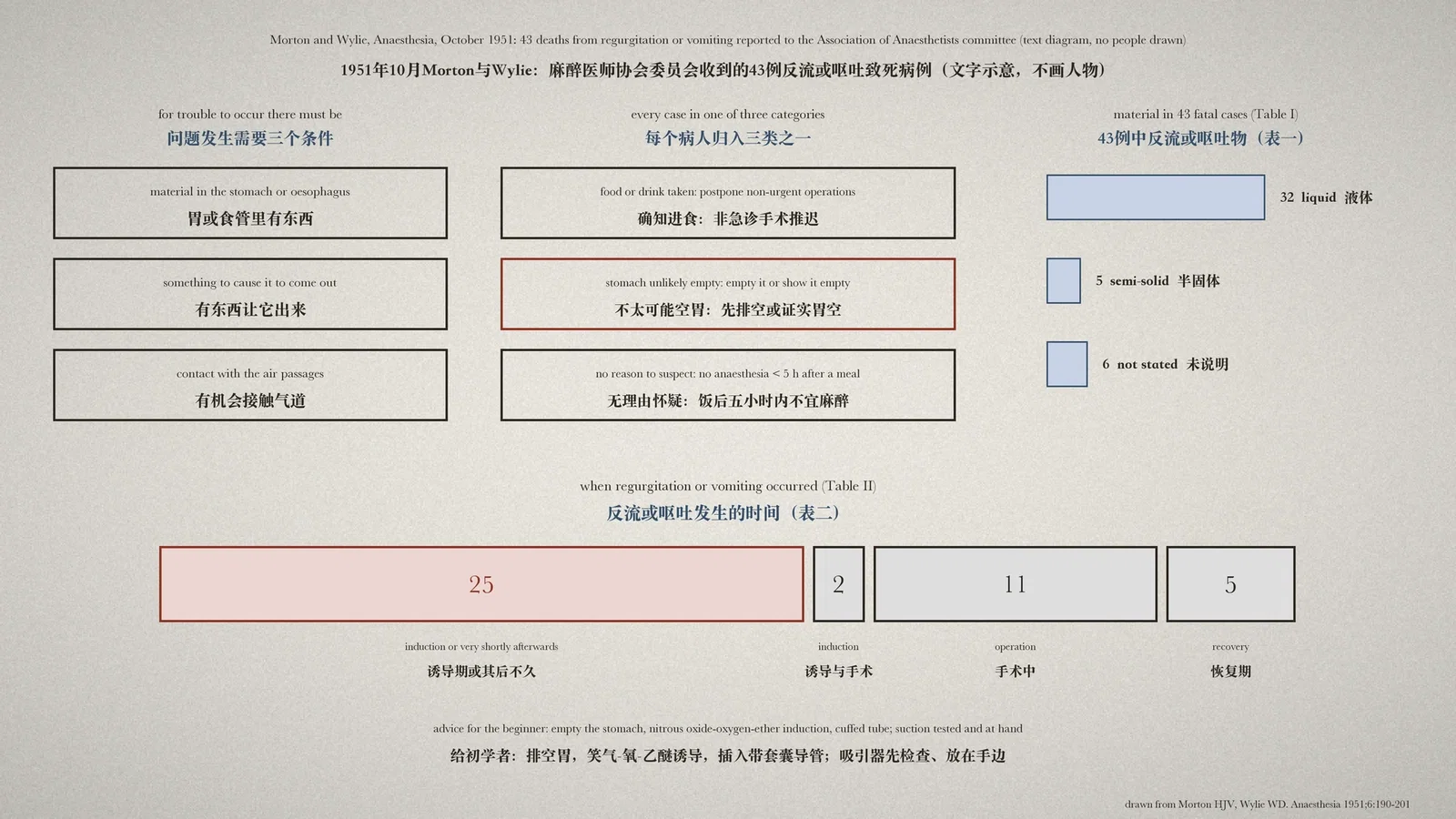
Regurgitation or vomiting of stomach contents, followed by their entry into the airway, is one of the oldest dangers of general anaesthesia. The October 1951 issue of Anaesthesia (vol. 6, no. 4) carried "Anaesthetic deaths due to regurgitation or vomiting" by H. J. V. Morton and W. D. Wylie. Its material came from a committee of the Association of Anaesthetists: eighteen months earlier the Association had set up a committee to investigate deaths associated with anaesthesia, and the two authors, as members, had studied 43 cases in which death resulted from regurgitation or vomiting. This article reads that article. [1, p. 190]
A "frankly didactic" paper
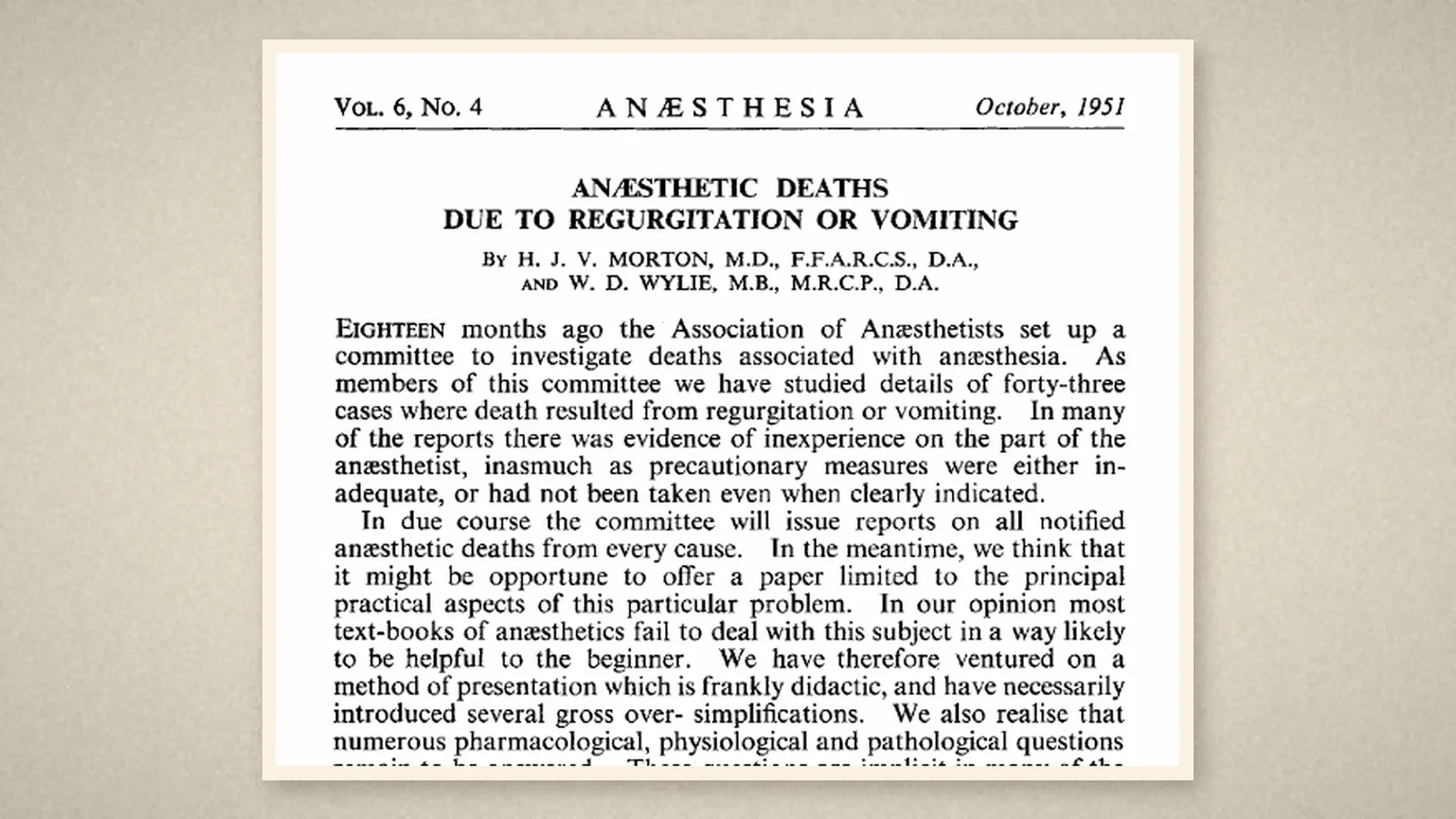
Many of the reports, the authors wrote, showed inexperience on the part of the anaesthetist: precautions were inadequate, or had not been taken even when clearly indicated. The committee would in due course report on all notified anaesthetic deaths; meanwhile the authors offered a paper limited to the practical aspects of this one problem. Most textbooks, in their opinion, failed to deal with it in a way likely to help the beginner, so they chose a method of presentation that was "frankly didactic", admitting several gross over-simplifications. Local and spinal techniques were left out as unsuitable for the learner. [1, p. 190]
For trouble to occur there had to be material in the stomach or oesophagus, something to cause it to come out, and a way for it to reach the air passages. The paper then listed the circumstances in which the stomach might contain material: food and drink, swallowed blood, intestinal obstruction, pyloric obstruction, and delayed emptying from pain, shock, labour, abdominal distension, severe illness and many drugs. [1, pp. 190-1]
Active and passive
Vomiting was treated as an active process and regurgitation as a passive one: with the patient horizontal or head-down, fluid would leave the stomach by gravity if both ends of the oesophagus were relaxed, and regurgitation was likely to accompany the injection of relaxants or thiopentone. Death could come from anoxia due to obstruction by an overwhelming quantity of material; from anoxia beginning with laryngeal spasm, which a very small quantity could provoke and which was most intense with thiopentone, and which was worse in a patient who had been breathing a gas mixture poor in oxygen; from reflex effects on the heart; or later from aspiration bronchopneumonia, atelectasis or lung abscess. [1, pp. 191-2]
Three categories of patient
Prevention began by placing every patient in one of three categories: food or drink certainly taken recently, so that material was certainly present; no recent food or drink, but the stomach unlikely to be empty; and no reason whatsoever to suspect material. In the first, non-urgent operations should be postponed, a rule to be strictly enforced because any exception would be taken as a precedent by unco-operative surgeons. In the second, acute abdominal conditions, operations on the stomach, cases in which a relaxant or very deep anaesthesia was intended before a cuffed tube was passed, and oesophageal obstruction all required the stomach to be emptied or shown to be empty first. [1, pp. 192-3]
Liquids, Ryle's tubes and failed emptying
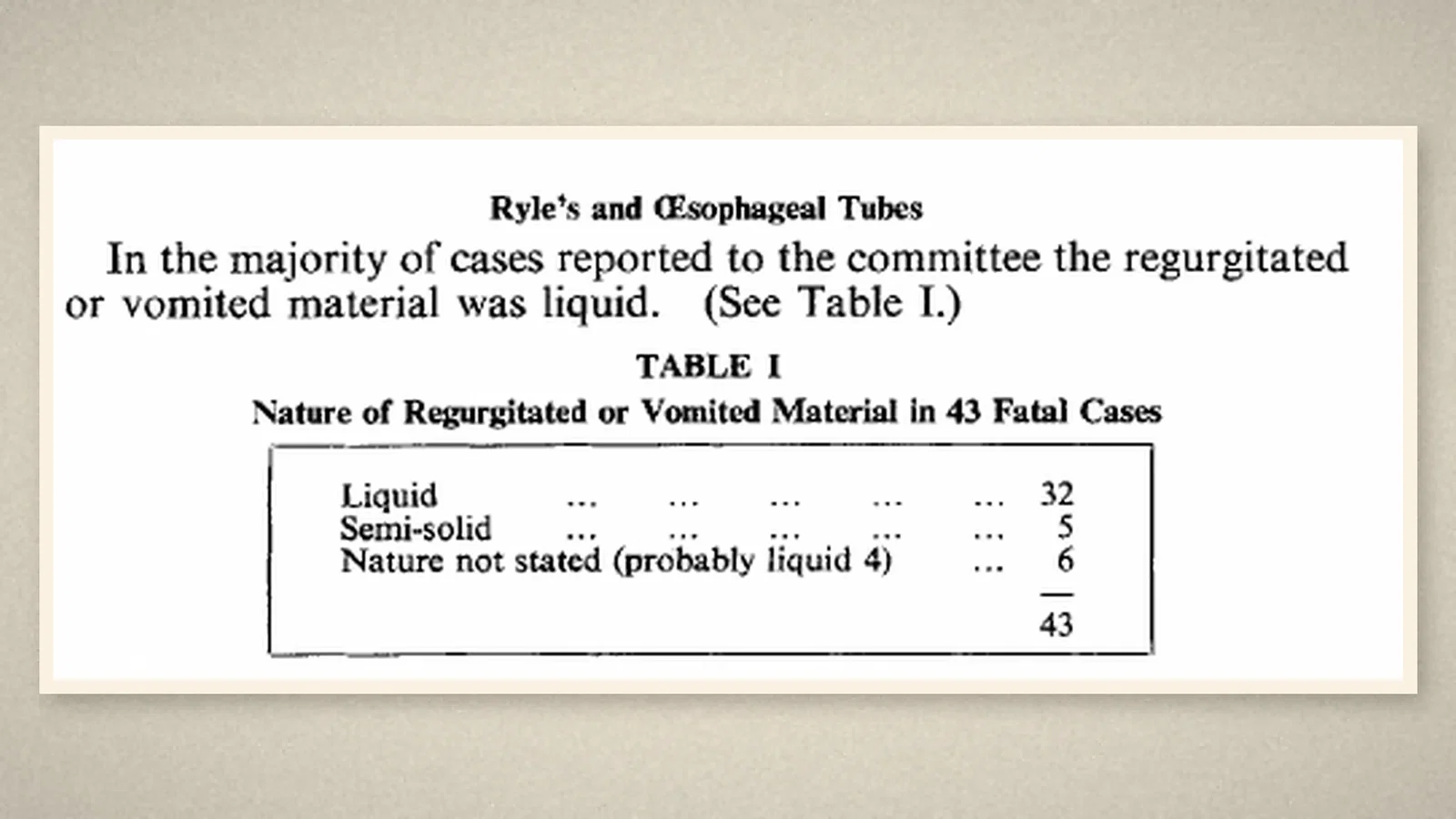
Table I shows that in 32 of the 43 cases the material was liquid, in 5 semi-solid and in 6 not stated (probably liquid in 4). Liquids could be removed with Ryle's or oesophageal tubes, and the authors described the technique and the "aspiration test" in detail: aspirate first, because only the return of stomach contents proves that the tube is in the stomach; then inject water and recover it, turn the patient and repeat. [1, pp. 194-5]
A treatment sheet from a partial gastrectomy illustrated the pitfalls: several early aspirations returned little, and then a large amount came back at ten o'clock, which coincided with the arrival of an experienced ward sister. The authors wanted surgeons, housemen and ward sisters to become "Ryle's tube conscious". Among the reported cases were 14 in which fluid in the stomach was very probable because of a clear diagnosis of intestinal obstruction or perforated ulcer, yet no tube was used; in 7 more a Ryle's tube was used but the stomach was inadequately emptied and fatal regurgitation followed. [1, p. 195]
An induction for the beginner
When a cuffed endotracheal tube was required, the authors advised the beginner, after every effort to empty the stomach, to use a nitrous oxide-oxygen-ether sequence. This "old-fashioned" technique had advantages: even the most inexperienced anaesthetist should know it; laryngeal reflexes stayed active while vomiting was possible, yet lengthy complete spasm was unlikely; and regurgitation was unlikely unless anaesthesia became very deep. The cuffed tube was to be passed once the jaw and glottis relaxed, and a relaxant could follow if required. Of other techniques the authors made only a few comments, among them that a few minutes of oxygen before induction with any agent other than nitrous oxide might be a wise precaution, so that the lungs held more than the normal quantity of oxygen if regurgitation or vomiting occurred. [1, pp. 196-7]
Twenty-five at induction
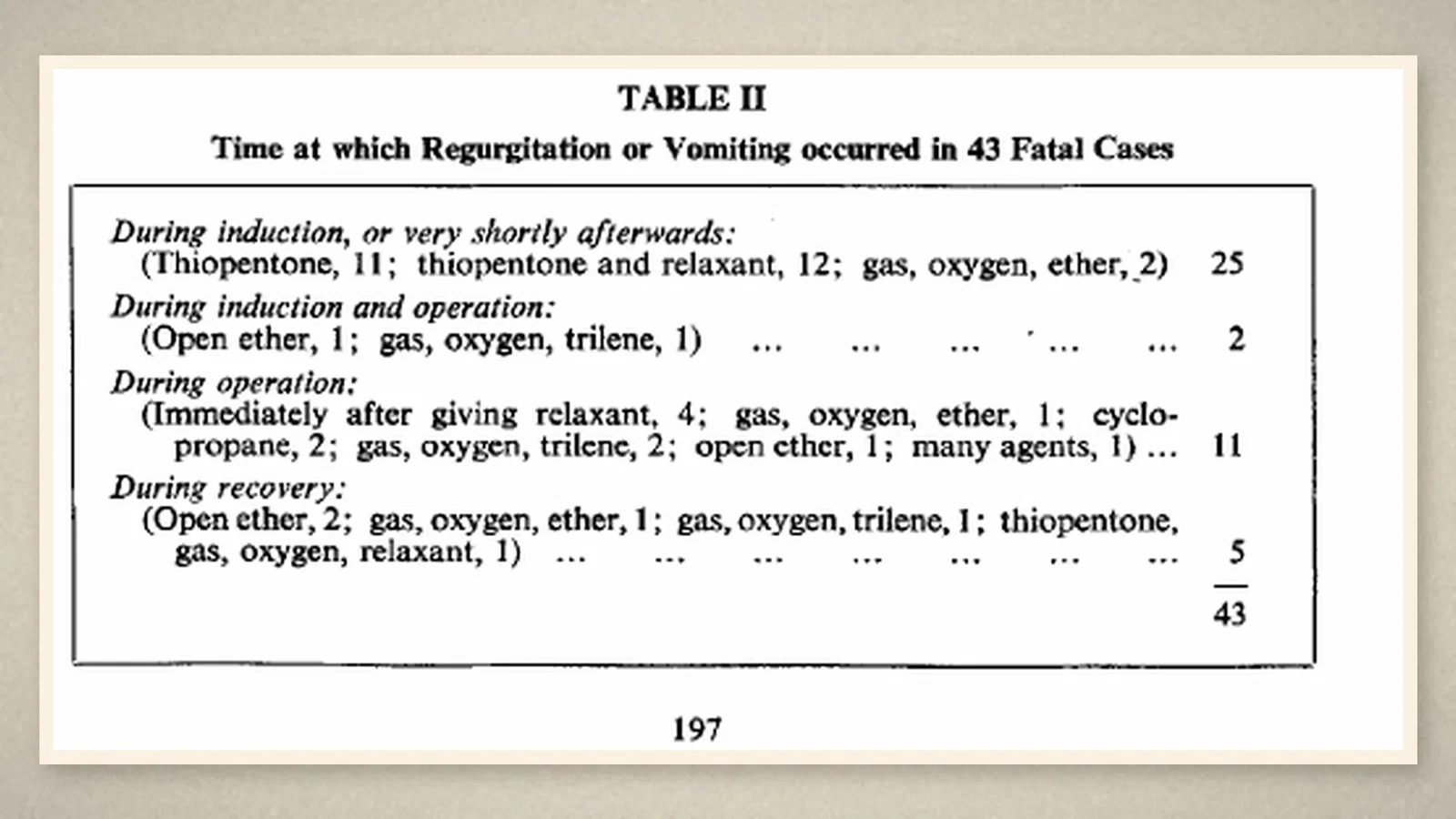
Table II sorts the cases by timing: 25 during induction or very shortly afterwards, 2 during induction and operation, 11 during operation and 5 during recovery. That is why the authors spent so long on induction. At the end of operation the stomach should be emptied again, the protective reflexes allowed to return before a cuffed tube was removed, and the patient placed on one side before leaving the theatre. [1, pp. 197-8]
For the "normal" patient, the authors judged that after a normal meal the stomach empties in three to four and a half hours, so anaesthesia less than five hours after a meal was unwise. Out-patient operations were best done in the morning, and parents of children should be given printed instructions stating the time of operation and the time of the last meal or drink. [1, p. 198]
Unsatisfactory procedures and treatment
The paper listed unsatisfactory procedures: thiopentone alone in suspected cases; reliance on dexterity at intubation, which the authors called foolhardy, since after thiopentone and relaxant in a horizontal patient regurgitation could occur before a laryngoscope was in the mouth; an uncuffed endotracheal tube without a wide-bore stomach tube; and pharyngeal packs, which could slip. The authors also had notes of four diabetic patients who died after the customary pre-operative glucose by mouth was followed by regurgitation or vomiting, and recommended that oral glucose be discontinued. In treatment they urged that, before suspected cases were anaesthetised, the suction apparatus be tested and brought to hand, because reports often described delay while the patient was taken to the apparatus, the apparatus brought to the patient, or the apparatus persuaded to work. [1, pp. 198-201]
The summary says the paper was largely based on the 43 fatal cases reported to the Association of Anaesthetists and deliberately written in a didactic fashion for junior anaesthetists called on to deal with cases in which regurgitation or vomiting might be anticipated. [1, p. 205]
What the record shows
The article turns 43 deaths gathered by a committee into conditions, categories of patient and steps that can be checked one by one, written directly for beginners. It shows one use of investigating anaesthetic deaths: turning individual tragedies into rules that can be taught.
Sources and reading limits
Read: Morton HJV, Wylie WD, "Anaesthetic deaths due to regurgitation or vomiting", Anaesthesia, October 1951, vol. 6, no. 4, pp. 190-201, concluded on p. 205, in full.
Not covered: the committee's reports on all notified anaesthetic deaths, which the article says would follow; Mendelson's paper on the inhalation of stomach acid and Morton's paper on a facepiece, both cited in the article.
Limits: drug doses in the case reports are not repeated. The committee's founding date is given only as the article's "eighteen months ago".
Three illustrations are taken from the 1951 article (pp. 190, 194 and 197). One is a diagram drawn from the text, with no people drawn.
- Morton HJV, Wylie WD. Anaesthetic deaths due to regurgitation or vomiting. Anaesthesia. 1951;6(4):190-201. doi:10.1111/j.1365-2044.1951.tb01388.x
Continue exploring
Related reading connects shared questions and contexts; it does not by itself establish historical influence.
Anesthesia Epochs · The Source Room · About & Editorial Method
Published November 4, 2026. Sources and reading limits are stated above. Illustrations are labelled as original source images or AI-made. Historical accounts are educational; they are not current treatment instructions.