
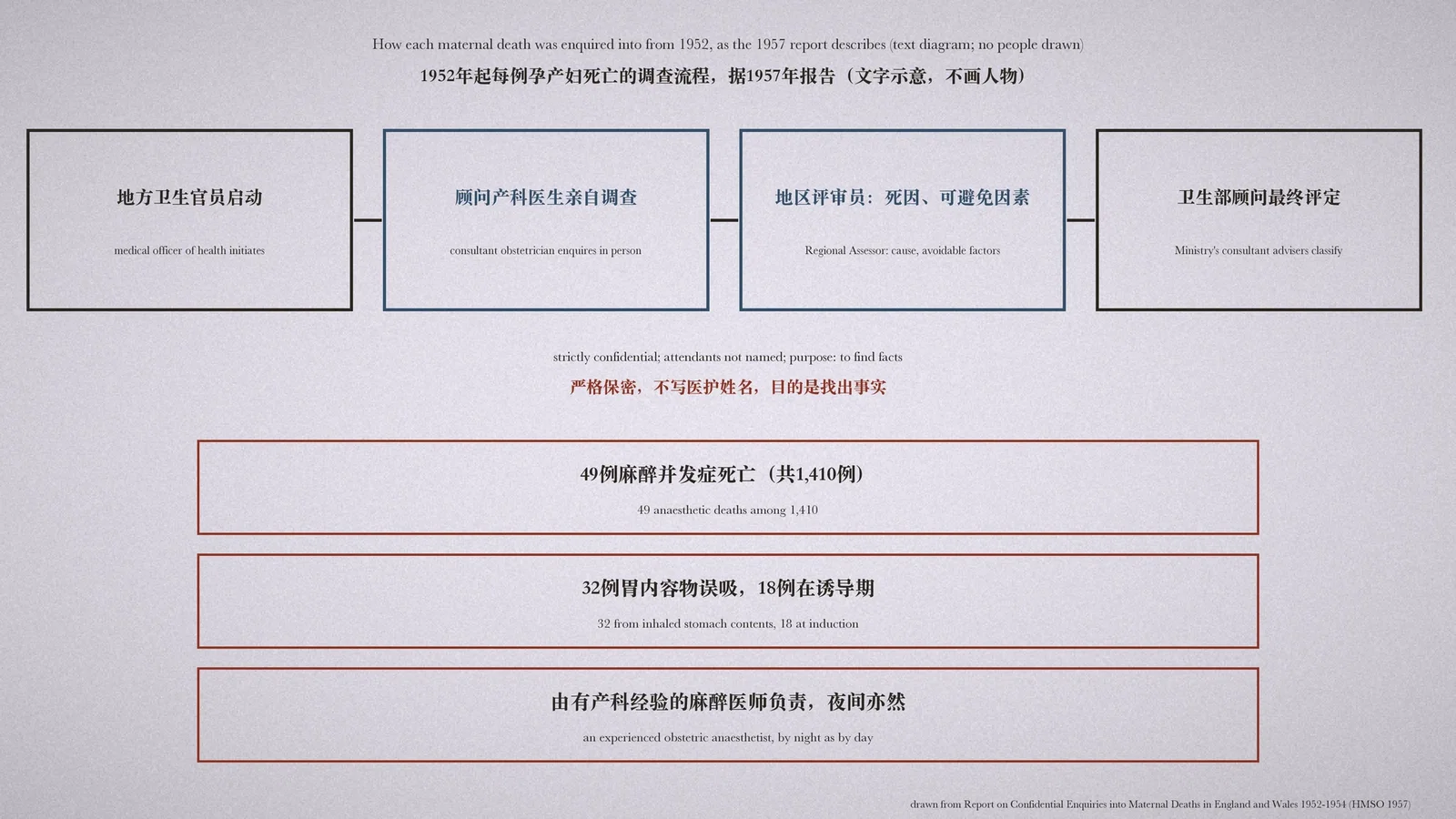
The Ministry of Health's Reports on Public Health and Medical Subjects No. 97, Report on Confidential Enquiries into Maternal Deaths in England and Wales 1952-1954 (HMSO 1957), by Walker, Wrigley, the anaesthetist Marston and others, describes how, after Sir Eardley Holland suggested an expert enquiry in 1949, a system began in 1952 in which every maternal death was investigated by a consultant obstetrician, assessed by a Regional Assessor for avoidable factors and finally classified by the Ministry's advisers, in strict confidence and without naming attendants. Its anaesthesia chapter found 49 deaths due to complications of anaesthesia among 1,410, 32 of them from inhalation of stomach contents, 18 during induction; it noted neglect of food and fluid intake and of emptying the stomach, urged that an anaesthetist experienced in obstetrics choose agent, depth and position with suction ready, condemned single-handed anaesthesia and delivery except in extreme emergency, and called for experienced obstetric anaesthetists by night as well as by day.
Reading Library · Anesthesia Epochs · 中文版
Watch the education video (for clinicians)
1957: Confidential Enquiries into Maternal Deaths — Aspiration · Anesthesia Epochs Education Series
When a mother dies, who finds out what happened, and how can those who gave care be persuaded to speak frankly? From 1952 every maternal death in England and Wales was the subject of a "confidential enquiry", and in 1957 a report covering 1952-1954 was published. The History of Anaesthesia Society timeline calls it the first report on confidential enquiries into maternal deaths. The report has a chapter of its own on deaths due to complications of anaesthesia. This article reads the report's account of its method and that chapter. [1, title page][2]
A government report
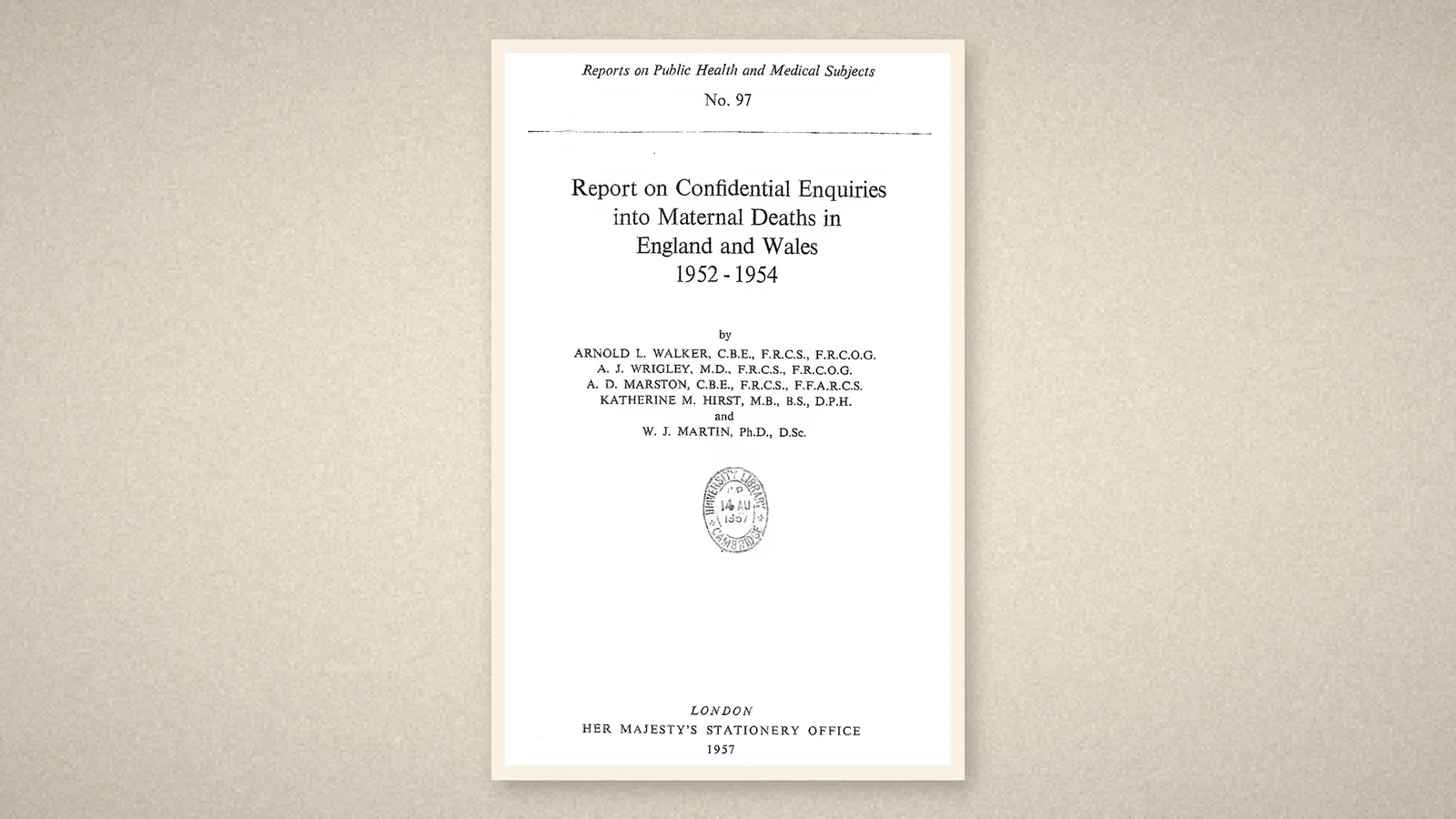
The report is No. 97 in the Ministry of Health's Reports on Public Health and Medical Subjects, published in London by HMSO in 1957; its authors were Arnold L. Walker, A. J. Wrigley, A. D. Marston, Katherine M. Hirst and W. J. Martin, Marston holding the Fellowship of the Faculty of Anaesthetists of the Royal College of Surgeons. [1, title page]
How the enquiry worked
The first chapter recalls that at the 12th British Congress of Obstetrics and Gynaecology in 1949, discussion of maternal mortality turned to an American method of enquiry by local committees of experts, with case reports and comments published in medical journals, and the Congress president, Sir Eardley Holland, suggested a similar method to the Minister of Health. After consultation with the Royal College of Obstetricians and Gynaecologists and the Society of Medical Officers of Health, a new system began at the start of 1952. [1, pp. 1-2]
Each maternal death was reported by the local medical officer of health to a consultant obstetrician, who preferably obtained full clinical information in person from all who had attended the woman, in hospital or at home. That report, with the medical officer's comments, went to a Regional Assessor, a senior obstetrician of high standing in each Regional Hospital Board area, who recorded views on the cause of death and on whether there was any avoidable factor in clinical care or administration; it then went to the Chief Medical Officer, with final assessment and classification by the Ministry's consultant advisers in obstetrics. [1, p. 2]
The purpose, the report said, was "to find facts, at first hand as far as possible, together with the candid comment of experienced obstetricians". At every stage the reports were strictly confidential and for medical use only, attendants' names were not required, and the report rested on information pooled over several years; every participant, it added, had benefited from the educative effect of reviewing each case. Finding avoidable factors did not mean that a death could certainly have been prevented. [1, pp. 2-4]
The anaesthesia chapter: aspiration
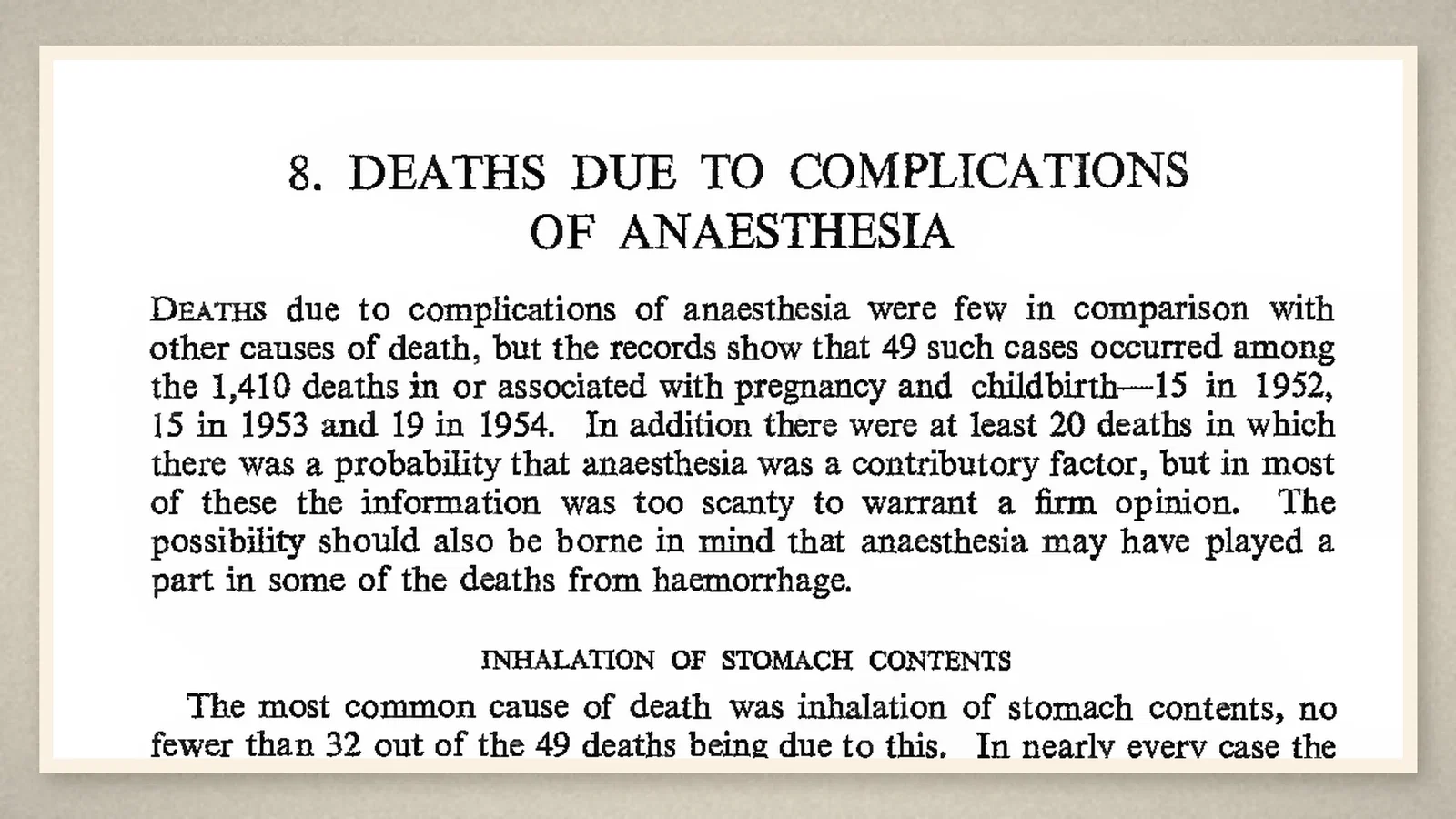
Chapter 8 is headed "Deaths due to complications of anaesthesia". They were few compared with other causes, the report said, but 49 occurred among the 1,410 deaths in or associated with pregnancy and childbirth, 15 in 1952, 15 in 1953 and 19 in 1954, with at least 20 more in which anaesthesia was probably contributory but the information too scanty for a firm opinion; anaesthesia might also have played a part in some deaths from haemorrhage. The report explains that it treats anaesthetic deaths separately because the international classification treats death due to anaesthesia as secondary, classing the case by the condition for which anaesthesia was given. [1, p. 4][1, p. 40]
The commonest cause was inhalation of stomach contents, 32 of the 49 deaths, nearly always during the administration of anaesthesia and in 18 cases during induction; death followed from immediate asphyxia or from pulmonary oedema within a few hours. The records said little about food and fluid taken before anaesthesia and suggested that their regulation was not usually considered, and there were very few references to emptying the stomach by tube; the stomach was generally believed to empty slowly in labour and might contain much fluid even after many hours without food. [1, pp. 40-41]
So, the report argued, the skill and judgment of an anaesthetist experienced in obstetric work were needed to decide the agent, technique and depth of anaesthesia, whether to empty the stomach, and the patient's position during anaesthesia and immediately afterwards, as while awaiting delivery of the placenta; suction apparatus should whenever possible be at hand from the start. Intravenous barbiturates and relaxants could relax the cardiac sphincter and cause regurgitation, a recognised risk, but at most in six of the 23 cases with information; the exhaustion of prolonged labour was probably a factor in many. Six further deaths occurred under chloroform or chloroform and ether, nearly all at home or in nursing or maternity homes. [1, pp. 41-42]
Who gives the anaesthetic
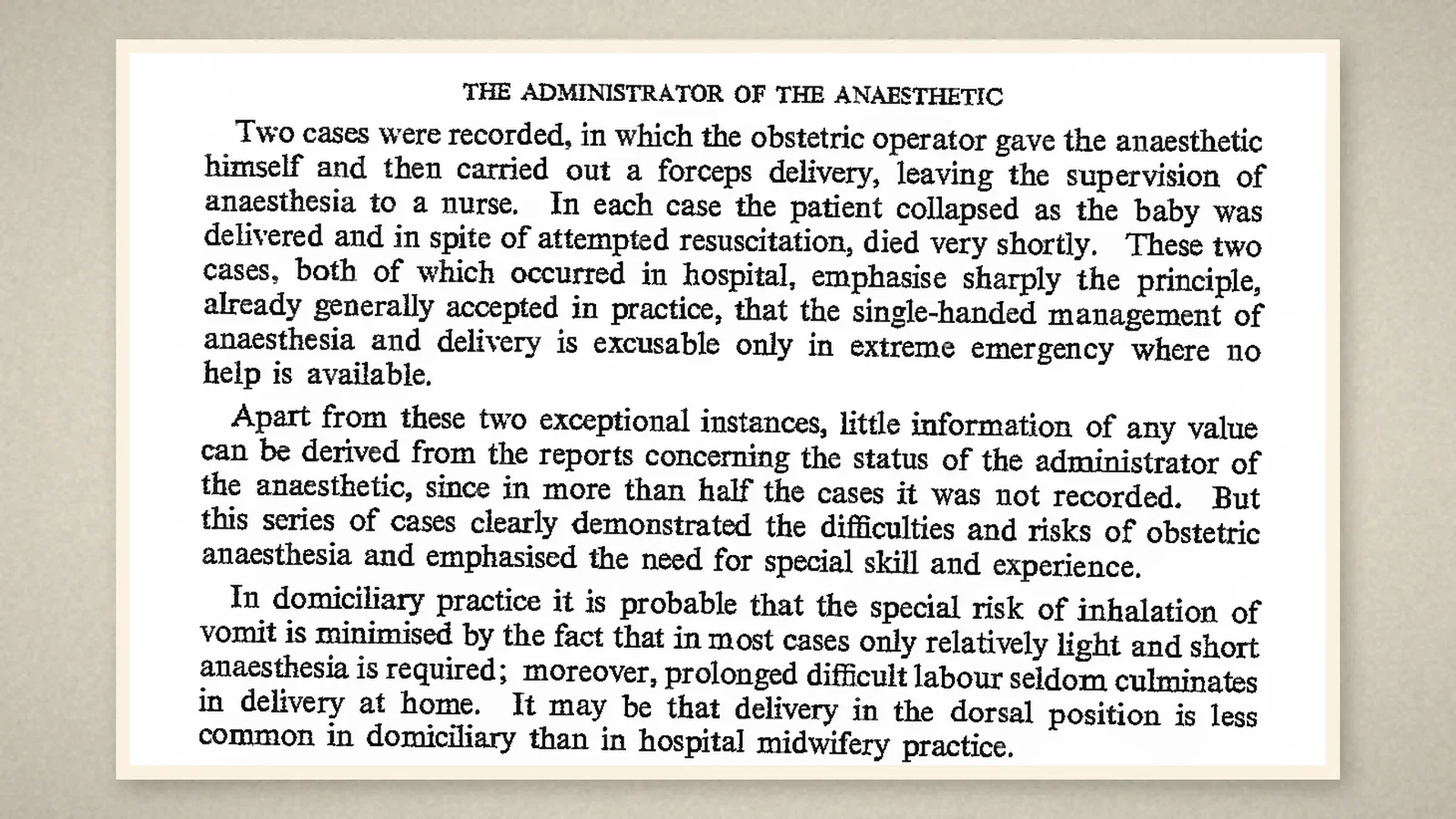
The report recorded two cases in which the obstetrician gave the anaesthetic, carried out a forceps delivery and left the supervision of anaesthesia to a nurse; both were in hospital, and in each the mother collapsed as the baby was delivered and died despite resuscitation. These cases, it said, "emphasise sharply the principle, already generally accepted in practice, that the single-handed management of anaesthesia and delivery is excusable only in extreme emergency where no help is available". Since the administrator's status was not recorded in more than half the cases, little else could be learned, but the series clearly showed the difficulties and risks of obstetric anaesthesia and the need for special skill and experience. [1, p. 42]
The report concluded that in hospital, given the varied and often unexpectedly difficult circumstances of anaesthesia in childbirth, it should not be undertaken by unsupervised and inexperienced junior staff; local anaesthesia was increasingly used, but for general anaesthesia an anaesthetist experienced in obstetric work should be available at night, when such cases so often occur, as well as by day. Most obstetricians, it said, would agree that this was possibly the most important of any measures to lessen the risks of anaesthesia in childbirth. [1, pp. 42-43]
What the record shows
The report combined confidentiality, the absence of individual blame and expert case-by-case assessment of avoidable factors, so that deaths became the basis for improvement. Its observations on aspiration and its demands about who should give obstetric anaesthesia turned the risks of a specialty into recommendations that could be tested and acted on.
Sources and reading limits
Read: Report on Confidential Enquiries into Maternal Deaths in England and Wales 1952-1954 (Ministry of Health Reports on Public Health and Medical Subjects No. 97, HMSO 1957; Internet Archive op1266938-1001, University of Southampton Library digitisation): the title page and contents; chapter 1 on history and method, including the procedure of enquiry and the assessment of avoidable factors (pp. 1-4); and chapter 8 on deaths due to complications of anaesthesia (pp. 40-43); the table of avoidable factors was glanced at. Page images of the title page and pp. 1-2 and 40-42 checked. The History of Anaesthesia Society online timeline entry for 1957 used as the lead.
Not covered: the report's other clinical chapters; the Departmental Committee reports of 1930 and 1932 referred to; later triennial reports.
Limits: the statistics follow the classification of the time. Details of individual cases are not repeated. "First report" is the timeline's phrase; this article makes no such judgement in its own voice.
Three illustrations are taken from the 1957 report (title page, p. 40, p. 42). One is a flow diagram drawn from the report, with no people drawn.
- Walker AL, Wrigley AJ, Marston AD, Hirst KM, Martin WJ. Report on Confidential Enquiries into Maternal Deaths in England and Wales 1952-1954. Reports on Public Health and Medical Subjects No. 97. London: HMSO; 1957. Internet Archive
- History of Anaesthesia Society. Timeline. Web page
Continue exploring
Related reading connects shared questions and contexts; it does not by itself establish historical influence.
- 1848: A Winlaton Girl Dies Under Chloroform, and Simpson Disputes Why
- 1997: Hawkins and the Denominators Behind Obstetric Anesthesia Mortality
- 2012: Singh Tests MEOWS, the Chart That Triggered a Call
Anesthesia Epochs · The Source Room · About & Editorial Method
Published November 4, 2026. Sources and reading limits are stated above. Illustrations are labelled as original source images or AI-made. Historical accounts are educational; they are not current treatment instructions.