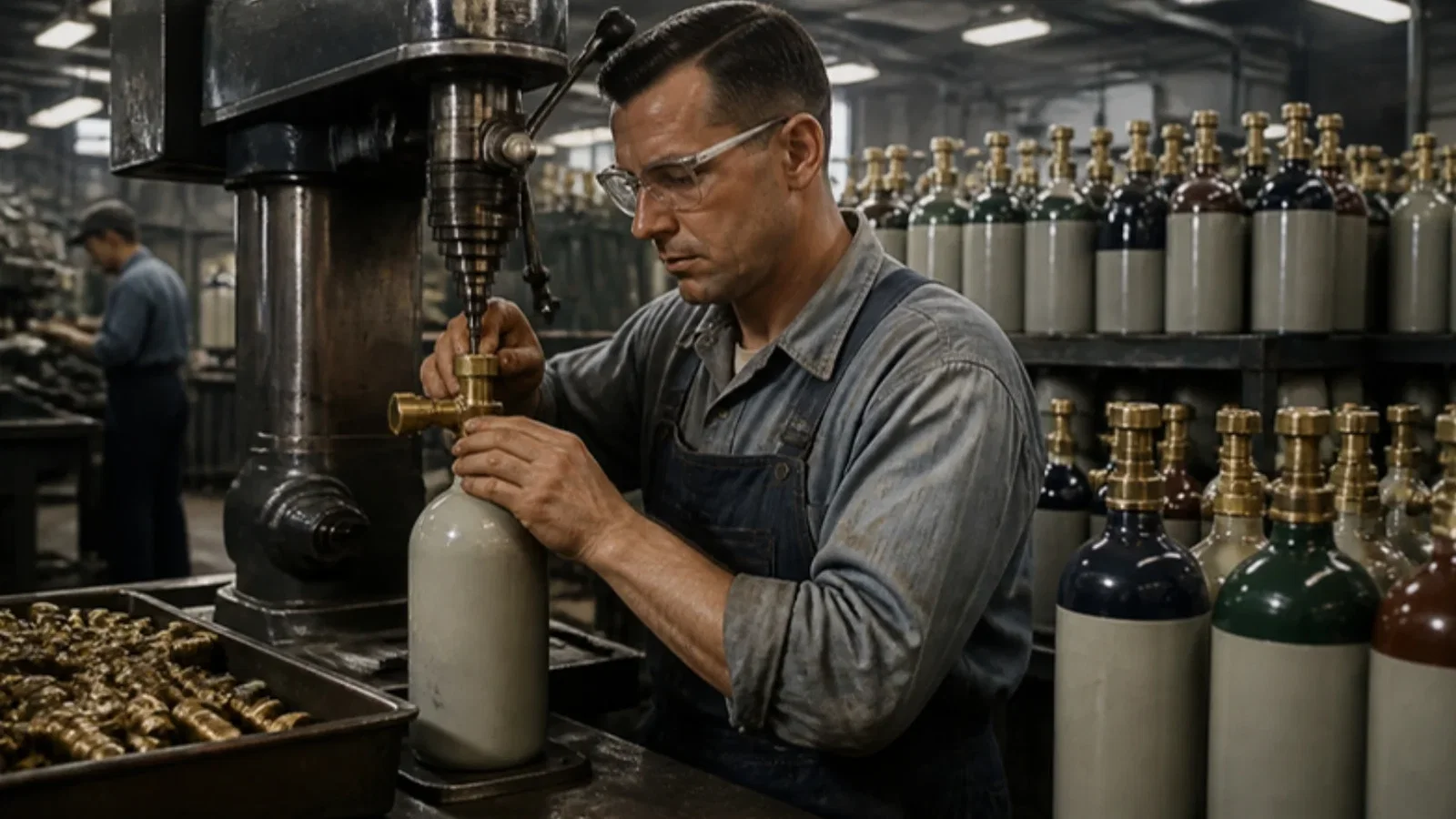
In January 1953 Ohio Chemical & Surgical Equipment Co. told customers that, to eliminate errors in attaching flush-type cylinder valves to anaesthetic apparatus, it had begun drilling all small cylinder valves to the newly standardized Pin-Index Safety System, adopted by the Compressed Gas Association with the American Society of Anesthesiologists and the American Hospital Association: ten combinations, each using two holes in the valve and two matching pins on the yoke. In September F. R. Fetherston of the Compressed Gas Association explained in Standardization that since 1 January 1953 only drilled cylinders had been shipped and that conversion of apparatus began on 1 May, after which a wrong cylinder could not be fitted.
Reading Library · Anesthesia Epochs · 中文版
Watch the education video (for clinicians)
1953: The Pin-Index Safety System — Gas Cylinders · Anesthesia Epochs Education Series
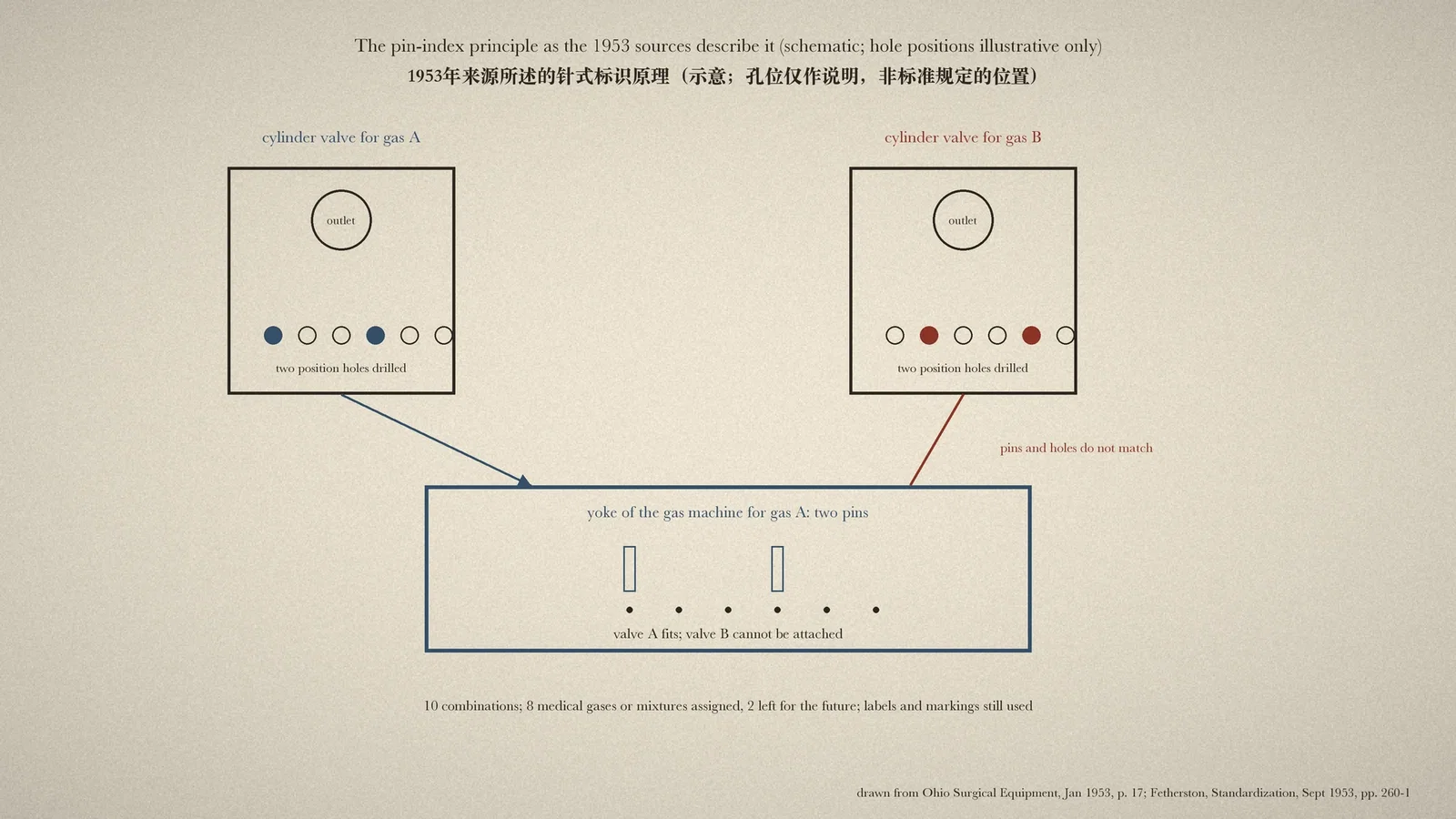
Look at the back of an anaesthetic machine and you will see small cylinders hanging on yokes, each held by a screw, each yoke carrying two short steel pins. The pins are there so that a cylinder of the wrong gas cannot be hung in the wrong place. The arrangement has a name, the Pin-Index Safety System, and two documents from 1953 record the months in which American hospitals changed over to it. [1][2]
The notice to customers
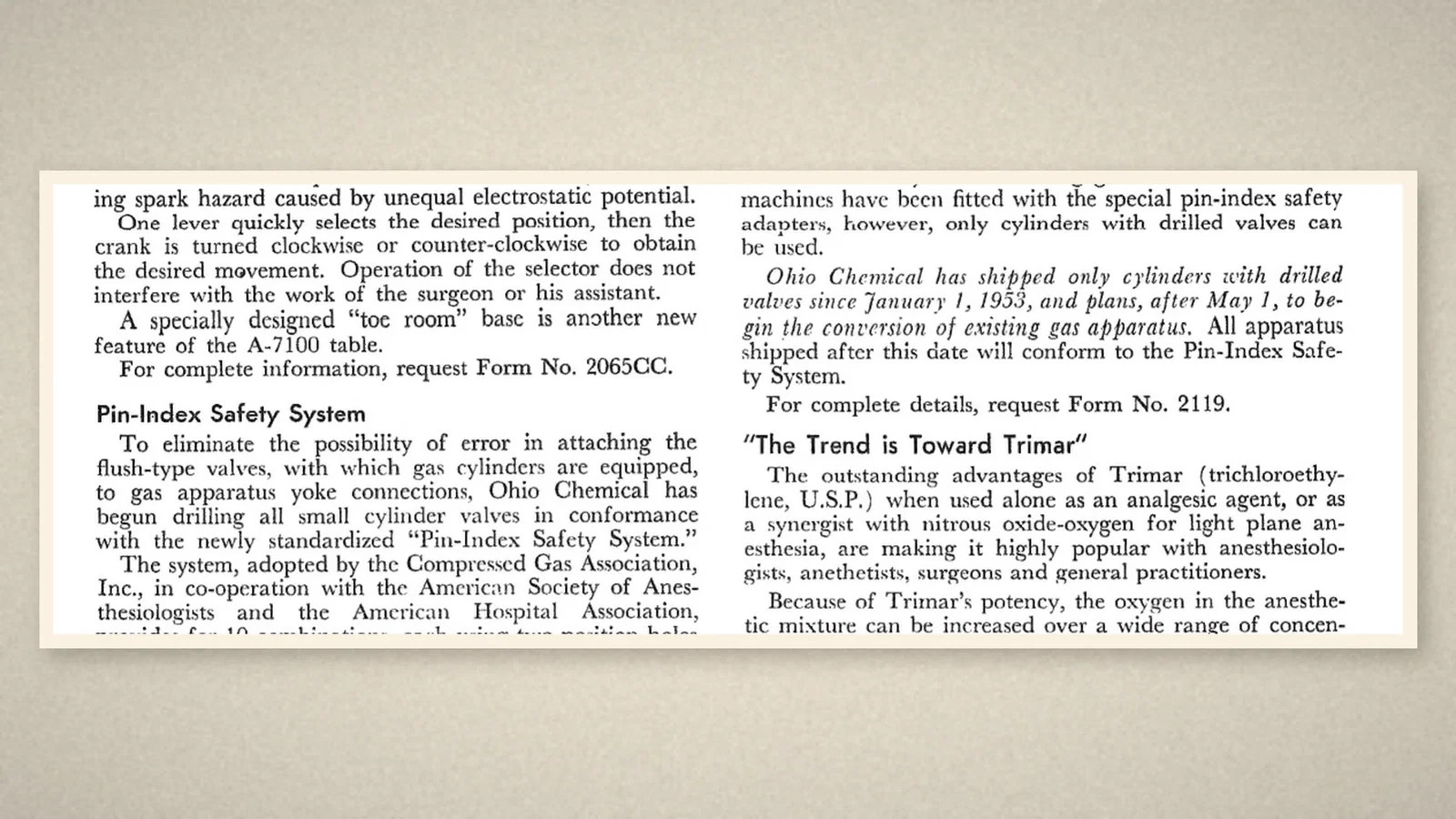
In January 1953 the customer bulletin of the Ohio Chemical & Surgical Equipment Company carried a short item headed "Pin-Index Safety System". "To eliminate the possibility of error in attaching the flush-type valves, with which gas cylinders are equipped, to gas apparatus yoke connections, Ohio Chemical has begun drilling all small cylinder valves in conformance with the newly standardized 'Pin-Index Safety System.'" [1, p. 17]
The system, the bulletin explained, had been "adopted by the Compressed Gas Association, Inc., in co-operation with the American Society of Anesthesiologists and the American Hospital Association". It "provides for 10 combinations, each using two position holes on the cylinder valve, and two corresponding pins on the yoke". Eight medical gases or gas mixtures had been assigned, leaving two combinations for the future. Drilled valves were marked with a small black tab. A drilled cylinder would still fit an old machine; but once a machine had been fitted with "the special pin-index safety adapters", only drilled cylinders could be used. Ohio had shipped only drilled cylinders "since January 1, 1953", and planned to begin converting existing apparatus after 1 May. [1, p. 17]
Why it was needed
In September 1953 the magazine of the American Standards Association, Standardization, gave the system a photo page headed "Two pins may mean the difference between life and death" and an article by F. R. Fetherston, secretary-treasurer of the Compressed Gas Association, titled "Not even one unnecessary death". [2, pp. 260-1]
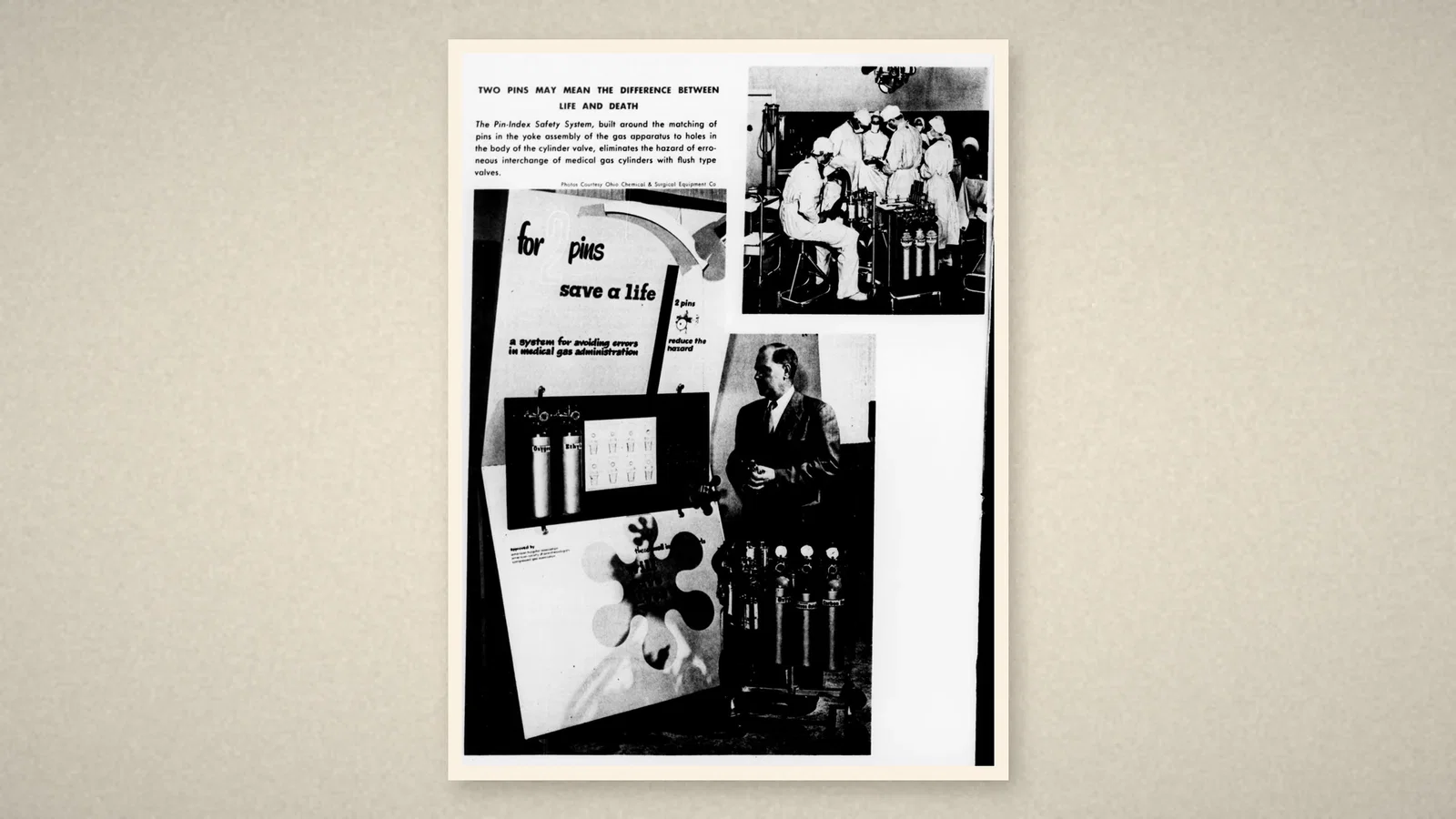
Fetherston began with the hazard. Despite every precaution, hospitals, dentists' and doctors' offices had found it impossible to prevent human errors "that have at times caused carbon dioxide to be administered instead of oxygen, or helium instead of cyclopropane, for example, with fatal results". An attendant, "through preoccupation, mental lapse, or pure carelessness", might fit a carbon dioxide cylinder where an oxygen cylinder should have gone; some machines carried as many as eight different cylinders at once. [2, p. 261]
The remedy was mechanical. "Now, two pins are being placed on the yoke connections in certain designated positions, a different position for each type of gas. Two holes are placed in a corresponding position in the valve connection of the gas cylinder. For any one gas there is only one combination of pins and holes." Unless the right valve was connected, "the holes and pins will not match and the two parts will not fit together". The same connections were used at the filling plant to make sure each cylinder held the gas it was meant to hold. [2, p. 261]
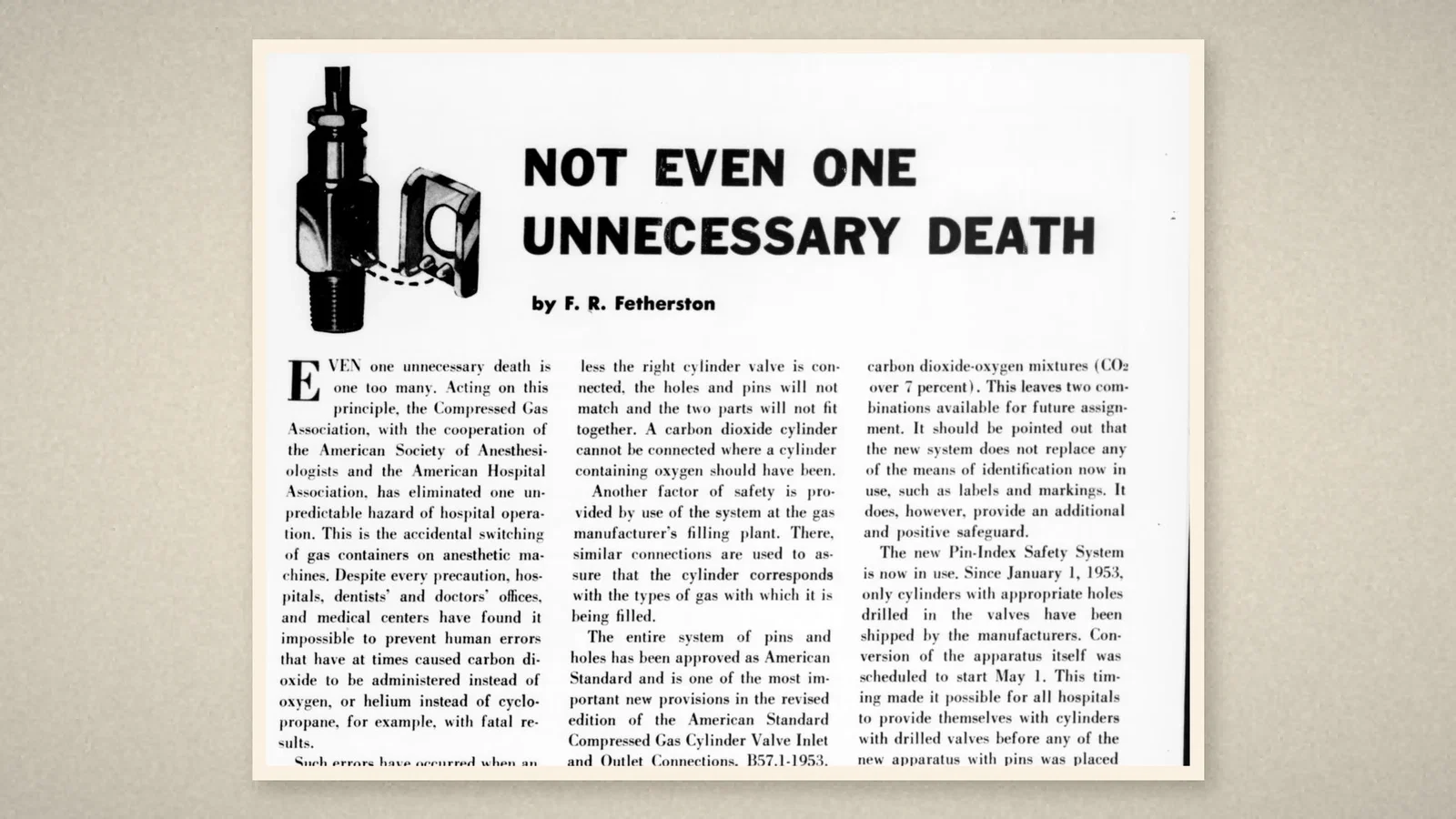
The pins and holes had been approved as part of an American Standard for cylinder valve connections, B57.1-1953. Fetherston was careful about what the system did not do: it "does not replace any of the means of identification now in use, such as labels and markings", but adds "an additional and positive safeguard". The changeover was staged so that hospitals held drilled cylinders before any pinned apparatus arrived, and old machines could be converted with a yoke adapter carrying the pins. [2, p. 261]
The timelines
The Australian Society of Anaesthetists (ASA) timeline dates the Pin-Index and Diameter-Index Safety Systems to 1952 and credits Wayne Hay and Harold May of the Ohio company, who, it says, donated the patents, granted in 1963, to the Compressed Gas Association, so that every manufacturer could make safe equipment. The New Zealand Society of Anaesthetists also lists "Pin index system introduced" under 1952. Under 1955 the ASA records a pin-index system for attaching gas cylinders added to the redesigned Boyle's machine in Belfast. [3, pp. 60, 63][4]
What the record shows
A fix for a fatal error that did not depend on anyone being careful. Labels can be misread; two pins cannot be argued with. The 1953 records show the change being made in stages, cylinders first and machines second, so that no hospital was left with a machine that would accept nothing.
Sources and reading limits
Read: the Ohio Chemical notice in Ohio Surgical Equipment, January 1953, p. 17; the photo page and Fetherston's article in Standardization, September 1953, pp. 260-1; the ASA timeline entries for 1952 and 1955; the NZSA timeline.
Not covered: the Compressed Gas Association pamphlet and American Standard B57.1-1953 themselves; Ohio Chemical's explanatory folder; the patents credited to Hay and May; any report by the American Society of Anesthesiologists on the adoption; British records of the 1955 adoption.
Limits: the ASA and NZSA date the system to 1952. The 1953 sources describe it as newly standardized, with some drilled cylinders shipped before the end of 1952, drilled-only shipments from 1 January 1953 and conversion of apparatus from 1 May 1953. Neither 1953 source names an inventor; the attribution to Hay and May and the patent year are the ASA's. The composition limits of the gas mixtures in the standard are not repeated. The schematic's hole positions are illustrative, not the standard's assignments. Quotations are from the English originals.
Three illustrations are crops of the 1953 bulletin and magazine; one is drawn from them.
- Ohio Chemical & Surgical Equipment Co. Pin-Index Safety System. Ohio Surgical Equipment. 1953 Jan:17. Internet Archive
- Fetherston FR. Not even one unnecessary death. Standardization. 1953;24(9):260-2. Internet Archive
- Australian Society of Anaesthetists. Anaesthesia history timeline. 2024. ASA
- New Zealand Society of Anaesthetists. History of anaesthesia. NZSA
Continue exploring
Related reading connects shared questions and contexts; it does not by itself establish historical influence.
Anesthesia Epochs · The Source Room · About & Editorial Method
Published November 3, 2026. Sources and reading limits are stated above. Illustrations are labelled as original source images or AI-made. Historical accounts are educational; they are not current treatment instructions.