Looking back in 1958, H. G. Epstein of the Nuffield Department of Anaesthetics at Oxford explained that the spread of muscle relaxants had lowered the ether concentrations needed enough to allow quantitative inhalers without any special heat source; the prototype designed in 1952 placed an automatic thermo-compensator in the vapour chamber, which opened its orifice as the ether cooled so that more of the inspired air passed over the ether while the concentration setting stayed the same; a water jacket, permanently filled, acted as a heat buffer; the production EMO worked with the Oxford inflating bellows for spontaneous or assisted breathing.
Reading Library · Anesthesia Epochs · 中文版
Watch the education video (for clinicians)
1952: The EMO Ether Inhaler — Oxford · Anesthesia Epochs Education Series
The Oxford vaporizer of 1941 kept its ether warm with hot water poured round a heat store. A decade later the same Oxford department built a draw-over ether inhaler that needed no heat source at all. The Australian Society of Anaesthetists (ASA) timeline records that the E.M.O. (Epstein, Macintosh, Oxford) inhaler "began to be designed" in 1952, with the department's technician Richard Salt, and reached commercial production in 1956. This article reads the designers' own accounts: H. G. Epstein and Sir Robert Macintosh's original description of the inhaler in Anaesthesia in January 1956, and Epstein's review "Principles of inhalers for volatile anaesthetics" in the British Medical Bulletin of 1958, which shows the 1952 prototype. [3][1][2]
A neglected class of apparatus
Epstein, of the Nuffield Department of Anaesthetics at the Radcliffe Infirmary, Oxford, began with a complaint. In many respects, "draw-over inhalers have led a Cinderella existence compared with other anaesthetic apparatus". Intravenous anaesthesia had been made quantitative with graduated syringes, and gas mixtures had been metered since Neu first used a flowmeter on an anaesthetic apparatus in 1910; yet vaporizing bottles and draw-over inhalers "were used for many years with practically no knowledge of the mixtures delivered by them". Draw-over inhalers, which deliver the anaesthetic mixture "by the inspiratory effort of the patient", had an honourable tradition, but a simple bottle cools quickly as the liquid evaporates, and its output falls with the temperature. [1]
The Oxford Vaporiser of 1941, designed at the start of the Second World War, solved that problem with hot water as the heat source and a chemical thermostat, a crystalline substance at its melting point, interposed between the hot water and the ether, which kept the ether at a constant temperature below its boiling point. [1]
Letting the surroundings be the heat source
Section 8 of the review explains what changed. "The increasing use of muscle relaxants during the past decade, and the correspondingly lower ether concentrations required in conjunction with them, has made possible the design of quantitative inhalers without any special heat source." [1]
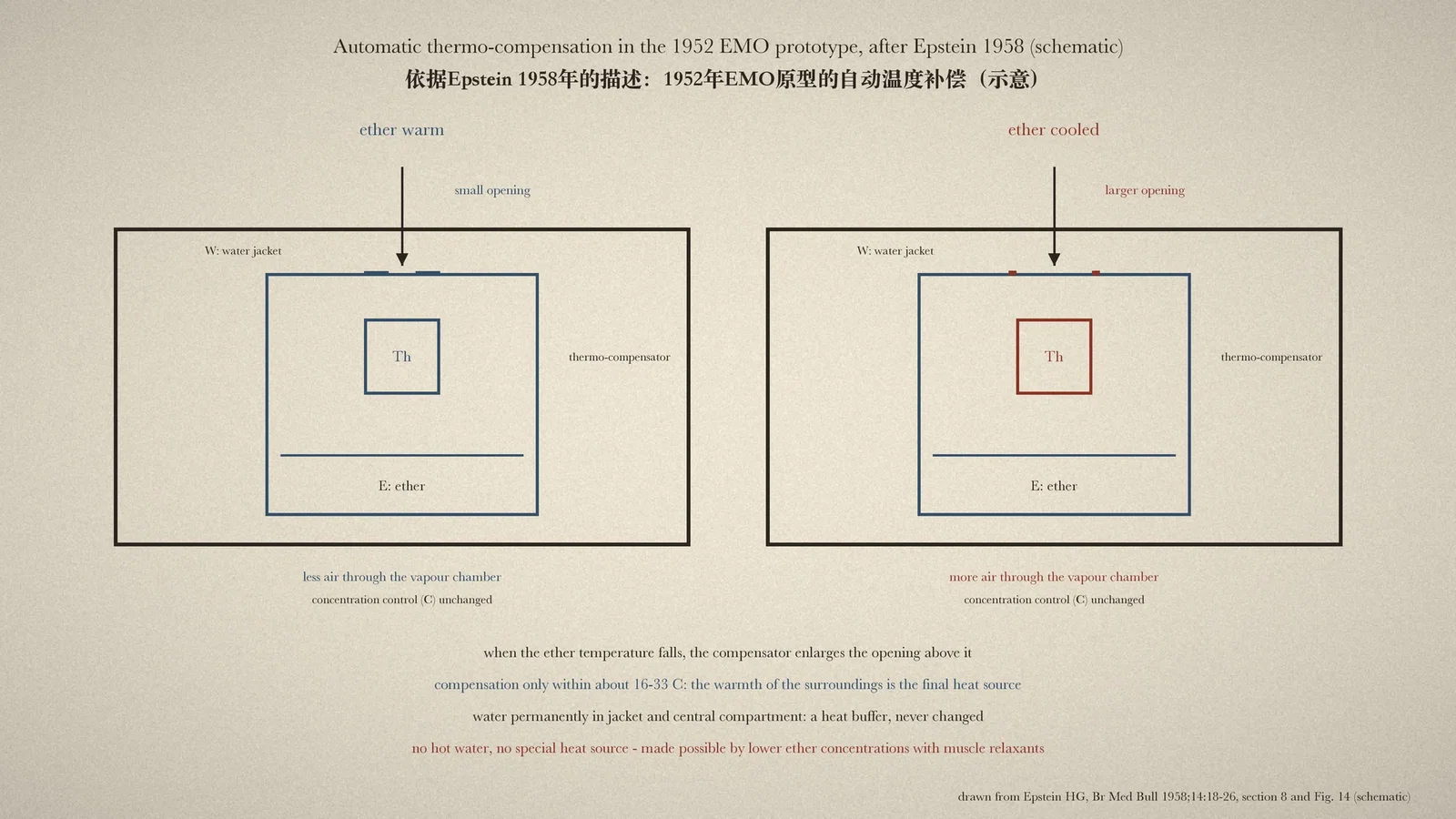
"The scheme of a model designed in 1952 (fig. 14) shows an automatic thermo-compensator (Th) in the vapour compartment. When the ether temperature falls, the compensator increases the size of the opening above it, and a greater proportion of the inspired air passes through the vapour chamber, while the concentration control (C) remains unaltered." The caption of Fig. 14 puts it more simply: "The thermo-compensator contracts and increases the opening in the orifice above it when the ether cools." [1]
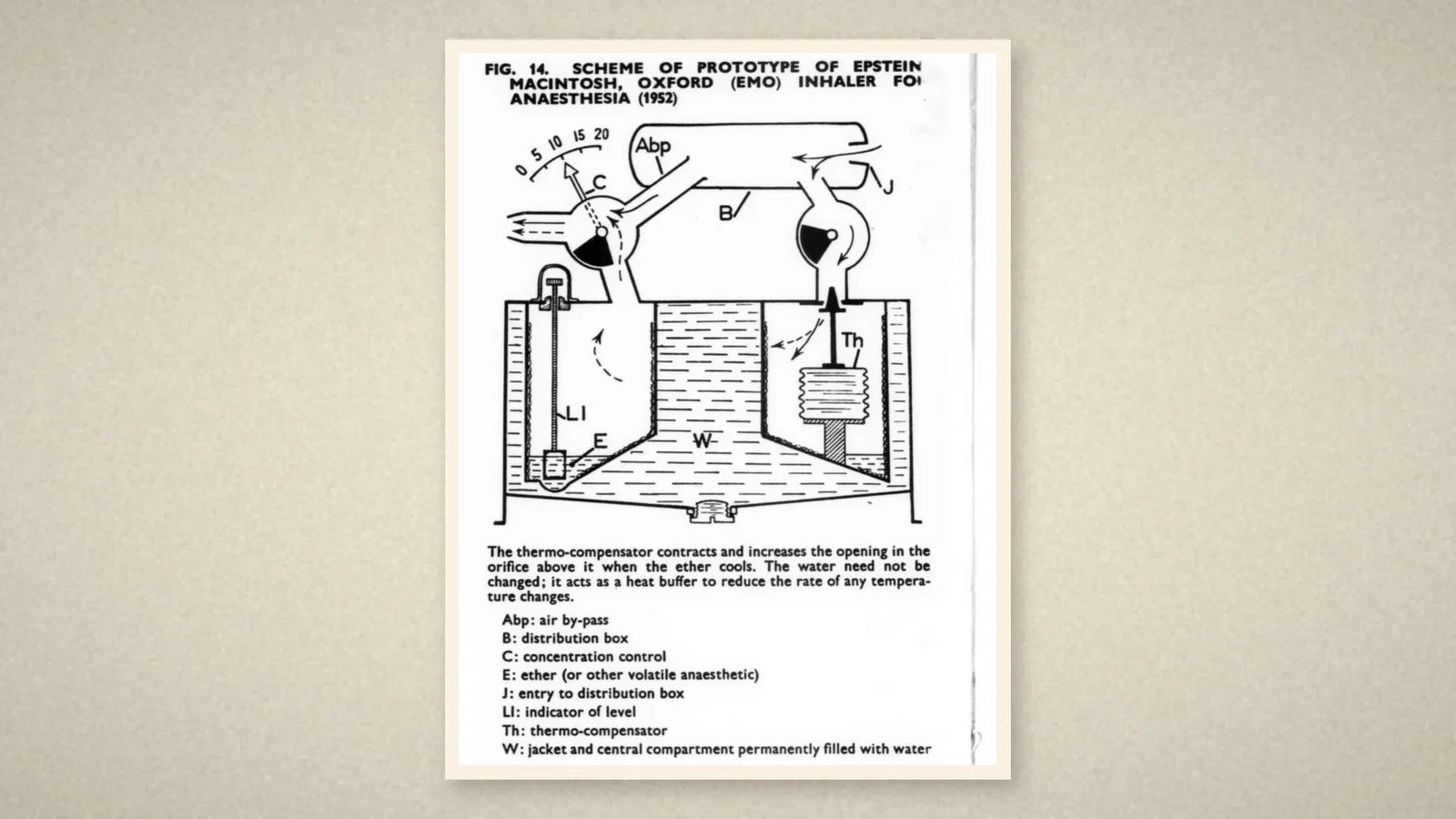
There was a limit. Compensation was possible "only within a limited temperature range (16–33° C.), because the warmth of the surroundings is the final heat source". A jacket and central compartment "permanently filled with water" gave a high heat capacity and prevented any rapid drop in ether temperature even at high settings; "the water need not be changed". The diluting air passed through a tubular by-pass, arranged so that the proportion of diluting air rose with the minute volume and the inspired concentration stayed constant. [1]
The 1956 description
The paper in Anaesthesia opens with its purpose: "This inhaler, the EMO, has been designed to deliver any desired concentration of anaesthetic vapour, irrespective of variations in the temperature of the liquid anaesthetic throughout the range likely to be encountered in clinical practice." It was calibrated for ether, and "with minor modifications" could be used for other liquid anaesthetics. [3, p. 83]
A series of simple diagrams take the reader through the inhaler. As the patient breathes in, air is drawn through two openings: part flows over the liquid ether and picks up vapour, part bypasses the chamber, and the two streams join before reaching the patient. A hand-operated control tap, whose pointer moves over a scale, shares the air between the two paths; a stop ensures that the by-pass "is never completely occluded". [3, pp. 83-4]
Then the thermo-compensator: "a small metal bellows containing a liquid", fitted inside the vaporising chamber below the outlet, with a cone-shaped plunger. When the inhaler warms, the bellows expands and the plunger rises into the outlet, narrowing it, so that less of the strong vapour leaves the chamber; when it cools, the bellows contracts, the outlet widens and more of the weaker vapour passes. In both cases, the authors write, "the strength of the final mixture is unaltered" for the same setting of the tap. [3, p. 85]
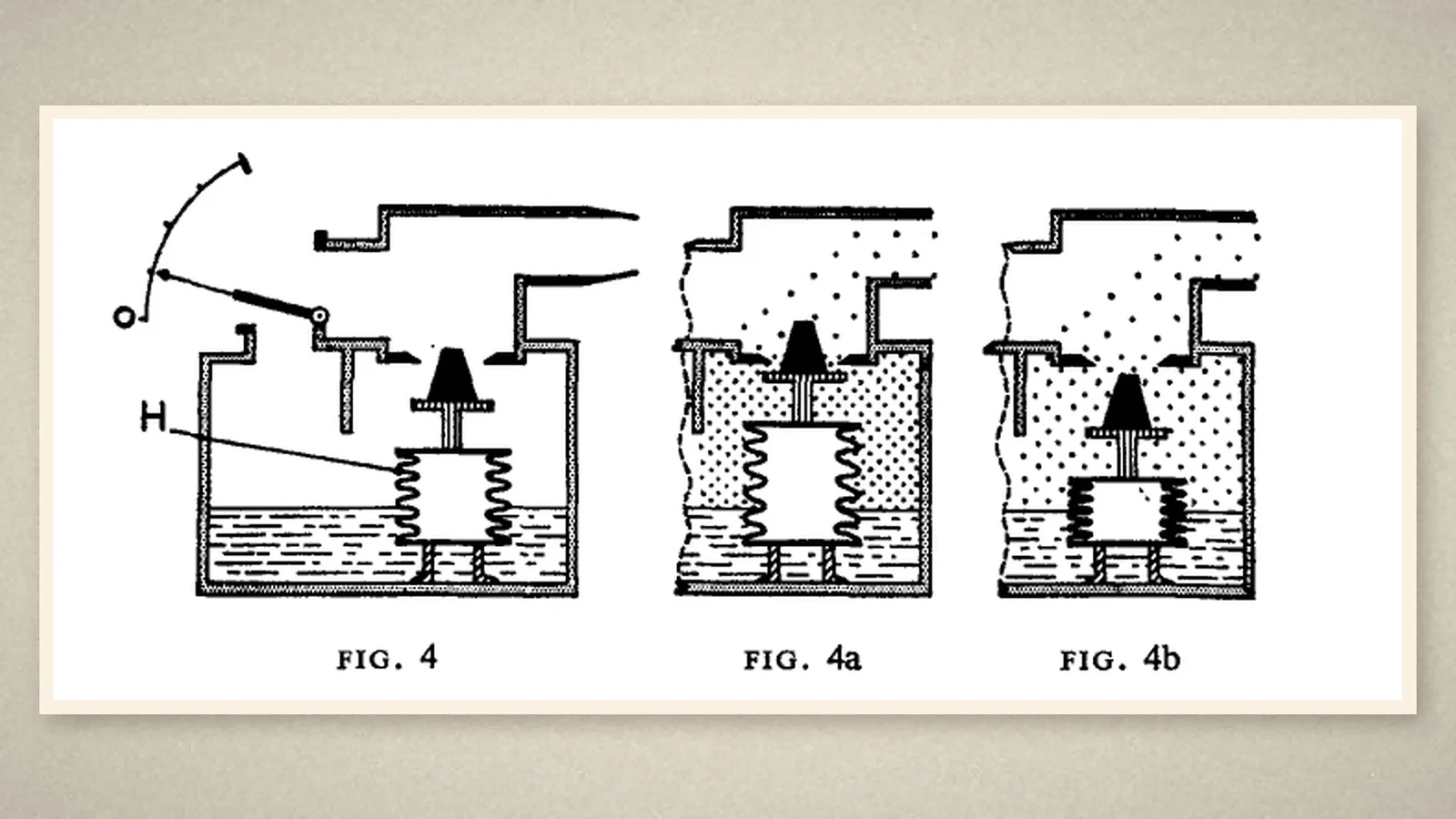
The depth of the patient's breathing could also change the output, and the paper lists the features that had to be balanced against it: the shape of the chamber and its wicks, the air passages, the travel of the bellows, the shape of the plunger. The authors did not set out the theory. "In practice repeated laboratory experiments had to be carried out: in fact, trial and error contribute significantly to the final design." In the finished inhaler, the vaporising chamber is annular and lined with wicks, and water around it "plays the part of heat buffer", slowing the effect of changes in room temperature and the fall in ether temperature during heavy use; normally there was no need to change it, though it could be emptied when weight mattered, "as in air transport". [3, pp. 85-8]
The EMO was designed "primarily as a 'draw-over' inhaler to be used in conjunction with an Oxford Inflating Bellows" to deliver ether and air, but with its top boxed in it could also be fed from a nitrous oxide-oxygen machine as a plenum system. The authors thanked "Mr. R. Salt, Senior Technician to this Department, for building various prototypes", and gave the Pentland Instrument Co of Oxford as the source of particulars. [3, p. 88]
The production inhaler
The performance data in Epstein's 1958 review were measured with "production models of the Epstein, Macintosh, Oxford (EMO) inhaler (Epstein & Macintosh, 1956)". With the compensator working, the output held steady as the room temperature changed; with it deliberately locked, the concentration drifted. The compensator also steadied the output during prolonged delivery at a constant room temperature. Fig. 18 shows the concentration held within narrow bands for minute volumes up to 12 litres a minute and respiratory rates up to 35 a minute, measured with a respiration pump. [1]
Fig. 17 shows the EMO "with Oxford inflating bellows (OIB) unit arranged for ether and air inhalation": air entered the EMO and the bellows lay between inhaler and patient, drawing fresh mixture from the inhaler as they returned to rest. Turned round, with the bellows at the inlet as a reservoir, the same apparatus could be fed with anaesthetic gases as a plenum system. Epstein added that similar inhalers had been built for Fluothane, and acknowledged that "prototypes of the inhalers developed at Oxford were constructed in collaboration with Mr Richard Salt, Chief Technician to the Nuffield Department of Anaesthetics". [1]
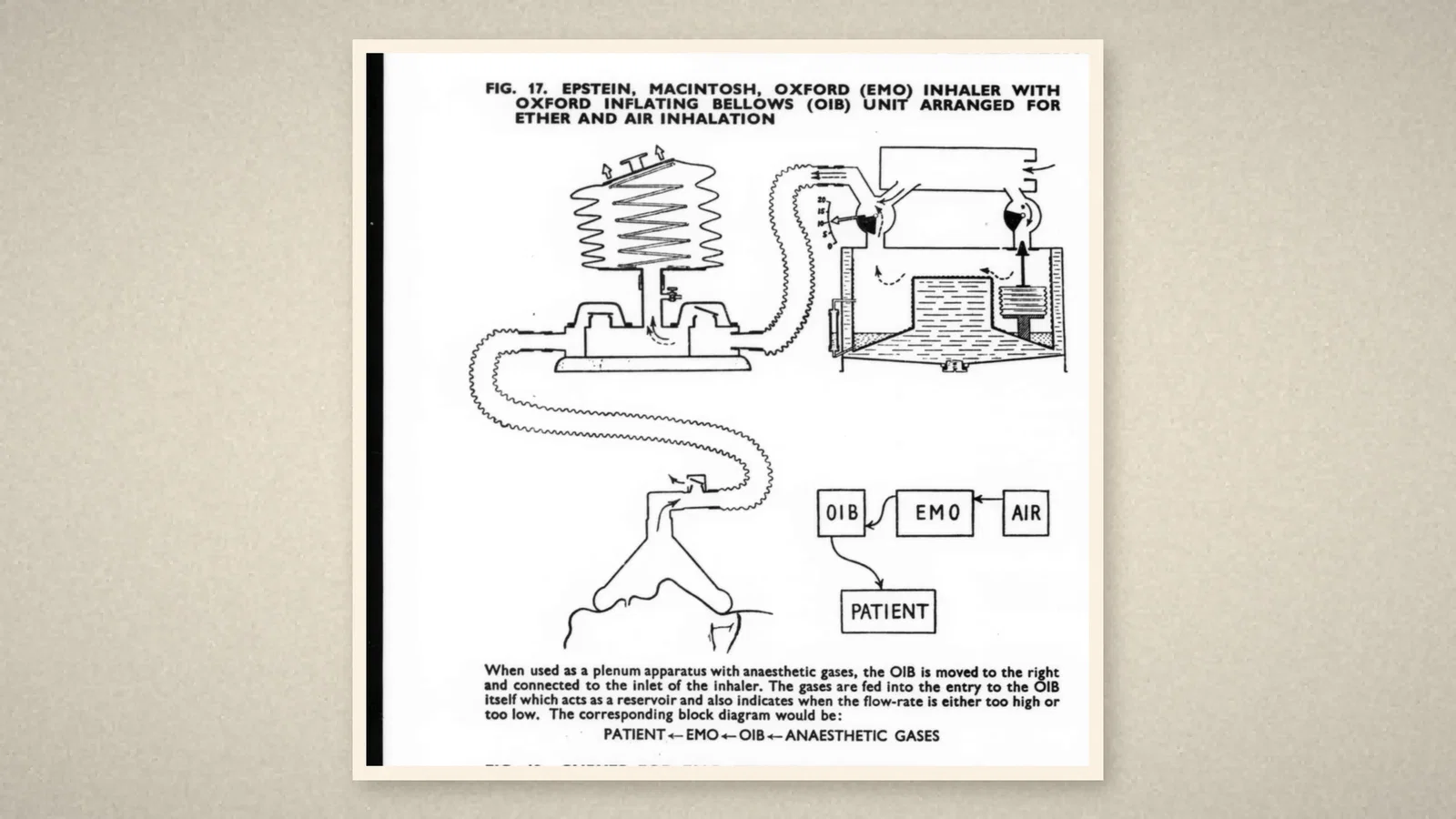
The ASA states the advantage directly: the EMO "did not require a special heat source, which gave it an advantage over the Oxford vaporizer". [2]
What the record shows
The EMO turned the problem of the Oxford vaporizer upside down. Instead of holding the ether at a fixed temperature, it let the temperature drift within limits and corrected the air flow mechanically. A water mass slowed the drift, a bellows-type compensator corrected it, and the room supplied the heat. The result was a quantitative draw-over inhaler that needed neither cylinders, electricity nor hot water. Epstein's review also records the clinical change that made the design possible: with muscle relaxants in use, lower ether concentrations were required.
Sources and reading limits
Read: Epstein HG and Macintosh RR, Anaesthesia 1956;11(1):83-8, in full; Epstein HG, Br Med Bull 1958;14:18-26, in full; the ASA timeline entry for 1952.
Not covered: Macintosh's 1953 description of the Oxford inflating bellows, cited in the 1956 paper; Epstein's 1955 article. The 1956 paper describes the production inhaler and does not date the design; the 1952 date is Epstein's (1958) and the ASA's, and the 1956 production date is the ASA's, consistent with the paper. The 1956 paper calls Salt "Senior Technician", the 1958 review "Chief Technician". Performance data are laboratory measurements with a pump, not clinical results. Concentration settings and the storage temperatures given in the 1956 paper are not repeated. Quotations are from the English originals.
Three illustrations are crops of the 1958 review (Figs. 14 and 17) and of the 1956 paper (Figs. 4, 4a and 4b); one is drawn from the text.
- Epstein HG. Principles of inhalers for volatile anaesthetics. Br Med Bull. 1958;14(1):18-26. Internet Archive
- Australian Society of Anaesthetists. Anaesthesia history timeline. 2024. ASA
- Epstein HG, Macintosh RR. An anaesthetic inhaler with automatic thermo-compensation. Anaesthesia. 1956;11(1):83-8. DOI
Continue exploring
Related reading connects shared questions and contexts; it does not by itself establish historical influence.
- 1941: The Oxford Ether Vaporizer Keeps Ether at Constant Temperature
- 1949: Carlens's Double-Lumen Catheter Separates the Two Lungs
Anesthesia Epochs · The Source Room · About & Editorial Method
Published November 2, 2026; updated November 3, 2026. Sources and reading limits are stated above. Illustrations are labelled as original source images or AI-made. Historical accounts are educational; they are not current treatment instructions.