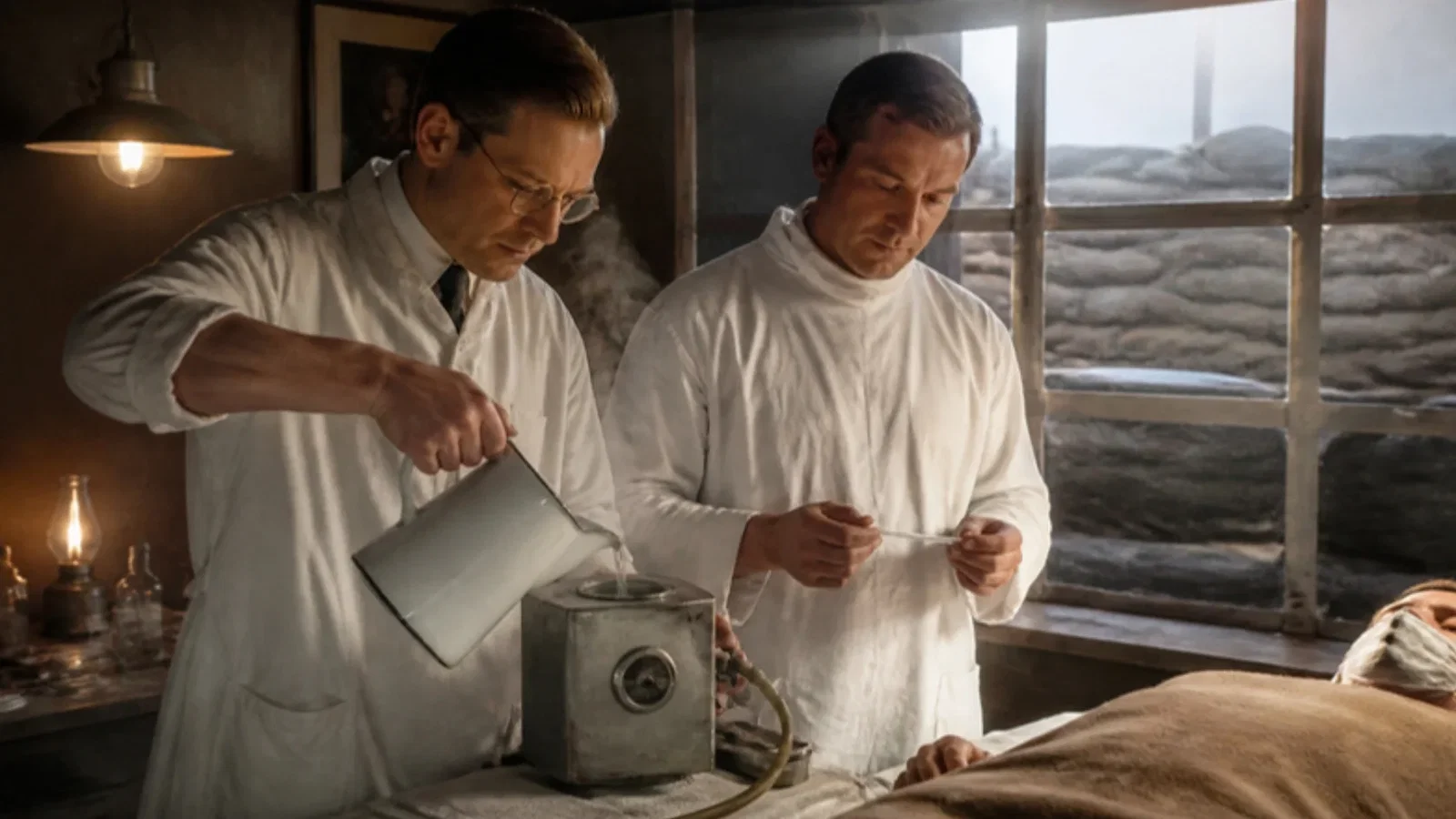
The Nuffield Department of Anaesthetics at Oxford set the ether chamber inside two further containers, crystals of calcium chloride melting at about 30 C in the middle and hot water outside; the molten salt gave up its latent heat as it recrystallized, holding the ether and its vapour concentration constant; air drawn in through a valve as the patient breathed was divided by a calibrated mixing tap between the ether surface and a by-pass; no compressed-gas cylinders were needed, a spring-loaded bag allowed hand ventilation, and Lord Nuffield decided to present a thousand to the Services.
Reading Library · Anesthesia Epochs · 中文版
Watch the education video (for clinicians)
1941: The Oxford Ether Vaporizer — Nuffield Department · Anesthesia Epochs Education Series
Every modern vaporizer must solve the same small problem of physics: a liquid cools as it evaporates, and as it cools it gives off less vapour. The Australian Society of Anaesthetists (ASA) timeline records under 1941 the Oxford ether vaporizer of the Nuffield Department of Anaesthetics at the Radcliffe Infirmary, Oxford. The four Lancet articles of 19 July 1941 that described it are not covered here. What follows reads two contemporary summaries of them, in the British Medical Journal of 9 August 1941 and in the abstracts of Surgery, Gynecology and Obstetrics of January 1942, and a letter of 1944 by R. R. Macintosh of the same department. [1][2][3][4]
A heat store for the ether
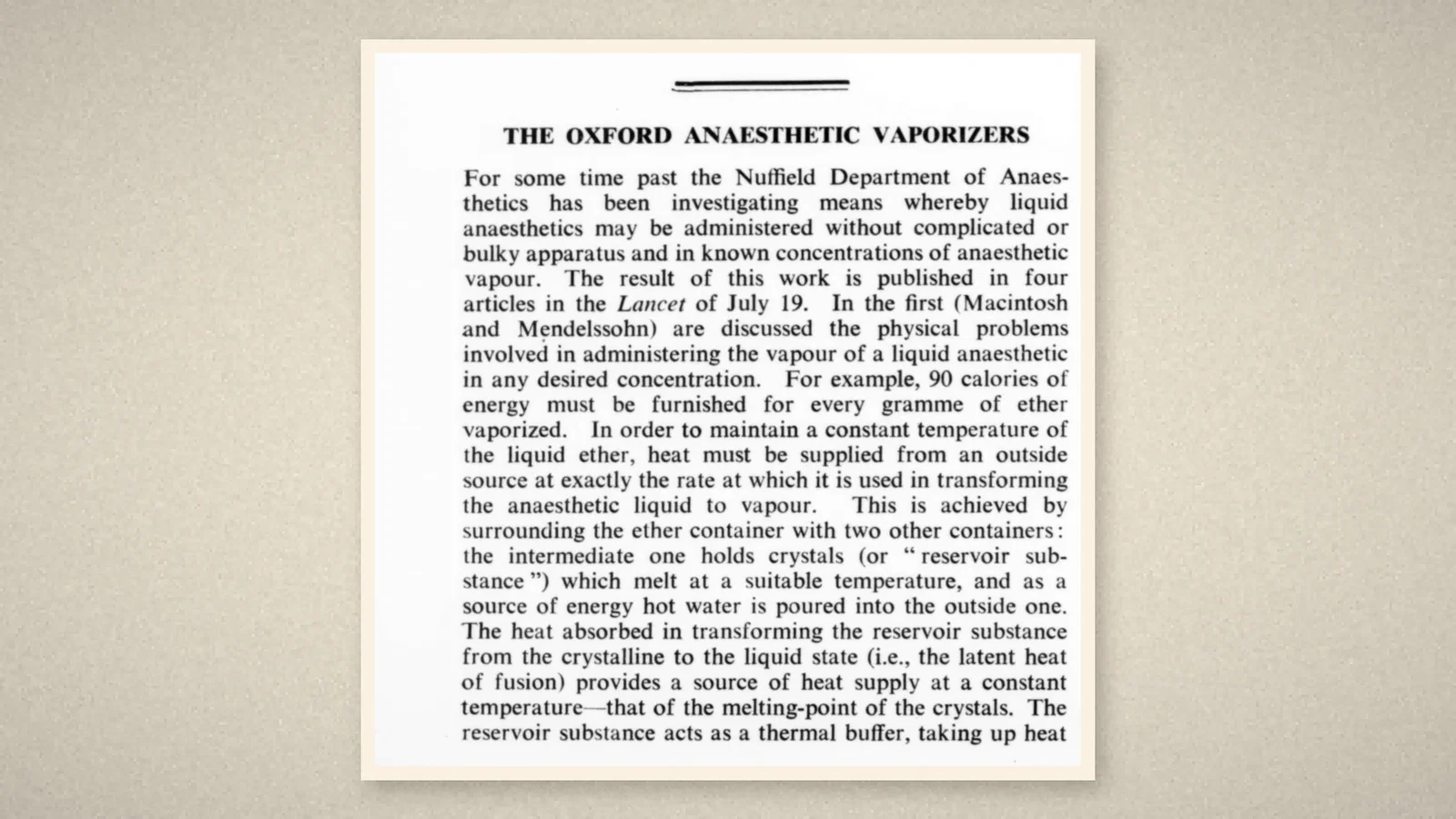
The BMJ explained the aim: for some time the Oxford department had been looking for ways to give liquid anaesthetics "without complicated or bulky apparatus and in known concentrations of anaesthetic vapour". The first Lancet paper, by Macintosh and K. Mendelssohn, set out the physics. "For example, 90 calories of energy must be furnished for every gramme of ether vaporized." To keep the liquid ether at a steady temperature, heat had to be supplied "at exactly the rate at which it is used". [1]
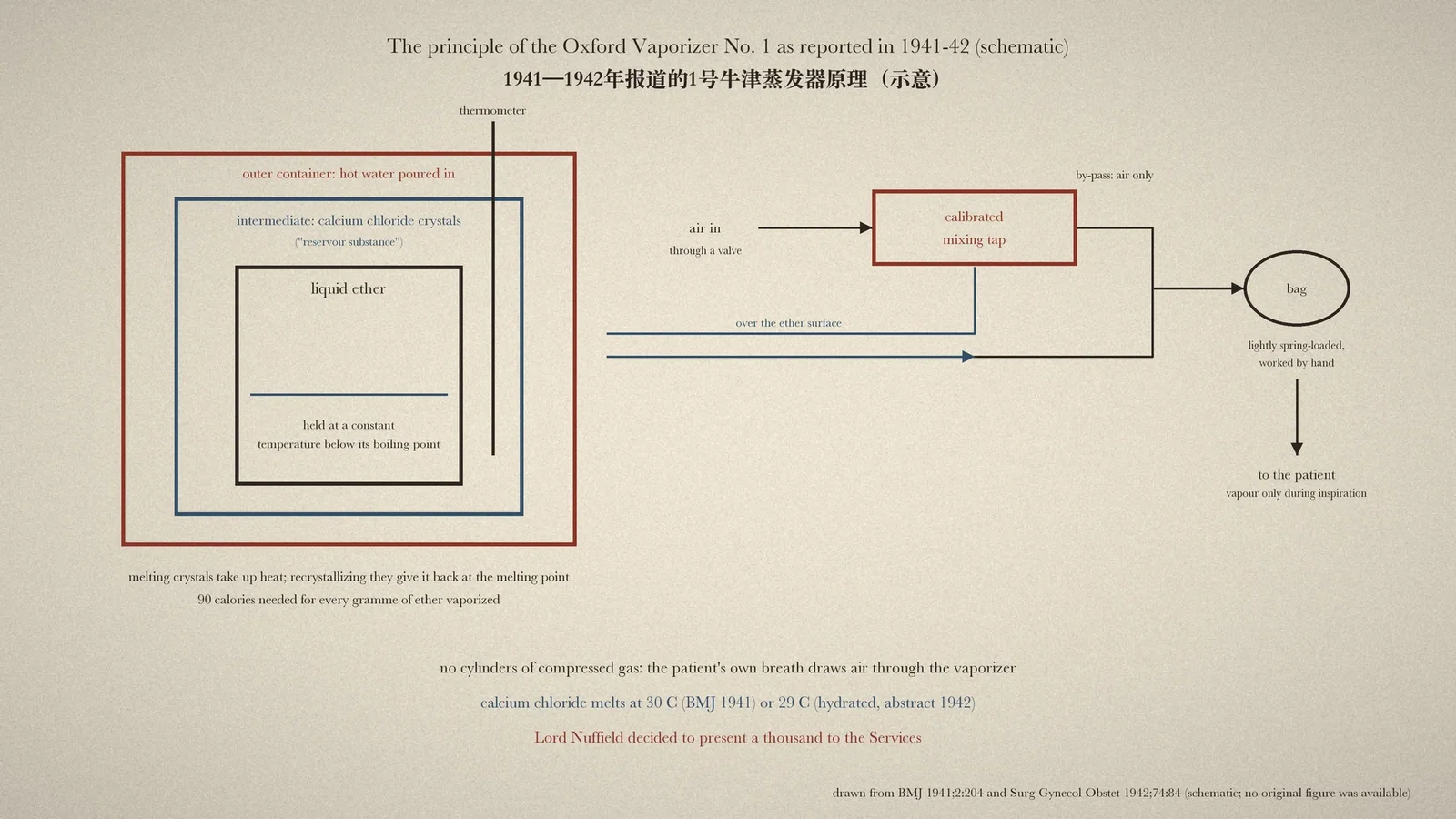
The solution was a set of nested containers. The ether container was surrounded "with two other containers": the intermediate one held crystals, a "reservoir substance" that melts at a suitable temperature, and hot water was poured into the outer one. The heat taken up as the crystals melted, their latent heat of fusion, was given back at the melting point as they set again; the reservoir substance "acts as a thermal buffer". A thermometer in the intermediate container showed by a sudden fall in temperature that the crystals had all set again, the signal to pour in more hot water. [1]
The Oxford Vaporizer No. 1
The second paper, by H. G. Epstein, Macintosh and Mendelssohn, described the Oxford Vaporizer No. 1. Here the reservoir substance was calcium chloride. The BMJ gives its melting point as 30 C; the 1942 abstract, which names "hydrated calcium chloride", gives 29 C, as does the ASA. With the ether held at that temperature, below its boiling point, there was always a constant and high concentration of ether vapour in the container. [1][2][4]
When the patient breathed, "air is drawn in through a valve". A mixing tap then sent the air "wholly or in part" over the surface of the ether, or by-passed it straight to the patient, who then received air only. The abstract adds that the tap was calibrated, so that its setting determined how much of the inspired air passed through the vaporizer. Since the machine delivered vapour only during inspiration, it was economical. A "lightly spring-loaded spirometer bag" could be worked by hand, so that artificial ventilation could be given with or without anaesthetic vapour. [1][2]
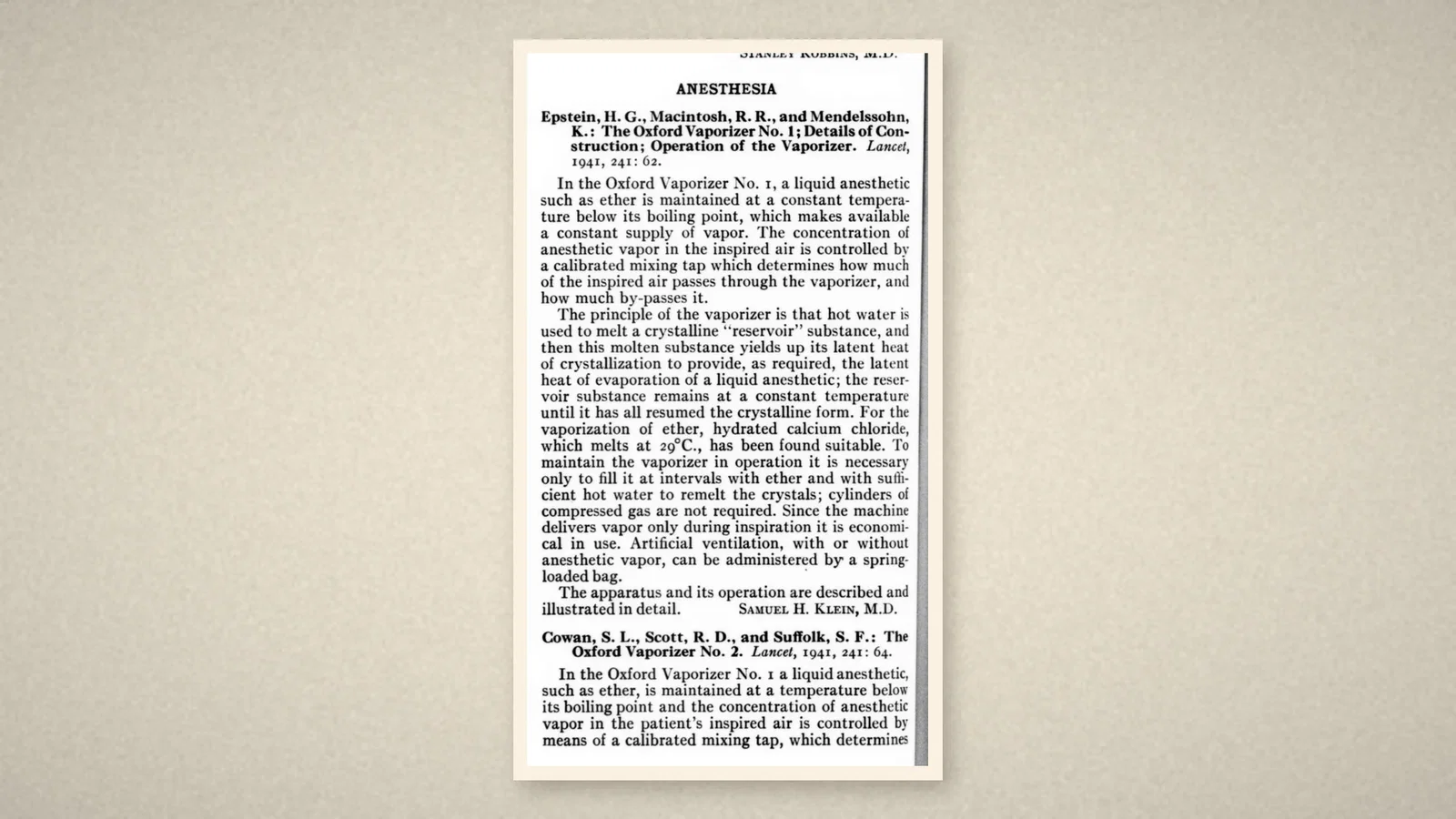
What made it unusual was what it did without. Air drawn in by the patient took the place of "the bulky cylinders of gases in common use" as the force that carried the vapour to the patient; to keep the vaporizer working it was necessary only to add ether and enough hot water to remelt the crystals, and "cylinders of compressed gas are not required". The BMJ called the economy in transporting cylinders "one of the outstanding features of this apparatus", and reported that Lord Nuffield had decided to present a thousand vaporizers to the Services. [1][2]
No. 2 and the trials
The third paper, by S. L. Cowan, R. D. Scott and S. F. Suffolk, described a different instrument, the Oxford Vaporizer No. 2: ether in a closed vessel held above its boiling point, released through a valve and measured by a flowmeter, then mixed with oxygen and, if wanted, nitrous oxide; the flowmeter and mixing chamber were kept warm by the same kind of reservoir substance to stop the vapour condensing. In the fourth paper E. A. Pask and Epstein reported on performance. In the BMJ's summary, the "definite smooth control" of No. 1 gave the anaesthetist "confidence in supervising less experienced helpers" when several patients had to be anaesthetised in an emergency; it made light ether anaesthesia easier, could be used for analgesia, and warm vapour seemed less irritating than cold. [1][2]
Built for war
Three years later a correspondent, Dr Durrans, wrote to the BMJ appalled by the incidence of vomiting reported in a paper from the Oxford department. Macintosh replied on 1 July 1944 that "the Oxford vaporizer was introduced not as a panacea for post-operative vomiting, but as a means of providing simple safe anaesthesia, particularly in war conditions". Macintosh had just returned from a hospital where one anaesthetist was responsible for four operating tables, one of them for induction, with three orderlies using Oxford vaporizers; three surgeons worked at once, and 38 operations were done in 10 hours "without incident". In the same column A. D. H. Simpson of Salisbury noted the department's statement that the concentration of ether vapour was "indicated by the position of the tap". [3]
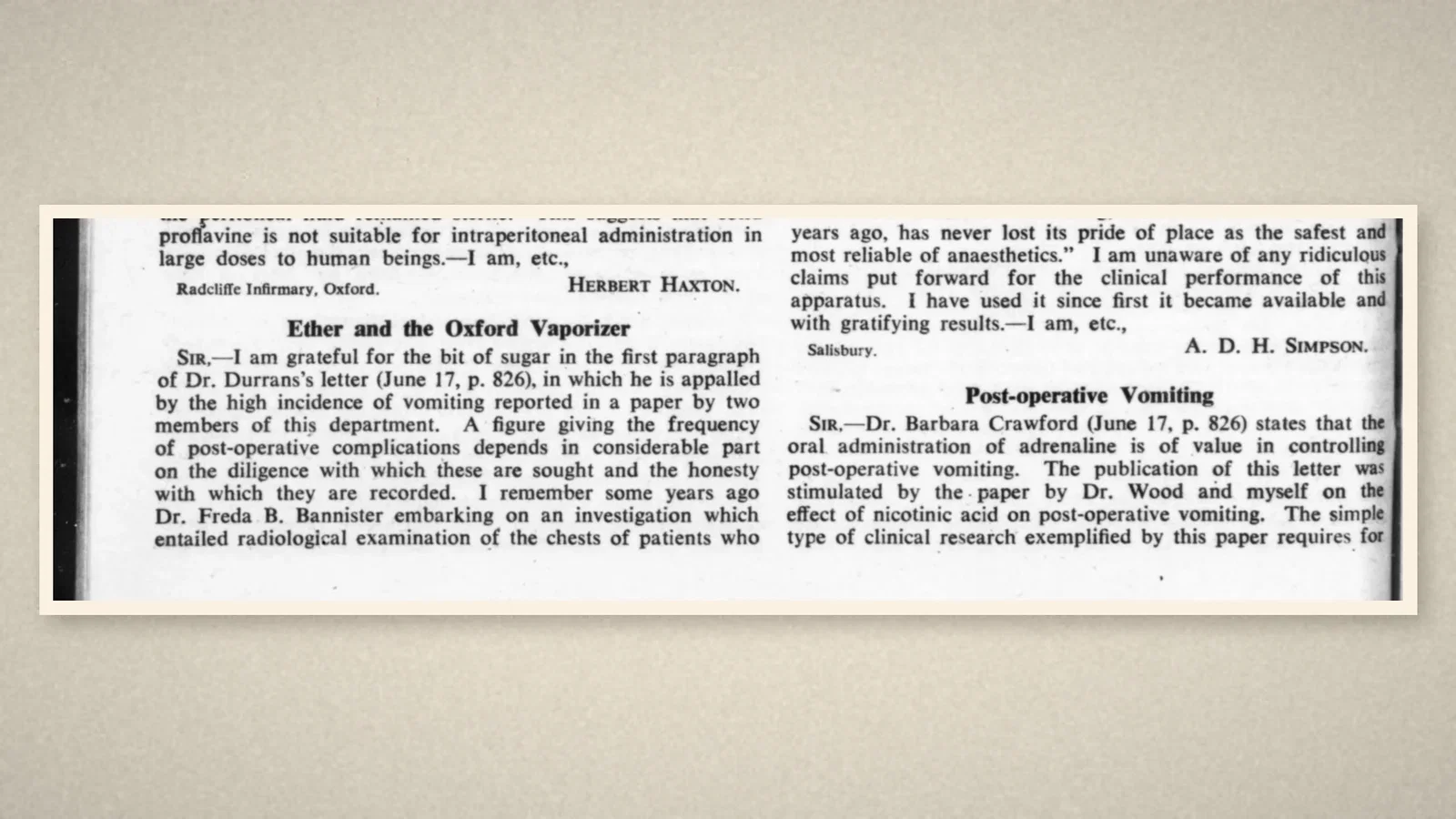
The ASA adds that Lord Nuffield provided engineers and the Morris Motors factory to increase production, and that the vaporizer became popular through use by the armed forces; that account is quoted here as the ASA's. [4]
What the record shows
The Oxford vaporizer combined three ideas that portable anaesthesia still uses. It compensated for the cooling of evaporating ether with a store of heat rather than electricity. A calibrated tap set the concentration, so a trained helper could follow the anaesthetist's setting. And it was a draw-over system: the patient's breath, not a cylinder, carried the vapour. The 1944 letters also record its purpose plainly: simple, safe anaesthesia where gas, equipment and specialists were scarce.
Sources and reading limits
Read: the BMJ annotation "The Oxford anaesthetic vaporizers", 9 August 1941, vol. 2, p. 204, in full; the abstracts of the Oxford Vaporizer No. 1 (Lancet 1941;241:62) and No. 2 (Lancet 1941;241:64) in the International Abstracts of Surgery, Surg Gynecol Obstet 1942;74:84-5; Macintosh's letter and Simpson's letter, BMJ 1944;2:22; the ASA timeline entry for 1941.
Not covered: the four Lancet articles of 19 July 1941 themselves, with their figures; Bannister's 1943 report on routine hospital use; the later EMO inhaler. The vaporizer is therefore described from two contemporary summaries and Macintosh's letter. No original figure or photograph was available; the drawn diagram shows only the principle stated in the text, not the instrument's shape. The two melting points (30 C in the BMJ; 29 C for hydrated calcium chloride in the abstract and the ASA) are both reported. The Morris Motors account is the ASA's. The 38 operations in 10 hours is an anecdote from a letter. No doses or concentrations for patients are given. Quotations are from the English originals.
Three illustrations are crops of the 1941, 1942 and 1944 pages; one is drawn from the text.
- The Oxford anaesthetic vaporizers [annotation]. Br Med J. 1941;2(4205):204. Internet Archive
- International abstracts of surgery: Anesthesia. Epstein HG, Macintosh RR, Mendelssohn K. The Oxford vaporizer No. 1 (Lancet 1941;241:62); Cowan SL, Scott RD, Suffolk SF. The Oxford vaporizer No. 2 (Lancet 1941;241:64). Surg Gynecol Obstet. 1942;74(1):84-5. Internet Archive
- Macintosh RR. Ether and the Oxford vaporizer [letter]. Br Med J. 1944;2(4356):22. Internet Archive
- Australian Society of Anaesthetists. Anaesthesia history timeline. 2024. ASA
Continue exploring
Related reading connects shared questions and contexts; it does not by itself establish historical influence.
- 1942: Millikan's Ear Oximeter Reads Arterial Oxygen Saturation
- 1938: Crafoord's Spiropulsator Breathes for Open-Chest Surgery
Anesthesia Epochs · The Source Room · About & Editorial Method
Published November 2, 2026. Sources and reading limits are stated above. Illustrations are labelled as original source images or AI-made. Historical accounts are educational; they are not current treatment instructions.