
The Australian Society of Anaesthetists' timeline dates the prototype of the 'Ambu Bag' to 1954 and credits the Danish anaesthetist Henning Ruben, who, it says, used sprung bicycle spokes to make the bag re-expand by itself; refined with Holger Hesse, it was marketed in 1957 as the Ambu Resuscitator. Contemporary records add the pieces: Anesthesiology indexes Ruben's new nonrebreathing valve in 1955 and Ruben and Hesse's low-resistance valves in 1956; a Canadian advertisement of 1957 offers 'the Ruben valve'; and a 1959 American equipment report describes the AMBU resuscitation-suction kit designed by Ruben of the Finsen Institute, Copenhagen, whose bag held foam rubber inserts that inflated it with air after each squeeze.
Reading Library · Anesthesia Epochs · 中文版
Watch the education video (for clinicians)
1954: The Self-Inflating Bag — Copenhagen · Anesthesia Epochs Education Series
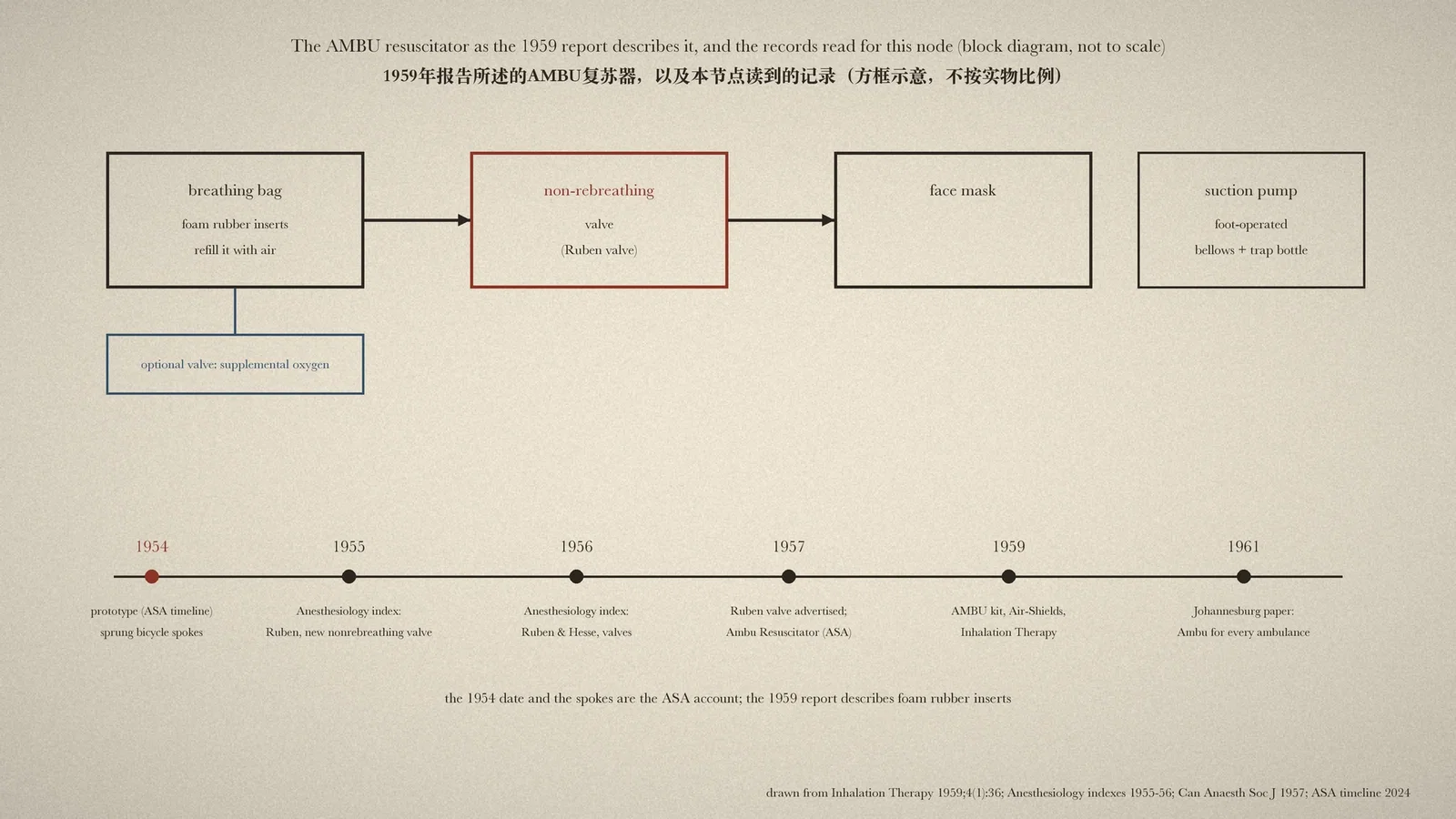
An ordinary anaesthetic bag is a collapsed rubber sack until gas flows into it from a machine. Away from the machine, in an ambulance or on a ward, there is nothing to fill it. The self-inflating bag answered that problem with a simple property: after each squeeze, the bag opens again by itself and draws in room air. Histories tie the idea to a Danish anaesthetist, Henning Ruben, and to the year 1954. The records that survive from those years show the device arriving in pieces: a valve, then a bag, then a kit. [1][2]
The timeline's account
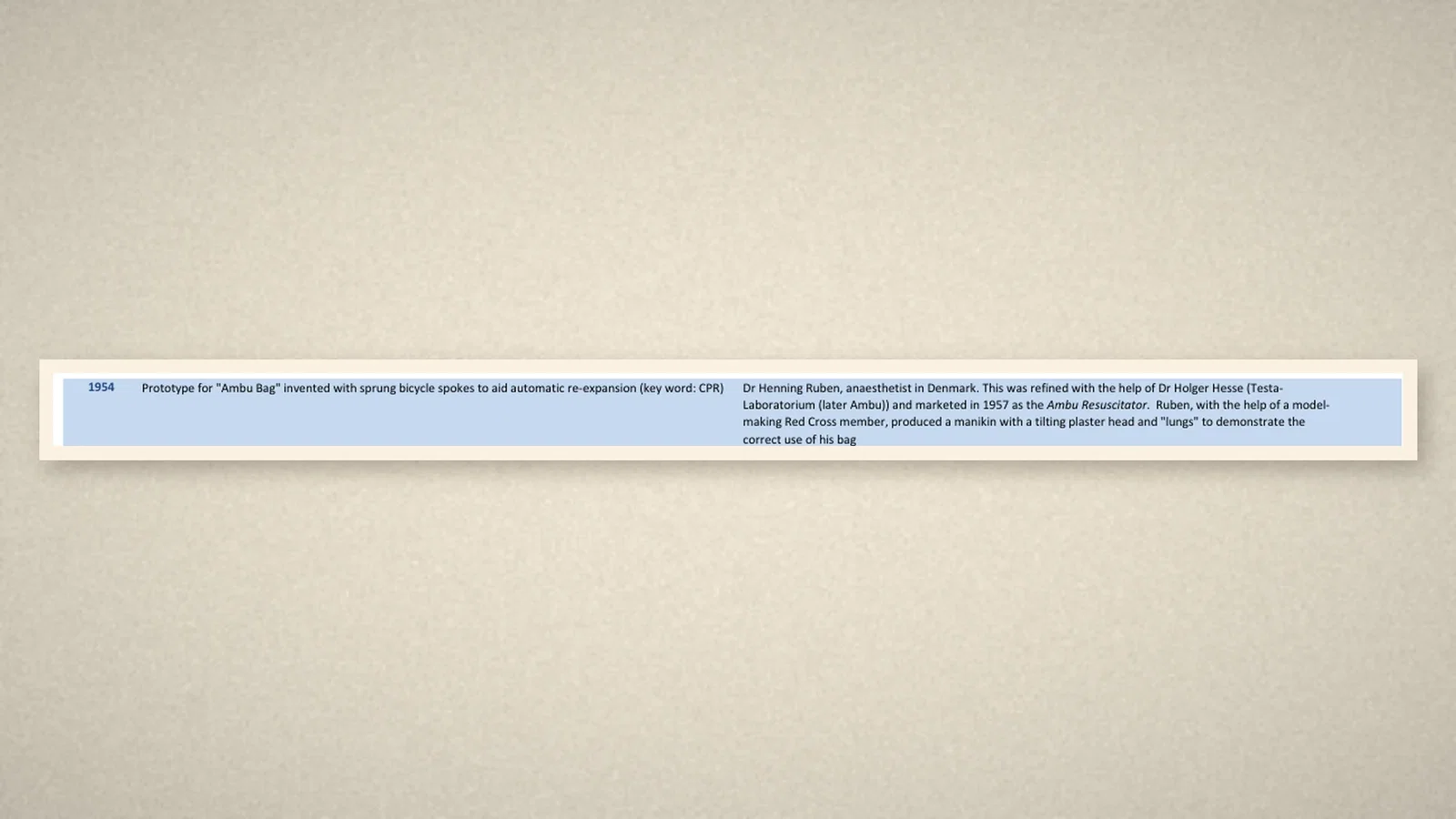
The Australian Society of Anaesthetists (ASA) timeline puts it under 1954: "Prototype for 'Ambu Bag' invented with sprung bicycle spokes to aid automatic re-expansion", by "Dr Henning Ruben, anaesthetist in Denmark". It was, the entry continues, "refined with the help of Dr Holger Hesse (Testa-Laboratorium (later Ambu)) and marketed in 1957 as the Ambu Resuscitator". The same entry says Ruben, with a model-making Red Cross member, produced a manikin with a tilting plaster head and "lungs" to demonstrate the bag. [1, p. 62]
The valve
The first contemporary traces read for this article are not of the bag at all, but of the valve that sits between bag and patient. The annual index of Anesthesiology for 1955 lists "Ruben, Henning, A new nonrebreathing valve", at page 643. The index for 1956 lists Ruben and Hesse together, on "adjustable respiratory valves offering low resistance to flow of gas", at page 782. [3][4]
In July 1957 an advertisement in the Canadian Anaesthetists' Society Journal offered "the Ruben valve: transparent, durable, compact, provides minimal dead space", a spring-loaded valve "developed" by Dr Henning Ruben of the Finsen Institute, Copenhagen. "The Ruben valve connects directly with the mask or endotracheal tube", the copy ran, where its action could be seen and heard, replacing the usual "yoke tree". [5]
The bag
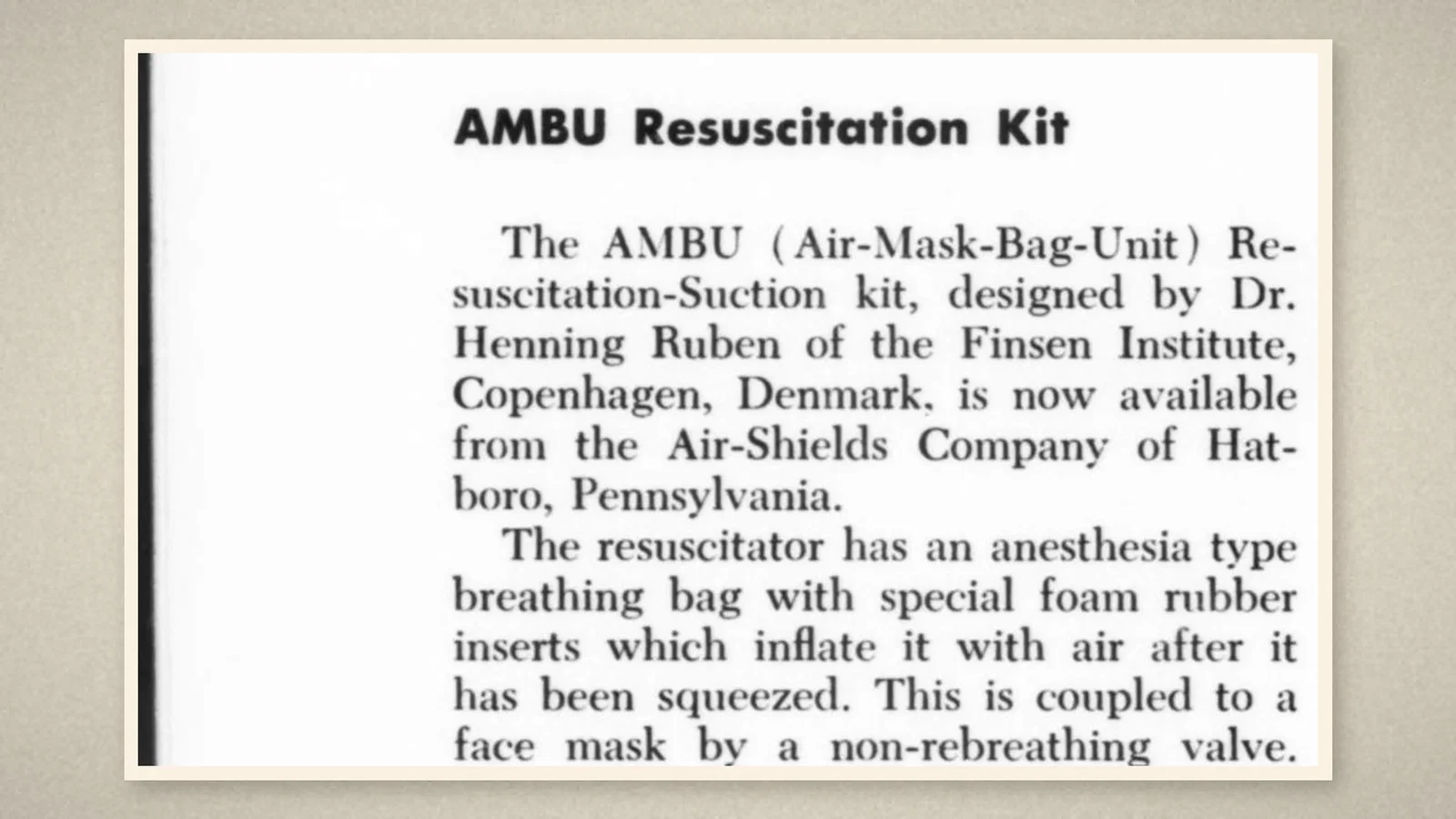
In March 1959 the American journal Inhalation Therapy printed, among its equipment news, the "AMBU (Air-Mask-Bag-Unit) Resuscitation-Suction kit, designed by Dr. Henning Ruben of the Finsen Institute, Copenhagen, Denmark", now available from the Air-Shields Company of Hatboro, Pennsylvania. The description is plain: "The resuscitator has an anesthesia type breathing bag with special foam rubber inserts which inflate it with air after it has been squeezed. This is coupled to a face mask by a non-rebreathing valve." An additional valve could admit supplemental oxygen, and three sizes of oral airway completed the kit. A second unit was a foot-operated suction pump, a bellows with a spring inside to re-expand it, connected to a trap bottle. [2, p. 36]
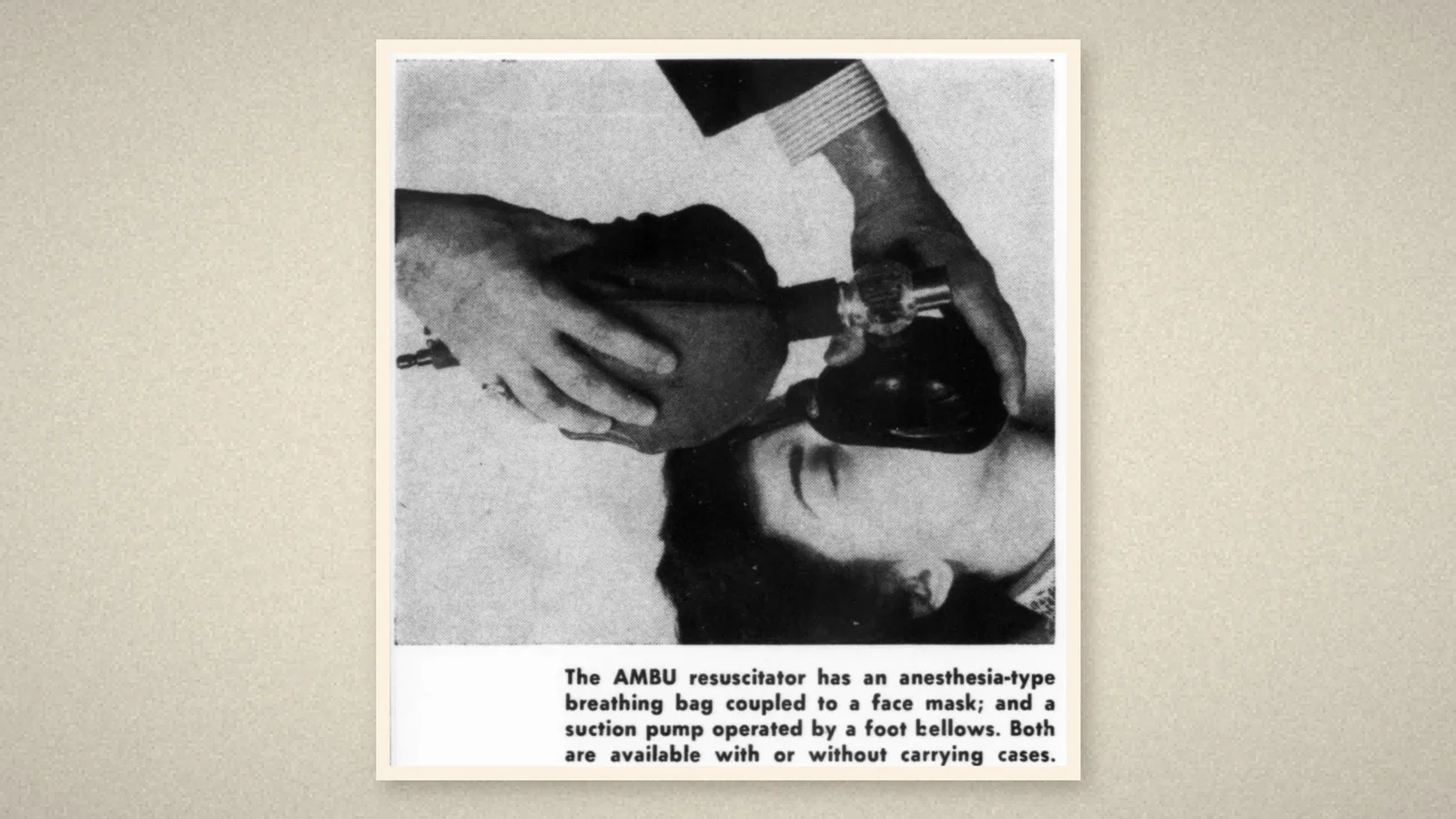
The photographs, supplied by the makers, show the bag and mask held on a subject's face, and the kit packed in a carrying case. [2, p. 36]
In the ambulance
By 1961 the device appears in teaching on first aid. A paper on oral resuscitation, read at a meeting of the Mine Medical Officers Association in Johannesburg on 1 June 1961 and printed in Medical Proceedings, named "Henning Ruben from Denmark" among the anaesthetists whose experiments on volunteers had shown oral methods to be superior to the old manual ones. The same paper recommended an apparatus "which should be immediately available in every ambulance, dentist's room, casualty department and hospital ward": the Ambu resuscitator, which "consists of a bag lined with foam rubber, a Ruben non-return valve, and a tight fitting mask" and could be connected to a supply of oxygen. Among the training aids it listed "the Ambu manikin". [6]
What the record shows
The moment a ventilating bag stopped depending on a gas supply. With a bag that refilled itself and a valve that sent each breath one way, a single person could ventilate a patient with room air anywhere. The records show that the parts came separately, the valve in the anaesthetic journals of 1955 and 1956, the bag in an equipment report of 1959, and that by 1961 the combination was being urged on every ambulance.
Sources and reading limits
Read: the Equipment News item on the AMBU kit in Inhalation Therapy, March 1959, p. 36; the paper on oral resuscitation in Medical Proceedings, 26 August 1961, the passages on Ruben, the Ambu resuscitator and the manikin; the Ruben valve advertisement in the Canadian Anaesthetists' Society Journal, July 1957; the annual indexes of Anesthesiology for 1955 and 1956; the ASA timeline 2024, p. 62.
Not covered: Ruben's own papers, Anesthesiology 1955;16:643 and, with Hesse, 1956;17:782, whose issues are not on the Internet Archive; any Danish publication on the bag; Ambu company records. The History of Anaesthesia Society timeline item was not re-read.
Limits: the 1954 prototype, the sprung bicycle spokes, Hesse's part, the 1957 market date and the manikin's origin are the ASA's account. The contemporary records read here describe foam rubber inserts, not spokes, and do not date a prototype; the 1957 advertisement is for the valve alone. The 1961 paper's author is not named here because the byline is unclear. Volumes, pressures and flows given in the 1959 and 1961 texts are not repeated. Quotations are from the English originals.
Three illustrations are crops of Inhalation Therapy (p. 36) and the ASA timeline (p. 62); one is drawn from the records.
- Australian Society of Anaesthetists. Anaesthesia history timeline. 2024:62. ASA
- Equipment news: AMBU resuscitation kit. Inhalation Therapy. 1959;4(1):36. Internet Archive
- Ruben H. A new nonrebreathing valve. Anesthesiology. 1955;16:643 (index entry read). Internet Archive
- Ruben H, Hesse H. Adjustable respiratory valves offering low resistance to flow of gas. Anesthesiology. 1956;17:782 (index entry read). Internet Archive
- Advertisement: The Ruben valve. Can Anaesth Soc J. 1957;4(3). Internet Archive
- Oral resuscitation. Medical Proceedings. 1961;7(17). Internet Archive
Continue exploring
Related reading connects shared questions and contexts; it does not by itself establish historical influence.
Anesthesia Epochs · The Source Room · About & Editorial Method
Published November 3, 2026. Sources and reading limits are stated above. Illustrations are labelled as original source images or AI-made. Historical accounts are educational; they are not current treatment instructions.