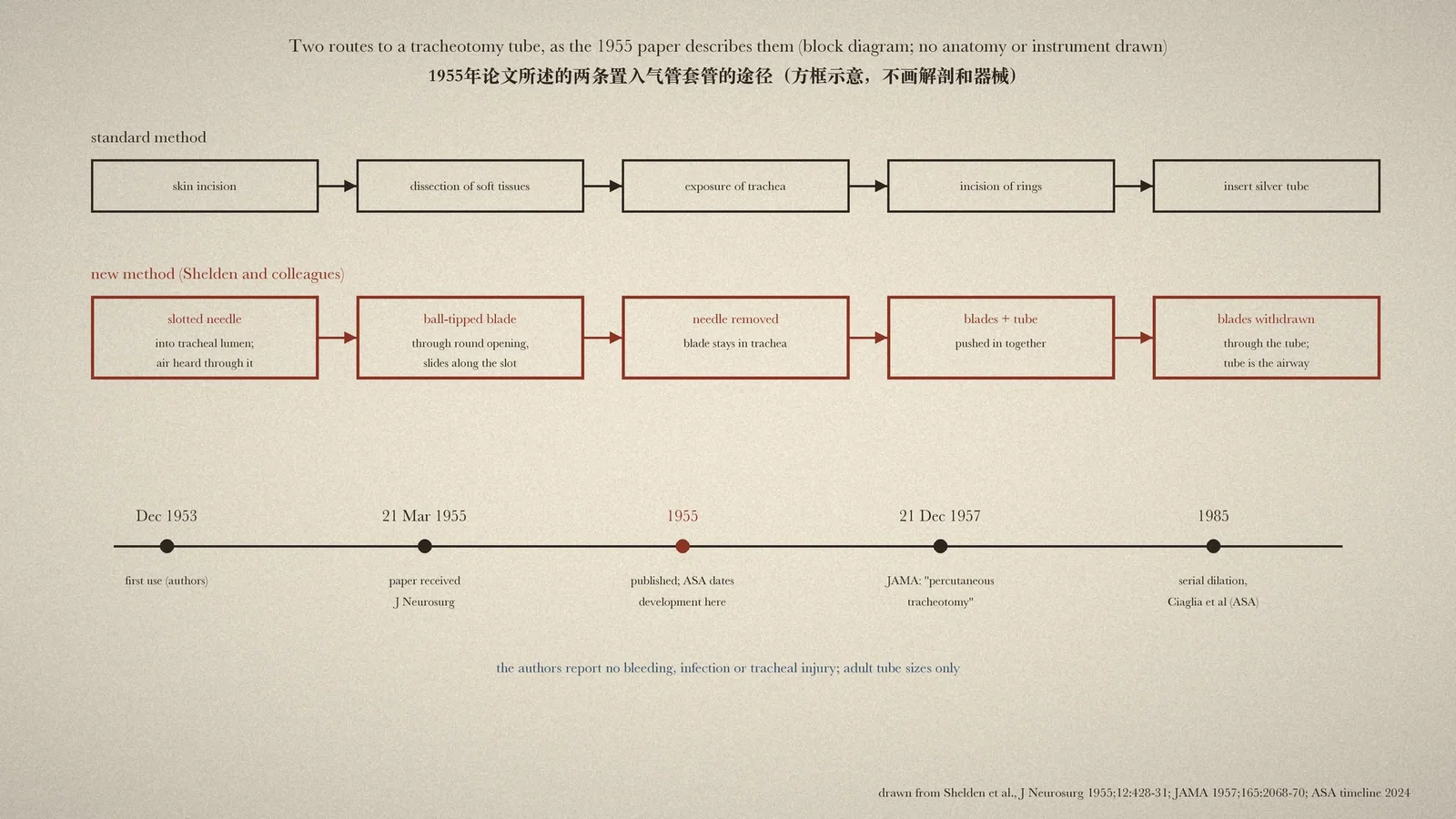
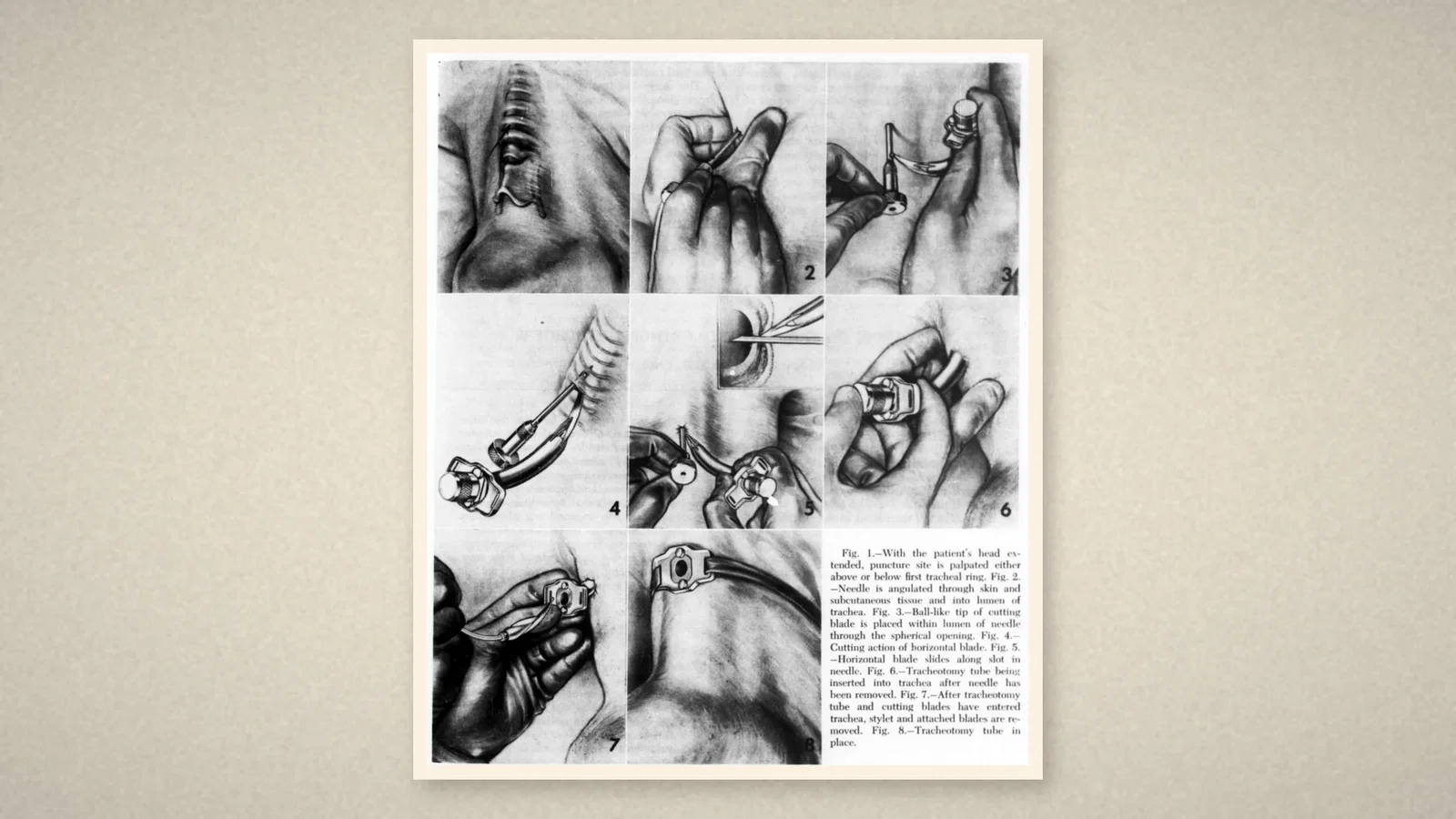
In 1955 the Journal of Neurosurgery published 'A new method for tracheotomy' by C. Hunter Shelden, Robert H. Pudenz, Donald B. Freshwater and Benjamin L. Crue of Pasadena, California: a slotted needle is passed into the tracheal lumen, a cutting blade with a ball tip follows the slot into the trachea carrying a silver tracheotomy tube with it, and the blades are withdrawn through the tube, which stays as the airway. The first tracheotomy by the method, the authors wrote, was done in December 1953 on a patient with a severe head injury. In 1957 Shelden, Pudenz and Fae Y. Tichy called it 'percutaneous tracheotomy' in JAMA. The Australian Society of Anaesthetists' timeline dates the development of percutaneous tracheostomy to 1955 and credits its refinement with serial dilating methods in 1985 to Pasquale Ciaglia and colleagues.
Reading Library · Anesthesia Epochs · 中文版
Watch the education video (for clinicians)
1955: Percutaneous Tracheotomy — Along a Needle · Anesthesia Epochs Education Series
In most intensive care units today a tracheostomy is often made at the bedside, through the skin, without the open dissection of the operating theatre. Histories of that technique begin with a short paper of 1955 by four doctors from Pasadena, California, who were not anaesthetists or laryngologists but neurosurgeons, and who wanted a quicker way to open the airway of patients with head injuries. [1][3]
The problem
"A New Method for Tracheotomy", by C. Hunter Shelden, Robert H. Pudenz, Donald B. Freshwater and Benjamin L. Crue of the Neurosurgical Research Project at the Huntington Memorial Hospital, was received by the Journal of Neurosurgery on 21 March 1955. Its starting point was that the operation had "changed little if any during the past fifty years". Standard tracheotomy was "a surgical procedure, consisting of skin incision, dissection of the soft tissues, exposure of the trachea, incision of the cartilaginous rings and insertion of a silver tube". As an emergency procedure it had "several obvious disadvantages": hospital facilities, a full set of instruments and considerable time. [1, p. 428]
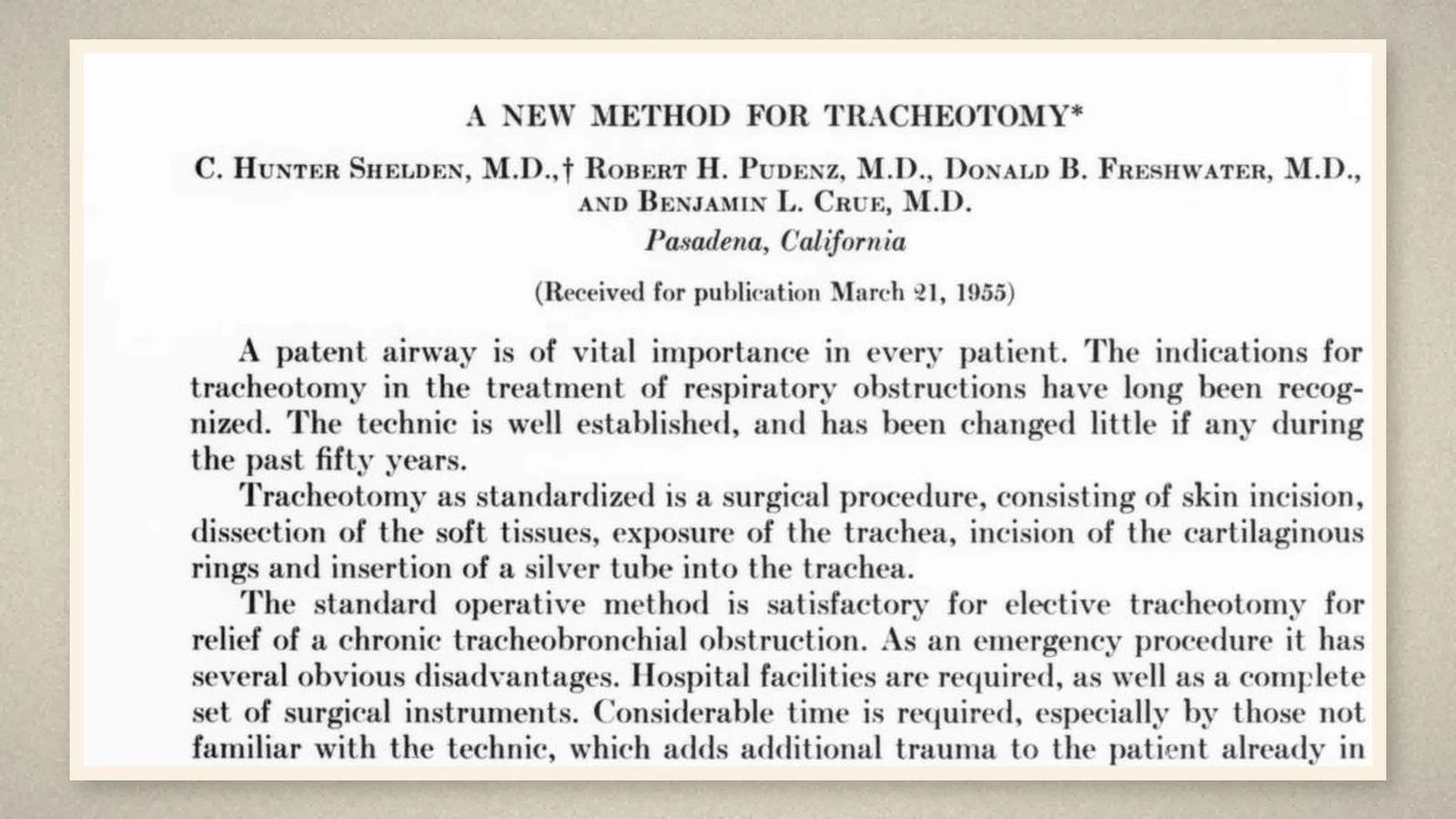
"Our interest in tracheotomy stems from the care of patients with serious acute head injuries", the authors wrote. Blood from facial fractures and spinal fluid from skull fractures ran into the airway of a deeply comatose patient without a gag reflex; partial obstruction led to anoxia, cerebral oedema and rising intracranial pressure. "Many patients in dire need of tracheotomy are denied the benefits of an artificial airway because of the complexities of the present methods." The new method, they said, needed no surgical instruments or hospital facilities and could be used by any physician, or by corpsmen in the Armed Services. [1, pp. 428-9]
The method
"The instrument at the present time consists of four parts (Fig. 1)": a needle with a retractable barb to transfix and lift the trachea; "a silver tracheotomy tube with three narrow slots in the tapered distal end"; a cutting trocar passing through the tube, with a long double-edged blade ending in "a small ball tip", which kept it from piercing the back wall of the trachea, and a short vertical blade; and a short 13-gauge needle with a slot ground along its wall and a round opening at the top of the slot. [1, pp. 429-30]
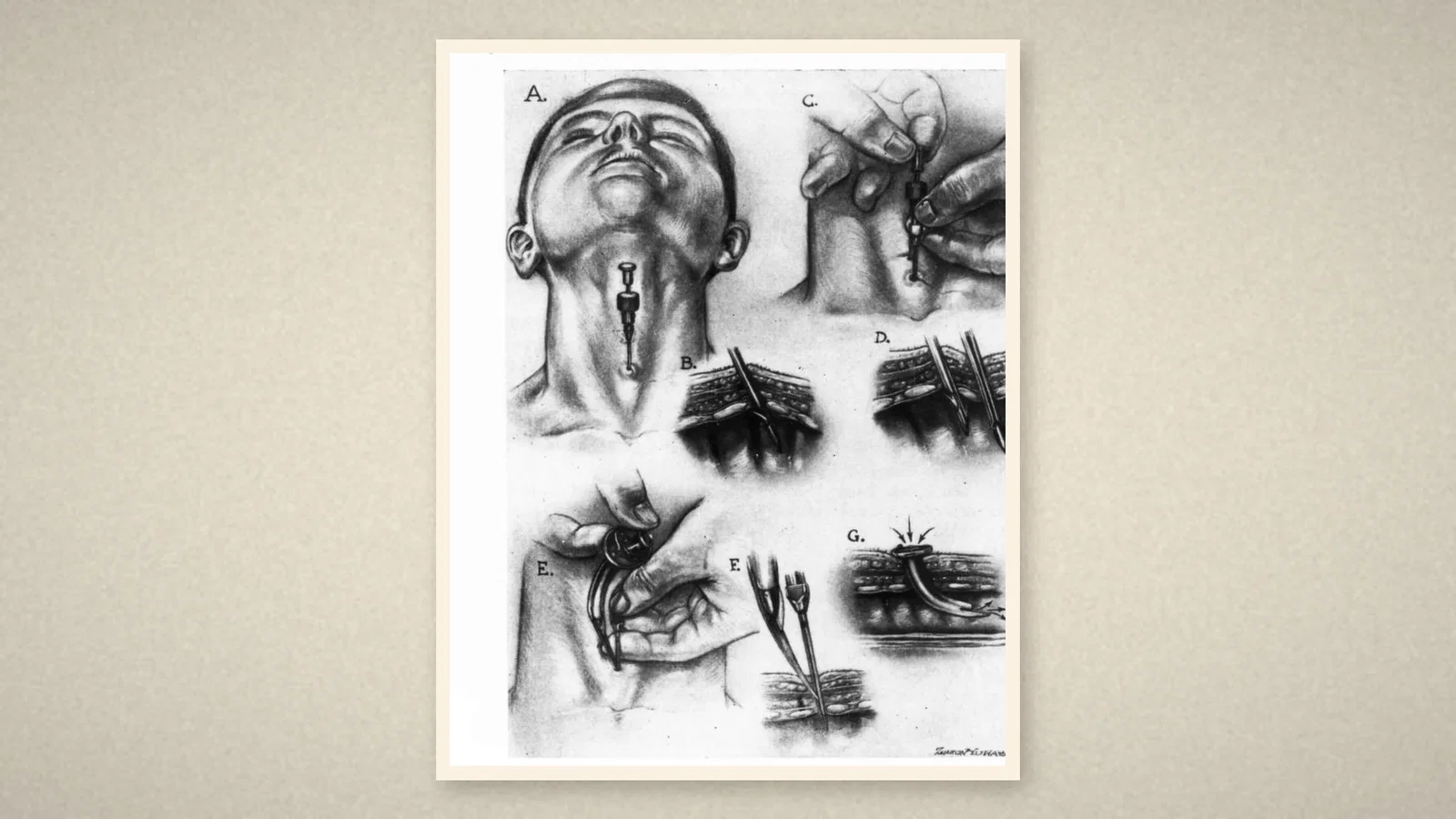
With the head hyperextended, the slotted needle went through the skin into the trachea. The ball tip was put into the round opening and pushed down the needle into the trachea, the blade following the slot; the needle came out, and blades and tube were pushed in together; then the blades were withdrawn through the tube, which stayed as the airway. Once the needle tip was inside, the authors argued, the cutters could go nowhere but into the trachea, "since they both follow the slot". In living tissue, air could be heard moving through the needle, confirming its place. [1, pp. 430]
The first patient was deeply comatose after a severe head injury, with secretions blocking the airway. The standard number 6 tube went in in "less than 30 seconds"; the patient recovered slowly, and the tube was removed after a little over two weeks. "The first tracheotomy by this method was done in December 1953." Since then, the authors wrote, they had used it routinely without bleeding, infection or tracheal injury; they had given up the barbed needle, and had not used the method in children, because the models carried an adult tube. A footnote said the instrument was being manufactured in Sierra Madre, California. [1, pp. 430-1]
Percutaneous tracheotomy
On 21 December 1957 Shelden, Pudenz and Fae Y. Tichy described the method again in JAMA, now under the title "Percutaneous Tracheotomy". The instrument had three parts; the whole procedure could be "done in less than a minute". The report also recorded a difficulty: in one patient breathing was so shallow that air could not be heard through the needle, and a catheter had to be passed through it to confirm the position; a short plastic catheter had since been added to the kit. The authors warned that deformity of the neck after surgery or radiation could displace the trachea, and wrote that the method had been used "in recent months by many other neurosurgeons throughout the world". [2, pp. 2068-2070]
The Australian Society of Anaesthetists (ASA) timeline lists "Percutaneous tracheostomy developed" under 1955, credited to "Dr C Hunter Shelden (neurosurgeon) et al", and, under 1985, the technique "refined with serial dilating methods" by Pasquale Ciaglia et al. [3, pp. 63, 80]
What the record shows
The idea that an airway through the neck could be made by following a needle instead of by opening the tissues. Shelden and colleagues built it from the problem in front of them, comatose patients drowning in secretions, and claimed for it speed and simplicity. Their own 1957 report already shows what would occupy later workers: how to be sure the needle is in the trachea, and what to do when the neck is not normal.
Sources and reading limits
Read: Shelden, Pudenz, Freshwater and Crue, Journal of Neurosurgery 1955;12:428-31, in full; Shelden, Pudenz and Tichy, JAMA 1957;165:2068-2070, in full; the ASA timeline 2024, pp. 63 and 80.
Not covered: Ciaglia, Firsching and Syniec, Elective percutaneous dilatational tracheostomy, Chest 1985;87:715-9, because the Internet Archive copy is lending-restricted and was not opened; any record of the manufacture or licensing of the instrument; later series testing it.
Limits: the ASA dates the development to 1955, the year of publication; the authors date the first use to December 1953. The absence of complications and the use by other neurosurgeons are the authors' own statements, not independently checked. The 1985 refinement is given only as the ASA states it. The schematic shows steps, not the instrument or the anatomy. Quotations are from the English originals.
Three illustrations are crops of the Journal of Neurosurgery (pp. 428-9) and JAMA (p. 2069); one is drawn from them.
- Shelden CH, Pudenz RH, Freshwater DB, Crue BL. A new method for tracheotomy. J Neurosurg. 1955;12(4):428-31. Internet Archive
- Shelden CH, Pudenz RH, Tichy FY. Percutaneous tracheotomy. JAMA. 1957;165(16):2068-70. Internet Archive
- Australian Society of Anaesthetists. Anaesthesia history timeline. 2024:63, 80. ASA
Continue exploring
Related reading connects shared questions and contexts; it does not by itself establish historical influence.
Anesthesia Epochs · The Source Room · About & Editorial Method
Published November 3, 2026. Sources and reading limits are stated above. Illustrations are labelled as original source images or AI-made. Historical accounts are educational; they are not current treatment instructions.